|
Esnoga Bet Emunah 12210 Luckey Summit San Antonio, TX 78252 United States of America © 2025 E-Mail: gkilli@aol.com |
|
Esnoga Bet El 102 Broken Arrow Dr. Paris, TN 38242 United States of America © 2025 E-Mail: waltoakley@charter.net |
Triennial Cycle (Triennial Torah Cycle) / Septennial Cycle (Septennial Torah Cycle)
|
Three and ½ year Lectionary Readings |
Fourth Year of the Triennial Reading Cycle |
|
Heshvan 24, 5786 / November 14/15, 2025 |
Fourth Year of the Shmita Cycle |
Candle Lighting and Habdalah Times: https://www.chabad.org/calendar/candlelighting.htm
Roll of Honor:
This Commentary comes out weekly and on the festivals thanks to the great generosity of:
His Eminence Rabbi Dr. Eliyahu ben Abraham and beloved wife HH Giberet Dr. Elisheba bat Sarah
His Honor Paqid Adon David ben Abraham
His Honor Paqid Adon Ezra ben Abraham and beloved wife HH Giberet Karmela bat Sarah,
His Honor Paqid Adon Tzuriel ben Abraham and beloved wife HH Giberet Gibora bat Sarah
Her Excellency Giberet Sarai bat Sarah & beloved family
His Excellency Adon Barth Lindemann & beloved family
His Excellency Adon John Batchelor & beloved wife
His Excellency Adon Yehoshua ben Abraham and beloved wife HE Giberet Rut bat Sarah
His Excellency Adon Michael ben Yosef and beloved wife HE Giberet Sheba bat Sarah
Her Excellency Giberet Prof. Dr. Emunah bat Sarah & beloved family
His Excellency Adon Robert Dick & beloved wife HE Giberet Cobena Dick
His Excellency Adon Ovadya ben Abraham and beloved wife HE Giberet Mirit bat Sarah
His Excellency Adon Shlomoh ben Abraham
His Excellency Adon Yaaqov ben David
His Excellency Adon Bill Haynes and beloved wife HE Giberet Diane Haynes
Her Excellency Giberet Krysta Wallrauch & beloved family
For their regular and sacrificial giving, providing the best oil for the lamps, we pray that GOD’s richest blessings be upon their lives and those of their loved ones, together with all Yisrael and her Torah Scholars, amen ve amen!
Also, a great thank you and great blessings be upon all who send comments to the list about the contents and commentary of the weekly Torah Seder and allied topics.
If you want to subscribe to our list and ensure that you never lose any of our commentaries, or would like your friends also to receive this commentary, please do send me an E-Mail to gkilli@aol.com with your E-Mail or the E-Mail addresses of your friends. Toda Rabba!
Blessings Before Torah Study
Blessed are You, Ha-Shem our GOD, King of the universe, Who has sanctified us through Your commandments, and commanded us to actively study Torah. Amen!
Please Ha-Shem, our GOD, sweeten the words of Your Torah in our mouths and in the mouths of all Your people Israel. May we and our offspring, and our offspring's offspring, and all the offspring of Your people, the House of Israel, may we all, together, know Your Name and study Your Torah for the sake of fulfilling Your delight. Blessed are You, Ha-Shem, Who teaches Torah to His people Israel. Amen!
Blessed are You, Ha-Shem our GOD, King of the universe, Who chose us from all the nations, and gave us the Torah. Blessed are You, Ha-Shem, Giver of the Torah. Amen!
Ha-Shem spoke to Moses, explaining a Commandment. "Speak to Aaron and his sons, and teach them the following Commandment: This is how you should bless the Children of Israel. Say to the Children of Israel:
May Ha-Shem bless you and keep watch over you; - Amen!
May Ha-Shem make His Presence enlighten you, and may He be kind to you; - Amen!
May Ha-Shem bestow favor on you and grant you peace. – Amen!
This way, the priests will link My Name with the Israelites, and I will bless them."
These are the Laws for which the Torah did not mandate specific amounts: How much growing produce must be left in the corner of the field for the poor; how much of the first fruits must be offered at the Holy Temple; how much one must bring as an offering when one visits the Holy Temple three times a year; how much one must do when performing acts of kindness; and there is no maximum amount of Torah that a person must study.
These are the Laws whose benefits a person can often enjoy even in this world, even though the primary reward is in the Next World: They are: Honoring one's father and mother; doing acts of kindness; early attendance at the place of Torah study -- morning and night; showing hospitality to guests; visiting the sick; providing for the financial needs of a bride; escorting the dead; being very engrossed in prayer; bringing peace between two people, and between husband and wife; but the study of Torah is as great as all of them together. Amen!
A Prayer for Israel
Our Father in Heaven, Rock, and Redeemer of Israel, bless the State of Israel, the first manifestation of the approach of our redemption. Shield it with Your lovingkindness, envelop it in Your peace, and bestow Your light and truth upon its leaders, ministers, and advisors, and grace them with Your good counsel. Strengthen the hands of those who defend our holy land, grant them deliverance, and adorn them in a mantle of victory. Ordain peace in the land and grant its inhabitants eternal happiness.
Lead them, swiftly and upright, to Your city Zion and to Jerusalem, the abode of Your Name, as is written in the Torah of Your servant Moses: “Even if your outcasts are at the ends of the world, from there the Lord your God will gather you, from there He will fetch you. And the Lord your God will bring you to the land that your fathers possessed, and you shall possess it, and He will make you more prosperous and more numerous than your fathers.” Draw our hearts together to revere and venerate Your name and to observe all the precepts of Your Torah, and send us quickly the Messiah son of David, agent of Your vindication, to redeem those who await Your deliverance.
We pray for his Honor Adon Tzuriel ben Avraham. Mi Sheberach…He who blessed our forefathers Abraham, Isaac and Jacob, Moses and Aaron, David and Solomon, may He bless and heal His Honor Paqid Tzuriel ben Avraham, May the Holy One, Blessed is He, be filled with compassion for him to restore his health, to heal him, to strengthen him, and to revivify him. And may He send him speedily a complete recovery from heaven, among the other sick people of Yisrael, a recovery of the body and a recovery of the spirit, swiftly and soon, and we will say amen ve amen!
Shabbat: “Bae-et Hahi Amar” – “At that time (HaShem) said”
Shabbat Mevarchim - Sabbath of the proclamation of the New Moon of Heshvan
(Evening of Wednesday, November 19, 2025 - Friday, November 21, 2025)
|
Shabbat |
Torah Reading: |
Weekday Torah Reading: |
|
בָּעֵת הַהִוא אָמַר |
|
Saturday Afternoon |
|
“Bae-et Hahi Amar” |
Reader 1 – Devarim 10:1-8 |
Reader 1 – Devarim 12:20-22 |
|
“At that time (HaShem) said” |
Reader 2 – Devarim 10:9-15 |
Reader 2 – Devarim 12:23-25 |
|
“En aquel tiempo (HaShem) me dijo: “ |
Reader 3 – Devarim 10:16-22 |
Reader 3 – Devarim 12:26-28 |
|
Devarim (Deuteronomy) 10:1 – 12:19 |
Reader 4 – Devarim 11:1-9 |
|
|
Ashlamatah: Melachim alef (I Kings) 8:9-18 |
Reader 5 – Devarim 11: 10-21 |
Monday and Thursday Mornings |
|
Special Ashlamatah: Shmuel alef (1 Samuel) 20:18 - 42 |
Reader 6 – Devarim 11:22-32 |
Reader 1 – Devarim 12:20-22 |
|
Tehillim (Psalms) 119:1-48 |
Reader 7 – Devarim 12:1-14 |
Reader 2 – Devarim 12:23-25 |
|
Mk 14:17-25; Luke 22:21-23; Lk 22:15-20 |
Maftir - Devarim 12:15-19 |
Reader 3 – Devarim 12:26-28 |
Contents of the Torah Seder
· Result of Moses’ Intercession – Deut. 10:1-11
· The Second Discourse of Moses – Deut. 10:12 – 11:32
o Final review of all the reasons for, and results of, obedience to G-d – Deut. 10:12-22
o Let Personal Experience of G-d’s Wondrous Deeds on Behalf of Israel Lead to Love and Obedience – Deut. 11:1-9
· Canaan and Egypt Contrasted – Deut. 11:10-12
· Reward and Punishment in Judaism – Deut. 11:13-25
· The Law of the Central Sanctuary – Deut. 12:1-7
· Private Altars to be Prohibited – Deut. 12:8-14
· Extension of Prohibition of Private Sanctuary – Deut. 12:15-19
Reading Assignment:
|
The Torah Anthology: Yalkut Me’Am Lo’Ez By: Rabbi Yitzchaq Behar Argueti - Portion Ekev Rabbi Shmuel Yerushalmi – Portion Re’eh and Shoftim Translated and edited by M. and S. Sprecher With assistance from Rabbi Matis Blum Published by: Moznaim Publishing Corp. (New York, 1992) Vol.17 – Deuteronomy – III – “Gratitude and Discipline” pp. 70-128 |
Ramban: Deuteronomy Commentary on the Torah Translated and Annotated by Rabbi Dr. Charles Chavel Published by Shilo Publishing House, Inc. (New York, 1976) pp. 113 - 148 |
JPS & Targum Pseudo Jonathan for: Devarim (Deuteronomy) 10:1 – 12:19
|
JPS |
Targum Pseudo-Jonathan |
|
1. At that time, the Lord said to me, "Hew for yourself two stone tablets like the first ones and come up to Me onto the mountain, and make for yourself a wooden ark, |
1. At that time did the Lord say to me: Hew for yourself two tables of marble according to the form of the first; and ascend before Me into the mountain, and make for yourself an ark of wood. |
|
2. And I shall inscribe on the tablets the words that were upon the first tablets which you shattered and you shall place them into the ark. |
2. And I will write upon the tables the words which were upon the former ones, which you did break with your entire strength; and you will put them within the ark. |
|
3. So I made an ark of acacia wood, and I hewed two stone tablets like the first ones, and I ascended the mountain, with the two tablets in my hand. |
3. And I made an ark of sitta wood, and hewed two marble tables according to the form of the first, and went up into the mountain, having the two tables in my hand. |
|
4. And He inscribed on the tablets, like the first writing, the Ten Commandments, which the Lord had spoken to you on the mountain, from the midst of the fire, on the day of the assembly, and the Lord gave them to me. |
4. And He wrote upon the tables according to the former writing, the Ten Words which the LORD spoke with you from the mount in the midst of the fire on the day that the congregation was gathered together, and the LORD gave them to me. |
|
5. And I turned and came down from the mountain, and placed the tablets in the ark which I had made, and there they were, as the Lord had commanded me. |
5. And I turned and came down from the mountain, and put the tables into the ark which I had made, and there are they laid up (hidden) as the LORD commanded me. |
|
6. The children of Israel journeyed from the wells of B'nei Ya'akan to Moserah; there Aaron died, and there he was buried; and Eleazar his son served as kohen in his stead. |
6. And the children of Israel journeyed from the villages of the wells of the Beni Jahakan to Mosera. There Amalek, who reigned in Arad, and who had heard that Aharon was dead, and that the Cloud of Glory had gone up, (came and) fought with them. And those of Israel who were distressed by that war sought to go back into Mizraim, and returned (towards it) six journeys; (but) the sons of Levi followed after them, and slew eight families of them, and the remainder returned. Of the sons of Levi also four families were slain. And they said one to another, What has been the cause of this slaughter? Because we have been remiss in the mourning for Aharon the Saint. Therefore all the children of Israel observed there a mourning for Aharon's death; and there was he buried, and Elazar his son ministered in his stead. |
|
7. From there, they journeyed to Gudgodah, and from Gudgodah to Yotvath, a land with streams of water. |
7. Thence they journeyed to Gudgod, and from Gudgod to Jotbath, a land flowing with streams of water.1 |
|
8. At that time, the Lord separated the tribe of Levi to bear the ark of the covenant of the Lord, to stand before the Lord to serve Him, and to bless in His Name, to this day. |
8. At that time the LORD distinguished the tribe of Levi, because they had been zealous (even) to slay for His honor; that they should bear the ark of the LORD's covenant, and stand before the LORD to minister unto Him and to bless in His Name until this day. |
|
9. Therefore, Levi has no portion or inheritance with his brothers; the Lord is his inheritance, as the Lord, your God spoke to him. |
9. Therefore the tribe of Levi has not a portion or inheritance with his brethren; the gifts which the LORD gives him are his inheritance, as the LORD your God has spoken to him. |
|
10. And I remained on the mountain like the first days forty days and forty nights, and the Lord hearkened to me also at that time; the Lord did not wish to destroy you. |
10. But I stood in the mount praying and interceding as in the former days (of the) forty days and nights, and the LORD received my prayer at that time also, and the LORD would not destroy you. |
|
11. And the Lord said to me, "Arise, go to lead the travels before the people, so that they may come and possess the land I promised their forefathers to give them. |
11. And the LORD said to me, Arise, go, lead forth the people, that they be brought in, and possess the land which I promised to their fathers to give them. |
|
12. And now, O Israel, what does the Lord, your God, demand of you? Only to fear the Lord, your God, to walk in all His ways and to love Him, and to worship the Lord, your God, with all your heart and with all your soul, |
12. And now, Israel, what does the Lord your God require of you, but that you fear the LORD your God, to walk in all the ways that are right before Him, and that you love Him, and serve the LORD your God with all your heart and with all your soul, |
|
13. to keep the commandments of the Lord and His statutes, which I command you this day, for your good. |
13. to keep the commandments of the LORD and His statutes which I command you this day, that it may be well with you? |
|
14. Behold, to the Lord, your God, belong the heavens and the heavens of the heavens, the earth, and all that is on it. |
14. Behold, the heavens, and the heavens of the heavens, are be LORD's your God, and the hosts of angels are in them to minister before Him, and the earth, and whatsoever is therein. |
|
15. Only your forefathers the Lord desired, to love them, and He chose their seed after them you, out of all peoples, as it is this day. |
15. Only the LORD had pleasure in your fathers, and because He would love you He has had favor to their children after them, as you, above all the nations upon the face of the earth, at the time of this day. |
|
16. You shall circumcise the foreskin of your heart, therefore, and be no more stiff-necked. |
16. Put away folly, therefore, from your heart, and be not stiff-necked anymore; |
|
17. For the Lord, your God, is God of gods and the Lord of the lords, the great mighty and awesome God, Who will show no favor, nor will He take a bribe. |
17. for the LORD your God is God, the Judge, and the Monarch of kings, a Great God, mighty and terrible, before whom there is no respect of persons, and who takes no bribe; |
|
18. He executes the judgment of the orphan and widow, and He loves the stranger, to give him bread and clothing. |
18. He does judgment for the orphan and widow, and has compassion upon the stranger to give him food and raiment. |
|
19. You shall love the stranger, for you were strangers in the land of Egypt. |
19. Have pity then (yourselves) upon the stranger, for you were strangers in the land of Mizraim. |
|
20. You shall fear the Lord, your God, worship Him, and cleave to Him and swear by His Name. |
20. Revere the LORD your God, and worship before Him, and cleave closely to His fear, and swear by His Name. |
|
21. He is your praise and He is your God, Who did these great and awesome things for you, which your eyes have seen. |
21. He is your praise, and He is your God, who has done for you these great and mighty acts which you have beheld with your eyes. |
|
22. With seventy souls, Your forefathers descended to Egypt, and now the Lord, your God, has made you as the stars of heaven in abundance. |
22. With seventy souls your fathers went down into Mizraim, and now has the LORD your God set you as the stars of the heavens for multitude. |
|
|
|
|
11:1. [Therefore] you shall love the Lord, your God, keep His charge, His statutes, His ordinances, and His commandments, all the days. |
11:1. Therefore will you love the LORD your God, and diligently observe His Word, His statutes, and His judgments always. |
|
2. And you shall know this day; that [I speak] not with your children, who did not know and who did not see the chastisement of the Lord, your God, His greatness, His mighty hand, and His outstretched arm, |
2. And know you this day, for (I speak) not with your children who have not known or seen the instruction of the Law of the LORD your God, nor His greatness, nor His mighty hand, nor His uplifted arm, |
|
3. His signs, and His deeds, which He performed in the midst of Egypt, to Pharaoh, king of Egypt and to his entire land, |
3. or His signs and works which He wrought in Mizraim, on Pharoh king of Mizraim, and on all the inhabitants of his land; |
|
4. and what He did to the army of Egypt, to its steeds, and to its chariots, that He caused the waters of the Red Sea to inundate them when they pursued you, and the Lord destroyed them, to this day, |
4. what He did also to the hosts of Mizraim, to their horses and chariots, when He made the waters of the Red Sea to overwhelm their faces when they followed after you, when the LORD destroyed them unto this day's time; |
|
5. and what He did for you in the desert, until you arrived at this place, |
5. and what He has done to you in the wilderness till the time that you came to this place; |
|
6. and what He did to Dathan and Abiram, sons of Eliab, the son of Reuben, that the earth opened its mouth and swallowed them up and their households and their tents, and all the possessions at their feet, in the midst of all Israel. |
6. and what He did unto Dathan and Abiram the sons of Eliab bar Reuben, when the earth opened her mouth and swallowed them up with the men of their house, and all their substance, in the midst of all Israel: |
|
7. But your eyes, which have seen all the great work of the Lord, which He did. |
7. for with your eyes have you seen all the great work of the LORD which He has wrought. |
|
8. [Therefore] keep all the commandments that I command you this day, in order that you may be strong and come and possess the land to which you are crossing, to possess it, |
8. Therefore will you keep all the precepts which I command you this day, that you may be strengthened, and go in, and inherit the land to possess which you go over; |
|
9. and in order that you may prolong your days on the land that the Lord swore to your forefathers to give to them and to their seed a land flowing with milk and honey. |
9. and that your days may be multiplied upon the land which the LORD swore to your fathers to give it to them and their children; a land whose fruits are rich as milk, and sweet as honey. |
|
10. For the land to which you are coming to possess is not like the land of Egypt, out of which you came, where you sowed your seed and which you watered by foot, like a vegetable garden. |
10. For the land to which you go in to possess it is not like the land of Mizraim, from whence you have come, in which you did sow your seed, and water it yourself as a garden of herbs; |
|
11. But the land, to which you pass to possess, is a land of mountains and valleys and absorbs water from the rains of heaven, |
11. but the land which you pass over to inherit is a land of mountains and valleys: it drinks water from the rain that comes down from the heavens; |
|
12. a land the Lord, your God, looks after; the eyes of Lord your God are always upon it, from the beginning of the year to the end of the year. |
12. it is a land which the LORD your God inquires after by His Word, that He may bless it evermore; [JERUSALEM. A land which the LORD your God inquires after continually.] the eyes of the LORD your God look upon it from the beginning of the year to the year's end. |
|
13. And it will be, if you hearken to My commandments that I command you this day to love the Lord, your God, and to serve Him with all your heart and with all your soul, |
13. And it will be that if you diligently obey My commandments which I command you this day, to love the LORD your God, and to serve Him with all your heart, and with all your soul, |
|
14. I will give the rain of your land at its time, the early rain and the latter rain, and you will gather in your grain, your wine, and your oil. |
14. then will I give you the rain of your land in its time, the early in Marchesvan, and the latter in Nisan, that you may gather in your corn, your wine., and your oil. |
|
15. And I will give grass in your field for your livestock, and you will eat and be sated. |
15. I will give herbage also in thy field for your cattle, that you may eat and have enough. |
|
16. Beware, lest your heart be misled, and you turn away and worship strange gods and prostrate yourselves before them. |
16. Take heed to yourselves, lest you be led away by the imagination of your heart, and turn aside to serve the idols of the Gentiles, and worship them, |
|
17. And the wrath of the Lord will be kindled against you, and He will close off the heavens, and there will be no rain, and the ground will not give its produce, and you will perish quickly from upon the good land that the Lord gives you. |
17. and the LORD's anger be provoked against you, and He shut up the clouds of heaven, and let not the rain come down, and the earth yield no provender, and you perish soon from off the glorious land which the LORD will give you. |
|
18. And you shall set these words of Mine upon your heart and upon your soul, and bind them for a sign upon your hand and they shall be for ornaments between your eyes. |
18. But lay these my words upon your heart, and upon your soul, and bind them, written upon tephillin, as a sign upon the upper part (wrist) of your left hands, and let them be for tephillin over your forehead between your eyes. |
|
19. And you shall teach them to your sons to speak with them, when you sit in your house and when you walk on the way and when you lie down and when you rise. |
19. And you will teach them to your children to study them when you are sitting in your house with your kindred, and when you are walking in the way, and in the evening when you lie down, and in the morning when you arise. [JERUSALEM. And when you repose, and when you rise up.] |
|
20. And you shall inscribe them upon the doorposts of your house and upon your gates, |
20. And you will write them upon parchment, upon the posts, and affix them to three (things), against your chest, against the pillars of your house, and against your gates: |
|
21. in order that your days may increase and the days of your children, on the land which the Lord swore to your forefathers to give them, as the days of heaven above the earth. |
21. that your days and the days of your children may be multiplied on the land which the LORD sware to your fathers to give you, as the number of the days that the heavens abide over the earth. |
|
22. For if you keep all these commandments which I command you to do them, to love the Lord, your God, to walk in all His ways, and to cleave to Him, |
22. For if you diligently keep every commandment that I command you to do it, to love the LORD your God, and walk in all the ways that are right before Him, and cleave unto His fear, |
|
23. then the Lord will drive out all these nations from before you, and you will possess nations greater and stronger than you. |
23. then will the Word of the LORD drive out all these nations from before you, and you will possess the heritage of nations greater and stronger than yourselves. |
|
24. Every place upon which the soles of your feet will tread, will be yours: from the desert and the Lebanon, from the river, the Euphrates River, and until the western sea, will be your boundary. |
24. Every place where the sole of your foot will tread will be yours, from the wilderness and the mountain; (among) your mountains will be the house of the sanctuary, and from the great river, the River Phrat, unto the ocean sea, whose waters are (old as) the creation, on the western side will be your limit. |
|
25. No man will stand up before you; the Lord your God will cast the fear of you and the dread of you on all the land upon which you tread, as He spoke to you. |
25. Not a man will be able to stand before you; but the LORD your God will set the fear and dread of you upon the faces of all the inhabitants of the land that you tread upon, as it has been told you. [JERUSALEM. Not a ruler nor a prince will stand before you; but your terror and your fear.] |
|
26. Behold, I set before you today a blessing and a curse. |
26. MOSHEH the prophet said: Behold, I have this day set in order before you a Blessing and its contrary: |
|
27. The blessing, that you will heed the commandments of the Lord your God, which I command you today; |
27. the Blessing, if you will be obedient to the commandments of the LORD your God which I command you this day; |
|
28. and the curse, if you will not heed the commandments of the Lord your God, but turn away from the way I command you this day, to follow other gods, which you did not know. |
28. and its contrary, if you will not obey the commandments of the LORD your God, [JERUSALEM. And their contraries, if you will not hearken.] but will go astray from the path which I have taught you this day, in turning aside after the idols of the nations whom thou have not known. |
|
29. And it will be, when the Lord, your God, will bring you to the land to which you come, to possess it, that you shall place those blessing upon Mount Gerizim, and those cursing upon Mount Ebal. |
29. And it will be, when the LORD your God will have brought you to the land into which you are going, to possess it, you will place six tribes upon the mountain of Gerizim, and six tribes on the mountain of Ebal. They who recite the blessings will turn their faces towards Mount Gerizim, and they who recite the curses will turn their faces towards Mount Ebal. |
|
30. Are they not on the other side of the Jordan, way beyond, in the direction of the sunset, in the land of the Canaanites, who dwell in the plain, opposite Gilgal, near the plains of Moreh? |
30. Are they not situated beyond Jordan by the way of the sunset, in the land of the Kenaanah, who dwell in the plain over against Gilgela by the side (of the place) of the vision of Mamre? |
|
31. For you are crossing the Jordan, to come to possess the land which the Lord, your God, is giving you, and you shall possess it and dwell in it. |
31. For you are to pass over Jordan to enter and possess the land which the LORD your God gives you, and you will hold and will dwell therein. |
|
32. And you shall keep to perform all the statutes and ordinances that I am setting before you today. |
32. Look well, therefore, that you perform all the statutes and judgments that I have set before you this day. |
|
12:1. These are the statutes and ordinances that you shall keep to perform in the land which the Lord God of your fathers gives you to possess all the days that you live on the earth. |
12:11. These are the statutes and judgments which you are to observe to do in the land which the LORD God of your fathers gives you to inherit all the days that you live upon the earth. |
|
2. You shall utterly destroy from all the places where the nations, that you shall possess, worshipped their gods, upon the lofty mountains and upon the hills, and under every lush tree. |
2. You will utterly destroy all the places in which the people (whose land) you will possess have worshipped their idols, upon the high mountains and hills, and under every tree of beautiful form. |
|
3. And you shall tear down their altars, smash their monuments, burn their asherim with fire, cut down the graven images of their gods, and destroy their name from that place. |
3. You will lay their altars in ruin, break down their pillars, burn their abominations with fire, and utterly destroy the images of their gods, and abolish their names from that place. |
|
4. You shall not do so to the Lord, your God. |
4. Not so may you do to blot out the inscription of the Name of the LORD your God. |
|
5. But only to the place which the Lord your God shall choose from all your tribes, to set His Name there; you shall inquire after His dwelling and come there. |
5. But in the land which the Word of the LORD your God will choose out of all your tribes for His Shekinah to dwell there, unto the place of His Shekinah will you have recourse, |
|
6. And there you shall bring your burnt offerings, and your sacrifices, and your tithes, and the separation by your hand, and your vows and your donations, and the firstborn of your cattle and of your sheep. |
6. and come thither, and bring your sacrifices and consecrated oblations, your tithes, the separation of your hands, your vows, your voluntary offerings, and the firstlings of your herds and flocks. |
|
7. And there you shall eat before the Lord, your God, and you shall rejoice in all your endeavors you and your households, as the Lord, your God, has blessed you. |
7. And you will there eat before the LORD your God, and rejoice in all that you put your hand unto, you and your households, in which the LORD your God will have blessed you. |
|
8. You shall not do as all the things that we do here this day, every man [doing] what he deems fit. |
8. It will not be lawful for you to do (there) as we do here today, whatever any one thinks fit for himself; |
|
9. For you have not yet come to the resting place or to the inheritance, which the Lord, your God, is giving you. |
9. for you are not yet come to the Sanctuary, to the dwelling of Peace, and to the inheritance of the land which the LORD your God will give you. |
|
10. And you shall cross the Jordan and settle in the land the Lord, your God, is giving you as an inheritance, and He will give you rest from all your enemies surrounding you, and you will dwell securely. |
10. But when you have passed over Jordan and dwell in the land which the LORD your God will give you to inherit, and He has given you repose from all your enemies round about, then will you build the house of the Sanctuary, and afterward will dwell securely. |
|
11. And it will be, that the place the Lord, your God, will choose in which to establish His Name there you shall bring all that I am commanding you: Your burnt offerings, and your sacrifices, your tithes, and the separation by your hand, and the choice of vows which you will vow to the Lord. |
11. And to the place which the Word of the LORD will choose to make His Shekinah to dwell there, will you bring all your oblations, firstlings, and tithes, which I command you; there will you offer your sacrifices and hallowed victims, there eat your tithes and the separation of your hands, and all your goodly vows which you may have vowed before the LORD. |
|
12. And you shall rejoice before the Lord, your God you and your sons and your daughters and your menservants and your maidservants, and the Levite who is within your cities, for he has no portion or inheritance with you. |
12. And you will rejoice before the LORD your God, you and your sons and daughters, your servants and handmaids, and the Levite who is in your cities, for he has no portion or inheritance with you. |
|
13. Beware, lest you offer up your burnt offerings any place you see. |
13. Beware lest you offer your sacrifices in any place which you may see fit; |
|
14. But only in the place the Lord will choose in one of your tribes; there you shall offer up your burnt offerings, and there you shall do all that I command you. |
14. but in the Place which the LORD will choose in the inheritance of one of your tribes, there will you offer your sacrifices and do whatever I command you. |
|
15. However, in every desire of your soul, you may slaughter and eat meat in all your cities, according to the blessing of the Lord, your God, which He gave you; the unclean and the clean may eat thereof, as of the deer, and as of the gazelle. |
15. Nevertheless, after every wish of your soul, you may kill and eat flesh according to the blessing of the LORD your God, which He will give you in all your cities; they who are unclean so as not to be able to offer holy things, and they who are clean that they may offer holy things, may eat of it alike, as the flesh of the antelope or of the hart. |
|
16. However, you shall not eat the blood; you shall spill it on the ground like water. |
16. Only be careful to pour out the blood upon the ground like water. |
|
17. You may not eat within your cities the tithe of your grain, or of your wine, or of your oil, or the firstborn of your cattle or of your sheep, or any of your vows that you will vow, or your donations, or the separation by your hand. |
17. It will not be lawful for you to eat the tenths of your corn, or wine, or oil, or the firstlings of your herd or flock, nor any of the vows that you have vowed, or freewill offerings, or the separation of your hands in your cities; |
|
18. But you shall eat them before the Lord, your God, in the place the Lord, your God, will choose you, your son, your daughter, your manservant, your maidservant, and the Levite who is in your cities, and you shall rejoice before the Lord, your God, in all your endeavors. |
18. but you will eat it before the LORD your God, in the place which the LORD your God will choose; you, and your sons and daughters, and your handmaids, and the Levites who are in your cities; and you will rejoice before the LORD your God, in all that you put your hand unto. |
|
19. Beware, lest you forsake the Levite all your days upon your land. |
19. Beware that you aggrieve not the Levite all your days in which you dwell in your land. |
Rashi’s Commentary for: Devarim (Deuteronomy) 10:1 - 11:9
1 At that time At the end of forty days [which was the first of Elul], God was reconciled with me and said to me, “Hew for yourself [two tablets],” and afterwards, “make for yourself a [wooden] ark.” I, however (see verse 3), made the ark first (Tanchuma 10), because [I considered that] when I would come with the tablets in my hand, where would I put them? This was not the ark that Bezalel made, because the Israelites did not occupy themselves with the Mishkan until after Yom Kippur [which was forty days later], for when Moses descended the mountain, he commanded them regarding the construction of the Mishkan. [Then] Bezalel made the Mishkan first, and only afterwards the ark and the [other] furnishings (Ber. 55a). It follows, therefore, that this was another ark, and that was the one that went out with them to battle, but the one Bezalel made did not go out to battle except in the days of Eli, and they were punished for it, and it [the ark] was captured [by the Philistines].-[Yerushalmi Shekalim 6:1]
6 And the children of Israel journeyed from the wells of B’nei Ya’akan to Moserah What is the relevance of this here? Furthermore, did they really journey from the wells of B’nei Ya’akan to Moserah? Was it not from Moserah that they came to the wells of B’nei Ya’akan, as it is said, “And they journeyed from Moseroth [and encamped in B’nei Ya’akan]” (Num. 33:31) ? Moreover, [why does it say:] "there Aaron died"? Did he not die at Mount Hor? If you calculate it, you will find eight stations from Moseroth to Mount Hor! However, [the answer is that] this is also part of the reproof [introduced in Deut. 1:1 and continued through here]: [In effect Moses said,] This, also, you did. When Aaron died on Mount Hor at the end of the forty years and [consequently] the clouds of the Divine Glory departed, you were afraid of the [impending] war with the king of Arad. So you appointed a leader to return to Egypt, and you went back eight stations until B’nei Ya’akan, and from there to Moserah. There, the sons of Levi battled with you. They slew some of you, and you some of them, until they forced you to return by the way you had retreated. From there, you returned to Gudgodah, which is Hor Hagidgad (Num. 33:32).
7 And from Gudgodah [to Yotvath...] And at Moserah, you made a great mourning for the death of Aaron, which was the cause of this [your retreat], and it seemed to you as though he had died there (Yerushalmi Sotah 1: 10, Tanchuma, Chukath 18). Moses juxtaposed this reproof with the breaking of the tablets to indicate that the death of the righteous is as grievous to the Holy One, blessed is He, as the day the tablets were broken (Lev. Rabbah 2)], and to inform you that when they said, “Let us appoint a leader [and return to Egypt]” (Num. 14:4)—and divorce ourselves from him [Moses], was as grievous for him as was the day on which they made the golden calf.
8 At that time, the Lord separated [the tribe of Levi] This is connected to the previous context -
At that time During the first year of your departure from Egypt, when you erred [by making] the calf, and the sons of Levi did not thus err, the Omnipresent separated them from you. This verse is juxtaposed to the retreat to B’nei Ya’akan, to tell you that also in this matter, the sons of Levi did not err, but rather remained steadfast in their faith.
to bear the ark [of the covenant] [Referring to] the Levites.
to stand before the Lord, to serve Him, and to bless in His Name [Referring to] the kohanim, and this is the “raising of the hands” [when they bless the people].-[Arachin 11a]
9 Therefore, Levi has no portion since they were separated for the service of the altar, and therefore were not free to plow and sow.
The Lord is his inheritance Levi receives his daily fare, designated for him, from the King’s house [i.e., with the gifts due the kohanim, granted them by God].
10 And I remained on the mountain to receive the latter tablets. Since Moses does not state above how long he remained on the mountain at this last ascent, he again begins with it.
as the first days I.e., those of the first tablets. Just as those days were with [God’s] good will, so were these with good will. But the intermediate [forty days], when I remained to pray for you, were in anger.
11 And the Lord said to me, [Arise, go, lead before the people] Although you [Israel] had turned away from following Him, and you had erred with the [golden] calf, He [nonetheless] said to me, “Go, lead the people” (Exod. 32:34).
12 And now, O Israel Even though you did all this, His mercy and His affection are still upon you, and with all that you have sinned against Him, He demands nothing of you, except only to fear [the Lord, your God,...]
Only to fear [the Lord your God,...] Our Rabbis derived from this verse ["And now... what does... God demand of you"] that everything is in the hands of Heaven except the fear of Heaven (Ber. 33b).
13 To keep the commandments of the Lord and this too, is not for nothing, but—for your good—that you should receive a reward.
14 Behold, to the Lord your God belong everything, and even so—"Only your forefathers the Lord desired"—out of everything [i.e., the whole universe].
15 [And He chose...] you Just as you see yourselves as the most beloved of all peoples, as it is this day.
16 the foreskin of your heart Heb. עָרְלַת לְבַבְכֶם the blockage and covering of your heart.
17 and Lord of the lords meaning that no lord will be able to deliver you from His hand.
Who will show no favor if you cast off His yoke, Nor will He take a bribe—i.e., to appease Him with money.
18 He executes the judgment of the orphan and widow [previously, in verse 17,] we had a description of God’s power. Now alongside His power, we find [a description of] His humility (Meg. 31a).
and He loves the stranger, to give him bread and clothing and this [provision of bread and clothing] is a matter of great importance, for the very essence of our father Jacob prayed for this [as it says], “And if He will give me bread to eat and a garment to wear” (Gen. 28:20). -[Gen. Rabbah 70:5]
19 [You shall love the stranger] for you were strangers Do not reproach others with your own defect.-[B. M. 59b]
20 You shall fear the Lord, your God and worship Him and cleave to Him. After you have all these qualities, then you may swear by His Name.
Hakham ben Haggai: The Hebrew word דָּבַק (Davaq) being translated as “cleave” is first used in the Torah with regards to marriage in Genesis 2:24 to describe the intense union between husband and wife – “Therefore will a man leave his father and his mother, and will cleave unto his wife, and they will be one flesh.” This same word is used in
- Deuteronomy 10:20 – as above in this Torah Seder (Deut. 10:1 – 11:9), and,
- Deuteronomy 11:22 – on the next Torah Seder (Deut. 11:10 – 12:19), and
- Deuteronomy 13:5(4) – on the following Torah Seder (Deut. 12:20-13:19)
That is, for three consecutive Torah Sedarim, this Hebrew word makes its debut. This word is also used with regards to discipleship in Ruth 1:14. The Midrash Sifre states: “And to cleave unto Him means that we should cleave to Hakhamim and their disciples.”
Chapter 11
2 And you shall know this day Set your attention to know, understand, and accept my reproof.
that not with your children am I now speaking, who would be able to say, “We did not know or see all this.”
6 [That the earth opened its mouth, and swallowed them up...] in the midst of all Israel Wherever one of them fled, there the earth split under him and swallowed him up; these are the words of Rabbi Judah. Rabbi Nehemiah said to him: But has it not already been stated, “And the earth opened its mouth” (Num. 16:32), and not, “its mouths” [implying that the earth opened up at only one place]? Rabbi Judah said to him: How, then, do you [Reggio ed.] explain: “in the midst of all Israel” [implying it opened up in many areas]? Rabbi Nehemiah replied to him: The earth began to slope as a funnel, and wherever one of them happened to be, he rolled down until he reached the place where the earth was split (Tanchuma Buber, addendum to Korach 4).
and all the possessions at their feet Heb. אֲשֶׁר בְּרַגְלֵיהֶם וְאֶת כָּל־הַיְקוּם This is a man’s money, which sets him on his feet. -[San. 110a]
7 But your eyes, which have seen This is connected to the verse stated above (verse 2), “That [I speak] not with your children, who did not know...,” but rather with you—"your eyes, which have seen..." [i.e. to you, whose eyes have seen...]
2 And you shall know this day: Set your attention to know, understand, and accept my reproof.
that not with your children: am I now speaking, who would be able to say, “We did not know or see all this.”
6 [That the earth opened its mouth, and swallowed them up…] in the midst of all Israel: Wherever one of them fled, there the earth split under him and swallowed him up; these are the words of Rabbi Judah. Rabbi Nehemiah said to him: But has it not already been stated, “And the earth opened its mouth” (Num. 16:32), and not, “its mouths” [implying that the earth opened up at only one place]? Rabbi Judah said to him: How, then, do you [Reggio ed.] explain: “in the midst of all Israel” [implying it opened up in many areas]? Rabbi Nehemiah replied to him: The earth began to slope as a funnel, and wherever one of them happened to be, he rolled down until he reached the place where the earth was split (Tanchuma Buber , addendum to Korach 4).
and all the possessions at their feet: Heb. וְאֶת כָּל-הַיְקוּם אֲשֶׁר בְּרַגְלֵיהֶם This is a man’s money, which sets him on his feet. - [San. 110a]
7 But your eyes, which have seen: This is connected to the verse stated above (verse 2), “That [I speak] not with your children, who did not know…,” but rather with you-“your eyes, which have seen…” [i.e. to you, whose eyes have seen…]
10 [The land to which you come…] is not like the land of Egypt: but better than it. This promise was made to Israel when they left Egypt, for they would say, “Perhaps we will not come to a land as good and beautiful as this one.” One might think that Scripture is speaking derogatorily of it [the Land of Israel], and so he said to them: It is not like the land of Egypt, but it is worse than it! Therefore, Scripture says, “And Hebron was built seven years before Zoan of Egypt…” (Num. 13:22): One man built [both of] them-Ham built Zoan for his son, Mizraim, and he built Hebron for Canaan [his other son]. It is customary that one first builds the better city and afterwards builds the inferior one, because the refuse [left over] from the first, he puts into the second, and in any case, the favorite one first. Thus we learn that Hebron was a more beautiful city than Zoan. Egypt was superior to all other lands, as is stated [of it], “like the garden of the Lord, like the land of Egypt” (Gen. 13:10), and Zoan was the best of the land of Egypt, as it was the seat of royalty, for so it is stated:“For his princes were in Zoan” (Isa. 30:4), and Hebron was the worst city of Eretz Israel. For this reason, they set it apart for a burial ground, and yet it was better than Zoan. In Tractate Kethuboth (112a), however, our Rabbis explained the above in another manner: Is it possible that a man would build a house for his younger son [here Canaan], and only afterwards for his older son [Mizraim]? We must therefore explain [the meaning of וְחֶבְרוֹן שֶׁבַע שָׁנִים נִבְנְתָה to be] that Hebron was built up seven times better than Zoan.
[The land of Egypt,] out of which you came: Even the land of Goshen and the land of Rameses in which you dwelt, and which is the best of the land of Egypt, as it is said, “in the best of the land, [in the land of Rameses]” (Gen. 47:11)-even that is not like the land of Israel.
[like the land of Egypt…] which you watered by foot: The land of Egypt required bringing water from the Nile by foot in order to water it; you had to rise from your sleep and toil. And only the low-lying areas were watered [i.e., were irrigated by the Nile], but not the high land, so you had to carry up water from the lower to the higher areas. But this [land, namely Canaan] “absorbs water from the rains of heaven.” While you sleep in your bed, the Holy One, blessed is He, waters both low and high areas, both areas that are exposed and those that are not, all at once [Sifrei]
like a vegetable garden: which does not have enough water from rain, and one has to water it by foot, [carrying water] upon one’s shoulder.
11 a land of mountains and valleys: The mountain land is superior to the land of the plain: On the plain, in an area of land that would produce a kor [a measure of grain], one would actually sow only [enough seed to produce] a kor . On the mountain, however, from an area of land that would produce a kor, one could take out of it five kors, four from its four slopes and one on its summit. — [Sifrei 11:11]
and valleys: Heb. וּבְקָעֹת. These are plains.
12 the Lord, your God, looks after: But does He not look after all lands, as it is said, “To rain on the earth where no man is” (Job 38:26)? Rather, it is as if God cares only for it, and with that caring, which He cares for it, He cares for all the [other] lands along with it. — [Sifrei 11:12]
the eyes of the Lord, your God, are always upon it: to see what it requires and to make for it new decrees, sometimes for good and sometimes for bad, as is found in [Tractate] Rosh Hashanah (17b).
from the beginning of the year [to the end of the year]: At the beginning of the year [i.e., Rosh Hashanah], it is judged [by God] what will be at its conclusion (Rosh Hashanah 8a).
13 And it will be, if you hearken: [The word] וְהָיָה is referring to what is said above (verse 11): “and absorbs water from the rains of heaven”
And it will be, if you hearken: Heb. וְהָיָה אִם שָׁמֹעַ תִּשְׁמְעוּ lit., And it will be, if hearkening you will hearken. If you hearken to the old [i.e., if you study what you have already learned], you will hearken to the new [i.e., you will have a new and deeper understanding]. Similar is [the meaning of] “And it will be, if you forget” (אִם שָׁכֹחַ תִּשְׁכַּח) (Deut. 8:19): If you have begun to forget [the Torah you have learned], eventually you will forget all of it, for so it is written in the Megillah 1: “If you leave Me for one day, I will leave you for two days.” - [Sifrei on Deut. 11:22, Yerushalmi Ber. 9:5, Midrash Shmuel 1]
command you this day: [“this day” suggests] that [the commandments] should [always] be to you as new, as though you had just heard them on this very day. — [Sifrei , 11:32]
to love the Lord: You should not say: “I will learn in order to become rich,” [or] “in order to be referred to as ‘Rabbi,’” [or] “in order that I receive a reward.” Rather, whatever you do, do out of love [for God], and ultimately, the honor will come.- [Sifrei]
and to serve Him with all your heart: i.e. with a service of the heart, and that is prayer, for prayer is called service, as it is said, “your God, Whom you serve regularly” (Dan. 6:17). But was there a [Temple] service in Babylon? Rather, [the term service is used] because he prayed, as it is said, “where there were open windows [in his upper chamber opposite Jerusalem, and three times a day he kneeled on his knees and prayed…]” (Dan. 6:11). And so, too, it states regarding David, “My prayer shall be established like incense before You” (Ps. 141:2). - [Sifrei]
[To love the Lord…] with all your heart, and with all your soul: But did he not already admonish us, [by the words] “[And you shall love the Lord, your God,] with all your heart and with all your soul” (Deut. 6:5)? [That, however, was] an admonition addressed for the individual, [while this is] an admonition to the community. — [Sifrei]
14 I will give the rain of your land: You will have done what is [incumbent upon] you; [so] I will do what is [incumbent] upon Me. — [Sifrei]
at its time: At night, so it will not disturb you. Another explanation of “at its time” is: On Sabbath [Friday] nights, when everyone is at home.
the early rain: Heb. יוֹרֶה. This is the rain that falls after [the] sowing [season], which thoroughly sates (מְרַוֶּה) the soil and the seeds.
the latter rain: Heb. מַלְקוֹשׁ. The rain that falls just before the harvest time, to fill the grain on its stalks. The term מַלְקוֹשׁ refers to something that is late, as in the Targum [Onkelos], we translate וְהָיָה הָעֲטֻפִים לְלָבָן “the ones that delayed were Laban’s” (Gen. 30:42) as לְקִישַׁיָּא. Another explanation: For this reason, it is called מַלְקוֹשׁ namely because it falls upon the ears (מְלִילוֹת) and the stalks (קַשִּׁין) [i.e., just before the harvest, thus מַלְקוֹשׁ is a combination of these two words].
and you will gather in your grain: You will gather it into the house, and not your enemies, as it is said: “[The Lord swore…] 'I will no longer give your grain as food [to your enemies, and foreigners will no longer drink your wine….[But those who gather it in will eat it…” (Isa. 62:8, 9), and not as it is said “And it was when Israel had sown, [that Midian came up… and they destroyed the produce of the earth]” (Jud. 6:3, 4).
15 And I will give grass in your field [for your livestock]: so that you will not have to lead them to distant pastures. Another explanation: That you will be able to trim your grain all through the winter and cast it before your livestock, and if you refrain from doing this thirty days before the harvest, it will not produce any less grain. - [Sifrei]
and you will eat and be sated: This is another blessing: That the bread will be blessed within the stomach, that you may eat and be sated.
16 Beware, [lest your heart be misled]: Since you will eat and be full, beware that you do not rebel [against the Holy One, blessed is He], for nobody rebels against the Holy One, blessed is He, except out of satiety, as it is said, “lest you eat and be sated… and your herds and your flocks multiply… What does he [Moses] say after this? ”and your heart grows haughty, and you forget the Lord, your God" (Deut. 8:12-14).
and you turn away: to depart from the Torah, and as a result of this, “and worship strange gods,” for as soon as a man departs from the Torah, he goes and cleaves to idolatry. Similarly, David said, “for they have driven me today, from cleaving to the Lord’s heritage, saying, 'Go, worship [strange gods]’” (I Sam. 26:19). But who [actually] said this to him? [He meant to say,] Since I am driven from being occupied with the Torah, I am closer to the danger of worshipping strange gods. — [Sifrei]
strange gods: [Gods] that are strangers to those who worship them. The worshipper cries out to it, but it does not answer him; consequently, it becomes to him as a stranger.
17 [The ground will not give] its produce: Heb. יְבוּלָהּ. It will not yield the quantity that you bring (מוֹבִיל) to it, as it said: “You have sown much, but you bring in little” (Hag. 1:6). - [Sifrei]
and you will perish quickly: In addition to all the other sufferings, I will exile you from the land that caused you to sin. This may be compared to a king who sent his son to a feast hall and admonished him, “Do not eat or drink more than necessary, so that you will arrive home clean.” The son, however, did not take heed. He ate and drank more than he needed, and he regurgitated and soiled all the guests. They took him by his hands and feet, and threw him behind the palace. — [Sifrei]
quickly: I will give you no extensions. And if you ask: Was not an extension given to the generation of the flood, as it is said, “and his days will be [i.e., an extension will be given to him for] one hundred and twenty years” (Gen. 6:3)? [The answer is that] the generation of the flood had no one to learn from, but you do have someone to learn from. - [Sifrei]
18 And you shall set these words of Mine: Even after you have been exiled, make yourselves distinctive with My commandments: Put on tefillin and make mezuzoth, so that these will not be new to you when you return. Similarly, it is said, “Set up markers for yourself” (Jer. 31:20). - [Sifrei]
19 [And you shall teach them to your sons,] to speak with them: From the moment your son knows how to speak, teach him, “Moses commanded us the Torah” (Deut. 33:4). Let him learn speech through this (Sukkah 42a). From this, our Rabbis taught: When the infant begins to talk, his father should speak to him in the Holy Tongue, and should teach him the Torah. If he does not do this, it is as though he buries him, as it is stated [here], “And you shall teach them to your sons to speak with them…” [in order that your days may increase, and the days of your children].
21 in order that your days may increase and the days of your children: If you do so, they will increase, but if not, they will not increase, for the words of the Torah may be interpreted, so that we may deduce from a negative statement its positive inference, and from a positive statement, its negative inference. — [Sifrei]
[the land which the Lord swore to your forefathers] to give them: it is not written here “to give you,” but rather, “to give them.” From this, we learn that [the tenet of] the resurrection of the dead has its basis from the Torah. — [Sifrei]
22 For if you keep [all these commandments]: Heb. שָׁמֹר תִּשְׁמְרוּן [The repetition ofשָׁמֹר is to] admonish us many times to be careful with one’s learning, lest it be forgotten. - [Sifrei]
to walk in all His ways: God is merciful, so you, too, be merciful; He bestows loving-kindness, so you, too, bestow loving-kindness. — [Sifrei]
and to cleave to Him: Is it possible to say this? Is God not “a consuming fire” (Deut. 4:24)? Rather, it means: Cleave to the disciples and the Sages, and I will consider it as though you cleave to Me. — [Sifrei]
23 Then the Lord will drive out [all these nations from before you]: Since you have fulfilled what is [incumbent] upon you, I will do what is [incumbent] upon Me. — [Sifrei]
stronger than you: You are strong, but they are stronger than you, for if it were not that the Israelites were strong, what is the praise that he [Moses] is praising the Amorites by saying of them that they are, “stronger than you”? But, [the answer is that] you are stronger than all other nations and they [the Amorites] are stronger than you. — [Sifrei]
25 No man will stand up [before you]: From this verse it is understood only [that] “a man” [will not be able to stand up before Israel]. How do we know that a nation, a family, or a woman with her witchcraft will also not be able to stand up before Israel? Therefore, it says: לֹא-יִתְיַצֵּב, “there will be no standing up [before you]”-at all. If so, why does it say: “man”? [It means any man], even as [mighty as] Og, king of Bashan. - [Sifrei]
The Lord… will set] the fear of you and the dread of you [on all the land]: Heb. פַּחְדְּכֶם וּמוֹרַאֲכֶם. Is not פַּחַד the same as מוֹרָא [both meaning fear]? But [the answer is that] פַּחְדְּכֶם “the fear of you,” refers to those near by, and מוֹרַאֲכֶם, “the dread of you,” to those distant, for פַּחַד denotes “sudden fear,” and מוֹרָא denotes anxiety enduring many days.
as He spoke to you: And where did He speak [about this]?“I will cast My terror before you” (Exod. 23:27). - [Sifrei]
26 A blessing and a curse: [i.e.,] those that were stated, [respectively,] on Mount Gerizim and on Mount Ebal.
27 The blessing: on the condition that you listen [and obey].
28 [If you… depart] from the way that I command you this day, to follow [other gods]: This teaches that whoever worships idols departs from the entire path that Israel has been commanded. From here [our Rabbis] said: One who acknowledges [the divinity of] pagan deities is as though he denies the entire Torah. — [Sifrei]
29 you shall place those blessing: As the Targum [Onkelos] renders it: יָת מְבָרְכַיָא, “those who bless.”
upon Mount Gerizim: [עַל, usually “upon,” here means] “facing Mount Gerizim.” [The Levites] turned their faces [toward the mountain] and began with the blessing: “Blessed is the man who does not make any graven or molten image….” Each of the curses in that section [beginning Deut. 27:15] were first stated in the expression of a blessing. Afterwards, they turned their faces towards Mount Ebal and began [to recite the corresponding] curse. — [Sotah 32a]
30 Are they not [on the other side of the Jordan]?- [: Moses] gave [geographical] landmarks [describing the mountains].
beyond: Heb. אַחֲרֵי, [I.e.,] after crossing the Jordan, much further on in distance, for that is the meaning of the expression אַחֲרֵי, “beyond”; wherever [the term] אַחֲרֵי is used, [it signifies] “a great separation [in time or place].”
[on the other side of the Jordan, way beyond,] in the direction of the sunset: [i.e.,] beyond the Jordan, toward the west. And the cantillation marks of the verse prove that [אַחֲרֵי and דֶּרֶךְ] refer to two separate things, for they are marked with two [conjunctive] accents [thus demonstrating that these words are not connected]: אַחֲרֵי is punctuated with a pashta [which separates the word from the succeeding one], and דֶּרֶךְ is punctuated with a mashpel [which we call a yetib]. In addition, [the ד of the word דֶּרֶךְ has a dagesh inside it [which indicates that the word דֶּרֶךְ begins a new phrase or topic]. If, however, אַחֲרֵי דֶרֶךְ were one phrase [meaning “beyond the direction”], then אַחֲרֵי would have been punctuated by a conjunctive accent, namely a shofar hafuch [which we call a mahpach] and דֶּרֶךְ by a pashta [the combination of which indicates the connection between those words. Additionally, the ד of the word דֶּרֶךְ] would not have a dagesh inside it. [But this is not so, and thus אַחֲרֵי and דֶּרֶךְ are separate words in this verse.]
opposite: Far off from Gilgal.
[near] the plains of Moreh: This is Shechem, as is stated: “to the place of Shechem, to the plain of Moreh” (Gen. 12:6).
31 For you are crossing the Jordan: The miracles [that will occur for you during your crossing] of the Jordan will be a sign in your hands that you will come and inherit the land [as promised]. — [Sifrei]
Chapter 12
2 You shall utterly destroy: Destroy and then destroy them again. From here [we derive that] one who eradicates idolatry must thoroughly uproot it [i.e., remove every trace of it]. — [A.Z. 45b]
from all the places where the nations,… worshipped: And what shall you destroy from them? Their gods that are on the mountains, etc.
3 altar: [constructed] of many stones.
monument: [constructed] of one stone. This is the בִּימוּס [the pedestal for an idol] concerning which we learn in the Mishnah (A.Z. 3:7): A stone that was originally carved for an idol’s pedestal.
asherah: a tree that is worshipped.
and destroy their name: By giving them disgraceful nicknames. What they call בֵּית גליא, “exalted temple,” [you] should call בֵּית כְּלִיָא, “dug out house,” what they call עַיִן כָּל, “the all-seeing eye,” [you] should call עַיִן קוֹץ “the thorn eye.” - [A.Z. 46a]
4 You shall not do so [to the Lord your God]: to burn sacrifices to God in any place you choose, but rather at the place that He will choose. Another explanation is: “And you shall tear down their altars… and destroy their name… [but] do not do so [to the Lord your God]”; this is an admonition [addressed] to one who would erase the Name [of God from any writing] or remove a stone from the altar or from the courtyard (Mak. 22a). Rabbi Ishmael said: Would it enter your mind that the Israelites would tear down the altars [of God]? Rather, [the meaning of “You shall not do so” is that] you should not do like the deeds of the nations so that your sins would cause the sanctuary of [i.e., built by] your fathers to be destroyed. — [Sifrei]
5 you shall inquire after His dwelling: Heb. לְשִׁכְנוֹ. This is the Mishkan in Shiloh.
6 and your sacrifices: Obligatory peace offerings.
your tithes: [I.e.,] the tithe of the cattle and the second tithe, to eat them within the walls [of Jerusalem].
the separation by your hand: These are the first fruits, of which it is stated: “And the kohen shall take the basket from your hand” (Deut. 26:4).
and the firstborn of your cattle: to give them to the kohen, and he shall offer them up there.
7 as the Lord, [your God,] has blessed you: Commensurate to to the blessing, bring [the offerings]. — [Sifrei]
8 You shall not do as all [the things] that we do [here this day]: This refers back to [what is stated above], “For you are crossing the Jordan…” (Deut. 11:31), meaning: When you will cross the Jordan, you immediately are permitted to offer up [sacrifices] on a bamah [a temporary altar] during the entire fourteen years of conquering [the nations] and dividing [the land among the tribes], but on a bamah you may not sacrifice all that you sacrifice “here this day,” in the Mishkan, which is with you and has been anointed and is [thus] fit to sacrifice therein sin-offerings and guilt-offerings, vows and donations, whereas on a bamah, you may sacrifice only what is vowed or a donated. And that is the meaning of “every man [doing] what he deems fit” vows and donations that you donate because you deem fit to bring them, not because of any obligation [imposed upon you]; only these may you offer up on a bamah . — [Sifrei; Zev. 117b]
9 For you have not yet come [to the resting place]: All those fourteen years [of conquering and dividing the land].
not yet: Heb., עַד עַתָּה, the same as עִדַיִין, “not yet.”
to the resting place: This is Shiloh.
[or to] the inheritance: This is Jerusalem. — [Sifrei ; Zev. 119a]
10 And you shall cross the Jordan and settle in the land: You will have apportioned it [among yourselves] and every man will recognize his portion and [the territory of] his tribe.
and He will give you rest: [I.e.,] after conquering and dividing [the land] and having obtained rest from the “nations which the Lord left over, through whom to test Israel” (Judg. 3:1). And that was only in the days of David. Then:
11 It will be, that the place [which the Lord your God will choose… there you shall bring all that I am commanding you]: [At that time,] build for yourselves the Temple in Jerusalem. And so [Scripture] states concerning David, “And it was, when the king sat in his house and the Lord had given him rest from all his enemies surrounding him, that the king said to Nathan the prophet, 'See now, I dwell in a house of cedars, but the Ark of God dwells within the curtain’” (II Sam. 7:1, 2) [i.e., the temporary Mishkan].
there you shall bring [all that I am commanding you]: Above (verse 6), [the same expression] is stated referring to Shiloh, but here it is stated referring to Jerusalem. Accordingly, Scripture separates the two to permit [sacrificing on a bamah during the intermediate period] between the existence of] one [sanctuary] and the other. After Shiloh was destroyed, and they came to Nob [and erected the Mishkan there], and then again, when Nob was destroyed and they came to Gibeon, [sacrificing on] a bamah was permitted-until they [finally] arrived in Jerusalem. — [Zev. 119a]
the choice of your vows: This teaches that one should bring [offerings] from the choicest. — [Sifrei]
13 Beware, [lest you offer up your burnt-offerings any place you see]: [This negative form of the positive command in verse 11 is repeated in order] to attach a negative commandment to this matter.
any place you see: [i.e.,] that enters your mind. However, you may offer [anywhere] by the bidding of a prophet, for example, as Elijah [did] on Mount Carmel (I Kings 18: 22). - [Sifrei]
14 [But only in the place the Lord will choose] in one of your tribes: in the territory of Benjamin. But above (verse 5), it says, “[the place which the Lord… will choose] from all your tribes.” How can these be reconciled? When David purchased the threshing-floor [later to become the Temple site] from Araunah the Jebusite (II Sam. 24:24), he collected the [required] gold from all the tribes; however, the threshing-floor itself was [situated] in the territory of Benjamin. — [Sifrei]
15 However, [you may slaughter and eat meat in all your gates,] in every desire of your soul: What is the text speaking about? If [you think that] it [is speaking] about [non-sacrificial] meat eaten to satisfy the appetite, to permit it for them without offering up any sacrificial portions, [we already have a reference to this, for Scripture] says elsewhere: “When the Lord, your God, expands your boundary… and you say, 'I will eat meat… [you may eat meat…]’” (verse 20). So what is this [verse] speaking about? It is [referring to] animals designated for holy [sacrificial] purposes that had [subsequently] become blemished, that they are to be redeemed [that is, replaced by their equivalent value in money] and they may [then] be eaten anywhere. Now one might think that [this rule applies] even if the blemish is a temporary one. Therefore, Scripture says: רַק -“However” [lit., “only.” This limits the permission to that of a permanent blemish]. — [Sifrei]
you may slaughter and eat [meat]: You have no permission to shear or milk [the blemished animals], but only to eat the [meat] after their ritual slaughter. — [Bech. 15b]
the unclean and the clean [may eat thereof]: Since they formerly had holy status, about which it is stated: “And the flesh that touches any unclean thing shall not be eaten” (Lev. 7:19), it is necessary to give explicit permission for both the unclean and clean person alike to eat [from the meat, even] from the same dish…
as of the deer and as of the gazelle: of which no sacrifice is [ever] brought.
as of the deer, and as of the gazelle: This [comparison to a deer and a gazelle] exempts these [redeemed animals] from [the obligation of] “the foreleg, the jaws, and the maw” (see Deut. 18:3) [just as the deer and the gazelle are exempt from these gifts to the kohen]. — [Chul. 130a; Sifrei]
16 However, you shall not eat the blood: Although I said that these [animals] do not require sprinkling the blood on the altar, you shall not eat it.
you shall spill it [on the ground] like water: [This comes] to tell you that it does not require covering [with earth (see Lev. 17:13)] (Sifrei ; Chul. 84a). Another explanation: [The phrase, “like water,” teaches us that] it is like water insofar as it renders seeds susceptible [for receiving ritual uncleanness (Lev. 11:38).] - [Chul. 35b]
17 You may not eat within your cities the tithe of your grain: Scripture comes to attach a negative commandment to this matter [i.e., eating the firstborn, tithes, etc., outside the walls of Jerusalem, in addition to the positive command (stated in verse 6)]. You may not [eat] [Heb. לֹא תוּכַל lit., “you cannot eat.”] Rabbi Joshua the son of Korchah said: You are able, but you are not permitted [to do so]. Similar to this, in the verse “As to the Jebusites, the inhabitants of Jerusalem, the children of Judah could not drive them out” (Josh. 15:63), they were [physically] able to do so but they were not so permitted, since Abraham had made a [non-aggression] treaty with them when he bought the cave of Machpelah from them. [In fact,] they were not Jebusites [of the Jebusite nation] but Hittites. They were, however, called Jebusites after the city, named Jebus. So it is explained in Pirkei d’Rabbi Eliezer (chapter 36). And this is what is stated [when David was about to drive out the Jebusites. They said to him], “Unless you take away the blind and the lame [you shall not come in here]” (II Sam. 5:6), [referring to] the images [that stood at the gates] upon which the oath [that Abraham had taken regarding the Jebusites] was written.
[You may not eat within your gates…] the firstborn of your cattle: This prohibition is addressed to the kohanim [in contrast to “the tithe of your grain,” since Israelites were never permitted to eat the firstborn, even within the walls of Jerusalem].
or the separation by your hand: This refers to the first fruits (see above on verse 6). - [Sifrei , Mak. 17a]
18 [But you shall eat them] before the Lord: [i.e.,] within the walls [of Jerusalem].
and the Levite who is in your cities: If you have nothing to give him from his portion, such as the first tithes, then give him the tithe of the poor. And if you have no tithe of the poor, invite him [to partake of] your peace offering. — [Sifrei]
19 Beware, lest you forsake the Levite: This [in addition to the positive command expressed in the previous verse,] is to attach a negative commandment to the matter.
[Beware, lest you forsake the Levite…] upon your land: But in exile, you are not admonished regarding him more than poor Israelites. — [Sifrei]
Ketubim: Tehillim (Psalms) 119:1-48
|
JPS |
Targum |
|
1. ALEPH. Praiseworthy are those whose way is perfect, who walk with the law of the Lord. |
1. ALEPH. How happy are the perfect of way, who walk in the Torah of the LORD. |
|
2. Praiseworthy are those who keep His testimonies; who seek Him wholeheartedly. |
2. How happy those who keep His testimony; with a whole heart they will seek His instruction. |
|
3. Not only have they committed no injustice, they walked in His ways. |
3. Truly they have not acted deceitfully; in His proper ways they have walked. |
|
4. You commanded Your precepts, to keep diligently. |
4. You have given Your commandments, to keep very much. |
|
5. My prayers are that my ways should be established, to keep Your statutes. |
5. It is good for me that my ways are straight, to keep Your decrees. |
|
6. Then I shall not be ashamed when I look at all Your commandments. |
6. Then I will not be disappointed when I look to all Your commandments. |
|
7. I shall thank You with an upright heart when I learn the judgments of Your righteousness. |
7. I will give thanks in Your presence with uprightness of heart, when I learn the judgments of Your righteousness/generosity. |
|
8. I shall keep Your statutes; do not forsake me utterly. |
8. BETH. I will keep Your decrees; do not abandon me utterly. |
|
9. BETH. In what manner should a youth purify his way? To observe according to Your word. |
9. In what way will a youth purify his way? To keep it as Your words. |
|
10. With all my heart I searched for You; do not cause me to stray from Your commandments. |
10. With all my heart I have sought Your teaching; do not let me go astray from Your commandments. |
|
11. In my heart I hid Your word, in order that I should not sin against You. |
11. In my heart I have hidden Your Word, that I might not sin in Your presence. |
|
12. Blessed are You, O Lord; teach me Your statutes. |
12. Blessed are you, O LORD; teach me Your decrees. |
|
13. With my lips I recited all the judgments of Your mouth. |
13. With my lips I have recounted all the judgments of Your mouth. |
|
14. With the way of Your testimonies I rejoiced as over all riches. |
14. In the way of Your testimonies I have rejoiced, as at a stroke of luck. |
|
15. Concerning Your precepts I shall converse, and I shall look at Your ways. |
15. I will speak by Your commandments, and I will behold Your ways. |
|
16. With Your statutes I shall occupy myself; I shall not forget Your speech. |
16. I will find delight in Your decrees, I will not forget Your utterance. |
|
17. GIMEL. Bestow kindness upon Your servant; I shall live and I shall keep Your word. |
17. GIMEL. Requite Your servant with good; I will live, and keep Your words. |
|
18. Uncover my eyes and I shall look at hidden things from Your Torah. |
18. Uncover my eyes, and I will behold wonders from Your Torah. |
|
19. I am a stranger in the land; do not hide Your commandments from me. |
19. I am a dweller in the land; do not take away Your commandments from me. |
|
20. My soul is crushed from longing for Your judgments at all times. |
20. My soul has longed with longing for Your commandments at all times. |
|
21. You shall rebuke cursed wilful sinners who stray from Your commandments. |
21. You have rebuked the malicious; cursed are all who stray from Your commandments. |
|
22. Remove from me disgrace and contempt, for I kept Your testimonies. |
22. Remove from me humiliation and shame; for I have kept Your testimonies. |
|
23. Although princes sat and talked about me, Your servant conversed about Your statutes. |
23. For leaders sit speaking against me; Your servant is engaged in instruction of Your decrees. |
|
24. Also, Your testimonies are my affairs, men of my counsel. |
24. Also, Your testimonies are my delight, the source of my counsel. |
|
25. DALETH. ¶ My soul clung to the dust; revive me according to Your word. |
25. DALETH. My soul is joined to the dust; heal me according to Your word. |
|
26. I told of my ways, and You answered me; teach me Your statutes. |
26. I numbered my ways and You received my prayer; teach me Your decrees. |
|
27. Make me understand Your precepts, and I shall speak of Your wonders. |
27. Give me insight into the way of Your commandments, and I will speak of Your wonders. |
|
28. My soul drips from grief; sustain me according to Your word. |
28. My soul is grieved by weariness; sustain me according to Your word. |
|
29. Remove from me the way of falsehood, and favor me with Your Torah. |
29. Remove from me the path of lies; and by Your Torah have compassion on me. |
|
30. I chose the way of faith; Your judgments I have set [before me]. |
30. I have chosen the faithful path; I have placed Your judgments with me. |
|
31. I clung to Your testimonies; O Lord; put me not to shame. |
31. I have joined myself to Your testimonies, O LORD; do not make me ashamed. |
|
32. [In] the way of Your commandments I shall run, for You will broaden my understanding. {P} |
32. I will run in the path of Your commandments, for You will expand my heart. |
|
33. HE. ¶ Instruct me, O Lord, [in] the way of Your statutes, and I shall keep it at every step. |
33. HE. Teach me, O LORD, the way of Your decrees, and I will keep it totally. |
|
34. Enable me to understand and I shall keep Your Torah, and I shall keep it wholeheartedly. |
34. Give me insight, and I will keep Your Torah, O LORD; and I will keep it with a whole heart. |
|
35. Lead me in the path of Your commandments for I desired it. |
35. Make me walk in the course of Your commandments, for I desire it. |
|
36. Extend my heart to Your testimonies and not to monetary gain. |
36. Incline my heart to Your testimonies, and not to money. |
|
37. Turn away my eyes from seeing vanity; with Your ways sustain me. |
37. Turn my eyes away from the sight of deceit; by Your words heal me. |
|
38. Fulfill for Your servant Your word that is for Your fear. |
38. Confirm Your word to Your servant, which leads to Your worship. |
|
39. Remove my disgrace, which I feared, for Your judgments are good. |
39. Take away my reproach, which I fear, for Your judgments are good. |
|
40. Behold, I longed for Your precepts; with Your righteousness sustain me. {P} |
40. Behold, I have yearned for Your commandments; in Your generosity heal me. |
|
41. VAV. ¶ And may Your acts of kindness befall me, O Lord, Your salvation according to Your word. |
41. VAV. And let Your kindness come upon me, O LORD, Your redemption in accordance with Your word. |
|
42. And I shall answer a word to those who disgrace me, for I trusted in Your word. |
42. And I will give answer to those who mock me, for I have trusted in Your word. |
|
43. And do not take out utterly from my mouth a word of truth, because I hoped for Your words. |
43. And do not remove the word of truth from my mouth utterly, for I have waited long for Your judgments. |
|
44. And I shall keep Your Torah constantly, forever and ever. |
44. And I will keep your Torah always, for ages upon ages. |
|
45. And I shall walk in widely accepted ways, for I sought Your precepts. |
45. And I will walk in the wideness of the Torah, for I have sought Your commandments. |
|
46. And I shall speak of Your testimonies in the presence of kings, and I shall not be ashamed. |
46. And I will speak of Your testimonies before kings, and I will not be ashamed. |
|
47. And I shall engage in Your commandments, which I love. |
47. And I will delight myself in Your commandments, which I love. |
|
48. And I shall lift up my palms to your commandments, which I love, and I shall converse about Your statutes. {P} |
48. And I will lift my hands to Your commandments, which I love, and I will speak of Your decrees. |
Rashi’s Commentary for Tehillim (Psalms) 119:1-48
3 Not only have they committed no injustice They are praiseworthy if all this is in them.
they walked in His ways Although they committed no injustice, their reward is incomplete unless they walked in His ways. And so he says (above 43:15): “Shun evil and do good.” Even though you shun evil, everything is not complete unless you do good. Midrash Aggadah.
5 My prayers are that my ways should be established Heb.אחלי . The “aleph” is a radical that is sometimes dropped, like the “aleph” in (Job 13:17): “and my speech (ואחותי) in your ears,” and the “aleph” of (II Kings 4:2): “a jug (אסוך) of oil.”
My prayers These prayers of mine are that my ways should be established Likewise (II Kings 5:3): “The supplications (אחלי) for my master should be that he go before the prophet who is in Samaria, etc.” The supplications of those who pray should be that he go before the prophet who is in Samaria, and it is an expression of wishes, souhait in French, as a person says, “If only I were a prophet and a sage.”
11 In my heart I hid I did not allow myself to forget it.
16 I shall occupy myself Heb.אשתעשע , I shall engage, like (Isa. 17:7): “man shall turn to his Maker”; (Exod. 5:9) “and let them not engage (ישעו) in useless things.”
17 Bestow kindness upon Your servant A thing with which I shall be able to live, through the bestowal of your kindness.
18 hidden things from Your Torah Hidden things in it, which are not explained therein.
(from Your Torah) Wonders from the explanations of your Torah which are not explained therein.
19 I am a stranger in the land for a short time.
do not hide Your commandments from me The hidden ones, so that I should be able to fulfill them, for if not now, when?
20 is crushed Heb.גרסה . My soul breaks because of longing, as (Lev. 2:14): “crushed kernels (גרשׂ) of the fresh ears.” Menachem (p. 183), however, associated “from longing” (לתאבה) with (Amos 6:8) “I destroy (מתאב) the pride of Jacob,” and both are an expression of breaking.
22 Remove from me Heb. גל , an expression of rolling, like (Gen. 29:10): “and he rolled (ויגל) the stone.”
23 talked about me Although the kings of the heathens scorn me because I engage in the Torah.
26 I told of my ways to You, [of] my needs and my sin, and You answered me.
28 My soul drips Heb. דלפה , drips; i.e., it is becoming less and less.
30 Your judgments I have set I applied myself to your judgments and I clung to your testimony, to choose the way of faith. Therefore, I ask, “Remove from me the way of falsehood.”
33 and I shall keep it at every step Heb. עקב . I shall keep it in all its paths and the steps of its paths, an expression of “heels” (עקבים) , traces in French, footsteps.
38 Fulfill for Your servant Your word that You promised me.
that is for Your fear That I and my children shall fear Your name, for on that condition You promised me (I Kings 2:4): “if your children take heed in their way, etc.”
39 Remove my disgrace Forgive me for that sin [with Bath-sheba], and my enemies will no longer be able to disgrace me with it.
for Your judgments are good and I already accept upon myself “to repay the ewe-lamb fourfold.”
41 And may...befall me May Your salvation befall me according to Your word which You promised me.
43 And do not take...from my mouth a word of truth Heb. תצל . Do not separate from my mouth a word of truth, as (Gen. 31:9): “And God separated (ויצל) your father’s property and gave it to me.” I found this.
utterly...a word of truth in all my instructions [regarding ritual law] and in all my legal decisions, that I should not stumble over them.
45 And I shall walk in widely accepted ways in the halachah that is widely accepted and widespread in Israel.
Meditation from the Psalms
Tehillim (Psalms) 119:1–48
By Hakham Dr. Hillel ben David
The life of King David was devoted to the attainment of self-perfection in the service of G-d. Every action and every step in David’s life was calculated to bring him closer to this lofty goal. In this psalm of one hundred seventy-six verses, the lengthiest in the Book of Tehillim, David painstakingly charts the progressive stage of his determined ascent toward spiritual perfection. The psalm follows the sequence of the twenty-two letters of the Hebrew alphabet - eight verses begin with א, aleph, the next eight with ב, beit, and so on — because this psalm embodies an orderly program for achieving personal perfection. The Talmud[1] refers to this psalm as תמניא אפין, the repetition of eight. Whereas the number seven symbolizes the power of This World, which was created in seven days, eight symbolizes release from the desires of the mundane work which distract a person from his spiritual aspirations.[2]
In these verses David describes the many obstacles and danger that confronted him in his lifetime. Yet his spirit refused to be overwhelmed by sorrow, for he embraced the fount of joy, the Torah. As David followed the guiding light of G-d’s Torah, his lips burst forth in these ecstatic verses of praise for G-d’s salvation. This psalm opens with the statement: Praiseworthy are those whose way is wholesome, who walk with the Torah of HaShem. It goes on to cite scores of examples of how David strived to walk with G-d. In conclusion David declares: ‘I have attempted to follow You all my life HaShem. If I have failed, I beseech You not to abandon me! I have strayed like a lost sheep; seek out Your servant, I have not forgotten Your commandments’.[3]
Psalm 119 is the longest chapter in the Tanach. Despite its inspiring content and exquisite form, Psalm 119 is one of the “orphan psalms”; in other words, unlike many other chapters in the Book of Psalms that begin with phrases like “A Song of David”, the author of Psalm 119 did not incorporate his name into the text of the chapter. Never the less, the Rabbis of the Talmud and Midrash, followed by Rashi and Radak,[4] maintain that Psalm 119 was composed by King David. [5] By contrast, Ibn Ezra[6] suggests that this Psalm may actually have been written by an unknown individual who lived during the Babylonian Exile. Some even attribute the Psalm to Ezra the Scribe.
Our chapter of Psalms focuses on the Torah and the observance of the mitzvot. One verse, in particular, stands out in our first portion:
Tehillim (Psalms) 119:10 With my whole heart have I sought Thee; O let me not err from Thy commandments (mitzvoteca - מִמִּצְוֹתֶיךָ).
This pasuk portrays the Jewish soul’s longing to do the will of HaShem, to perform the mitzvot. Along with the various laws that were commanded to the Jewish people, such as the commandment to wear Tefillin and to rest on Shabbat, came an oral explanation that explained exactly what the mitzva entails. This is called the Oral Torah, as it was meant to remain as an “oral tradition” and passed on from parent to child, and teacher to student, throughout the generations. Some 1700 years ago, when the harsh Roman persecutions threatened the transmission, the Oral Torah was written down to form the Talmud.
My goal is to show that the scripture assumes that there is an oral law, and that without the oral law, the scriptures are incomplete.
The Jewish Encyclopedia tells us that Rabbinic authority, the ability to make oral law, was invested in men, and that this authority was validated by Yeshua:
It is known that from the beginning of the third century before the common era, rabbinical authorization by the patriarch consisted in the bestowal of authority and power to teach, to judge, and to grant permission regarding “the forbidden first-born among animals”.[7] But it is obvious that this is no longer the original form of rabbinical authorization. Far more significant and expressive of the idea of Rabbinical Authority are the words used by Yeshua when ordaining Peter as chief apostle, or his disciples as his successors, and undoubtedly taken from pharisaic usage: “I will give unto thee the keys of the kingdom of heaven: and whatsoever thou shalt bind on earth shall be bound in heaven; and whatsoever thou shalt loose on earth shall be loosed in heaven”.[8] This corresponds exactly with what Josephus, or rather his source, tells of the Pharisees in the time of Queen Alexandra: “They were the real administrators of the public affairs; they removed and readmitted whom they pleased; they bound and loosed [things] at their pleasure”. The terms “bind” and “loose”, employed by the Rabbis in their legal terminology, point indeed to a sort of supernatural power claimed by the Pharisees for their prohibitory or permissory decrees, probably because they could place both men and things under the ban, or “Cherem”.[9]
The greatest Torah scholars (Hakhamim) were empowered with the ability to apply the principles of Torah, both oral and written, and utilizing these principles as new cases presented themselves, or where confusion arose regarding existing law. Despite the attributes of the judges who possessed the combination of intellectual prowess with superior personal moral standards, the possibility of an error remained. In such cases the question would arise: Do the sages retain their authority in the event that they are mistaken?
The textual basis for the question revolves around the Torah statement:
Devarim (Deuteronomy) 17:8-12 If there arises a matter too hard for you in judgment, between blood and blood, between plea and plea, and between plague and plague, being matters of controversy inside your gates, then shall you arise, and get to the place which HaShem your G-d shall choose. And you shall come to the priests the Levites, and to the judge who shall be in those days, and inquire. And they shall declare to you the sentence of judgment. And you shall do according to the sentence, which they of that place which HaShem shall choose shall declare to you. And you shall take care to do according to all that they inform you. According to the sentence of the Torah which they shall teach you, and according to the judgment which they shall tell you, you shall do; you shall not deviate from the sentence which they shall declare to you, to the right hand, nor to the left. And the man who will act presumptuously, and will not listen to the priest who stands to minister there before HaShem your G-d, or to the judge, that man shall die; and you shall put away the evil from Israel.
The same idea is found in the Midrash Shir HaShirim:
Midrash Rabbah - The Song of Songs 1:18 You shall not turn aside from the sentence which they shall declare to you to the right hand nor to the left. If they tell you that the right hand is right and the left hand left, listen to them, and even if they shall tell you that the right hand is left and the left hand right.
This concept of absolute authority of the sages is quite disturbing especially in cases where is appears that they are mistaken. The Jerusalem Talmud records a dissenting opinion:
Yerushalmi Horiot 2b Is it possible that if they told you right is left and left is right you would have to listen to them? The verse teaches we must follow [the sages] “left and right” only when they tell you right is right, and left is left.
This approach is comforting, for the individual is not obligated to follow the sages astray, yet the normative law follows the approach of Rashi.
Rashi in the name of the Sifri: Even if they tell you that what you think is the right is really the left or visa versa, and it goes without saying that you must listen if they inform you that this is right and this is left [and you do not know otherwise].
Nachmanides[10] elaborates: Even when you are convinced that they are in error, and the matter is as clear to you as the difference between your right hand and your left, do as they tell you. And do not say to yourself, “How can I eat this food when it is clearly fat [a forbidden substance], or how can I execute this clearly innocent person?” Rather say to yourself, “My Master who commanded me to observe His commandments, instructed me to observe them as the Hakhamim dictate.”
Thus, according to this doctrine, we are commanded to follow what the Hakhamim tell us with blind faith, even if we know that what they are telling us is clearly wrong. But how can the Torah command us to do such a thing?
Nachmanides explains that the injunction to follow the rulings of the Sanhedrin (Hakhamim) even when it is clear to you that they are mistaken has no relation to blind faith. Mistaken or not, what the Sanhedrin (Hakhamim) decides determines the shape that the reality in the Torah adopts.
In passing, Nachmanides refers to a famous argument between two of the leading sages of the era of the Mishna. Rabbi Yehoshua and Rabban Gamliel had arrived at different conclusions regarding the dates of Rosh HaShanah. This argument had serious ramifications including what day would be observed as the Day of Atonement – Yom HaKippurim:
Rosh Hashanah 25a Thereupon Rabban Gamaliel sent for him saying, “I enjoin upon you to appear before me with your staff and your money on the day which according to your reckoning should be the Day of Atonement.” ... He [Rabb Yehoshua] then went to Rabbi Dosa ben Harkinas, who said to him: “If we call in question [the decisions of] the House of Rabban Gamaliel, we must call in question the decisions of every House of Judgment which has existed since the days of Moses up to the present time. For it says, then went up Moses and Aaron, Nadab and Abihu and seventy of the elders of Israel. Why were not the names of the elders mentioned? To show that every group of three which has acted as a House of Judgment over Israel is on a level with the House of Moses.” He [Rabbi Yehoshua] thereupon took his staff and his money and went to Yavneh to Rabban Gamaliel on the day on which the Day of Atonement fell according to his reckoning. Rabban Gamaliel rose and kissed him on his head and said to him: “Come in peace, my teacher and my disciple — my teacher in wisdom and my disciple because you have accepted my decision.”
Nachmanides[11] explains the perspective of Rabbi Yehoshua. Even though Rabbi Yehoshua knew that his position was correct, he accepted the court’s decision.
One issue that is intriguing about this case is the fact that the Sanhedrin was no longer functioning. The Temple had been destroyed, and as the text had stated, now the court resided in Yavneh. This would explain the hesitation of Rabbi Yehoshua to acquiesce to the position of the court, and why he was not concerned with the label of “rebellious elder”, whose punishment is death.
Now we understand the argument put forward by Rabbi Dosa. The rejection of this court in Yavneh is tantamount to the rejection of every court which has ever existed; it will produce the same result, religious anarchy.
I believe that one of the most telling arguments for the requirement of an oral law, other than the command of Torah, is the tradition that gives us the pronunciation of the words of the Torah. The words written in a Torah scroll are written without any vowel markings. This means that any word in the Torah has potentially many meanings, depending on what vowels are applied to the consonants to form the sounds of the word. We have a tradition which teaches us how the words are pronounced. This tradition, found in the oral law, defines the meaning of each word in the Torah! Thus, all the Christian and Jewish translations of the Torah rely on this tradition for their translations. Without this tradition it would be impossible to make a translation of the Torah. Without this tradition there would be anarchy in the translations and in the pronunciation of the words. Without this tradition it would be impossible to know what HaShem is telling us through His Torah.
Each word, in the Torah, can be read and made to mean almost anything, depending on the vowels one introduces. The first verse in chapter two of Genesis reads: “Thus the heavens and the earth were finished.” It can also be read as: “Thus the heavens and the earth were destroyed.” Thus, we see that without an oral tradition to teach us the vowels and the sounds of the words, it would be impossible for us to understand their meaning.
Our Sages teach us that each Hebrew letter has a particular meaning such that an unfamiliar word can be understood by adding together the meanings of the letters. With this background it is instructive to note that the letters of the mishna - משנה [12] can be rearranged to form the word neshama - נשמה.[13] Thus we learn that the Mishna is the soul of the Written Torah. As the soul is intangible, so the Mishna is oral and intangible.
The neshama, one of the higher levels of the soul, presents an interesting understanding when we take the Hebrew letters that compose the word ‘neshama’, and rearrange the same letters, as you can see from the following chart. These relationships teach us that there is much more to the neshama than meets the eye. The neshama is connected with the higher world in the same way that HaShemen, Mishna, Shemone, and Menashe are all connected to the higher world. All of which have the numerical value of 395, which is that of the 5th word in the Torah, HaShamayim (the heavens).
|
HaShemen |
השמן |
is Hebrew word for “the oil”. To extract the oil, the olive must be squeezed. The light and heat, found in the oil, remains hidden till it is ignited. Oil is a substance that, when intermingled with other liquids, does not become absorbed. The oil is the energy which powers the flame. If you rearrange the letters it spells: |
|
|
|
|
|
Neshama |
נשמה |
which is the body’s connection to the higher world. Oil represents and is associated with wisdom. Tekoa, a city south of Bethlehem, was renowned for its olive oil. The Talmud says that because the residents of Tekoa “were accustomed to olive oil, wisdom was found in them”.[14] The neshama, like the oil, is hidden within the body, potential light that only shines when “extracted” and “ignited”. Just as oil is a substance that, when intermingled with other liquids, does not become absorbed, the neshama does not lose its identity when joined to the body – it always has a separate identity. In the wisdom of Kabbalah, the soul equals our energy. It’s our energy to do things and to get through things. If you rearrange these letters again, they spell |
|
|
|
|
|
Mishna |
משנה |
which is the essence of the Torah Shebalpeh, the Oral Torah. The Mishna, is the Oral Law that is hidden in the Written Law.[15] To extract the soul and reveal it, the body must be “squeezed” also so-to-speak, which is the role of the Mishna and mitzvot. The Mishna is the connection between this world and the higher world. It is through the Torah that HaShem forged His eternal covenant with the Jewish nation. Studying Mishna has the capacity to cleanse and rectify the soul. Thus, it is Torah study, particularly Mishna, which symbolizes the soul’s connections to the foundations of Jewish history, and the eternal spiritual bond with HaShem. If we rearrange the letters they spell |
|
|
|
|
|
Shemona |
שמנה |
which is the number eight. Eight is the connection between the natural world of seven (seven colors in the rainbow and notes in music spectrum) and the higher mystical worlds. The eighth day is always miraculous, that is why a brit takes place on the eighth day as we help the body to transcend this world. That is also why Chanukah is eight days, commemorated with the burning of oil that has concealed within it the Ohr HaGanuz.[16] That is why the Chanukah miracle relates to the oil. This is the feast that transcends this world. As a prism brings out the hidden colors of the light, so also is eighth hidden in the seventh. That is why we are given a taste of the world to come in our celebration of Shabbat. Shemone is the power, or goal, of the covenant. If you rearrange the letters again, they spell |
|
|
|
|
|
Menashe |
מנשה |
was Yosef HaTzadik’s son who provided the light of Torah in Egypt. Yosef’s light was hidden in Egypt and was waiting for the pressure of his brothers to reveal it. Just as oil is a substance that, when intermingled with other liquids, does not become absorbed, so also did Menashe become intermingled with the Egyptians, yet he did not become assimilated. Menashe in one of the blessing powers that we bestow on our children every Friday evening. |
Mashiach is the written Torah, with the oral Torah being His soul. That is why it says that:
Yochanan (John) 1:1 In the beginning was the Word, and the Word was with G-d, and the Word was G-d.
This is the intangible part, the soul. The tangible part, the body is defined in:
Yochanan (John) 1:14 And the Word was made flesh, and dwelt among us, (and we beheld his glory, the glory as of the only begotten of the Father,) full of grace and truth.
The Mishna is divided into six orders (sedarim), each order into tractates (massekhtot), and each tractate into chapters (peraqim). The six orders are: Zera’im,[17] Mo’ed,[18] Nashim,[19] Neziqin,[20] Qodashim,[21] and Tohorot.[22]
My teacher has likened the oral law to the decisions rendered by secular courts. These decisions become the precedents upon which future judgments are rendered.
Our halachic incisors who state new halachot in response to new situations are not adding to the Torah any more than state legislators are adding to the physical law when they make a law requiring certain safety standards concerning, for example, toxic waste dumps. The laws didn’t exist 100 years ago because the situation didn’t exist 100 years ago. But the fact that such laws would have to be made would have been known 100 (and more) years ago.
The first oral law was given to Adam and Eve in the Garden of Eden. The oral command was:
Bereshit (Genesis) 2:15-17 HaShem took the man and put him in the Garden of Eden to work it and take care of it. And HaShem commanded the man, “You are free to eat from any tree in the garden; But you must not eat from the tree of the knowledge of good and evil, for when you eat of it you will surely die.”
Not only was this an oral command, but it also was a chok, a command without a reason, and for which we can not even deduce a reason.[23] This first oral command declared all fruit to be kosher except the fruit of the Tree of the Knowledge of Good and Evil.
Consider that ALL of the commands given By HaShem prior to Sinai, were all oral. This includes the command for the first Passover, the command to build Noah’s ark, and all of the commands kept by Abraham:
Bereshit (Genesis) 26:5 Because Abraham obeyed me and kept my requirements, my commands, my decrees and my laws.”
Here we have Abraham keeping all of HaShem’s laws, more than four hundred years before the written Torah was given!
To emphasize the requirement that we must have an oral law, I would like to give a few examples to illustrate that the Torah cannot stand alone. There can be no sola scriptura!
HaShem has forbidden us to work on Shabbat:
Shemot (Exodus) 20:9 Six days shalt thou labor, and do all thy work:10 But the seventh day is the Sabbath of HaShem thy G-d: in it thou shalt not do any work, thou, nor thy son, nor thy daughter, thy manservant, nor thy maidservant, nor thy cattle, nor thy stranger that is within thy gates:11 For in six days HaShem made heaven and earth, the sea, and all that in them is, and rested the seventh day: wherefore HaShem blessed the Sabbath day, and hallowed it.
The problem, of course, is that the Torah does NOT define what work is. So, without an oral law, we do not know whether we can mow the lawn or tend our garden. Yet, with an oral law, we know that both are forbidden. The labors the Mishna[24] says were used to construct the Mishkan, these are defined as ‘work’, and these are the thirty-nine labors:
|
The Thirty-nine Melachot (works) Forbidden on Shabbat |
|
|
1. Sowing 2. Plowing 3. Reaping 4. Binding sheaves 5. Threshing 6. Winnowing 7. Selecting 8. Grinding 9. Sifting 10. Kneading 11. Baking 12. Shearing wool 13. Washing wool 14. Beating wool 15. Dyeing wool 16. Spinning 17. Weaving 18. Making two loops 19. Weaving two threads 20. Separating two threads |
21. Tying 22. Untying 23. Sewing two stitches 24. Tearing 25. Trapping 26. Slaughtering 27. Flaying 28. Salting meat 29. Curing hide 30. Scraping hide 31. Cutting hide up 32. Writing two letters 33. Erasing two letters 34. Building 35. Tearing a building down 36. Extinguishing a fire 37. Kindling a fire 38. Hitting with a hammer 39. Transferring between domains
|
Thus, we see that it is impossible to fulfill the requirements of the Torah, regarding work on the Sabbath, without the oral law.
In the Prophets we see that HaShem acknowledges the oral law and explicitly restates it as a command:
Yirmiyahu (Jeremiah) 17:21 Thus saith HaShem; Take heed to yourselves, and bear no burden on the Sabbath day, nor bring it in by the gates of Jerusalem; 22 Neither carry forth a burden out of your houses on the Sabbath day, neither do ye any work, but hallow ye the Sabbath day, as I commanded your fathers.
To understand this pasuk, please recall that Yirmiyahu was written about 800 years AFTER the Torah was given on Mt. Sinai. This means that HaShem could have included this command in the written Torah. The question is, why did He give it orally? The answer is found in the understanding that EVERY one of the Torah’s 613 commands require the oral law to teach us HOW to obey the written command. Thus, the Torah tells us not to work on Shabbat and the oral law comes to tell us HOW not to work.
The Torah never commands us not to buy or sell on the Sabbath; however, it was obviously a prohibition in:
Ezra-Nehemiah (Nehemiah) 13:15-22 In those days I saw men in Judah treading winepresses on the Sabbath and bringing in grain and loading it on donkeys, together with wine, grapes, figs and all other kinds of loads. And they were bringing all this into Jerusalem on the Sabbath. Therefore I warned them against selling food on that day. Men from Tyre who lived in Jerusalem were bringing in fish and all kinds of merchandise and selling them in Jerusalem on the Sabbath to the people of Judah. I rebuked the nobles of Judah and said to them, “What is this wicked thing you are doing--desecrating the Sabbath day? Didn’t your forefathers do the same things, so that our HaShem brought all this calamity upon us and upon this city? Now you are stirring up more wrath against Israel by desecrating the Sabbath.” When evening shadows fell on the gates of Jerusalem before the Sabbath, I ordered the doors to be shut and not opened until the Sabbath was over. I stationed some of my own men at the gates so that no load could be brought in on the Sabbath day. Once or twice the merchants and sellers of all kinds of goods spent the night outside Jerusalem. But I warned them and said, “Why do you spend the night by the wall? If you do this again, I will lay hands on you.” From that time on they no longer came on the Sabbath. Then I commanded the Levites to purify themselves and go and guard the gates in order to keep the Sabbath day holy. Remember me for this also, O my G-d, and show mercy to me according to your great love.
The existence of the oral tradition is alluded to in the Written Law in numerous places. For example: The Torah says: (Deut. 12:20) “When HaShem expands your borders as He promised you, and your natural desire to eat meat asserts itself, so that you say; ‘I wish to eat meat’, you may eat as much meat as you wish, you need only slaughter your cattle and small animals, in the manner I have commanded you.” Nowhere in the Written Torah is such a manner described. So, what is the manner in which we are supposed to slaughter cattle?
Rashi puts it this way: you may slaughter... as I have commanded you We learn [from here] that there is a commandment regarding slaughtering, how one must slaughter. [Since this commandment is not written in the Torah we deduce that] these are the laws of ritual slaughtering given orally to Moses on [Mount] Sinai.[25]
Though the laws of slaughtering cattle are not explained in the Written Torah, they are described in detail in the Oral Law. The written law can be understood ONLY in conjunction with the oral law. The Torah says:
Devarim (Deuteronomy) 12:21 If the place where HaShem your HaShem chooses to put his Name is too far away from you, you may slaughter animals, as I commanded you, from the herds and flocks HaShem has given you, as I have commanded you, and in your own towns you may eat as much of them as you want.
‘You may slaughter <the animal> as I commanded you’. Nowhere in the Torah do we find HaShem commanding Moshe about the laws of Shechita (slaughter).
Ashlamatah: Melachim alef (1 Kings) 8:9-18
|
JPS |
Targum |
|
1. ¶ Then Solomon assembled the elders of Israel, and all the heads of the tribes, the princes of the fathers' (houses) of the children of Israel, unto king Solomon in Jerusalem; to bring up the ark of the covenant of the Lord out of the city of David, which is Zion. |
1. ¶ Then Solomon gathered the elders of Israel and all the heads of the tribes, the chiefs of the clans for the sons of Israel, unto King Solomon to Jerusalem to bring up the ark of the covenant of the LORD from the City of David, that is Zion. |
|
2. And all the men of Israel assembled themselves unto king Solomon at the feast in the month Ethanim, which (is) the seventh month. |
2. And all the men of Israel were gathered unto King Solomon in the month that the ancients called the first month (the festival) and now it is the seventh month. |
|
3. And all the elders of Israel came, and the priests took up the ark. |
3. And all the elders of Israel came, and the priests bore the ark. |
|
4. And they brought up the ark of the Lord, and the tabernacle of meeting, and all the holy vessels which (were) in the tabernacle, and the priests and the Levites did bring them up. |
4. And they brought up the ark of the Lord and the tent of the appointed time, and all the holy vessels that were in the tent; and the priests and the Levites brought them up. |
|
5. And King Solomon, and all the congregation of Israel, that were assembled unto him, (were) with him before the ark, sacrificing sheep and oxen, that could not be counted nor numbered for multitude. |
5. And King Solomon and all the assembly of Israel who were joined with him were standing with him before the ark, sacrificing sheep and oxen which could not be counted and could not be numbered for greatness. |
|
6. And the priests brought in the ark of the covenant of the Lord to its place, into the Sanctuary of the house, to the most holy (place), under the wings of the cherubim. |
6. And the priests brought in the ark of the covenant of the LORD to its place, to the house of atonements that was prepared for it, in the midst of the houses to the holy of holies, to beneath the wings of the cherubim. |
|
7. For the cherubim spread forth (their) wings over the place of the ark, and the cherubim covered the ark and the staves thereof above. |
7. For the cherubim spread their wings over the place of the ark, and the cherubim made a covering over the ark and over its poles from above. |
|
8. And the staves were so long that the ends of the staves were seen from the holy (place) before the Sanctuary, and they were not seen without; and they are there unto this day. |
8. And so long were the poles that the ends of the poles were seen from the holy place facing the house of atonements- and were not seen outside; and they are there unto this day. |
|
9. There was nothing in the ark save the two tablets of stone which Moses put there at Horeb, when the Lord made (a covenant) with the children of Israel, when they came out of the land of Egypt. |
9. In the ark lay the two tablets of stones that Moses deposited there on Horeb upon which were written the ten words of the covenant that the LORD cut with the sons of Israel in their going forth from the land of Egypt. |
|
10. And it came to pass, when the priests came out of the holy (place), and the cloud filled the house of the Lord. |
10. And when the priests went forth from the holy place, a dense cloud filled the house of the sanctuary of the LORD. |
|
11. And the priests could not stand to minister because of the cloud; for the glory of the Lord filled the house of the Lord. {P} |
11. And the priests were not able to stand to minister from before the cloud, for the glory of the LORD filled the house of the sanctuary of the LORD. {P} |
|
12. ¶ Then Solomon said, "The Lord said that He would dwell in the thick darkness. |
12. ¶ Then Solomon said: “The LORD has chosen to make His Shekinah reside in Jerusalem. |
|
13. I have surely built You a house to dwell in; a settled place for You to dwell in forever." |
13. Indeed I have built the house of the sanctuary before You, a place prepared for the house of Your Shekinah forever." |
|
14. And the king turned his face about, and blessed all the congregation of Israel, and all the congregation of Israel stood. |
14. And the king turned his face and blessed all the assembly of Israel, and all the assembly of Israel was standing. |
|
15. And he said, "Blessed (be) the Lord, the God of Israel Who spoke with His mouth unto David my father, and has fulfilled it with His hand, saying. |
15. And he said: "Blessed be the LORD the God of Israel who decreed by his Memra with David my father and by his good pleasure fulfilled it, saying: |
|
16. 'Since the day that I brought forth My people Israel out of Egypt, I chose no city out of all the tribes of Israel to build a house, that My name might be therein; but I chose David to be over My people Israel.' |
16. ‘From the day that I brought forth my people Israel from Egypt I did not choose a city from all the tribes of Israel to build the house to make My Shekinah reside there, and I chose David to be the king over My people Israel.’ |
|
17. And it was in the heart of David my father to build a house for the name of the Lord, the God of Israel. |
17. And it was in the heart of David my father to build the house to the name of the LORD the God of Israel. |
|
18. And the Lord said to David my father, 'Since it was in your heart to build a house unto My name, you did well that it was in your heart. |
18. And the LORD said to David my father: ‘Inasmuch as it was with your heart to build the house to My name, you have done well for it was with your heart. |
|
19. Nevertheless, you shall not build the house; but your son that shall come forth out of your loins, he shall build the house for My name.' |
19. Only you will not build the house, but a son whom you will beget - he will build the house to My name.’ |
|
20. And the Lord has established His word that He spoke, and I have risen up in the place of David my father, and sit on the throne of Israel, as the Lord spoke, and have built a house for the name of the Lord, the God of Israel. |
20. And the LORD fulfilled his words that he spoke, and I rose up in the place of David my father and sat upon the throne of the kingdom of Israel as the LORD spoke, and I built the house to the name of the LORD the God of Israel. |
|
21. And I have set there a place for the ark, wherein (is) the covenant of the Lord, which He made with our fathers, when He brought them out of the land of Egypt." {S} |
21. And I made a place there prepared for the ark in which lay the two tablets of stone upon which was the covenant of the LORD that he cut with our fathers when he brought them out from the land of Egypt. {S} |
Rashi’s Commentary on Melachim alef (1 Kings) 8:9-18
1 The princes of the fathers’ houses of the children of Israel [Literally, to the children of Israel, but translated] of the children of Israel.
Out of the city of David David had placed it there when he brought it [back] from the house of Obed-edom (Samuel II 6:12).
2 In the Month Ethanim Jonathan rendered [these words] בְּיֶרַח הָאֵיתָנִים בֶּחָג as follows: ‘In the month which the ancients called the first month, on the festival, and at present it is the seventh month,’ i.e., since the Torah was given, and it is written in reference to the month of נִיסָן that it is the first of the months, so תִּשְׁרֵיwill then be called the seventh [month].
4 And the tabernacle of meeting Which Moses made [in the desert, and was in Gibeon until now], And Solomon stored this away as soon as the first temple was built, [in the upper story which was above the temple and the Sanctuary,] as we have learned in the Tosefta of the tractate Sota (13:1).
Which were in the tabernacle which David pitched for the ark.
6 Under the wings of the cherubim Those which Solomon made, which are standing on their feet on the ground [and facing the temple.] And these are not the cherubim of the cover which was on the ark.
7 Over the place of the ark [Their wings were spread] from wall to wall as he said above on this subject (6:27).
8 The ends of the staves were seen. In the curtain which was against the entrance [of the sanctuary in the אמה טרקסין . You might think they tore through the curtain and protruded [on the other side]. The text, therefore, states “and they were not seen without.” How is this possible? They were pushing and bulging similar to two breasts of a woman, as it says, “he lies between my breasts” (Song of Songs 1:13).
|
WRONG |
Right |
|
|
|
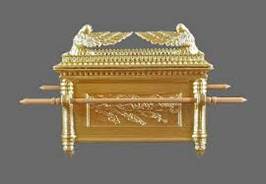
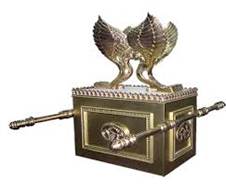
10 When the priests came out of the holy place When the priests who carried the ark into the Sanctuary were leaving, the Divine presence immediately came to rest there.
12 Then When he saw the cloud, he said, Now I see that the Divine presence is in the house which I built, for thus did He promise to come and dwell in it from the midst of a cloud and thick darkness. And where did he say this promise? “For in the cloud will I appear upon the ark-cover” (Lev. 16:12). Thus is this taught in the Sifrei.
13 For You to dwell in forever And from the time that this [place] was chosen, it would no longer be permissible [to offer sacrifices] on any strange altars, [except those in the temple,] and the Divine presence no longer dwelled in any other place.
15 Who spoke with His mouth [He also told him] that he would grant him a son who would build the temple.
And has fulfilled it with His hand He has fulfilled His word with His good power, lit. with His good hand.
16 ...Since the day, etc. This is what He spoke to my father David.
Commentary for Ashlamatah of Melachim alef (1 Kings) 8:9-18
By: H.Ex. Adon Shlomoh Ben Abraham
This Ashlamatah reading corresponds to the annual cycle reading of the Haftara portion Parshat Pikudei, Exodus 38:21-40:38. The Torah passage here in Exodus 38-40 gives us a description of the tally of materials used in building the Tabernacle in the wilderness. Also included is a tally of the material used to make the priestly vestments and all the instruments to be used in the tabernacle. Moses also instructed as to where and how to place the furniture in the tabernacle and how the priests were to perform their duties. It has been said that the service in the Tabernacle mirrored the world and mirrored God’s actions in creating the world. Scholars have noted that some of the language and phraseology in (Exo. 38-40) is similar to phrases in (Gen 1-2) in the creation of the world. We are told at the end of this reading that “the tabernacle was set up in the first month of the second year, on the first of the month.” (Exo 40:2,17)[26] After all the work was done and the offerings and incense burnt and the tabernacle purified, the presence of HaShem moved from Mt. Sinai and took up its abode in the Tabernacle and in the midst of the children of Israel. (Exo 40:34-38)[27]
In 1 Kings chapter 8, we learn that the dedication ceremonies took place in the seventh month, Ethanim,[28] called “Tishri” after the Babylonian exile. It corresponds to September–October and is the month when the high holidays, Rosh Ha-Shana (New Year) and Yom Kippur (Day of Atonement) are observed, followed immediately by Sukkot (Tabernacles or Booths).[29] The dedication, eleven months after the completion of the Temple (see 6:37),[30] was scheduled for the feast of Booths, Sukkot (v. 2).[31] In 1 Kings 6 we are told that four hundred and eighty years after leaving Egypt Solomon begin construction on the Temple in the month of Ziv,(v.1) also known as Iyar, which is the second month after Nissan. The Temple took seven and a half years to build and was finished in the month of Bul, also known as Marcheshvan. (v.37) [32] The sacred objects were kept in a tent within the City of David. They had to be carried up to the Temple, which had been constructed on a hill north of the city.[33] The elders were called to assemble in ‘Jerusalem to bring the ark up from the city of David, which is Zion’ (v.1). Originally, the name Zion was restricted to the southern portion of the hill rising on the eastern side of Jerusalem. The name was subsequently extended to the northern portion on which the Temple stood, and ultimately to the whole of the city.[34]
When the ark was brought to the Temple, we are told, there was nothing in the ark save the two tables of stone which Moses put there at Horeb, when the Lord made a covenant with the children of Israel when they came out of the land of Egypt. [35] This is also stated in Deut. 31:26, however, some have concluded from this statement that Aaron’s rod (Num. 17:10), the golden censor, and the manna (Exod. 16:33) had been removed since the Israelites were settled in the promised land, while the ark was captive among the Philistines. But nothing else was ever in the ark, the above articles mentioned (Heb. 9:4), being not in, but by it, being laid in the most holy place before the testimony (Exod. 16:33; Num. 17:10).[36] Or as suggested, perhaps the objects, being in front of the tabernacle, not in the ark, were but here added to the ark sometime later, after Solomon, suggesting when the Temple was destroyed and the ark and other items were hidden. The writer of Hebrews (N.T.) evidently knew of a tradition that the manna, Aaron's rod, and the tablets were kept together in (near) the ark. [37]
The Priest is ministering in the Holy Place, and as the Divine Presence filled the area, the Priest had to leave, no longer being able to minister. It has been suggested the cloud of smoke of the sacrifices was so strong they had to leave, I think another way to understand their leaving is that the divine Presence was so strong in the Holy of Hollies the Priest were not able to stay in the same area as the Presence or ‘Glory’ of Hashem, (v.11) just as we learn in (Exo.40:35) with Moses. In Lev 16:2, we are told that HaShem would appear in the cloud over the mercy seat, and Aaron was warned not to be in the Holy place except during the annual purification ritual, briefly alluded to in (Exod. 30:10), is to be performed on the tenth day of the seventh month (v. 29).[38] Elsewhere (23:27, 28; 25:9) this day is referred to as “yom HaKippurim”—often translated as “Day of Atonement,” with the verb “kiper,” “atone,” being used in the sense of “decontaminate [the sacred precincts] of sin or defilement” (1:4; 4:1–5:26 ). This day is found only in the Priestly calendar of sacred times (23:26–32; also Num. 29:7–11).[39] Later in this chapter (v.27ff), Christians have seen a contradiction here and in Solomon's prayer, when he affirms that the Temple cannot contain God. “To the Hebrews, there was no incompatibility between belief in God’s omnipresence and His ‘Abode' in Zion. In the Sanctuary, he was, so to speak, ‘at home’ to them.” [40] Here we should ask a question, in a biblical sense, where is man’s home and what is the temple representative of, and for a woman, where(what place) does she feel most comfortable?[41] In (v.13) Solomon said, I have built a house of habitation, a place for thee to dwell in forever and he repeats this five more times in this chapter of the dedication of the Temple. (v.20,27,43,44,48) Solomon in his prayer sought HaShem to recognize the temple as a focal point of His communion with Israel and all people and to respond from heaven (Compare 2 Chr. 6: 23, 25, 27, 30, 33, 35, 39), His true dwelling place (2 Chr. 6: 30, 33, 39; 2 Chr. 30:27).
King Solomon blesses all the congregation of Israel, and the congregation stood, and Solomon began to review and remind the people of the origin of the Temple and the promises God made with his father David. The word “blessed” (יְבָרֵךְ) denotes the wish for a blessing with which the king greeted the assembled congregation and introduced the praise of God which follows.—In (v. 15–21) he praises HaShem for having now fulfilled with His hand what He spoke with His mouth to his father David (2 Sam. 7).[42] With His own hand means HaShem Himself fulfilled the promise made to David. The promise Solomon referred to was that God would place His Name in Jerusalem. “Name” occurs in Solomon’s prayer 14 times (1 Kings 8:16–20, 29, 33, 35, 41–44 [twice in v. 43], 48). The temple was not to be a “container” for God (v. 27) but a place for His Name[43] to dwell (vv. 16–17, 19–20), that is, a place where His presence and character would be evident.[44] The term Name, which occurs 14 times in this chapter and 14 times elsewhere in 2 Chronicles, refers to God’s attributes or presence (cf. 1 Chron. 13:6). David had not been allowed to build the temple but God in His infinite wisdom ordained that Solomon, David’s son, would do so and now that promise had come to pass (2 Chron. 6:7–11).
The promise of God, to choose Jerusalem as the place for the temple and David as prince, is taken from (2 Sam. 7:7, 8). In 2 Chron. 6:6, before “I chose David,” we find “and I chose Jerusalem, that my name might be there” … David’s intention to build the temple, and the answer of God that his son was to execute this work, are taken from (2 Sam. 7:2, 12, 13), that God approves the intention of David as such. הֱטִיבֹתָ, “Thou didst well that it was in thy mind.”[45] Me’am Lo’ez tells us that the location was chosen at the time of the creation. But it was not revealed to the people until the time of David. In (Deut. 12:5 ff), the people of Israel are told what they are to do in the worship of HaShem for as long as they live on the earth, and it is to this site in Jerusalem they are to come. Although they did not know the location of the site until the time of David. In (Exo. 20:21) Hashem tells the people, as a temporary measure, he would meet them at the altar in the place he “chose to have his name mentioned,” but now and for all time, the place for Hashem’s name to dwell is in Jerusalem.
Our story in 1 Kings chapter eight is repeated in 2 Chronicles when King Solomon related how Israel had arrived at the building and dedication of the Temple, And he said: ‘Blessed be the Lord, the God of Israel, who spoke with His mouth unto David my father, and hath with His hands fulfilled it, saying: Since the day that I brought forth My people out of the land of Egypt, I chose no city out of all the tribes of Israel to build a house in, that My name might be there; neither chose I any man to be prince over My people Israel; but I have chosen Jerusalem, that My name might be there; and have chosen David to be over My people Israel.[46]
We find over thirty verses in the bible that speak of the place God chooses to place his name, and that physical location is Mt. Zion in Jerusalem.
1 Kings 14:21 Now Rehoboam, the son of Solomon, reigned in Judah. Rehoboam was forty-one years old when he became king, and he reigned seventeen years in Jerusalem, the city which the Lord had chosen from all the tribes of Israel to put His name there. And his mother’s name was Naamah the Ammonitess.
Nehemiah 1:9 but if you return to Me and keep My commandments and do them, though those of you who have been scattered were in the most remote part of the heavens, I will gather them from there and will bring them to the place where I have chosen to cause My name to dwell.’
1 Kings 8:43 You [47] hear in heaven Your dwelling place, and do according to all for which the foreigner calls to You, in order that all the peoples of the earth may know Your name, to fear You, as do Your people Israel, and that they may know that this house which I have built is called by Your name.
Melchizedek is the first king of Jerusalem mentioned in the bible. After Abraham’s defeat of an Assyrian alliance, he was commended and blessed by “Melchizedek king of Salem” (Gen. 14:18). The city name Salem is the earliest biblical form of the name Jerusalem. (Psalm 76:3 identifies Salem as Zion, another name for Jerusalem.)[48] The name “Melchizedek” means “king of righteousness.” This individual was both king of Jerusalem and “priest of God the Most High” (Gen 14). Abraham paid tithes to this king-priest of Jerusalem, and a Nazarene Codicil (New Testament) tradition about Abraham looking toward Jerusalem “which hath foundations, whose builder and maker is God” (Hebrews 11:10). Scriptural and archaeological evidence indicate that Melchizedek was the founder of the city. The name of the city, Salem, means peace (or completeness). The alternate form, Jerusalem, means “city (or foundation) of peace.” Perhaps that name was only taken on after these “foundations” were laid, during the 1800s B.C.E. The traditional rabbinic opinion is that he (Melchizedek) was Shem, and according to the ages given in (Gen. 11), he would have still been on the scene during the lifetime of Abraham. One Christian view, building off of Psalm 110, says he was the promised Messiah, the one Yeshua (Jesus), the Messiah (Heb. 5-7, John 8:56-58). Another opinion has also been found among the Jewish Qumran community of the second and first centuries B.C.E. The Dead Sea Scrolls 11QMelch (circa 100 B.C.E.) identifies Melchizedek with the term “Elohim” (citing Psalm 82:6), also the “anointed one” of Daniel 9, and as one who would make an atonement for sins. Another somewhat related connection can also be found with the first-century Jewish philosopher Philo, who referred to Melchizedek using the Greek title “Logos.”[49] The same title is also linked to Yeshua (Jesus) in the Nazorean codicil (NT). (John 1:1).
A central place for worship was
necessary for maintaining the unity and purity of Israelite worship. It was at this
location that the major feasts, sacrifices, and religious observances were to be
conducted. "Then the LORD your God will choose a dwelling for His Name,
and there you are to bring all that I command you: your burnt offerings and sacrifices,
your tithes and special gifts, and all the choice offerings you vow to the LORD."(Deut.12:11)
A reminder of God's promises and the people's obligations under the covenant. The
Temple, as the dwelling place of God's name, was a symbol of divine favor and protection,
a focal point for the covenant relationship between God and Israel. According to
Solomon's prayer at the dedication of the temple and the Prophets of Israel, the
temple will one day be the focal point not only of Israel but of all the nations
in their worship of HaShem, and the more we learn about the temple, the more we
understand how important the restored temple will be for humanity's future.
The prophets spoke of the place of God's name in terms of both judgment and restoration. When Israel strayed from God's commandments, the prophets warned that the place of His name would be desecrated or destroyed, as seen in (Jer. 7:11-14).[50] However, they also foretold a time of renewal when God's presence would be fully restored among His people. The prophets spoke of a future Jerusalem that will become the center of God's kingdom on earth. In (Isaiah 2:2-3), it is prophesied, "In the last days, the mountain of the house of the LORD will be established as the chief of the mountains; it will be raised above the hills, and all nations will stream to it. Many people will come and say, 'Come, let us go up to the mountain of the LORD, to the house of the God of Jacob. He will teach us His ways so that we may walk in His paths.' For the law will go forth from Zion, and the word of the LORD from Jerusalem."
Special Ashlamata for Shabbat Mevarchim:
JPS & Targum Pseudo Jonathan for: Shmuel alef (I Samuel) 20:18-42
|
JPS |
Targum Pseudo Jonathan |
|
18. And Jonathan said to him, "Tomorrow is the new moon, and you will be remembered, for your seat will be vacant. |
18. And Jonathan said to him: “Tomorrow is the (New) Moon, and you will be sought out, for your dining place will be empty. |
|
19. And for three days, you shall hide very well, and you shall come to the place where you hid on the day of work, and you shall stay beside the traveler's stone. |
19. And at the third (day) of the Moon you will be sought out very much, and you will go to the place where you hid yourself on the weekday, and you will dwell near "Stone Coming." |
|
20. And I shall shoot three arrows to the side, as though I shot at a mark. |
20. And I am to shoot three arrows with the bow so as to hit for myself at the target. |
|
21. And behold, I shall send the youth, (saying,) 'Go, find the arrows.' If I say to the youth, 'Behold, the arrows are on this side of you,' take it and come, for it is well with you, and there is nothing the matter, as the Lord lives. |
21. And behold I will send the young man: `Go, get the arrows.' If indeed I say to the young man: `Behold the arrow is on this side of you; take it and bring (it),' then there is peace for you and nothing evil as the Lord lives. |
|
22. But, if I say thus to the youth, 'Behold, the arrows are beyond you,' go! For the Lord has sent you away. |
22. And if thus I say to the young man: `Behold the arrow is beyond you,' go, for the Lord has rescued you. |
|
23. And (concerning) the matter which we have spoken, I and you, behold, the Lord is between me and you forever." |
23. And the word that we have spoken - I and you - behold the Memra of the Lord is a witness between me and you forever." |
|
24. And David hid in the field, and when it was the new moon, Saul sat down to the meal to eat. |
24. And David hid in the field, and it was the (New) Moon. And the king sat down at the food to eat. |
|
25. And the king sat upon his seat, as at other times, upon the seat by the wall, and Jonathan arose, and Abner sat down beside Saul, and David's place was vacant. |
25. And the king sat down upon his seat as at other times, upon the seat that was prepared for him near the wall. And Jonathan stood up, and Abner sat down by the side of Saul, and the place of David was empty. |
|
26. And Saul did not say anything on that day, for he thought, "It is an incident; he is not clean, for he is not clean." |
26. And Saul did not speak anything on that day, for he said: “Perhaps an accident has happened to him, and he is not clean; or perhaps he went on the road, and we did not invite him.” |
|
27. And it was, on the morrow of the new moon, the second (day of the month), that David's place was vacant, and Saul said to Jonathan, his son, "Why has not the son of Jesse come to the meal either yesterday or today?" |
27. And on the day after that, which is the intercalation of the second month, the place of David was empty, and Saul said to Jonathan his son: “Why has the son of Jesse not come both yesterday and today for food?” |
|
28. And Jonathan answered Saul, "David asked leave of me (to go) to Bethlehem. |
28. And Jonathan answered Saul: “David earnestly requested from me to go unto Bethlehem. |
|
29. And he said, 'Let me go away now, for we have a family sacrifice in the city, and he, my brother, commanded me, and now, if I have found favor in your eyes, let me slip away now, and see my brothers. ' He, therefore, did not come to the king's table." |
29. And he said: ‘Send me away now, for they have begun an offering of holy things for all our family in the city, and my brother commanded me. And now if I have found favour in your eyes, let me get away now and see my brothers.' Therefore he did not come to the table of the king.” |
|
30. And Saul's wrath was kindled against Jonathan, and he said to him, "You son of a straying woman deserving of punishment! Did I not know that you choose the son of Jesse, to your shame and to the shame of your mother's nakedness? |
30. And the anger of Saul was strong against Jonathan, and he said to him: “You son of an obstinate woman whose rebellion was harsh, do I not know that you love the son of Jesse to your disgrace and to the disgrace of the shame of your mother? |
|
31. For all the days that the son of Jesse is living on the earth, you and your kingdom will not be established. And now, send and take him to me, for he is condemned to death." |
31. For all the days that the son of Jesse is alive upon the earth, neither you nor your kingdom will be established. And now send and bring him unto me, for he is a man deserving killing.” |
|
32. And Jonathan answered Saul his father, and said to him, "Why should he be put to death? What has he done?" |
32. And Jonathan answered Saul his father and said to him: “Why will he be killed? What did he do?” |
|
33. And Saul cast the spear upon him to strike him; and Jonathan knew that it had been decided upon by his father, to put David to death. |
33. And Saul lifted up the spear against him so as to strike him, and Jonathan knew that it was determined from his father to kill David. |
|
34. And Jonathan arose from the table in fierce anger; and he did not eat any food on the second day of the new moon, for he was grieved concerning David, for his father had put him to shame. |
34. And Jonathan arose from the table in strong anger, and he did not eat food on the day of the intercalation of the second month, for he grieved over David, for his father shamed him. |
|
35. And it was in the morning, that Jonathan went out at David's appointed time, and a small boy was with him. |
35. And in the morning Jonathan went forth to the field at the time that David said to him, and a small boy was with him. |
|
36. And he said to his boy, "Run, find now the arrows which I shoot." The boy ran; and he shot the arrow to cause it to go beyond him. |
36. And he said to his young man: “Run, get the arrows that I am shooting.” The young man ran, and he shot the arrow beyond him. |
|
37. And the lad came up to the place of the arrow, which Jonathan had shot. And Jonathan called after the lad, and said, "Isn't the arrow beyond you?" |
37. And the young man came unto the place of the arrow that Jonathan shot, and Jonathan called after the young man and said: “Is not the arrow beyond you?” |
|
38. And Jonathan called after the lad, "Quickly, hasten, do not stand!" And Jonathan's lad gathered up the arrows, and came to his master. |
38. And Jonathan called after the young man: “Hurry, in haste; do not delay.” And Jonathan's young man was gathering the arrows, and he came unto his master. |
|
39. And the lad knew nothing; only Jonathan and David knew the matter. |
39. And the young man did not know anything. Only Jonathan and David knew the matter. |
|
40. And Jonathan gave his weapons to his boy, and said to him, "Go, bring (them) to the city." |
40. And Jonathan gave his armor to the young man that was his, and he said to him: "Go, bring it to the city." |
|
41. The lad departed, and David arose from (a place) toward the south; and he fell upon his face to the ground three times, and prostrated himself three times. And they kissed one another, and wept one with the other, until David exceeded. |
41. And the young man went, and David arose from the side of “Stone Coming” that is opposite the south, and he fell upon his face upon the ground, and he bowed down three times, and they kissed each man his fellow, and they wept each man his fellow until David exceeded. |
|
42. And Jonathan said to David, "Go in peace! (And bear in mind) that we have sworn both of us in the name of the Lord, saying, 'May the Lord be between me and you, and between my descendants and your descendants forever.' " |
42. And Jonathan said to David: “Go in peace, for the two of us have sworn by the name of the LORD saying, ‘May the Memra of the LORD be a witness between me and you, and between my sons and your sons forever.’” And he arose and went, and Jonathan entered the city. |
Verbal Tallies
By: Hakham Dr. Hillel ben David
Devarim (Deuteronomy) 10:1 – 12:19; Tehillim (Psalms) 119:1-48; Melachim alef (I Kings) 8:9-18
Looking at the Hebrew of Deuteronomy 10:1 and I Kings 8:9, what is the verbal tally (all root words) that connects these two passages?
The verbal tally that connects Deuteronomy 10:1 and 1 Kings 8:9 centers on the three core components of the Ark of the Covenant: the Ark itself, the two tablets, and the material stone.
The following table provides the (JPS translation) with the Hebrew root words and their corresponding Strong's numbers (KJV system) inserted.
|
English Root Word |
Hebrew Tally (Root) |
Strong's Number |
|
Ark |
אֲרוֹן ('ārōn) |
H727 |
|
Tablets/Tables |
לוּחַ (lūacḥ) |
H3871 |
|
Stone |
אֶבֶן ('eḇen) |
H68 |
Devarim (Deuteronomy) 10:1 At that time the Lord said unto me: 'Hew thee two tables (לוּחֹת / H3871) of stone (אֲבָנִים / H68) like unto the first, and come up unto Me into the mount; and make thee an ark (אֲרוֹן / H727) of wood.
Melachim alef (I Kings) 8:9 There was nothing in the ark (בָּֽאָרוֹן / H727) save the two tables (לֻחֹות / H3871) of stone (הָאֲבָנִים / H68) which Moses put there at Horeb, when the Lord made a covenant with the children of Israel, when they came out of the land of Egypt.
* * *
What is/are the thematic connection(s) between Devarim (Deuteronomy) 10:1 – 12:19, and Tehillim (Psalms) 119:1-48?
The central thematic connections between Devarim (Deuteronomy) 10:1-12:19 and Tehillim (Psalms) 119:1-48 revolve around the Law of God and the proper heart response to that law. Both passages emphasize that God's instruction is not merely a set of external rules but requires a wholehearted, internal commitment from His people.
Central Thematic Connections
|
Theme |
Devarim (Deuteronomy) 10:1-12:19 |
Tehillim (Psalms) 119:1-48 |
|
Law and Instruction |
Moses delivers the law and commands, stressing the renewal and importance of the covenant and commandments (e.g., Deut 10:13, 11:1). |
The Psalmist praises, meditates on, and delights in God's Law (Torah), statutes, precepts, commandments, and judgments (the word of God is mentioned in almost every verse). |
|
Wholehearted Obedience |
God requires Israel to "fear the LORD your God, to walk in all his ways, to love him, to serve the LORD your God with all your heart and with all your soul" (Deut 10:12). This is explicitly connected to circumcision of the heart (Deut 10:16). |
The Psalmist expresses a desire to seek God's instruction "with my whole heart" (Ps 119:2, 10) and asks God to establish his way in God's law (Ps 119:5). |
|
Blessing and Life |
Obedience to the commandments is consistently presented as leading to life, prosperity, and blessings in the land (Deut 11:8-9). |
The Psalm opens by declaring the blessedness of those who walk in the Law of the LORD and keep His testimonies (Ps 119:1-2). The Word of God is seen as the way to keep one's life pure (Ps 119:9) and a source of life (Ps 119:25). |
|
Personal Relationship |
The exhortation is direct and personal ("And now, O Israel, what does the LORD your God require of you...," Deut 10:12), reflecting God's unique choice and love for Israel (Deut 10:14-15). |
The Psalm is deeply personal, written in the first person ("I," "my"), expressing a direct and intimate love, longing, and reliance on God and His Word (e.g., Ps 119:20, 33). |
The deepest link is the move from mere external compliance to internalized devotion. Deuteronomy 10:12-19 calls the people to a fundamental choice—to love God and "circumcise your hearts"—which Psalm 119:1-48 demonstrates in practice. The Psalmist is a living example of the heart that delights in, meditates on, and wholeheartedly seeks the Law that Deuteronomy commands Israel to embrace.
* * *
The connection between the Torah seder and the Ashlamata, though seemingly strictly verbal, is in addition eschatological. The messianic kingdom, rather than the related contents of the Torah lesson, is the dominant theme of the Ashlamata.
What is the eschatological message of Melachim alef (I Kings) 8:9-18?
The passage Melachim Alef (I Kings) 8:9-18 focuses on the fulfillment of HaShem's covenant with David and the establishment of a permanent dwelling for HaShem's presence (the Shekhinah) in Jerusalem, which has eschatological implications in Jewish tradition.
Fulfillment of the Davidic Covenant
Solomon's successful construction of the Temple and the installation of the Ark of the Covenant fulfills a crucial element of the promise HaShem made to David, as recounted by Solomon himself (vv. 15-16, 20).
In Jewish eschatology, the Mashiach, who will redeem Israel, is a direct descendant of King David (Mashiach ben David). The establishment of the Temple and the Davidic dynasty in Jerusalem, as celebrated in this text, are the necessary and foundational preconditions for the Messianic Era. The permanent centrality of God's presence (Shekhinah) in Jerusalem, as symbolized by the cloud filling the Temple (vv. 10-11), points toward the ultimate, uninterrupted Messianic redemption.
Significance of the Ark
The text emphasizes that only the two Tablets of Stone were in the Ark (v. 9), reminding Israel that the covenant established at Horeb (Sinai), based on the Torah (Law), is the sole, enduring basis of HaShem's relationship with them.
The Messianic era is often envisioned as a time when the Torah will be fully internalized (Jeremiah 31:33), and knowledge of HaShem will cover the earth (Isaiah 11:9). The dedication of the Temple and the central placement of the Tablets symbolize that the complete and perfect realization of the covenant and the Law—which defines the eschaton—begins with the permanent physical center in the Temple.
The very existence of the completed Temple and the established Davidic kingdom is a significant step toward the future perfection of the world, setting the stage for the final and complete redemption heralded by the Messiah.
Nazarean Talmud
Sidrot of “Devarim” (Deuteronomy) “10.1- 12:19”
“Bae-et Hahi Amar” – “At that Time [HA-SHEM] Said”
By: Hakham Dr. Eliyahu ben Abraham
|
School of Hakham Shaul’s Tosefta – Luqas (LK) |
School of Hakham Tsefet’s Pshat – Mordechai (Mk)
|
|
|
“But behold, the hand of the one who is betraying me is with me on the table (Psalm 41:10)! For the Son of Man[51] is going according to what has been pre-determined, but woe to that man by whom he is betrayed!” And they began to debate with one another who of them could it be who was going to do this.
|
And when the first evening of the 14th of Nisan came, he (Yeshua) arrived with the twelve (talmidim). And as they reclined and ate, Yeshua said Amen ve amen, one of you will betray me (hand me over), and he is eating with me (Psalm 41:10). And they began to grieve and asked him one after the other, Is it me? And answering, he (Yeshua) said to them it is one of the twelve who is dipping with me in the same bowl. Because the Son of Man[52] has to go away as it is written in the Scriptures (Tanakh) concerning him, but woe to that man who betrays the Son of Man. It would have been more beneficial for him not to have been born. |
|
|
And he said to them, “I have earnestly desired to eat this Pesach with you before I suffer. For I tell you that I will not eat it until it is fulfilled in the kingdom (governance) of G-d through the Hakhamim and Bate Din as opposed to human kings.” And he took in hand the (third) cup, and after saying a Brakhah he said, “Take this and divide this among yourselves. For I tell you, from now on I will not drink of the fruit of the vine until the kingdom of G-d through the Hakhamim and Bate Din as opposed to human kings comes.” And he took bread, and after giving thanks, he broke it and gave it to them, saying, “This is analogous of my life which is given for you. Do this in remembrance of me.” And in the same way the cup after they had eaten, saying, “ This is analogous of my life (the blood) of the renewal of the Covenant, which is poured out for you. |
And Yeshua received bread (the afikomen) and said Ha-Motsi and broke it, and he gave it to them and said, Receive this, it is analogous to my Jewish body politic. And he (Yeshua) said grace (Birkat Hamazon), after they ate (the meal), and taking the cup (the 3rd one of redemption), after saying Ha-Gefen and gave to them, and they all drank out of it. And he said to them, this is analogous of my life (the blood) of the renewal of the Covenant, which is poured out for the many (the Gentiles). Amen ve amen I say to you, I will no more drink of the fruit of the vine until that day that I drink it (or, I am refreshed -strengthened) anew in the kingdom (governance) of G-d through the Hakhamim and Bate Din as opposed to human kings. |
|
Nazarean Codicil to be read in conjunction with the following Torah Seder
|
Deu 10.1 – 12.19 |
Ps 119. 1-48 |
I Kings 8:9-18 |
Mordechai 14:17-25 |
Luqas 22:22-23; 22:15-21 |
Commentary on Hakham Tsefet’s School of Pshat
Shabbat HaGadol
This week’s pericope of Mordechai (Mark) aligns well with the Bimodal aspect of the Triennial Torah reading cycle. It causes us to ask several questions. Seeing the betrayal of the Master forces us to look at the virtues and depravity of man. This is evident in the present pericope of Mordechai (Mark) and Luqas of Hakham Shaul. The words of Psalm 41:10[53] “My ally in whom I trusted, even he who shares my bread, has been utterly false to me” allows us to see the negative side of a man’s relationship to his “teacher.” Marcus believes that the “act of treachery is an act of Divine providence and human sinfulness.”[54] Likewise, the Torah sets the tone for the weekly pericope of Mordechai (Mark). The repetitive statement concerning the observance of mitzvoth stands out in the Torah portion as Moshe delineates the contents of the Lukot. We have discussed the idea that the phrase “chok” is singular and “chukkim” is plural in the past. These mitzvoth are the most complex of all. This is because they are supra-rational. In our humble opinion, the “statutes and judgments” (Heb. Mishpatim) relate to the Oral Torah and Mesorah.
We also find it to be Divine providence that we have the Mishnah Abot so closely aligned with the themes of the Torah and the pericope of Mordechai.
And when [the first] evening of the 14th of Nisan came, he (Yeshua) arrived with the twelve (talmidim).
We are taught, from the Sages, that the Hebrew word “mitzvah” is rooted in the idea of connection. In other words, the mitzvoth are a way of connecting with G-d. Following the mitzvoth leads the man of righteousness/generosity down a path of righteousness/generosity as ordered by G-d. In the present verse, we see Yeshua and his talmidim observing the mitzvah of keeping Pesach.
Therefore, we have a Nazarean Mitzvah implied by the actions of the Master. Here, the implied mitzvah of the Nazarean Codicil is …
- The Festival of Hag HaMatzah (Pesach) is a holy convocation[55]
By further implication, the master teaches us that man must keep the mitzvot and that it is the depravity of Yehudah’s (Judas), which keeps him from observing the mitzvot and connecting with G-d.
Yehudah (Judas) was cursed by his own free willed choice. God did not make a mistake in giving Judas life but brought to judgment the evil that Judas' own will acquired by his own choice (Origen, John of Damascus).[56]
Here, we also note the magnanimity of Yeshua’s compassion and discretion in dealing with Yehudah Ish Keriyoth, the betrayer.[57] Yeshua does not openly tell us who the betrayer is. However, he does reveal who he is through implication. Bowman notes, “The Marcan account is more restrained and more effective.”[58] In such a case, Yeshua has followed the example of his mentor Hillel, who taught him to be a talmid of Aaron, loving peace.[59]
Amen ve amen one of you will betray[60] me – 14:18b
The doubting Thomas, Craig Evans,[61] in agreement with the Tübingen School of thought[62] tells us that someone (one of Yeshua’s Jerusalem friends) told Yeshua that one of his talmidim had been conspiring with the Kohen Gadol and the Tz’dukim. According to Evans, the Master had no intuitive or prophetic abilities. His “knowledge” of these facts was “derived from various friendly sources.”[63] The absurdity of the claim takes little logic to refute. Yehuda Ish Keriyoth most certainly would not have publicized his intent, nor would the Kohanim have. Mr. Evan’s words are too irrational to accept. Interestingly enough, Evans changes his tune to suggest that Mark is emphasizing Yeshua’s predictive (prophetic) abilities. Mr. Evans needs to make up his mind.
And as (they) reclined and ate, Yeshua said amen ve amen one of you will betray[64] me (hand me over), and he is eating with me.
Sheb’chol haleilot anu och’lin, bein yoshu’vin m’subin, halailah kulanu m’subin? “On all other nights, we eat in an upright position or reclining, while on this night we only eat reclining.”
Here, we note that the Nazarean Codicil implies another mitzvah.
- To recline while eating the Passover[65]
The question asked by the “simple son” notes that the Pesach Seder is a night of reclining like Kings. Here in our present pericope of Mordechai, the master demonstrates that this was a very ancient practice as well as being the correct one.
Here we note that Hakham Tsefet has intentionally inserted this small piece of information for halakhic purposes. Since we have a “Mesorah” rather than a “Gospel”, we have a halakhic behaviour that is the normative practice of the Master, and which is given to us in order to follow.
And they began to grieve and asked him one after the other, Is it me? (It’s not me?)
Mark only uses this word twice in his Mesorah.[66] On both occasions, the term denotes those who fail Yeshua.[67] The first occasion is the young property owner[68] who has trouble with Yeshua’s charge to sell everything and follow him.
Here, the talmidim are “grieved” at the possibility of failing the master. As stated above, this forces every talmid to look internally as one who must search the house for chametz.[69]
Clumsy Greek? Or Mishnaic Hebrew? - 14:19b
one after the other, is it me? (It’s not me?)
The Greek text here is awkward[70] as it tries to master the Hebraic origin of the text. Here again, the Greek text yields to the understanding that the original language was Mishnaic Hebrew.[71] Scholars have suggested that the difficulty is not in the language but in the author, who they suggest is not very educated or not versed in Greek. Please note that regardless of how we interpret the idea that Mordechai is writing this book, we MUST realize that Hakham Tsefet is the real author behind the text. However, we here suggest that Mordechai, the Sofer and talmid of Hakham Tsefet, was no dummy either. When we realize that Yeshua, the prophetic “son of man,” knew that he was establishing a Mesorah for his talmidim, we must believe that Yeshua sought capable men of great intellect for the transmission of his Mesorah. Here, we can further surmise that Hakham Tsefet was chief in ability and understanding of the Torah. Black[72] tells us that Mordechai accompanied Hakham Shaul on his missionary journey[73] to the gentiles as a catechist. “His occupation was to see that the converts really knew who and what the Sh’liachim (Apostles)[74] were talking about.”[75] While concurring with Black, we interpret things just a little bit differently. We agree that Mordechai was the teacher “catechist,” training new converts. However, we would further suggest that Mordechai taught them the “Mishnah of Mordechai” or the “Mishnaic Import of the Teachings of the School of Hakham Tsefet.” We would also further opine here that the materials that we are speaking about[76] were the materials he used to catechize his converts and students. Of course, this would mean that these documents were already in existence. This would refute the idea that these documents were written in the mid-sixties of the first century of the Common Era. We propose that the materials of the “Mishnaic import of the Teachings of the School of Hakham Tsefet” were written before 41 C.E.[77] or earlier. While other scholars tend to push the “Gospel of Mark” to the early/middle part of the second century, Eusebius records Papias[78] of Hierapolis, vindicating the authenticity of the “Gospel of Mark” – the “Mishnaic import of the Teachings of the School of Hakham Tsefet”.[79] This would mean that the understanding of the original Mishnaic Hebrew text was lost by the time of his writing, and that the Judaic understanding of the Mesorah had been lost or “sanitized” by this time. As such, this points to the fact that the calamity of the Nazarean faith occurred sometime immediately following 70 C.E. Our joint thesis is that Nazarean Judaism retreated to Orthodox Judaism and related circles while still believing in Yeshua as Messiah immediately following 70 C.E.
Tishri or Nisan
and asked him one after the other, is it me? (It’s not me?)
The text of our pericope suggests that we are either in the month of Tishri or Nisan.[80] This is because Yeshua forces his talmidim to do introspection. The month of Tishri tells one to search his inner being for false motives. This lesson is evident in the present pericope. However, the month of Nisan has a parallel message. The house of the Jew is turned “upside down,” so to speak, in a search for Chametz in order to keep the seven-day festival of Hag HaMatzot free of leaven.
Origen suggests that Yeshua taught each of his talmidim to introspect.[81] As noted above, Yeshua uses discretion in revealing the betrayer. This causes all the talmidim to introspect and question their interior motive. However, introspection demands a standard by which we judge ourselves. Again, the Torah Seder is replete with Moshe’s commands to keep the mitzvoth. Therefore, the mitzvoth serve as a means for introspection. Yeshua’s statement at this place in the Pesach Seder serves to heighten the tension and drives the idea of introspection deep within the talmidim.
And answering, he (Yeshua) said to them [It is one of the twelve who is dipping with me in the same bowl.
Here we have translated the final words of the verse “the same bowl.” Three of the Greek variants include the word “same.”[82] Thus, the implication[83] is that Yehudah Ish Keriyoth is dipping in the same bowl as Yeshua. Undoubtedly, this limited the possible traitor to Yehuda Ish Keriyoth. We suggest that the seating arrangement allowed Yeshua and Yehuda to dip from the same bowl or dish. Exactly who all had access to the same dish is speculation. However, it would appear from the text that Yeshua is implicating Yehuda Ish Keriyoth. However, Gould suggests that Hakham Tsefet is not as interested in implicating Yehuda Ish Keriyoth, so much as pointing out the act of treachery against the master.[84] If this were the case, it would easily match the theme of introspection requisite at this time of the year. It would also suggest that the search for chametz, in the home of the observant Jews, which starts just after Purim and lasts until Hag HaMatzot.
Moshe entreated the LORD to allow him to enter Eretz Yisrael. While the LORD did not allow Moshe to enter Eretz Yisrael, Moshe was a man of virtue, who modelled virtue for all men. Moshe led many men to righteousness/ generosity, as did Yeshua our Master. However, as our Mishnah says, he who leads the many to sin, to him will be given no means for repentance/returning.[85] Such was the case of Yehuda Ish Keriyoth. Like Jeroboam, Yehuda Ish Keriyoth placed a “stumbling block” before the blind.
When the Bne Yisrael failed to allow the land to lie fallow in the Shmitah year, G-d enacted “middah k’neged middah,” a punishment matching the misdeed. Jeroboam’s punishment was “middah k’neged middah,” a punishment which matched his crime. In a similar manner, we can see that Yehudah’s punishment matched his crime.
Yeshua, the prophetic “son of man,” accepts Yehuda’s treachery as a part of his destiny[86] in accordance with the writings of the Tanakh. However, the pronouncement of the oath and “woe” serves as a caveat that should Yehuda Ish Keriyoth proceed with his plan. The Rabbis of the Gemara, in their discussion on the Messiah, tell us “all the prophets prophesied of the days of the Messiah.”[87] While we realize that we look forward to the “days of Messiah,” we also believe that Yeshua knew that Moshe and the Prophets accurately depicted his life, death, and resurrection in the Tanakh, just as it was ordained in the will of G-d. This is because Yeshua was truly a Torah Scholar and a Hakham. The sublime theme of the Torah portions this week speaks of those who are faithful to Torah study. There is also an allusion to the study of the Mishneh Torah (Yad Chazaqah) in our present Torah Seder.
Hakham Tsefet is perfectly aware of all the nuances found in the Torah and related writings. His intention is to demonstrate that Yeshua, like Moshe, was a man of virtue. His failure to directly mention the traitor among the talmidim tells us that every man MUST introspect to be assured that his motives are pure, like Matzah. Here, Hakham Tsefet plays on the bi-modality of the Torah readings, weaving that same bi-modality into the Mishnah of Mark.
Pesach
Order – Seder
While scholars quibble over Second Temple period practices and the order of the Pesach Seder, they miss the whole point of our pericope. Likewise, most scholars want to institute the “Eucharist” without an understanding of the true order and meaning of the Pesach Seder and the Greek word order of our present text. The present context of the Pesach Seder relates to the events that follow the Pesach Meal, called “Shulchan Aruch” or “the Prepared Table.” Hakham Tsefet does not elaborate on the details of the Seder or those events that took place in the earlier parts of the Seder. Why?
Life is structured by the Torah! Hakham Tsefet demonstrates a life that follows the structure of the Torah and related mitzvot. The basis of the “Ten Words” as found in the Torah Seder lays the foundation for the order of Jewish life. Hakham Tsefet relates to the Torah Seder’s ordered life by use of the Pesach Seder’s order to teach us about the structured life mandated through the “Ten Words.”
The key essential to Jewish life is order. The title of our Prayer book is Siddur, “order.” The title of the Passover ceremony is “Seder,” “Order.” The “order” of the Seder is very ancient. We have the basic structure listed in the Mishnah. Scholars such as Mary Healy tell us that the central element of the Passover, the lamb, is missing in the Markan texts.[88] This is because we are at the point in the Seder where the “lamb” has been consumed. At this juncture of the Pesach Seder, the focus is no longer on a lamb. The present focus is on the “bread,” the “cup,” and “Hallel.”
Because the Greek copyists (MONKeys) had no understanding of Pesach and Ritual Hermeneutics, they butchered the texts, not realizing and not caring that the Pesach Seder follows a very specific order.
This verse is one of the more problematic verses in the Nazarean Codicil. Entire denominations and theologies have been built on the Greek word εὐχαριστήσα eucharistesa. Likewise, we must say that we struggled with this word for several minutes as we went through the possible translations and lexical data. We have recently suggested that Hakham Shaul’s first letter to the Corinthians is based on the “Haggadah” in and of itself. Likewise, we recently stated that Christians base the “eucharist” on a place in the Pesach Seder, which brings the bread, matzah — afikomen before the third cup of wine. Our understanding that Yeshua “blessed” εὐλογέω eulogeo in verse 22 was no longer problematic. To “bless” meant that Yeshua simply said “Ha-Motsi,” or that he blessed G-d for bringing the bread from the earth (matzah in this case). However, the Greek word εὐχαριστήσα eucharistesa does not fit with the idea that Yeshua “blessed” saying ‘Ha-Gefen,” blessing G-d for the fruit of the vine.
|
New King James |
My Translation |
|
Mk 14:22 And as they were eating, Jesus took bread, blessed and broke it, and gave it to them and said, "Take, eat; this is My body." 23 Then He took the cup, and when He had given thanks He gave it to them, and they all drank from it. (Mar 14:22-23 NKJ) |
Mar 14:22 And Yeshua received bread (the afikomen) and said Ha-Motsi and broke it, and he gave to them and said, receive this, it is analogous to my Jewish body politic. Mar 14:23 And he (Yeshua) said grace (Birkat Hamazon), after they ate (the meal), and taking the cup (the 3rd one of redemption), after saying Ha-Gefen and gave to them, and they all drank out of it. |
Firstly, we must understand that the “sentence”[89] as found in the Greek Nazarean Codicil, often covers “trans-verse”[90] parameters. In other words, we look to a “verse” believing this to be a concise statement wrapped up in the constraints of a “verse.” This is not true of Greek or Hebrew. We must keep in mind that the “chapter and verse” invention is very late in the history of scripture. Therefore, sometimes, as is our present case, things get a bit jumbled up. Moreover, to set them straight, for them to be intelligible in another language, they need a bit of unscrambling. This is because the Greek verb and sentence structure is not as exact as it is in English or Hebrew. Greek writers often place words at the beginning or at the end of a sentence to stress importance. Here, the cup is central to the thought of verse 23. Therefore, we have worded the sentence so that the ideas all flow together. This reveals exactly what happened in the scene about which we are reading. The structure now flows in the true order of the Pesach Seder and order of occurrence.
Yeshua says the Birkat Ha-Mazon[91], because they have just finished the meal. The next step in the Seder is to eat the afikomen, a piece of matzah, which was hidden and returned. Scholars have hesitated to suggest that the practice of the afikomen existed during Second Temple Times.[92] The language of the Markan text strongly suggests that the afikomen was in fact a part of Yeshua’s Pesach Seder. However, for further clarification, rather than translating λαβὼν ὁ Ἰησοῦς ἄρτον as Yeshua “took” the bread, the text should read that Yeshua received the bread (afikomen) after it had been “redeemed” or “returned.”[93]
After eating the “afikomen,” the Birkat Ha-Mazon is recited. The εὐχαριστήσα eucharistesa of our verse is the Birkat Ha-Mazon or the “Grace after the Meal.”
Covenant
Here we wish only to comment superficially. We MUST realize that the central theme of the Covenant has its foundation in the Torah as a structured way of life. To violate the Torah brings about an abrogation of Covenantal standards. This does NOT excommunicate the person who has violated the Torah Standard. This is because the idea of Teshubah is built into the fabric of the Torah. Therefore, doctrines that suggest that G-d needed a “human sacrifice” to propitiate for sin are a fallacy.
Mark 14:24 And he said to them, This is analogous to my life (the blood) of the renewal of the Covenant, which is poured out for the many (the Gentiles).
In a review of the textual variants, we find that the dominant portion of texts does NOT use the word καινός kainos (new). Research shows the oldest texts, such as the Vaticanus and Sinaiticus, omit the word καινός. On the other hand, to put it differently, the latter texts of the Greek “New Testament” have been amended to add the idea of a “New Covenant.” Therefore, there is no such thing as a “New Covenant.” If we realize that everything Yeshua did was a renewal of the Torah, we will better understand his relationship to covenantal terminology. The Nazarean Codicil must be understood as Yeshua’s Mesorah, the establishment of a system of Oral Elucidation of the Torah from the perspective of the Messiah.
Ritual hermeneutics is a method of interpreting ritual through hermeneutics or defining the meaning of a ritual through the process of hermeneutics. This process is very precarious when we confine the materials within the infrastructure of Pshat. This is because “ritual” is often associated with festivals or more sublime practices such as ceremony or prayer. Therefore, “ritual hermeneutic” would be better suited for higher hermeneutic levels. However, because we have a “ritual practice” in Pshat materials, we must interpret from the simple literality of the text. We might say that we are following “Pshat Ritual Hermeneutic” as opposed to the other levels of PRDS hermeneutic levels. The highest and most capable hermeneutic for interpreting ritual, festival, and prayer processes would be Sod. However, because our present material is Pshat, we must strip the ritual of all of its Sodic apparel. As such, we note that “ritual hermeneutic” is subject to the applicable PaRDeS hermeneutic. When we see a ritual within a particular text, we must determine the level of hermeneutics and therein confine the ritual to the specific level of hermeneutics. Ritual Hermeneutics interprets the ritual within the confines of the materials in which we find it. Our present ritual, the Pesach Seder, must be confined to the level of Pshat because we are reading Pshat materials. Consequently, we must use the “Ritual Hermeneutics” of Pshat to decode Pesach.
Accordingly, when certain ritual actions are rehearsed ceremonially, we often move from the Pshat to the Midrashic interpretation of those actions without ever noticing that we have made a transition. Having established a “ritual hermeneutic” for Pshat, we can now look at the text through the vision of Pshat rather than jumping the fence of our corral.
Collins tells us that verse 22 is terse, lacking any idea of transubstantiation at this event.[94] Her suggestion is that the verse has other meanings.[95] Nevertheless, she correctly notices that there can be NO transubstantiation from the present materials. Again, the Ritual hermeneutic within Pshat demands a simple explanation, NOT Spiritualization or So’odic elucidation. Those who have read Spiritual data into this text have violated Pshat ritual hermeneutics.
Therefore, the “body” must be a literal body, NOT an esoteric explanation of the physical body of Yeshua. The physical body of Yeshua cannot be “broken” and interpreted as a mysterious transubstantiation or metaphor of the establishment of a NEW “Congregation” or ceremony! The Congregation of Yeshua always has been Yisrael and will always be Yisrael.[96] The Gentile who will join the congregation of Yisrael has always been subject to Torah observance and ALWAYS will. Consequently, there is no establishment of a NEW COVENANT, New Congregation, or Ceremony, which abrogates the previous. This is nothing more than the lie of REPLACMENT Theology invented through anti-Semitism.
The broken body of the Messiah must be understood as the people of G-d, the B’ne Yisrael, as they have been scattered throughout the world in the present diaspora. Hakham Tsefet, through ingenious means and use of the theme of Shabbat Shuba, Shabbat HaGadol, and Pesach, has told us, through the mechanism of Pshat ritual hermeneutics, that the people of Yisrael must be dispersed throughout the world, only to “Return” at the appointed time to drink the cup of the kingdom, Governance of G-d. Furthermore, our Ritual Hermeneutic reveals that there is no institution of the εὐχαριστέω – eucharisteo in Mark. By definition, the establishment of the εὐχαριστέω – eucharisteo in Mark means that there must be a command of “remembrance.”[97]
Moloney[98] sees “eucharistic” practices in Mark[99] but does not see the “institution” of the “Eucharist” in Markan materials. Here, we wish to circumvent the entire “Eucharistic myth” with reference to the practices of Yeshua as an Orthodox Jewish Hakham.
Deu 8:10-14 10 "When you have eaten and are full, then you shall bless the L-RD your God for the good land which He has given you. 11 "Beware that you do not forget the L-RD your God by not keeping His commandments, His judgments, and His statutes which I command you today, 12 "lest-- when you have eaten and are full, and have built beautiful houses and dwell in them; 13 "and when your herds and your flocks multiply, and your silver and your gold are multiplied, and all that you have is multiplied; 14 "when your heart is lifted up, and you forget the L-RD your G-d who brought you out of the land of Egypt, from the house of bondage;
The “thankfulness” of the Jew and the Birkat Ha-Mazon find their basis in the above-cited passages. The Birkat Ha-Mazon is made up of four blessings.
- The first blessing is a blessing of thanks for the food
- The second blessing is a thanks for the land
- The third blessing concerns Jerusalem
- And, the fourth is a blessing of thanks for G-d’s goodness
One need not look hard at this blessing to realize the antiquity of the practice.
From the Birkat Ha-Mazon, the Rabbis deduced that there should also be a blessing before food is eaten. Each type of food has its particular type of blessing. The blessing of the “Bread, Ha-Motsi” was said in all the cited passages of Mark listed in the footnote. What is so amazing about all of this is that the “Motsi” is a rabbinic interpretation (gezeirah or seyag la-Torah).
Nonetheless, the Rabbis of antiquity determined logically that we should make a B’rakha before partaking of certain foods. This addendum to the Torah’s mention of “grace” was derived from a hermeneutic practice called “Kal va Komer.” The logic says that since we are obligated to say the Birkat Ha-Mazon after eating food, we should say a B’rakha before eating as well. Actually, this is only good common sense and did not really need much of a hermeneutic to establish this halakhic practice. If the Western practice were modified just a little, it would be closer to Orthodox Jewish practice, or following the practice Yeshua followed. However, the Birkat Ha-Mazon would still be required after the meal per the Biblical mandate mentioned above.
Consequently, we have set out Markan passages where Yeshua concurs with the rabbinic interpretation of saying a blessing over food (Blessing G-d) “BEFORE” it is eaten. From this rabbinic practice, other religions have deduced that it is proper to say a blessing over food before eating. Albeit they “bless the food” rather than G-d.
Therefore, the practice of Blessing G-d, with thanksgiving before and after eating any type of food, is rabbinically deduced from the above-cited passages. The Birkat Ha-Mazon is the Jewish way of thanking G-d for His generosity in the above-mentioned areas. If there is such a thing as the “eucharist,” so to speak, it is of rabbinic interpretation. Its abuse by other religions is another attempt at replacement theology. Applying the idea of “eucharist” as a substitute for the Birkat Ha-Mazon is ludicrous. The practice of the Birkat Ha-Mazon has existed for millennia.
Let us summarize our thoughts on this matter before concluding this commentary on Mark 14:22-25.
The Greek scholars have most likely MONKeyed with the text, possibly rewording or reorganizing the structure of Mark 14:22-24. With this rewording and reorganization of the text, they were able to masterfully take an ancient Jewish practice and turn it into an abomination. If they did not reword or reorganize the wording of Mark 14:22-24, they have allowed their anti-Semitic predilections to again masterfully take an ancient Jewish practice and turn it into an abomination. There is NO “eucharist,” from a Christian perspective, presented, instituted, or alluded to in ANY of Hakham Tsefet’s materials. Therefore, when reading Hakham Shaul’s materials on the Pesach Seder we MUST filter them through the Peshat ritual hermeneutic of Hakham Tsefet! Therefore, “Holy Communion” as practiced by Christianity is another form of replacement theology and an abomination in the eyes of G-d!
The Mishnah, tractate Pesachim, discusses the Third Cup of the Passover Seder.
m. Pesachim 10:6 Therefore, we are duty-bound to thank, praise, glorify, honor, exalt, extol, and bless him who did for our forefathers and for us all these miracles. He brought us forth from slavery to freedom, anguish to joy, mourning to festival, darkness to great light, subjugation to redemption, so we should say before him, Hallelujah.[100]
The third cup of the Pesach Seder is the “Cup of Redemption.” It is also called the cup of thanksgiving.[101] The Theological Dictionary admits that the so-called “Last Supper” was the Passover.[102] Drinking the “cup of the kingdom,” Governance of G-d, means acceptance of the “Ten Words” and by extension the whole Torah. Here we reiterate the remarks we have offered above. The practice of the “Pesach Seder,” as represented in Markan texts, has been misrepresented and hijacked by the so-called “Church Fathers” to institute an abomination of replacement theology, which they call “Holy Communion” or “Eucharist.”
Blessing After Torah Study
Barúch Atáh Adonai, Elohénu Meléch HaOlám,
Ashér Natán Lánu Torát Emét, V'Chayéi Olám Natá B'Tochénu.
Barúch Atáh Adonái, Notén HaToráh. Amen!
Blessed is Ha-Shem our GOD, King of the universe,
Who has given us a teaching of truth, implanting within us eternal life.
Blessed is Ha-Shem, Giver of the Torah. Amen!
“Now unto Him who is able to preserve you faultless, and spotless, and to establish you without a blemish,
before His majesty, with joy, [namely,] the only one GOD, our Deliverer, by means of Yeshua the Messiah our Master, be praise, and dominion, and honor, and majesty, both now and in all ages. Amen!”
Next Shabbat: Kislev 2, 5786
Shabbat “Ki Yarchiv” - “When will enlarge”
|
Shabbat |
Torah Reading: |
Weekday Torah Reading: |
|
כִּי-יַרְחִיב |
|
Saturday Afternoon |
|
“Ki Yarchiv” |
Reader 1 – Devarim 12:20-28 |
Reader 1 – Devarim 14:1-3 |
|
“When will enlarge” |
Reader 2 – Devarim 12:29-31 |
Reader 2 – Devarim 14:4-6 |
|
“Cuando ensanchare” |
Reader 3 – Devarim 13:1-6 |
Reader 3 – Devarim 14:7-10 |
|
|
Reader 4 – Devarim 13:7-12 |
|
|
Devarim (Deuteronomy) 12:20–14:3 |
Reader 5 – Devarim 13:13:16 |
Monday & Thursday Mornings |
|
Tehillim (Psalms) 119:49-96 |
Reader 6 – Devarim 13:17-19 |
Reader 1 – Devarim 14:1-3 |
|
Ashlamatah: Yeshayahu (Isaiah) 54:2-9 + 17 |
Reader 7 – Devarim 14:1-3 |
Reader 2 – Devarim 14:4-6 |
|
N.C.: Mark 14:26-31; Mk 14:32-42; Lk 22:31-34; Lk 22:39-46 |
Maftir – Devarim 14:1-3 |
Reader 3 – Devarim 14:7-10 |
Reading Assignment:
|
The Torah Anthology: Yalkut Me’Am Lo’Ez By: Rabbi Yitzchaq Behar Argueti - Portion Ekev Rabbi Shmuel Yerushalmi – Portion Re’eh and Shoftim Translated and edited by M. and S. Sprecher With assistance from Rabbi Matis Blum Published by: Moznaim Publishing Corp. (New York, 1992) Vol.17 – Deuteronomy – III – “Gratitude and Discipline” pp. 128-151 |
Ramban: Deuteronomy Commentary on the Torah Translated and Annotated by Rabbi Dr. Charles Chavel Published by Shilo Publishing House, Inc. (New York, 1976) pp. 148 - 172 |
Hakham Dr. Hillel ben David
Hakham Dr. Eliyahu ben Abraham
Edited by HH Paqid Adon Ezra ben Abraham
A special thank you to HH Giberet Giborah bat Sarah and Giberet Sarai bat Sarah for their diligence in proof-reading