|
Esnoga Bet Emunah 12210 Luckey Summit San Antonio, TX 78252 United States of America © 2026 E-Mail: gkilli@aol.com |
|
Esnoga Bet El 102 Broken Arrow Dr. Paris TN 38242 United States of America © 2026 E-Mail: waltoakley@charter.net |
Triennial Cycle (Triennial Torah Cycle) / Septennial Cycle (Septennial Torah Cycle)
|
Three- and 1/2-year Lectionary Readings |
First Year of the Triennial Reading Cycle |
|
Iyar 15, 5786 - May 1/2, 2026 |
Fourth Year of the Shmita Cycle |
Candle Lighting and Havdalah Times: https://www.chabad.org/calendar/candlelighting.htm
Roll of Honor:
This Commentary comes out weekly and on the festivals thanks to the great generosity of:
His Eminence Rabbi Dr. Hillel ben David and beloved wife HH Giberet Batsheva bat Sarah
His Eminence Rabbi Dr. Eliyahu ben Abraham and beloved wife HH Giberet Dr. Elisheba bat Sarah
His Honor Paqid Adon David ben Abraham
His Honor Paqid Adon Ezra ben Abraham and beloved wife HH Giberet Karmela bat Sarah,
His Honor Paqid Adon Tzuriel ben Abraham and beloved wife HH Giberet Gibora bat Sarah
Her Excellency Giberet Sarai bat Sarah & beloved family
His Excellency Adon Barth Lindemann & beloved family
His Excellency Adon John Batchelor & beloved wife
His Excellency Adon Yehoshua ben Abraham and beloved wife HE Giberet Rut bat Sarah
His Excellency Adon Michael ben Yosef and beloved wife HE Giberet Sheba bat Sarah
Her Excellency Giberet Prof. Dr. Emunah bat Sarah & beloved family
His Excellency Adon Robert Dick & beloved wife HE Giberet Cobena Dick
His Excellency Adon Ovadya ben Abraham and beloved wife HE Giberet Mirit bat Sarah
His Excellency Adon Shlomoh ben Abraham
His Excellency Adon Ya’aqob ben David
His Excellency Adon Bill Haynes and beloved wife HE Giberet Diane Haynes
Her Excellency Giberet Krysta Wallrauch & beloved family
For their regular and sacrificial giving, providing the best oil for the lamps, we pray that GOD’s richest blessings be upon their lives and those of their loved ones, together with all Yisrael and her Torah Scholars, amen ve amen!
Also, a great thank you and great blessings be upon all who send comments to the list about the contents and commentary of the weekly Torah Seder and allied topics.
If you want to subscribe to our list and ensure that you never lose any of our commentaries, or would like your friends also to receive this commentary, please do send me an E-Mail to gkilli@aol.com with your E-Mail or the E-Mail addresses of your friends. Toda Rabba!
Blessings Before Torah Study
Blessed are You, Ha-Shem our GOD, King of the universe, Who has sanctified us through Your commandments, and commanded us to actively study Torah. Amen!
Please Ha-Shem, our GOD, sweeten the words of Your Torah in our mouths and in the mouths of all Your people Israel. May we and our offspring, and our offspring's offspring, and all the offspring of Your people, the House of Israel, may we all, together, know Your Name and study Your Torah for the sake of fulfilling Your delight. Blessed are You, Ha-Shem, Who teaches Torah to His people Israel. Amen!
Blessed are You, Ha-Shem our GOD, King of the universe, Who chose us from all the nations, and gave us the Torah. Blessed are You, Ha-Shem, Giver of the Torah. Amen!
Ha-Shem spoke to Moses, explaining a Commandment. "Speak to Aaron and his sons and teach them the following Commandment: This is how you should bless the Children of Israel. Say to the Children of Israel:
May Ha-Shem bless you and keep watch over you; - Amen!
May Ha-Shem make His Presence enlighten you, and may He be kind to you; - Amen!
May Ha-Shem bestow favor on you and grant you peace. – Amen!
This way, the priests will link My Name with the Israelites, and I will bless them."
These are the Laws for which the Torah did not mandate specific amounts: How much growing produce must be left in the corner of the field for the poor; how much of the first fruits must be offered at the Holy Temple; how much one must bring as an offering when one visits the Holy Temple three times a year; how much one must do when performing acts of kindness; and there is no maximum amount of Torah that a person must study.
These are the Laws whose benefits a person can often enjoy even in this world, even though the primary reward is in the Next World: They are: Honoring one's father and mother; doing acts of kindness; early attendance at the place of Torah study -- morning and night; showing hospitality to guests; visiting the sick; providing for the financial needs of a bride; escorting the dead; being very engrossed in prayer; bringing peace between two people, and between husband and wife; but the study of Torah is as great as all of them together. Amen!
A Prayer for Israel
Our Father in Heaven, Rock, and Redeemer of Israel, bless the State of Israel, the first manifestation of the approach of our redemption. Shield it with Your lovingkindness, envelop it in Your peace, and bestow Your light and truth upon its leaders, ministers, and advisors, and grace them with Your good counsel. Strengthen the hands of those who defend our holy land, grant them deliverance, and adorn them in a mantle of victory. Ordain peace in the land and grant its inhabitants eternal happiness.
Lead them, swiftly and upright, to Your city Zion and to Jerusalem, the abode of Your Name, as is written in the Torah of Your servant Moses: “Even if your outcasts are at the ends of the world, from there the Lord your God will gather you, from there He will fetch you. And the Lord your God will bring you to the land that your fathers possessed, and you shall possess it, and He will make you more prosperous and more numerous than your fathers.” Draw our hearts together to revere and venerate Your name and to observe all the precepts of Your Torah, and send us quickly the Messiah son of David, agent of Your vindication, to redeem those who await Your deliverance.
We pray for his Eminence Hillel ben David. Mi Sheberach…He who blessed our forefathers Abraham, Isaac and Jacob, Moses and Aaron, David and Solomon, may He bless and heal his Eminence Hillel ben David, May the Holy One, Blessed is He, be filled with compassion for him to restore his health, to heal him, to strengthen him, and to revivify him. And may He send him speedily a complete recovery from heaven, among the other sick people of Yisrael, a recovery of the body and a recovery of the spirit, swiftly and soon, and we will say amen ve amen!
We pray for his Honor Adon Tzuriel ben Avraham. Mi Sheberach…He who blessed our forefathers Abraham, Isaac and Jacob, Moses and Aaron, David and Solomon, may He bless and heal His Honor Paqid Tzuriel ben Avraham, May the Holy One, Blessed is He, be filled with compassion for him to restore his health, to heal him, to strengthen him, and to revivify him. And may He send him speedily a complete recovery from heaven, among the other sick people of Yisrael, a recovery of the body and a recovery of the spirit, swiftly and soon, and we will say amen ve amen!
Shabbat: “Vayizkor Elohim Et Noach” – “And G-d remembered Noah”
|
Shabbat: |
Torah Reading: |
Weekday Torah Reading: |
|
וַיִּזְכֹּר אֱלֹהִים, אֶת-נֹחַ |
|
|
|
“Vayizkor Elohim Et Noach” |
Reader 1 – Bereshit 8:1-3 |
Reader 1 – Bereshit 8:15-17 |
|
“And G-d remembered Noah” |
Reader 2 – Bereshit 8:4-6 |
Reader 2 – Bereshit 8:18-20 |
|
“Y se acordó Dio de Noé” |
Reader 3 – Bereshit 8:7-9 |
Reader 3 – Bereshit 8:21-9:1 |
|
Bereshit (Genesis) 8:1-22 |
Reader 4 – Bereshit 8:10-12 |
|
|
Ashlamatah: Habakkuk 3:2-10 + 19 |
Reader 5 – Bereshit 8:13-14 |
Monday and Thursday |
|
Reader 6 – Bereshit 8:15-19 |
Reader 1 – Bereshit 8:15-17 |
|
|
Tehillim (Psalms) 5:1-13 |
Reader 7 – Bereshit 8:20-22 |
Reader 2 – Bereshit 8:18-20 |
|
N.C.: Mark 1:14-15 Luke 4:14-15 |
Maftir – Bereshit 8:20-22 Habakkuk 3:2-10 + 19 |
Reader 3 – Bereshit 8:21-9:1 |
Contents of the Torah Seder
· The Diminution of Waters – Gen. 8:1-5
· The Raven and the Dove – Gen. 8:6-14
· Leaving the Ark and Building an Altar – Gen. 8:15-22
Week’s Reading Assignment:
|
The Torah Anthology: Yalkut Me’Am Lo’Ez By: Rabbi Yaakov Culi Translated by Rabbi Aryeh Kaplan Published by: Moznaim Publishing Corp. (New York, 1988) Vol.1 – Genesis – 1 – (Genesis) Vol.1 pp. 364 - 379 |
Ramban: Genesis Commentary on the Torah Translated and Annotated by Rabbi Dr. Charles Chavel Published by Shilo Publishing House, Inc. (New York, 1971) {Genesis) pp. 120 - 132 |
JPS & Targum Pseudo Jonathan for: Bereshit (Genesis) 8:1-22
|
JPS |
Targum Pseudo Jonathan |
|
1. And God remembered Noah and all the beasts and all the cattle that were with him in the ark, and God caused a spirit to pass over the earth, and the waters subsided. |
1. And the LORD in His Word remembered Noah, and all the animals and the cattle which were with him in the ark; and the LORD caused the wind of mercies to pass over the earth, and the waters were dried. JERUSALEM: And He remembered in His mercies the good that was with Noah. And the LORD caused the wind of mercies. |
|
2. And the springs of the deep were closed, and the windows of the heavens, and the rain from the heavens was withheld. |
2. And the fountains of the deep were shut up, and the windows of heaven, and the rain was forbidden to descend from heaven. |
|
3. And the waters receded off the earth more and more, and the water diminished at the end of a hundred and fifty days. |
3. And the waters returned from being on the earth, going and returning. And the waters were diminished at the end of a hundred and fifty days. |
|
4. And the ark came to rest in the seventh month, on the seventeenth day of the month, on the mountains of Ararat. |
4. And the ark rested in the seventh month, which is the month of Nisan, in the seventeenth day of the month, upon the mountains of Qadron; the name of the one mountain is Qardania, and the name of the other mountain Irmenia; and there was built the city of Armenia in the land of the east. |
|
5. And the waters constantly diminished until the tenth month; in the tenth [month], on the first of the month, the mountain peaks appeared. |
5. And the waters went and diminished until the tenth month, the month Tammuz. In Tammuz, in the first of the month, the heads of the mountains were seen. |
|
6. And it came to pass at the end of forty days, that Noah opened the window of the ark that he had made. |
6. And it was at the end of forty days, and Noah opened the aperture of the ark which he had made. |
|
7. And he sent forth the raven, and it went out, back and forth until the waters dried up off the earth. |
7. And he sent out a raven; and it went forth, going forth and returning, until the waters had dried from the earth. |
|
8. And he sent forth the dove from with him, to see whether the waters had abated from upon the surface of the earth. |
8. And he sent forth a house-dove from being with him, to see whether the waters were lightened from off the faces of the earth. |
|
9. But the dove found no resting place for the sole of its foot; so, it returned to him to the ark because there was water upon the entire surface of the earth; so, he stretched forth his hand and took it, and he brought it to him to the ark. |
9. And the dove found no rest for the sole of the foot and returned unto him to the ark; and he knew that the waters were (yet) upon the face of all the earth. And he reached out his hand and took and brought her unto him into the ark. |
|
10. And he waited again another seven days, and he again sent forth the dove from the ark. |
10. And he prolonged (waited) yet seven days, and again he sent the dove from the ark. JERUSALEM: And he began to number, and again he sent the dove from the ark. |
|
11. And the dove returned to him at eventide and behold it had plucked an olive leaf in its mouth; so, Noah knew that the water had abated from upon the earth. |
11. And the dove came to him at the evening time, and behold, a leaf of olive gathered, broken off, she brought in her mouth, and which she had taken from the Mount of the Messiah. And Noah understood that the waters had lightened from being on the earth. |
|
12. And he again waited another seven days, and he sent forth the dove, and it no longer continued to return to him. |
12. And he prolonged yet seven days and added to send forth the dove; but she added not to return to him again. |
|
13. And it came to pass in the six hundredth and first year, in the first [month], on the first of the month, that the waters dried up from upon the earth, and Noah removed the covering of the ark, and he saw, and behold, the surface of the ground had dried up. |
13. And it was in the six hundred and first year, in Tishri, in the first of the month, in the beginning of the year, that the waters were dried from upon the earth. And Noah removed the covering of the ark, and saw the faces of the ground to be dried. |
|
14. And in the second month, on the twenty seventh day of the month, the earth was dry. |
14. And in the month Marcheshvan, in the twenty-seventh day of the month, the earth was dry. |
|
15. And God spoke to Noah saying: |
15. And the LORD spoke with Noah, saying: |
|
16. "Go out of the ark, you and your wife, and your sons, and your sons' wives with you. |
16. Go forth from the ark, you, and your wife, and your sons, and the wives of your sons, with you. |
|
17. Every living thing that is with you of all flesh, of fowl, and of animals and of all the creeping things that creep on the earth, bring out with you, and they shall swarm upon the earth, and they shall be fruitful and multiply upon the earth." |
17. Every living animal that is with you of all flesh, of fowl, of cattle, and of every reptile that creeps on the earth, bring forth with you, that they may reproduce in the earth, and spread abroad and multiply on the earth. |
|
18. So Noah went out, and his sons and his wife and his sons' wives with him. |
18. And Noah went forth, and his sons, and his wife, and the wives of his sons, with him. |
|
19. Every beast, every creeping thing, and all fowl, everything that moves upon the earth, according to their families they went forth from the ark. |
19. Every animal, every reptile, and every bird, which moves upon the earth, according to its seed, went forth from the ark. |
|
20. And Noah built an altar to the Lord, and he took of all the clean animals and of all the clean fowl and brought up burnt offerings on the altar. |
20. And Noah built the altar before the LORD; that altar which Adam had built in the time when he was cast forth from the garden of Eden and had offered an oblation upon it; and upon it had Kain and Habel offered their oblations. But when the waters of the deluge descended, it was destroyed, and Noah rebuilt it; and he took of all clean cattle, and of all clean fowl, and sacrificed four upon that altar. And the LORD accepted his oblation with favour: |
|
21. And the Lord smelled the pleasant aroma, and the Lord said to Himself, "I will no longer curse the earth because of man, for the imagination of man's heart is evil from his youth, and I will no longer smite all living things as I have done. |
21. and the LORD said in His Word, I will not add again to curse the earth on account of the sin of the children of men; for the imagination of the heart of man is evil from his youth; neither will I add to destroy whatever lives as I have done. |
|
22. So long as the earth exists, seedtime and harvest, cold and heat, summer and winter, and day and night shall not cease." |
22. Until all the days of the earth, sowing in the season of Tishri, and harvest in the season of Nisan, and coldness in the season of Tebeth, and warmth in the season of Tammuz, and summer and winter, and days and nights will not fail. JERUSALEM: Until all the days of the earth from now, sowing and reaping, and cold and heat, and days and nights will not cease. |
Rashi’s Commentary for Bereshit (Genesis) 8:1–22
1 And God remembered Heb. אֱלֽהִים This name represents the Divine Standard of Justice, which was converted to the Divine Standard of Mercy through the prayer of the righteous/generous. But the wickedness of the wicked converts the Divine Standard of Mercy to the Divine Standard of Justice, as it is said: (above 6:5ff.): “And the Lord (י-ה-ו-ה) saw that the evil of man was great, etc. And the Lord (י-ה-ו-ה) said, ‘I will blot out, etc.’ “although that name is the name of the Divine Standard of Mercy. - [Gen. Rabbah 33:3, Succah 14a] That Noah prayed in the ark appears in Tan. Noach 11, Aggadath Beresheet 7:3, Sefer Hayashar.
And God remembered Noah, etc. What did He remember regarding the animals? The merit that they did not corrupt their way before this [the Flood], and that they did not copulate in the ark. - [Tan. Buber Noach 11, Yer. Ta’an. 1:6]
and God caused a spirit to pass A spirit of consolation and calm passed before Him. - [Targum Jonathan and Yerushalmi]
over the earth Concerning [events on] the earth.
and the waters subsided Heb. וַיָשֽׁכָּוּ, like (Esther 2:1): “when the king’s fury subsided,” an expression of the calming of anger. - [from Tan. Buber Noach 12]
2 And the springs...were closed When they were opened, it was written (7: 11): “all the springs,” but here, “all” is not written, because some of them remained [open], those that were necessary for the world, such as the hot springs of Tiberias and the like. - [Gen. Rabbah 33:4]
was withheld Heb. וַיִכָּלֵא, and it was withheld, like (Ps. 40:12): “You will not withhold (תִכְלָא) Your mercies”; (Gen. 23:6): “[None of us] will withhold (יִכְלֶה) from you.”
3 at the end of a hundred and fifty days they commenced to diminish, and that was on the first of Sivan. How so? On the twenty-seventh of Kislev, the rains stopped, leaving three days in Kislev and twenty-nine in Teveth, making a total of thirty-two days, and Shevat, Adar, Nissan, and Iyar total one hundred and eighteen [days], making a grand total of one hundred fifty [days]. - [Seder Olam ch. 4]
4 in the seventh month Sivan, which is the seventh counting from Kislev, in which the rains stopped. - [from aforementioned source]
on the seventeenth day From here you learn that the ark was submerged in the water eleven cubits, for it is written: (verse 5)” In the tenth [month], on the first of the month, the mountain peaks appeared.” That is [the month of] Av, which is the tenth month counting from Marcheshvan, when the rains fell, and they were fifteen cubits higher than the mountains. They diminished from the first of Sivan until the first of Av fifteen cubits in sixty days, at the rate of a cubit in four days. The result is that on the sixteenth of Sivan they had diminished only four cubits, and the ark came to rest on the next day. You learn [from here] that it was submerged eleven cubits in the waters [which were] above the mountain peaks. - [from aforementioned source]
5 in the tenth [month], etc., the mountain peaks appeared This refers to Av, which is the tenth [month] from Marcheshvan, when the rain commenced. Now if you say that it refers to Elul, which is the tenth [month] from Kislev, when the rain stopped, just as you say: “in the seventh month,” refers to Sivan, which is the seventh [month] after the cessation [of the rain]; [I will tell you that] it is impossible to say this. You must admit [that] the seventh month can be counted only from the time that the rain stopped, because there did not end the forty days of the rains and the one hundred fifty days when the water gained strength, until the first of Sivan. And if you say that it refers to the seventh [month] from the [beginning of the] rain, it would not come out to be Sivan. The tenth [month] can be counted only from the time the rain commenced to fall, for if you say [that it is counted] from the time when the rain stopped, which is Elul, you would not understand (verse 13): “In the first [month], on the first [day] of the month, the waters dried up from upon the earth,” for at the end of the forty days, when the mountain peaks appeared, he sent forth the raven, and he waited twenty-one days with sending the dove, totaling sixty days from the time the mountain peaks appeared until the surface of the earth dried. and if you say that they appeared in Elul, it would mean that they dried up in Marcheshvan. Scripture, however, calls it the first [month] and that can refer only to Tishri, which is the first [month] from the creation of the world, and according to Rabbi Joshua, it is Nissan.
6 at the end of forty days since the mountain peaks appeared.
the window of the ark that he had made for light, and this is not the opening of the ark, which was made for going in and out.
7 and it went out, back and forth Going and encircling around the ark, but it did not go to fulfill its errand because it [the raven] suspected him [Noah] concerning its mate, as we find in the Aggadah of [chapter] “Chelek.”- [from Sanh. 108b]
until the waters dried up The simple explanation is its apparent meaning, but the Midrash Aggadah (Gen. Rabbah 33:5) [explains that] the raven was destined for another errand during the lack of rain in the time of Elijah, as it is said (I Kings 17:6): “and the ravens brought him bread and meat.”
8 And he sent forth the dove seven days later, for it is written: “And he waited again another seven days.” From this general statement you learn that the first time too he waited seven days. - [Gen. Rabbah 33:6]
And he sent forth Heb. וַיְשַׁלַח This is not an expression of sending on a mission but an expression of sending away. He sent it forth to go on its way, and thereby he would see whether the waters had abated, for if it would find a resting place, it would not return to him.
10 And he waited Heb. וַיָחֶל, an expression of waiting, and so, (Job 29:21): “They listened to me and waited (יִחֵלוּ),” and there are many such instances in Scripture.
11 it had plucked...in its mouth Heb. טָרָף, lit. he had plucked. [Rashi interprets טָרָף as a verb in the masculine form. According to his reading, there would be an inconsistency in the verse: “He had plucked an olive leaf in her mouth,” because the subject (which is masculine) would not agree with the final prepositional phrase (which is feminine).] I say that it was a male. Therefore, Scripture sometimes refers to it in the masculine gender and sometimes in the feminine, because every יוֹנָה in Scripture is in the feminine gender, like (Song 5:12): “like doves beside rivulets of water, bathing (רֽחֲצוֹת)”; (Ezek. 7:16): “like doves of the valleys, they all moan (הֽמוֹת)”; and like (Hos. 7:11): “like a silly (פוֹתָה) dove.”
it had plucked Heb. טָרָף, “he plucked.” The Midrash Aggadah explains it טָרָף as an expression of food and interprets בְּפִיהָ as an expression of speech. It [the dove] said: Let my food be as bitter as an olive in the hands of the Holy One, blessed be He, and not as sweet as honey in the hands of flesh and blood. - [Sanh. 108b]
12 And he...waited Heb. וַיִיָחֶל This has the same meaning as וִַיָחֶל, except that the latter is the וַיַפְעֶל form (the קַל conjugation), and the former is in the וַיִתְפָעֵל form (the reflexive conjugation). וַיָחֶלis equivalent to וַיַמְתֵּן (and he waited); וַיִיָחֶל is equivalent to וַיִתְמַתֵּן (and he was patient).
13 in the first [month] According to Rabbi Eliezer, it is Tishri, and according to Rabbi Joshua, it is Nissan. - [from Rashi R.H. 12b] See above 7:11, 8:5.
dried up It [the earth] became a sort of clay, for its upper surface had formed a crust. - [Seder Olam ch. 4, Gen. Rabbah 33:7, according to Yalkut Shim’oni]
14 on the twenty-seventh And they [the rains] started to fall in the second month, on the seventeenth day of the month. These are the eleven days by which the solar year exceeds the lunar year, for the judgment of the Generation of the Flood was for a whole year. - [from Eduyoth 2:10]
the earth was dry It became dry earth, as it should be.
16 you and your wife, etc. A man and his wife. Here He permitted them to engage in marital relations. See above 6:18, 7:7.
17 bring out It is written הוֹצֵא, but it is read הַיְצֵא. הַיְצֵא means: tell them that they should come out. הוֹצֵא means: if they do not wish to come out, you take them out.-[from Gen. Rabbah 34:8]
and they shall swarm upon the earth But not in the ark. This tells us that even the animals and the fowl were prohibited from mating. - [from Gen. Rabbah ad loc.]
19 according to their families They accepted upon themselves the condition that they cleave to their own species.
20 of all the clean animals He said, “The Holy One, blessed be He, commanded me to take in seven pairs of these only in order to offer up a sacrifice from them.”- [from Tan. Vayakhel 6, Gen. Rabbah 34:9]
21 from his youth This is written: מִנְעֻרָיו [i.e., without a “vav”] [implying that] from the time that he [the embryo] shakes himself [ נִנְעָר] to emerge from his mother’s womb, the evil inclination is placed in him. - [from Gen. Rabbah 34:10]
I will no longer...and I will no longer He repeated the words to denote an oath. That is what is written (Isa. 54:9): “That I swore that the waters of Noah shall never again pass over the earth,” and we do not find an oath concerning this matter except in this [statement, in] which He repeated His words, and this [repetition denotes that it] is an oath. So did our Sages expound in Tractate Shevuoth (36a).
22 So long as the earth exists… shall not cease Each of these six seasons has two months, as we learned: Half of Tishri, Marcheshvan, and half of Kislev are “seedtime.” Half of Kislev, Teveth, and half of Shevat are the “cold” season, etc. in B.M. (106b). (Other editions add:
So long as the earth exists Heb. עֽד means “always”, like (Num. 19:13): “his uncleanness is permanently (עוֹד) upon him.”
cold is more severe than winter.
winter Heb. חֽרֶף, the time for sowing barley and beans, which are early (חֲרִיפִין) to ripen quickly. The cold period is half of Shevat, Adar, and half of Nissan.
Summer - קַיִץ This is half of Sivan, Tamuz, and half of Av, which is the time of the gathering of the figs and the time when they dry them in the fields, and it (the dried fig) is קַיִץ, as (II Sam. 16:2): “the bread and the dried fruits (וְהַקַיִץ) for the young men to eat.”
heat That is the end of the sunny season, half of Av, Elul, and half of Tishri, when the world is hottest, as we find in Tractate Yoma (29a): The end of the summer is more severe than the summer.
and day and night shall not cease From here we deduce that they ceased for the duration of the Flood: the planets did not function, and day was indistinguishable from night. - [from Gen. Rabbah 25:2, 34:11]
shall not cease All these shall not cease to perform according to their natural course.
Ketubim: Tehillim (Psalms) 5:1-13
|
JPS |
Targum |
Keter Crown Bible (Chorev) |
|
1. For the Leader; upon the Nehiloth. A Psalm of David. |
1. ¶ For praise, with dancing. A hymn of David. |
1. For the conductor, on the flutes, a psalm by David. |
|
2. Give ear to my words, O LORD, consider my meditation. |
2. Hear my utterance, O LORD, consider my murmuring. |
2. Hear my words, O LORD, perceive my thoughts. |
|
3. Hearken unto the voice of my cry, my King, and my God; for unto You do I pray. |
3. Hear the sound of my petition, my king and God, for I will pray in Your presence. |
3. Hearken to the sound of my outcry, my King, and my GOD, for to You do I pray. |
|
4. O LORD, in the morning will You hear my voice; in the morning will I order my prayer unto You, and will look forward. |
4. O LORD, in the morning hear my voice; in the morning I set myself before You and keep watch. |
4. O LORD, hear my voice in the morning, as I arrange my prayer before You in the morning, and I wait expectantly. |
|
5. For You are not a God that has pleasure in Lawlessness; evil will not sojourn with You. |
5. Because You are not a God who takes pleasure in wickedness/ Lawlessness; evil does not abide with You. |
5. For You are not a GOD Who desires wickedness; no evil abides with You. |
|
6. The boasters will not stand in Your sight; You hate all workers of Lawlessness. |
6. Scoffers will not stand before Your eyes; You hate all deeds of falsehood. |
6. Revelers cannot stand firm before Your eyes; You despise all evildoers. |
|
7. You destroy them that speak falsehood; the LORD abhors the man of blood and of deceit. |
7. ¶ You will destroy tellers of lies; the LORD will loath the man who sheds innocent blood and the deceiver. |
7. May You doom the speakers of deception; the LORD abhors a bloodthirsty and deceitful man. |
|
8. But as for me, in the abundance of Your loving-kindness will I come into Your house; I will bow down toward Your holy temple in the fear of You. |
8. And I, through Your great goodness, will enter Your house; I will bow down to Your holy temple in awe of you. |
8. As I/me, through Your abundant kindness I will enter Your righteous house; I will prostrate myself toward Your holy House in awe of You. |
|
9. O LORD, lead me in Your righteousness/ generosity because of them that lie in wait for me; make Your way straight before my face. |
9. O LORD, guide me by your righteousness/ generosity; because of my hymn, make firm Your paths before me. |
9. O LORD, guide me in Your righteousness, because of my watchful enemies; make Your way straight before me. |
|
10. For there is no sincerity in their mouth; their inward part is a yawning gulf; their throat is an open sepulcher; they make smooth their tongue. |
10. Because there is no reliability in the mouths of the wicked/Lawless; their bodies are full of tumult; like Sheol, their throat is open; their tongues flatter. |
10. For there is no sincerity in the mouth of any of them, their inner thought is treacherous; their throat is an open grave, their tongue is glib. |
|
11. Hold them guilty, O God, let them fall by their own counsels; cast them down in the multitude of their transgressions; for they have rebelled against You. |
11. God has accused them; they will be done away with by their counsel; for their great sin He overturned them, for they rebelled against Your command. |
11. Declare them guilty, O GOD, may they fall short in the schemes; cast them away because of their many sins, for they have rebelled against You. |
|
12. So will all those that take refuge in You rejoice, they will ever shout for joy, and You will shelter them; let them also that love Your name exult in You. |
12. And all who trust in Your Word will rejoice forever; they will give praise and You will protect them; and those who love Your Name will rejoice in You. |
12. But all who take refuge in You will rejoice, they will sing joyously forever, You will shelter them; and those who love Your Name will exult in You. |
|
13. For You do bless the righteous/generous; O LORD, You do encompass him with favor as with a shield. |
13. Because You will bless the righteous/generous, O LORD; as with a shield, You will crown him with good will. |
13. When You will bless the righteous, O LORD, You will envelop him with favor like a shield. |
Rashi’s Commentary on Tehillim (Psalms) 5:1-13
1 on nehiloth. Menahem [b. Jacob Ibn Saruq] explained that all of the terms nehiloth, alamoth (Ps. 46:1), gittith (Ps. 8:1; 81:1; 84:1), and Jeduthun (Ps. 39:1; 62:1; 77:1) are names of musical instruments and that the melody for the psalm was made appropriate to the music characteristic of the particular instrument named in the title of the particular psalm. An aggadic midrash on the Book [of Psalms] interpreted nehiloth as a synonym of nachalah “inheritance,” but this is not the meaning of the word. Moreover, the subject matter of the psalm does not refer to inheritance. It is possible to interpret nehiloth as a synonym of gayasót “military troops” as is suggested by the expression nachil shel deborim “swarm of bees.” [Thus, our psalm could be understood as] a prayer referring to enemy troops who attack Israel. The poet has composed this psalm on behalf of all Israel.
2 Give ear to my words, O Lord. when I have strength to ask before You and, when I have no strength to pray before You and the worry is confined to my heart…
consider my meditation. Heb. בינה. Consider the meditation of my heart. So it is explained in Midrash [Psalms 5:6]: In every [instance of] בינה in Scripture, the accent is under the “nun,” except this one and its fellow (in Job 34:16): “And if you wish, understand (בִּנָה), hearken to this,” which is not a noun but an expression of “understand,” like (Prov. 23:1): “you should understand well (בין תבין) who is in front of you.” Therefore, the accent is under the “beth.”
4 in the morning You shall hearken to my voice. In the morning, I call out to You about them, because it is a time of judgment for the wicked, as it is stated (below 101:8): “Morning by morning will I destroy all the wicked of the land;” (Isa: 33:2), “Be their arm every morning;” (ibid. 28:19), “for every morning it shall pass.”
in the morning I shall arrange to You. my prayer concerning this. [The word]: אערך is an expression of arrangement (מערכה). Menachem (p. 138) classifies it in this manner.
and I shall look forward. that You execute justice upon them.
5 For You are not a God Who desires wickedness. Therefore, I arrange my prayer to You in the morning (appears only in certain editions) and it befits You to destroy wickedness from the world.
evil does not abide with You. Heb. יגרך, it will not abide beside You.
6 Confused people. who make themselves man, and in the language of the Mishnah, מערבבין, confused.
7 a man of blood and deceit. This [refers to] Esau and his descendants.
8 I… shall enter Your House. to thank You for Your great loving-kindness that You have wondrously bestowed upon us, to grant us revenge upon them.
9 those who lie in wait for me. Heb. שוררי, those who look after me, who look forward to my betraying You, so that You should forsake me. [The word] שוררי is like (Num. 24:17): “I behold it (אשורינו), but it is not near.”
10 For there is no sincerity in his mouth. They appear as friends but they are enemies.
there is malice in their heart. Their thoughts are deceitful.
their throat is an open grave. to swallow others’ toil, like a grave that swallows up the body.
they make their tongue smooth. with words of flattery.
11 by their own counsels. which they formulate against Israel. Then all who take shelter in You shall rejoice.
12 and You shall shelter them. You shall shield and shelter them.
exult in You. when they see that You bless the righteous man, Jacob, and his seed.
13 like a shield. which encompasses a man from three sides.
will. satisfaction, apayement in Old French; appeasement, kindness, peace of heart.
You shall encompass him. תעטרנו, You shall encompass him (in Sam. 23: 26): “but Saul and his men were encircling (עוטרים) David and his men.”
Meditation from the Psalms
Tehillim (Psalms) 5:1-13
By: Hakham Dr. Hillel ben David
In the previous psalm, David spoke to the masses who followed Absalom.[1] He admonished them for adopting alien, Gentile values. In this psalm he describes the ideologists of the revolt, specifically Achitophel,[2] whose crime surpasses that of the masses. Achitophel has not imitated foreign ways; rather he has taken the most authentic of Jewish concepts, the Holy Torah itself, and grotesquely distorted it to serve his own ends. Instead of studying Torah for the sake of pure truth which penetrates to the very core of one’s being, filling it with a love and awareness of HaShem, Achitophel learned only for the sake of presenting an outer appearance of brilliance and originality. Inwardly he yearned only for power and honor. Because he sought to impress people with his ability to be a self-made man, he never accepted the authority and discipline of a ‘Hakham’, a teacher and so he had no link with tradition.
Achitophel closely resembled another arch enemy of David, Doeg[3] the Edomite, a great prodigy and scholar. He, too, was insincere and hated the successful David with a passion. He, too, resorted to bloodshed and deceit in an attempt to obliterate David’s name.
Thus, we can well appreciate why this psalm is dedicated to Nechilot - נחילות, which Midrash Shocher Tov[4] renders as נחלות ‘an estate, an eternal inheritance’. This refers, we are told, to the Torah, which is an inheritance for all of Israel, for all times. The Midrash continues: ‘Rav Chanan said: The Torah mourns because Torah scholars are impoverished. Hasn’t it been promised otherwise that those who engage in Torah will receive riches and honor’? To this the Holy Spirit replies: ‘That I may cause those who love me to inherit a substance of value’.[5] ‘I keep the scholars impoverished now so that riches should not corrupt them and lure them away to material pursuits causing them to forget their Torah.’
For Doeg and Achitophel the Torah was not an ‘inheritance’. They were too proud to receive it from teachers, so their Torah was not genuine. They were ruined by the lure of riches and fame and so their studies did not remain with them as an ‘estate’ for all time.
Since this psalm is dedicated to condemning the insincere, David presents a sharp contrast to them in the four opening verses where he describes the man of faith who calls out to HaShem in total sincerity.[6]
The superscription for this psalm attributes it to King David. Some[7] have suggested that this psalm is an admonishment against those who followed Absalom, like Achitophel, David’s counsellor. Our Sages teach that Achitophel had no teacher because he studied Torah only to demonstrate his own brilliance and originality.[8] This meshes well with our Torah portion where we see Noach preaching to his generation the whole time, he was building the ark. Rashi indicated that it took one hundred and twenty years to build the ark.[9] The people of Noach’s generation did not want a teacher any more than did Achitophel.
King David connects this psalm to our Torah portion with his constant references to the wicked of the world. V.4 in particular speaks directly to the generation of the flood:
Tehillim (Psalm) 5:4 For thou art not a God that hath pleasure in wickedness: neither shall evil dwell with thee.
This psalm contains several references[10] to the destruction of the wicked which correlates well with the destruction of the wicked by the flood.
As I reviewed Our Torah portion and Psalm 5, I noticed that our Torah portion repeatedly uses ‘Elohim - אלהים’ as the name of G-d. This name is the name that G-d used when He is exercising the attribute of strict justice. The only time the name became ‘HaShem’, is when G-d was dealing with Noach rather than the wicked of his generation.
However, when I reviewed our chapter of psalms, I noted that G-d used the name of ‘HaShem’ repeatedly when he was dealing with King David. The only times that He switched to the name ‘Elohim’ was when He was dealing with the wicked. Thus, to connect our psalm to our Torah portion, only the name of ‘Elohim’ is found in the opening words of our Torah portion. Clearly our Torah portion focuses on the judgment of the wicked.
Nevertheless, the verbal tally also connects the Ish - איש, the noble man with the tzadik - צדיק, the righteous/generous. Thus, we connect Noach and King David using two terms for the upright.
Our Torah portion, in v.11, speaks of the seventeenth day of the second month,[11] which is a date very close to the Shabbat (the twentieth day of the second / eighth month) on which we read this portion. In fact, our Sages teach that Heshvan / Iyar 18 was the first full day of the flood. What makes this date so interesting is that this is the Shabbat which is normally closest to Iyar 18. Further, Iyar 18 is also known a Lag B’Omer, the thirty-third day of the counting of the omer. Most Jews celebrate Lag B’Omer as the most important day of the omer count.
Most folks understand that the word ‘omer’ is a unit of measure. However, ‘omer’ also means ‘ear’ or ‘sheaf’. Our psalm contains a hint to the word ‘omer’ in the second verse of our psalm. The direct object האזינה, “give ear to”. The form of this noun (האזינה) in the absolute state is אמר, omer, with a holam.[12] What makes this so fascinating is that during the Middle Ages, Lag B’Omer became a special holiday for Hakhamim and Rabbinical students and was called the Scholar’s festival.[13] This name is surely related to the fact that only the most diligent talmid can understand the secrets of the Torah as revealed in the Zohar, the esoteric part of the oral law. This adds emphasis to “give ear to - omer” that which is given orally. Thus, on the Shabbat closest to Lag B’Omer, the Scholar’s Holiday, King David beseeches HaShem, in v.2, to “give ear to” him. The only reason he has to expect HaShem to give him an ear is because he already gave ear to the oral law of HaShem.
It is worth noting that at the beginning of this commentary we noted that Our Sages teach that Achitophel had no teacher because he studied Torah only to demonstrate his own brilliance and originality.[14] The above hint to the omer period and to Lag B’Omer in particular, suggests that Achitophel is specifically in King David’s mind as He contemplates Lag B’Omer as the holiday of the Zohar which can only be taught by a teacher to one student at a time. This environment does not lend itself to boasting about one’s knowledge.
Finally, the flood was a “do over”, of sorts, for Noach and his family. As it was in the days of Adam, so it was in the days of Noach. Noach’s family, like Adam and Eve, had a chance to start over in a new world. They had the opportunity to make the world into what HaShem desired. This “second chance” is also a hint to Pesach Sheni, the second Passover. Pesach Sheni is celebrated on Iyar fifteen, the fifteenth day of the second month. Pesach Sheni is a second chance to draw near to HaShem after one has been far away, whether because of a trip or because of sin. As man was given a second chance to make the world into a place where he could draw near to HaShem, so Pesach Sheni gave those who were far off the opportunity to draw near.
I would like to spend some time examining the ‘mouth’ as it appears in:
Tehillim (Psalms) 55:10 For there is no sincerity in their mouth; their inward part is a yawning gulf; their throat is an open sepulcher; they make smooth their tongue.
The mouth is composed of the following sephirot:
|
Sefirah |
Part of Mouth |
|
Chachmah |
Palate |
|
Binah |
Throat |
|
daat |
Contact point of tongue and throat |
|
chesed |
Upper jaw and teeth |
|
Gevurah |
Lower jaw and teeth |
|
Tiferet |
Length of the tongue |
|
Netzach |
Upper lip |
|
hod |
Lower lip |
|
yesod |
Tip of the tongue |
|
malchut |
Cavity of the mouth |
We know that everything that exists in the material world is paralleled in the spiritual world. Smell and taste refer to Torah and mitzvot. Taste and smell are the spiritual core and the living essence of everything and Torah and mitzvot are similarly the living essence of everything.
The dimple of the upper lip is the inclusion of the ten sefirot within the mouth.
The lips also hide a deep secret. This is the secret of our conscience which guides us in life. It is the secret that explains how a man might derive a novel understanding of the Torah that has not been explained by others. This secret is expressed in the body by the dimple of the upper lip. Chazal[15] teach the following about this dimple:
Midrash Tanchuma (S. Buber Recension) for Vayikra (Leviticus) 12:1 – 13:28
4.1 Leviticus 12:lff, Part I
(Lev. 12:1-2) THEN THE LORD SPOKE UNTO MOSES, SAYING: SPEAK UNTO THE CHILDREN OF ISRAEL, SAYING: WHEN A WOMAN EMITS HER SEED AND BEARS A MALE. This text is related (to Job 29:2): O THAT I WERE AS IN THE MONTHS OF OLD, AS IN THE DAYS WHEN GOD WATCHED OVER ME! In regard to this verse, Job spoke it when the afflictions had come upon him. He said: O THAT I WERE [AS IN THE MONTHS OF OLD], and would that I had the days which I had when I was in my mother’s belly! AS IN THE DAYS WHEN GOD WATCHED OVER ME!
<These words> teach that the infant is watched over while it is in its mother’s belly.
[(Job 29:3) WHEN HIS LIGHT SHONE OVER MY HEAD. From here you learn that the infant has light in its mother’s belly.]
Iyov (Job) 29:4 WHEN I WAS IN THE DAYS OF MY YOUTH (horef), [WHEN THE GOD’S COMPANY WAS OVER MY TENT. These words teach about the infant.] Just as the rain is at work in the soil for it to become muddy, so the infant is muddy in its mother’s womb. {WHEN THE GOD’S COMPANY WAS OVER MY TENT. These words teach about the infant.} Moreover, just as the infant stays muddy, [so is a person muddied] by sins, so that misfortunes come upon him. At that time <Job> said (in Job 29:2): O THAT I WERE AS IN THE MONTHS OF OLD, AS IN THE DAYS WHEN GOD WATCHED OVER ME, and would that I had the days which I had when I was in my mother’s belly! What does he finally say (in vs. 4)? WHEN I WAS IN THE DAYS OF MY YOUTH. R. Abbahu said: The infant comes out of the mother’s belly covered with slime and covered with blood; yet everyone praises and cherishes it, especially when it is a male. Ergo (in Lev. 12:2): WHEN A WOMAN EMITS HER SEED AND BEARS A MALE.
TONGUE
The place of circumcision is the medium through which man pours his physical life force into the universe, while the tongue is the medium through which man pours his thoughts and ideas into the world.[16] Chazal teach that a man has two male organs: The brit Milah (circumcised organ) and the brit lashon (tongue). With the organ of the lower world we bring children into this world. With the organ of the upper world, we bring children into the next world.
The life force in man is focused in three places, his intelligence, his organs of reproduction, and his heart. Two of these he has the obligation to circumcise. On the eighth day his parents circumcise his organ of reproduction. It is up to them to turn their child into a channel for HaShem’s goodness to enter the world through proper training and education. If they do their job well, parents can correct this defect.
It is up to the individual himself to circumcise his tongue, to employ his adult intelligence to open his eyes and ears to the positive in other people and in the world.
The circumcision of the heart is more complex and awaits the end of days. Yet, we have no access to the spiritual world except through the physical. Thus, we understand that the circumcision of the heart begins with the circumcision of the male organ.
Devarim (Deuteronomy 30:6) The Lord your God will circumcise your heart and the heart of your offspring, to love the Lord your God, with all your heart and with all your soul, that you may live.
This ultimate circumcision has the effect of removing the evil inclination entirely and shuts down the present era of human history by bringing free will to an end.
Midrash Tehillim Psalms 120:2-4 In my distress I called unto the Lord ... Deliver my soul, O Lord, from lying lips, and from a deceitful tongue.[17] The children of Israel said to the Holy One, blessed be He: Even as You have delivered us from all kinds of distress, deliver us from this one, and we will have no other distress, for lying lips—in them is our distress. Hence it is said Deliver my soul, O Lord, from lying lips, etc.
Of all the organs of a man’s body, some are fixed in place, and some have freedom of movement; his feet make him free to come and go, his hands make it possible for him to give and take. Only the tongue is neither fixed nor free. Being set inside it is isolated and hemmed in. And yet the tongue can smite the great and the small, the near and the far. It could smite all the more fatally, if it were outside a man’s body, or if like some other parts it could give and take, or if like the feet it were free to come and go.
III. What will it profit you, or what will be added unto you, you false tongue?[18] What will your falseness profit you, or what good can it do you? The tongue sins, but not for its own advantage.
The Holy One, blessed be He, says to the tongue: When a thief steals, he steals to eat. Though it is written You will not steal,[19] a thief will steal for the need of the moment, as it is said Men do not despise a thief, if he steal to satisfy his soul when he is hungry.[20] And though it is written You will not commit adultery,[21] a man will commit adultery and for the moment satisfy his appetite, as is said He that commits adultery with a woman lacks understanding; he that does it destroys his own soul.[22] Though the adulterer destroys his own soul, yet for the moment he satisfies his lust. But you, O tongue, what good have you done yourself by your slaying? I will tell you, O evil/lawless tongue, how I am going to act towards you! Even as you did act towards the world from the beginning—as a serpent you spoke evil to Adam—so will I act towards you. You were also the serpent tongue of the wilderness, when, as it is written, The people spoke against God and against Moses.[23] And how did the Lord act towards them? The Lord sent fiery serpents among the people.[24] Why serpents? Because it was a serpent that spoke evil/lawlessness, as is said They have sharpened their tongues like a serpent; vipers’ venom is under their lips.[25] And so I made those evil-tongued children of Israel into the dust that I had decreed for the serpent: Dust will you eat.[26]
IV. What will it profit you, or what will be added unto you, you false tongue?[27] The evil/lawless tongue is called “triple-slaying.” Why? Because it slays three: the one who owns it, the one who listens to it, and the one of whom it speaks. And so, you find in the story of Doeg that it slew three. It slew Doeg himself, for he has no portion in the world-to-come; it slew Ahimelech the priest, for it is said And Nob the city of the priests [Doeg] smote with the edge of the sword;[28] it also slew Saul, who listened to it and accepted its words, for it is said So Saul died, and his three sons[29] And the wicked/lawless kingdom (Rome) slays with its tongue as does a serpent, for it is said The voice thereof will go like a serpent.[30]
The tongue is like an arrow. Why? Because if a man takes his sword in hand to slay his fellow, who thereupon pleads with him and begs for mercy, the would-be slayer can repent and return the sword to its sheath. But an arrow—once the would-be slayer aims and lets it go, he cannot bring it back even if he wants to bring it back. Hence it is said, "Sharp are the arrows of the mighty, like coals of broom,[31] for a broom-shrub once set on fire makes coals that cannot be extinguished".
Once it happened that two men going through the wilderness sat down under a broom-shrub, gathered some fallen twigs of the broom, broiled for themselves what they wanted to eat, and ate their victuals. A year later when they came back into the wilderness to the place of the broom-shrub and found the ashes of the fire which they had kindled, they said: “It is now twelve months since we came through here and ate in this place.” Thereupon they raked up the ashes, and as they walked over them, their feet were burnt by the coals under the ashes, for they were still unextinguished. Hence the evil tongue is said to be like coals of broom, as in the verse Sharp are the arrows of the mighty, like coals of broom.[32]
A wicked/lawless man can slay other men with his tongue. Like an arrow which a man is unaware of until it reaches him, so is the evil tongue. A man is unaware of it until its arrows from the kingdom of Esau come suddenly upon him. A man remains unaware of it until suddenly a sentence of death or imprisonment is released against him. For while the man is given over to his own affairs, the scribes libel him wherever he may be and so slay him. Hence it is said Sharp are the arrows of the mighty. Thus, Moses said to Israel: You will not be afraid of the terror by night[33] —that is, of the terror of the kingdom of Esau; and he went on to say, Nor of the arrow that flies by day (ibid.)—that is, the arrow of the scribes of Esau. Hence it is said Sharp are the arrows of the mighty.
The human body, on its surface, is peach or tan, while the inner lining is red. The lips, on the other hand, are the opposite. The inner red lining is revealed on the outside, while the outer tan part is covered over by the bottom lip. Hashem made the lips of a person different from all other parts of the body in order to stress this concept that the language of a person reflects his inner self. The lips are the final stage that one’s words must pass before being exposed to the outside. Symbolizing the fact that the words of a person reveal his true inner self, the lips are flipped inside out, revealing the inner part of the person.
Teeth are used to reduce the bulk and consistency of food to a level that enables the digestive system to deal with it in an optimal manner. In fact, without the teeth, not only would eating not be a pleasure, but eating would be literally a “belly-ache”.
One of Jacob’s sons, Yehuda, received the blessings of “redness of eyes from wine, and whiteness of teeth from milk”. Just as wine promotes the expansion of veins in the eyes, it also allows the inner person to feel more at ease and also more pensive. “Wine” thus refers to the level of Torah where the “inner secrets” are located. Hence the teaching in the Talmud: “When wine enters, secrets are released”. Whiteness of teeth refers to the process of clarity (whiteness) of mind and emotion, refining these to conform with the Chessed (compassionate) nature of the universe. This involves the “chewing over” of one’s day or year at the appropriate moments, daily and annually.
Have you ever wondered why it is that when we wish to show warmth and friendliness to another person, we instinctively smile and reflexively display our teeth? If we were creating the body, would you suggest opening your mouth and showing your teeth as a way to show friendship? Why did G-d make our bodies react in this manner? Why is displaying our teeth associated with being open and pleasant?
A hint may be found in the following Midrash about teeth.
Yalkut Shimoni Just as the strength of a person is held within his teeth (if one has no teeth or weak teeth, he cannot eat, and gain strength -ed.), so too, strength is found within the Torah.
Teeth are linked here to wisdom.
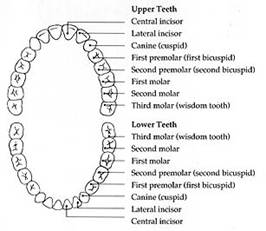
We have thirty-two[34] (32) teeth[35] corresponding to the thirty-two paths of wisdom (often understood as the ten sefirot and the twenty-two letters of the Hebrew alphabet) as taught in Sefer Yetzirah.
A malfunction in a particular tooth must represent a malfunction in a particular aspect symbolized by one of the paths of wisdom. I have no idea which tooth corresponds to which path, although I would take note of functions (biting, grinding, etc.) as well as age of development (a good clue to the late-coming wisdom teeth).
“He established twenty-two letters fundamentally by the voice, formed by the breath of air and fixed them on five places in the human mouth, namely:
One at the throat {guttural sounds}, Aleph, Hay, Chet, Ayin.
Two at the palate {palatal sounds}, Gimel, Yod, Kaf, Qof.
Three, at the tongue {lingual sounds}, Dalet, Tet, Lamed, Nun, Taw.
Four, at the teeth {dental sounds}, Zain, Shin, Samech, Resh, Tzaddi.
Five, at the lips {labial sounds}, Bet, Vav, Mem, Peh.” (Sefer Yetzirah chapter two, section three.)
|
|
|
According to Chazal, our Sages, the number four signifies completion or fullness.
The letter shin has five definitions.[36] The first is shein, which means “tooth”, or “teeth”. The second is lo shanisi, meaning “steadfastness in one’s faith”. The third is shinoy, which is “to change for the good”. The fourth is shuvah, which means “to return”. The fifth is shanah, or “year”.
The general use of one’s teeth (shein) is to chew food. The teeth break up and grind food. This action represents an individual who carefully “chews over” or is careful with his actions. Additionally, the teeth represent strength. Many times, if we don’t have the strength to break something with our hands, we use our teeth.
According to mystical sources there are 32 paths of wisdom. So too there are 32 sources of wisdom within a person (found in the head) which are channeled to each one of the entire set of 32 adult teeth. The number 32 has the gematria, the numerical value of the Hebrew word ‘lev’, which means ‘heart’. This means that our 32 teeth represent what is in our heart.
Teeth are linked to the heart and to wisdom. What does this all mean?
The wisdom of a human being begins with thoughts in the heart, but if it remains there the wisdom is self-serving. In order for that wisdom to make the world a better place it needs to be expressed through the mouth. When we open our mouths and speak, we share ourselves with the world. Smiling is a symbol of our willingness to open ourselves up to others.
Our many teeth represent the many thoughts that run through our heads; thoughts which have the potential to help others, to make a positive impact upon those around us and indeed the entire world.
When we open our mouths and smile at someone, we are communicating the following message: “I want to show you what is inside of me.” When we smile and display our teeth, we are showing others that there’s a lot inside that we want to share.
Whether we realize it or not, when we smile, we are showing a glimpse of our wisdom. HaShem created us so that when we are happy, we smile, we laugh, we show our teeth. This is as if to say, “I am in a wonderful mood”. I feel the grandeur of life. I am happy to be alive in this world. Thus, I am showing my teeth to the world, and through my teeth, I am displaying my wisdom. I have a precious role to play in this world by tapping into and utilizing my wisdom and sharing it with others. This is why I’m smiling; this is the reason I am showing you, my teeth.”
When we greet someone, we are supposed to smile at them. Smiling exhibits our kindness and openness to relate to another person. When I frown, I close my mouth tightly; I hide my teeth. I am saying that I do not wish to open myself or my wisdom up to anyone. But when I smile, I say to my fellow man, “Yes, I want to get to know you. I want to share my wisdom, my insights, my personal contributions to this world with you. I am showing you my teeth, the window to my world and my wisdom, and I want you to partake in what I have to offer”.[37]
HaShem is referred to exclusively by the name Elohim in the account of creation, and this name is mentioned exactly 32 times in the course of this section of the Torah. As we said above, the 32 teeth correspond to the 32 paths of wisdom. This provides another connection to our psalm.
RASHI’S COMMENTARY ON PSALM THREE verse eight: YOU BREAK THE TEETH OF THE WICKED. [‘THE TEETH’ is a metaphor for] their might.
One who suffers from a toothache and other oral woes might find their remedy in the recitation of Kiddush Levana.[38] Rabbi Chaim Kanievsky teaches[39] that for a toothache, it is a segula from early generations, to add several words to the Kiddush Levana at a specific point in the prayer for relief from toothaches. After one has recited the passage of “so too, may my enemies not be able to harm me”, one should immediately add “and I should no longer have a toothache”.
It seems that the Lubavitcher Rebbe concurred with the efficacy of this segula, as well.[40] This segula is also cited in the siddur “Beit Yaakov” of Rabbi Yaakov Emden. Rabbi Kanievsky adds that his father would recite these additional words not only for himself when needed, but also on behalf of others who were suffering from toothaches. The reason why teeth are associated with the moon and Kiddush Levana is because these words are all closely related to the word, lavan.[41]
The upper and lower jaws with their two rows of teeth correspond to the two sefirot of chesed and Gevurah within the mouth. Chewing food is like processing an idea to make it digestible. This process depends upon the two primary emotive powers of the soul. Love, chesed, motivates the desire of the soul to “integrate” the sparks present in external reality. Might, Gevurah, performs the actual grinding of the teeth, breaking the food into digestible pieces, of which is said, “malchut [in our context, the mouth] is built [i.e., made able to perform its function to eat] out of the [states of] Gevurah”.
Similar to the upper and lower jaws and teeth, the upper and lower lips correspond to the two sefirot of Netzach and hod within the mouth. These “guard” the entrance to the mouth from the outside (in Kabbalah, Netzach and hod are described as “outside the body”). In addition, the lips serve to convey an expression of the soul deeper than words, the kiss.[42] Here, they join together with the tip of the tongue, the union of the triplet Netzach-hod-yesod within the mouth. Just as “tongue” means “language,” so does “lip” (safah) mean “language” in Hebrew. This alludes to the language of the kiss.
We have thus completed the analysis of the inter-inclusion of the ten sefirot within the mouth.[43]
Now we can begin to appreciate the depth of these simple words in our psalm. J
Ashlamatah: Habakkuk 3:2-10 + 19
|
JPS |
Targum |
|
1. A prayer of Habakkuk the prophet concerning the errors. |
1. The prayer which Habakkuk the prophet prayed when it was revealed to him concerning the extension of time which He gives to the wicked, that if they return to the Law with a perfect heart they will be forgiven and all their sins which they have committed before Him will be as sins of ignorance. |
|
2. O Lord, I heard a report of You; I feared, O Lord, Your deed. In the midst of the years, revive it; in the midst of the years, let it be known. In anger You shall remember to have mercy. |
2. LORD, I have heard the report of Your strength and I was afraid! O LORD, Your works are great for You grant an extension of time to the wicked to see if they will return to your Law; but they have not returned and they provoke before You in the midst of the years in which You have given them life. Therefore, you will display Your might in the midst of the years, for You have promised to renew the world, to take vengeance on the wicked who have disregarded your Memra; but in the midst of Your anger, You will remember in mercy the righteous/generous who do Your will. |
|
3. God came from Teman; yea, the Holy One from Mt. Paran, with everlasting might. His glory covered the heavens, and His splendor filled the earth. |
3. When He gave the Law to His people. God revealed Himself from the south, even the holy One from Mount Paran with everlasting strength, the heavens were covered with the brightness of His glory, and the earth was full of those speaking His praise. |
|
4. And there was a brightness like the light; they had rays from His hand, and there was His strength hidden. |
4. And the splendour of his glory was revealed like the splendour of Creation, and sparks'? issued from his glorious chariot." there he revealed his Shekinah which was hidden from the sons of men" in the high fastness |
|
5. A pestilence went before Him, and sparks went out at His feet. |
5. The angel of death" was sent from before him and went forth in a flame of fire from his Memra, |
|
6. He stood and meted out to the earth; He saw and caused nations to wander. And the everlasting mountains were shattered; the everlasting hills were humbled. The procedures of the world are His. |
6. He revealed himself: and shook the earth and brought the flood upon the people of the generation which disregarded His Memra, and again. moreover. when they sinned before Him with their sins, He then confounded the nations, and the mountains which were from of old were torn apart. the ancient hills sank low. Everlasting strength belongs to Him! |
|
7. Because of iniquity I saw the tents of Cushan; the curtains of the land of Midian quaked. |
7. When the house of Israel served idols, I gave them into the hand of Cushan the Wicked, and when they returned to keep the Law, I performed signs and mighty acts for them. I delivered them from the power of the Midianites by the hand of Gideon son of Joash. |
|
8. Was the Lord angry with the rivers? Is His wrath against the rivers, or His fury against the sea? Only that You rode on Your steeds with Your chariots of salvation. |
8. Was there anger from before you, O LORD, against kings and their hosts which were numerous as the waters of river? Indeed, Your anger was against the kings, and in the sea, You showed them Your mighty retribution, when you revealed Yourself upon Your glorious chariot. Your Shekinah was strength and salvation to Your people. |
|
9. Your bow revealed itself; The oaths to the tribes were a perpetual statement; You split the earth into rivers. |
9. You did indeed reveal Yourself in Your strength on account of Your covenant which was with the tribes. Your Memra endures forever. For them, You cleft strong rocks, rivers flooding the ground issued forth. |
|
10. Mountains saw You and quaked. A stream of water passed. The deep gave forth its voice. The heaven raised up its thanks. |
10. When you revealed Yourself upon Mount Sinai they beheld Your glory, the mountains quaked, the rainclouds passed on, the deep lifted up its voice, the hosts on high were amazed and stood still. |
|
11. The sun and the moon stood in their dwellings; to the light of Your arrows they go, to the brightness of the lightning of Your spear. |
11. Moreover, when You performed signs for Joshua in the plain of Gibeon, the sun and moon stood still in their spheres Your people were strengthened by Your Memra, by the strength of Your victorious might. |
|
12. With fury You tread the earth; with wrath You trample nations. |
12. When You brought a curse upon the enemies of Your people, when You revealed Yourself to destroy the wicked of the earth, You slew nations in Your anger. |
|
13. You went forth to rescue Your people, to rescue Your anointed. You have crushed the head of the house of the wicked, uncovering it from the foundation to the neck-forever. {P} |
13. You revealed Yourself to deliver Your people, to deliver Your anointed; You destroyed kings from before them and princes from their palaces; You drove out the wicked, You destroyed their hosts, the feet of Your people were upon the necks of their enemies, Your Memra endures for ever. |
|
14. You pierced the heads of his villages with his war clubs. They storm to scatter me. Their joy was when they could devour a poor one in secret. |
14. You cleft the sea by Moses’ rod, and the mighty men, the captains of Pharaoh's armies who fabricated plots against Your people, You pursued with whirlwinds. You drowned them in the Red Sea because they oppressed and enslaved Your people and gave counsel in secret to destroy them. |
|
15. You trampled in the sea with Your steeds, a heap of many waters. |
15. You revealed Yourself upon the sea in Your glorious chariot, in the heap of great waters. |
|
16. I heard, and my inward parts trembled; my lips quivered at the sound. Decay entered my bones, and I quaked in my place, that [the time] I would rest is destined for a day of trouble-to bring up a people that will troop back. |
16. Babylon said. “I heard, and my kings trembled at the judgement with which the Egyptians were judged, at the sound of these words my lips trembled. Jeer took hold of my wise men and 1 trembled in the place where I dwell because He abandoned me to the day of trouble; at the time of bringing up the exiles of His people from me. He will destroy me.” |
|
17. For a fig tree shall not blossom; neither is there produce on the vines. The labor of the olive tree shall fail, and the grain field shall not produce food. The flock shall be cut off from the fold, and there shall be no cattle in the stalls. |
17. For the kingdom of Babylon will not endure nor exercise suzerainty over Israel, the kings of Media will be killed, and the warriors from Greece will not prosper; the Romans will be destroyed and will not collect tribute from Jerusalem. |
|
18. Yet, I will rejoice in the Lord; I will jubilate in the God of my salvation. |
18. Therefore they will give praise for the sign and deliverance which You will perform for Your anointed One and for the remnant of Your people who are left, saying, "The prophet said, ‘And I will rejoice in the Memra of the LORD, I will exult in God who brings about my deliverance.’” |
|
19. God the Lord is my strength. He made my feet [as swift] as the hinds, and he guides me on my high places. To the conductor [to play] with my melodies! {P} |
19. God the LORD who supports me with strength and makes my feet swift as hinds and makes me stand upon my stronghold, to whom belong victories and mighty deeds, before Him I am playing in my songs of praise. |
Rashi’s Commentary for Habakkuk 3:2-10 + 19
1 concerning the errors This may be interpreted according to the Targum. However, according to the apparent meaning, Habakkuk is begging for mercy for himself because he spoke rebelliously: (1:4) “Therefore Torah is slackened,” and (verse 14) “You have made man like the fish of the sea.” He criticized the Divine standard of justice.
2 I heard a report of You that from days of yore You always inflicted retribution upon those who provoked You, yet You tolerate this wicked man.
I feared I said, “How has the Divine standard of justice changed because of Israel’s iniquity?”
Your deed. In the midst of the years Your original deed, that You would wreak vengeance for us upon our enemies in the midst of the years of trouble in which we are found.
revive it Awaken it and restore it.
in the midst of the years And in the midst of these years let it be known.
In anger In the anger that You will vent upon the wicked, You will remember to have mercy.
to have mercy like לְרַחֵם , to have mercy.
You shall remember You shall remember to have mercy on Israel.
3 God The prophet now mentions before God His original deed, which he begs Him to revive - the deed of the love of Israel and the retribution of the first generations: When You came to give the Torah, You went around to Esau and Ishmael, and they did not accept it.
Teman Esau.
Paran Ishmael, as Scripture states (Gen. 21:21): “And he dwelt in the desert of Paran.”
His glory covered the heavens at Sinai for Israel.
4 And there was a brightness on that day.
like the light Like the special light of the seven days of Creation. So did Jonathan render it.
rays The expression of a light, which, when piercing and shining through a hole, appears like protruding horns. Similarly, (Ex. 34:29) “For the skin of his face shone.”
from His hand From the hand of the Holy One, blessed be He, they came to them.
and there was His strength hidden As the Targum renders: There His strength, which had previously been hidden, was revealed in the secret place of the Most High.
5 A pestilence went before Him I found in a Midrash Aggadah: At the time the Holy One, blessed be He, gave the Torah to Israel, He drove away the Angel of Death to divert him to other things, lest he stand to accuse and say, “You are giving the Torah to a nation that is destined to deny you at the end of forty days?”
and sparks went out at His feet Fiery angels came with Him to Sinai.
6 He stood and meted out to the earth He waited to examine minutely the case of the generation of the Flood, to mete out to them a measure for a measure, and He meted it out. “He stood” is to be understood in the sense of (Isa. 3: 13) “The Lord stands to plead, and He stands to judge the peoples.” He waits and examines their case minutely.
and meted out to the earth They sinned with heat, and they were judged with boiling water.
He saw the generation of separation, who, since they were of one language, all came upon the plan, as it is written (Gen. 1 1:1): “And all the earth was of one language.”
and caused nations to wander He caused them to jump into seventy languages as it is said (Lev. 11:21): “To jump with them on the earth,” and (Job 37:1) “My heart trembles and jumps from its place.”
the everlasting mountains The heavenly princes of the nations.
the procedures of the world are His He demonstrated to them that all the procedures of the world are His.
7 Because of iniquity that was found in Israel.
I saw the tents of Cushan standing in the open and inflicting injury upon Israel, and when they humbled themselves before you...
the curtains... quaked All is to be understood according to the Targum.
8 Was... with the rivers? Some questions are in the affirmative. Have we seen that He performed all these? The explanation of the verse is according to the Targum.
Your chariots were salvation for us.
9 Your bow revealed itself Your might was revealed.
the oaths to the tribes The oaths that You swore to the tribes.
perpetual statement A statement that is to last forever. אֽמֶר is vowelized with a “pattah,” [meaning a “seggol”] and the accent is on the first syllable, making it a noun.
You split the earth into rivers According to the Targum.
10 Mountains saw You and quaked The mountains of the streams of Arnon that cleft to one another.
A stream of water passed When they crossed the Jordan, the water was “completely cut off,” and the flow of the stream of water passed downstream; the water “which came down from above stood and rose up.”
The deep gave forth its voice The inhabitants of the land praised Him.
The heaven raised up its thanks The host of the heaven thanked Him.
11 stood in their dwellings in their dwellings. In every word that requires a “lammed” at the beginning - Scripture placed a “he” at the end [meaning “to”]. They explained the phrase as referring to the war of Gibeon, as the Targum paraphrases it.
to the light of Your arrows they go Israel.
12 With fury You tread the earth to drive out the seven nation [the heathens of Canaan].
13 to rescue Your anointed Saul and David.
uncovering it from the foundation The walls of their enemies.
to the neck The height of the walls and the towers.
14 You pierced the heads... with war clubs Sennacherib and his company.
the heads of his villages The heads of his towns and his castles, as in (Deut. 3:5) “The open towns” and (Zech. 2:8) “Jerusalem shall be inhabited without walls.”
they storm Who were storming with a tempest to scatter me. [Sennacherib] was the staff with which you chastised the nations. When he came and stormed to scatter me, You pierced the heads of his troops with his staffs, with which he had come to chastise me.
their joy was when they could...
devour a poor one in secret Israel, known as a poor people.
15 You trampled in the sea You trampled upon [Sennacherib’s] hordes, which were as heavy as the sand by the sea.
a heap of many waters Jonathan renders. upon a heap, an expression of (Exod. 8:10) “many heaps.”
16 I heard, and my inward parts trembled Jonathan rendered. Said Babylon, “I heard, and the kings trembled before the judgment meted out upon the Egyptians.”
my lips quivered at the sound At the sound of the report, trembling took hold of me until my lips knocked one against the other and their sound was heard.
quivered An expression of (Zech. 14:20) “The bells of the horses.” Tentir in O.F., to tinkle.
and I quaked in my place In my place, I quake.
that [the time] I would rest is destined for a day of trouble That this tranquility of mine is destined for a day of trouble.
to bring up a people that will troop back For the day that He said to bring up from there the people that He will cause to troop back, to return with its troops to its land.
17 For a fig tree shall not blossom As the Targum renders. However, the phrase may be interpreted according to its simple meaning: From now on, none of Babylon’s deeds shall succeed.
the grain field a white field.
from the fold a stall for sheep.
18 Yet I the nation of Israel, will rejoice in the Lord.
19.To the conductor [to play] with my melodies To the Levite who conducts the music in the Temple. I will compose for him [the Levites’ conductor] with my melodies, and the Levite[s] will accompany him with musical instruments.
To the conductor As it is stated (Ezra 3:8) “... appointed the Levites from twenty years old and upward to superintend the work of the house of the Lord.”
with my melodies This is an expression of a vocal melody to raise and lower, orgenedors in O.F
Commentary on The Ashlamatah of (Haḇaqqûq) Habakkuk 3: 2 -10 + 19
By: H.Ex. Adon Shlomoh Ben Abraham
The book of Habakkuk consists of a dialogue between the prophet and HaShem. (1–2:20) and a prayer or psalm, recorded as a report of a conversation or vision between the prophet and the LORD. (chp.3) The book opens with the burden that Habakkuk did see. These same words are used in Isaiah 13:1; both prophets glimpsed the future, and what they saw they carried with them as a burden on their souls. [44] Nothing is known about Habakkuk, the person behind the prophetic book that bears his name. His name appears twice in two headings in the book (1:1; 3:1), where he is introduced as Habakkuk the prophet. His name does not appear anywhere else in the Tanach, and we have no other information about him.[45] Although nothing is known of Habakkuk, his style and vocabulary suggest he was a Levite and worked in the music department of the Temple. Scholars agree that the prayer or Psalm of chapter 3 is treated as music or a poem. When we humans find it hard to express ourselves, sometimes the best way to express the yearnings of our souls and the cry of our hearts is through poetry and music.
The word translated oracle מַשָּׂא maśśāʾ A masculine noun meaning a burden or load; by extension, a burden in the form of a prophetic utterance. (1:1) It’s a common word in the prophetic books (compare Nahum 1:1) and is often used when the prophet speaks against pagan nations (Isa 13:1).[46] In modern English, it means “message.” The Hebrew word implies that the message is a religious one, and some translate it as the oracle of God (RSV). [47] In Ezekiel 24:25, it is interesting that the lifting of one’s soul, mas;s;āʾnap̱šām (5315), is used to mean the desires of the heart and that to which a person lifts up their souls. This term is also applied to certain divine oracles that had negative proclamations. The Prophets used this formula to pronounce judgments against pagan nations. [48]
Some scholars say the text presents Habakkuk’s vision as preceding the fall of Babylon. How can God, who is holy and just, use evil men to fulfil his purposes in the world? This question is the main topic of the prophecy of Habakkuk, and it is just as relevant today as it was some 2,700 years ago. The book is therefore unusual in that it deals with the prophet’s challenge to God rather than God’s challenge to his people.[49] Some believe the book is rooted in the historical context of the Babylonians due to (1:6). Nothing in the text directly anchors the questions to a particular historical situation. Some scholars who do not believe the prophets looked into the future only see this vision as Habakkuk looking back to events that had transpired in his time. But what if the prophet saw not only the present but the distant future and how God would punish Babylon near the end of time by the Persians and Medes? The speaker implicitly identifies himself with the righteous, but not much is said of who they are.[50] I don’t have a good answer to the above question, but if one looks at current events, it is obvious this is the way HaShem runs the world today, as he did in Habakkuk's time. The Chaldeans mentioned in (1:6) regard Babylon with pride (Isa 13:19). The Chaldeans are associated with Ur, where Haran, brother of Abram, died, and whence Terah, Abram, and their family set forth for Harran and Canaan. (Gen 11:28, 31; 15:7) The land of Chaldea is used in parallelism with Babylon (Isa 47:1, 5; 48:14; Jer 25:12; 50:1; 51:35). It is the land to which the Judeans are sent (Ezek. 12:13), and as exiles they reside (Ezek. 1:3; 11:24), whose language and culture they are taught and from whence they will return (Isa 48:20; Jer 24:5; 50:8) after God punishes it (Isa 43:14; Jer 50:10, 25, 35, 45; 51:4, 24, 54). [51] It would seem the Chaldeans and Babylonians become a catchphrase for all throughout time who fight against God and his children. Not only do they create dangerous living conditions they also lead the children of Israel into idolatry. The Chaldeans were the wealthier people and known to be involved in trade and politics. The Chaldeans were understood to have been brought against the people of God as a judgment (Job 1:17; Hab. 1:6). The term is applied to the Neo-Babylonian army which brought an end to the kingdom of Judah.[52] From about 625 BCE, the Neo-Babylonian Empire started to gain power under the leadership of Nabopolasser, the founder of the Chaldean dynasty, when he succeeded in establishing Babylon as an independent city-state from the Assyrian Empire. In 612 BCE, Nineveh, the capital of the Assyrian Empire, was demolished, but it was only after the decisive victory over King Neco of Egypt at Carchemish in 605 BCE that the Babylonians became the next superpower of that time[53]
The exact dating of the book of Habakkuk within this period depends on whether the wicked people described in (1:2–4 and 1:12–17) are understood to be Judean citizens or foreign enemies. On (1:4) Malbim differentiates between the Torah and Justice. Torah refers to philosophical beliefs, opinions, and commandments that are between man and God. Whereas justice refers to the civil laws that govern relations between man and his neighbor. He said both will cease to be observed in the future due to the success of the wicked.[54] I would contend that the above-mentioned enemies of Israel are both Judean citizens and foreign enemies, any people who oppose Gods righteous teachings. Just as Babylon becomes a symbol for all that opposes and fights against HaShem and his people, and according to the Revelation of John, Babylon seems to exist at the end of time to be destroyed in a single day. (Rev.17:1-15ff, 18:2ff) The prophet turns in (1:5) to the people and tells them to observe the nations, for God is bringing an occurrence in your days you will not believe. To the naysayers, I say, remember what HaShem told Elijah, I have a remnant - you are not alone.
The main events of the period were as follows: In 612 BCE, the Assyrian capital Nineveh was captured by the Babylonians and Medes, and the Assyrian empire came to an end. The Egyptians saw this as an opportunity for them to take control of the smaller states west of the river Euphrates. King Josiah of Judah attempted to resist them and was killed at the battle of Megiddo in 609 (2 Kgs 23:29–30). The Egyptians took the new King Jehoahaz, who was one of Josiah’s sons, as a prisoner to Egypt. In his place, they appointed another of Josiah’s sons called Jehoiakim (2 Kgs 23:31–34). Jehoiakim proved to be a selfish and oppressive ruler (Jer 22:13–17), and during his reign (609–598), there was a breakdown in law and order, and an increase in idolatry. In 605 BCE, the Egyptians were defeated at the Battle of Carchemish by the Babylonians under Nebuchadnezzar. And from then on, the Babylonians dominated the whole of Western Asia. With King Neco of Egypt forced to retreat to Egypt, the whole of Syria and Palestine was now subjected to Babylonian control. King Jehoiakim submitted to the Babylonians for three years but then rebelled against them (2 Kgs 24:1). This rebellion eventually led to a Babylonian invasion of Judah, and the deportation of Jehoiakim’s son and successor, King Jehoiachin, in 598.[55]
Another source says, the most that can be said is that the book presumes the situation that began with the rise of Babylonian power around 612 BCE, and not earlier than that date. The text assumes a (readership and authorship) that was aware that Babylonia was the main power in the area at some point. The audience was also aware of the fall of the Babylonian (or Chaldean) empire—as any Persian period individual would be—the book is not so much about why justice does not emerge, but rather about living under injustice. How do readers relate the known attributes of the Lord to an international system in which the dominant imperial power “slays nations without pity,” or “seizes homes not their own,” and which surely does not place its trust in the Lord? How is a pious, righteous person supposed to deal with this situation? From the perspective of such readers, the fact that Babylonia has already fallen makes a prominent contribution to the persuasive power of the book and its message.[56] Can it truly be said that Babylon and the forces that animate it in all its forms, has it been destroyed or should we think of it similar to Amalek, an entity that exists throughout time until its finial destruction?
It seems clear that the setting of the book is indeed the years after the Babylonians came to power, but before the deportation of Judeans into exile in Babylonia. (2:20) [57] The Babylonian king acted with force, besieged Jerusalem (587/586 BCE), devastated the temple, and took the blinded Zedekiah[58] to Babylon, where he died (2 Kgs 25:6; Jer. 52:9–11). Judah suffered dearly: the Davidic dynasty came to an end, the temple was demolished, and they lost the land promised and granted to them. The Babylonians ruled until 539 BCE, when the Persian Empire, under Cyrus, became the next world power.[59] It would stand to reason that for the above mentioned things that Judah lost to be restored there would have to be a reversal and returning to the land, the promise, the temple and the Davidic dynasty of King Messiah.
We find it interesting that Babylon and Persia operated in diverse ways regarding Israel and the land of Judea. Babylon brings exile, destruction, and enslavement, full blown idolatry. Persia brings a semblance of liberty, peace, freedom, toleration and the return to the land and assistance in rebuilding the temple. However, there are nefarious workings and evil actors at odds with the Jewish people in the Persian empire. Then just as in our day, the forces of good and evil – the righteous and the wicked – are at war with each other, fighting to gain, maintain, and put forth their position. It has been said that nothing or no one is truly evil and the battle is raging between “the sons of light and the sons of darkness.” Many times, Christian eschatology places Persia in the role of Gog Magog, but that is not what the scriptures seem to teach, nor is it or has it ever been the general understanding of the Jewish sages. In Tanakh, Gog is a leader; Magog is his land (Ezekiel 38–39). Later Jewish literature often treats “Gog u‑Magog” as a collective name for the eschatological enemies of Israel. [60]
They are not the same entity in the primary sources: Paras is one of the nations in Gog’s coalition, not Gog itself.[61] The Talmud often uses Paras as a standard geopolitical term for the Persian kingdom (e.g., in discussions of calendars, kings, and empires), but does not equate Paras with Gog or Magog. Midrashim (e.g., Yalkut Shimoni on Yeshayahu) speak of Malchut Paras clashing with Malchut Edom near the end of days—often read as an eastern power (Persia) confronting a western/Christian power (Edom/Rome). This is eschatological, but still distinct from Gog himself. Classical commentators treat Paras historically—as the known Persian Empire—and, in Ezekiel 38, as one of the nations in Gog’s alliance, not as Gog. The prophet foretold the downfall and destruction of Nebuchadnezzar’s descendants at the hands of the Persians and Medes. [62] The Talmud speaks of “Milchemet Gog u‑Magog” as a key eschatological event but does not pin Gog/Magog to a specific known empire like Paras/Persia/Iran. It treats them as archetypal end‑time enemies.[63] In Ezekiel 38, Malbim reads Gog u‑Magog as a clash of two great religious civilizations—often framed as Christianity vs. Islam. He explicitly notes Paras as a leading Muslim power in the final war, which many contemporary readers naturally map onto modern Iran. [64] Tosafot discuss a statement that “Paras will rule until the coming of Mashiach,” and qualifies it to mean “close to” that time, not literally until. Later writers sometimes connect this to a late‑stage prominence of Paras (again, often read as Iran) in the pre‑Messianic era. [65] From Tanakh and Hazal, we see the archetypal end‑time enemies of Israel—Gog as a leader from the land of Magog, heading a multinational coalition that includes Paras.
The book, as it stands, presents all three chapters as “the (prophetic) pronouncement that Habakkuk, the prophet, saw (i.e., perceived in a revelation/vision).” A long commentary on the first two chapters of Habakkuk has been preserved among the Dead Sea Scrolls. This commentary, called by scholars Pesher Habakkuk, understands this prophetic work as being actualized in its author’s own day, centuries after Habakkuk was written. Specifically, it identifies Habakkuk’s Chaldeans, as a name for the Babylonians, with the Kittim, almost certainly the Romans. This offers clear proof of how prophetic works were read and studied in Jewish groups that lived in the late Maccabean period as works that contain information about the life of their community of readers rather than arcane reports of a past historical period. [66] History tells us the Babylonian empire displaced the Assyrians, the Achaemenid empire (Persia/Iran) was displaced by Alexander the Great and then came the Roman empire. It is believed the Persians descended from the Elamites some three thousand ago. [67]
We should understand and read all of the biblical books, not as history, but as a document that deals with the past, present, and future, similar to how the Dead Sea Scrolls Pesher understands it. A document applicable for all time, and if so, can we look for an application for our current day and time? The fact that Habakkuk 3 is not included in the Qumran manuscript of the book is not an argument that the last chapter was not part of the book. Another Hebrew manuscript consisting of the Minor Prophets, dating from more or less the same time as IQpHab does contain chapter 3 of Habakkuk. Chapter 3 continues the dialogical style of the first two chapters, such that it can be viewed not only as the continuation of the dialogue but also as the conclusion and climax of the book. It should be noted that chapter 3 is part of the book in all of the Septuagint manuscripts as well as in several texts from the third and second centuries BCE. [68]
The answer to the question raised in (1:12–17) is to be dated at about the same time, the answer is given in (2:2–5). The rest of chapter 2 and the whole of chapter 3 are not as closely linked with specific historical events. Habakkuk makes his first complaint to the Lord (1:2-4). He declares that there is wrongdoing all around him, but the Lord has taken no action to bring it to an end. He demands a reason for the Lord’s apparent lack of interest. In the first sentence, the question of how long echoes from other parts of the scriptures. (compare Psa. 13:1, 2; Jer 12:4). The implication is that the problem has been troubling the prophet for an exceptionally long time. Thus, one could question, if one has this cry coming from the depths of their soul, could we say they have the soul, fire, or cry of the biblical prophet? In the second sentence, the word cry translates a different Hebrew verb from the one used in the first sentence and carries a slightly different emphasis. The previous verb means “to cry for help,” whereas this one means “to cry out in distress or horror.”[69]
In (1:3), the Hebrew actually means “Why do you look upon trouble?” The prophet implies that the Lord is watching without taking any action to put things right. This meaning is expressed more clearly in some other translations as, “How can you stand to look on such wrongdoing,” or “How can you endure to look on such wrongdoing.” The NIV translates as “Why do you tolerate wrong?” We are not told who the subject of " wrongdoing " is. The terms Destruction and violence often go together (Jer 6:7; 20:8; Ezek. 45:9; Amos 3:10). Here, the prophet says that they are “all around me.” The last part of the verse has another pair of nouns, strife, and contention, which balance Destruction and violence. One translation says in modern terms, “there is fighting and quarreling everywhere.”[70]
The background for our Prayer in chapter three is (2:5–11). These verses present HaShem's response to the human complaint. On the surface, it seems incongruous, since it announces that the Lord gives victory to the Babylonians, who are described by the same voice in the most terrifying terms. So not only will the wicked prosper and have dominion, but even the righteous in Judah, and as we see today, the righteous in the entire world will continue to suffer at the hands of dreaded and fierce, wicked power. The righteous people continue to suffer, and it is the same as for our current situation in the world; not much has changed in 3,000 years. HaShem’s response strengthens rather than weakens the case advanced in the Prophet's complaint. They make their own laws and rules (v.7).
They, the enemies of God, take upon themselves a role as if they are like God, and despite their arrogance, God raises them and allows them to do what they do. Here we are reminded of what Paul said in the first century and recorded in Romans 9:22-25 - What if God, desiring to show his wrath and to make known his power, has endured with much patience vessels of wrath prepared for destruction, in order to make known the riches of his glory for vessels of mercy, which he has prepared beforehand for glory— even us whom he has called, not from the Jews only but also from the Gentiles? As indeed he says in Hosea, “Those who were not my people I will call ‘my people,’ and her who was not beloved I will call ‘beloved.’” (ESV)
At this point, the reader waits to see how the Lord will respond. The response comes in the form of the speaker’s report of a revelation, a prophecy for a set time. (2:3-4). In Jewish tradition, this verse is associated with the coming of the Messiah and is reflected in the language of the twelfth principle of the thirteen principles of faith of Maimonides. The righteous man is rewarded with life for his fidelity, often translated “the righteous one lives (or shall live) by his faith” or “the righteous one shall live through (or is sustained by) his faith.” According to one of the Rabbis,[71] This saying encapsulates all the commandments. The saying also had an important influence in Christianity, in the doctrine of justification by faith (Rom. 1:17; Gal. 3:11; Heb. 10:38–39). According to Malbim, the events of our Parsha are to occur at the time of the ultimate redemption of Israel from exile, and during this last exile, Israel is oppressed by two kingdoms, those of the Edomites and Ishmaelites. Here we get another glimpse of these two peoples dispersed throughout the world and again a hint of both a good part and an evil part for all nations are not a homogeneous whole.
In its original context (2:3-4), the saying is clearly interwoven with the first part of the verse. The saying there focuses on a person whose life is swollen and crooked (the unrighteous). Then it moves to the opposite pole, a pious person who keeps his or her trust in the Lord under the dire circumstances described in the book, i.e., when the righteous are asked to wait while those who do not deserve world power wield it over them. The text does not identify such people with any particular characters, thereby facilitating different identifications and, accordingly, diverse readings of the text. Given the general focus in the book on Babylonia and its wickedness, readers may have understood the negative character in the first line as pointing at the king of Babylon, as an archetypal representative of both the Babylonian empire and any proud people who rely on their own power [and oppose the people of Israel and their God].[72] Habakkuk is told by HaShem to write the vision. The vision awaits its appointed time, it runs to its end, it will not lie, wait for it, it will surely come, it will not delay. (ESV 2:2-3)
The Babylonians do not think that their power is established and maintained by God. They believe they answer to no power higher than themselves. They come with their faces set forward for violence. (1:7-11) The prophet, like us today, had to deal with all these Babylonians running around, and he voices a second complaint, one that takes into account the divine response and the aggravating circumstances that it describes. The Hebrew actually says something akin to “we shall not die” or “let us not die.” And the last two lines in (1:12-13) are something like “[why do you] remain silent when the wicked swallow those more righteous than they?” The question is not why an absolutely righteous one would suffer, but why the hierarchy of people in the spectrum of righteousness-wickedness runs opposite to that of power in the “real world.” This is a reversal of people’s role as described in (Gen. 1:26, 28). Meaning the more righteous you are, the less power you have, and the more powerful people seem to be the more corrupt. (1:12-17) The answer to the question raised in (1:2–4) is given in (1:5–11), where the rise of the Babylonians (“Chaldeans”) is spoken of as something still future. The description of the wicked in (1:12–17) seems to be speaking of the same people as those mentioned in (1:5–11), that is, the Babylonians. The people in and around the first century believed the Babylonians (Chaldeans), Rome, Kittims existed in their day, and in the spirit of speculation, we can see the same people in our day.[73] This is the theme and discussion in the Pesher Habakkuk found at Qumran. The liars, false witnesses, and those who were unfaithful and opposed to the teaching of the one teacher of righteousness from the mouth of God. There has been only one man who spoke mouth-to-mouth to HaShem and then delivered his Torah to mankind. [74] The world has known, many liars, many false witnesses and many corrupt and unrighteous individuals. They wear different names and faces; they come from many different nations and tribes but the one thing they all have in common is they serve their father Sa ’tan and oppose HaShem and his Torah.
After the attack from Gaza on Israel on October 7, 2023, Pope Francis called for an investigation to determine if Israel’s operation in Gaza constitutes genocide, according to a new book published for the Catholic Church’s jubilee year. “According to some experts, what is happening in Gaza has the characteristics of a genocide,” the Pope said in excerpts published by the Italian daily La Stampa.[75] Pope Francis became increasingly vocal in condemning Israel’s war against Hamas in the months before his death, including a nativity scene featuring baby Jesus wrapped in a keffiyeh, which was unveiled at Pope Francis’ Nativity Scene and Christmas Tree inauguration in December in St. Peter’s Square.[76] Francis, now followed by Pope Leo. In the first weeks of the war, the Chicago-born Leo was initially reluctant to publicly condemn the violence and limited his comments to muted appeals for peace and dialogue. But Leo stepped up his criticism starting on Palm Sunday. And this week, he said Trump's threat to annihilate Iranian civilization was "truly unacceptable" and called for dialogue to prevail. Praying for peace, Leo said, was a way to "break the demonic cycle of evil" to build instead the Kingdom of God where there are no swords, drones, or "unjust profit." "It is here that we find a bulwark against that delusion of omnipotence that surrounds us and is becoming increasingly unpredictable and aggressive," he said. "Even the holy Name of God, the God of life, is being dragged into discourses of death." Leo has said God doesn't bless any war, and certainly not those who drop bombs. [77] Pope Leo’s assertions of what the Kingdom of God is seem to be in opposition to the clear teaching of the Scriptures and what the Sages of Israel have always understood. In the biblical schema, the Pope will not be in such an exalted position as he covets for himself. The Pope, just like all of mankind, will have to decide if he will stand with God, Torah, and Israel, or whether he stands in opposition and on the side of Gog u- Magog. Since Pope Leo’s open remarks some of the good people of the Roman church have openly come out against Leo and question whether, he can speak for the Catholic church on this topic. [78]
As this writer watches the realigning of the world with a ceasefire in place,[79] waiting on Iran and their devastated leadership, they struggle to decide which side they want to be on. We in America and in other nations of the world are in the same struggle. The world must decide to stand with Israel and the righteous people of the world or stand with Gog u-Magog and those who oppose all that is called decent and true. The pathway is being smoothed and made straight for the Lord's Anointed as foretold by Isaiah. In the core Jewish sources, Paras (Persia/Iran) is not Gog or Magog. It is one of the nations in Gog’s alliance (Ezekiel 38:5). Later midrashim and commentators give Paras a central eschatological role, and modern rabbis often read Iran into that role, but they still preserve the basic biblical structure: Gog u-Magog is the overarching enemy framework; Paras/Iran is a major player— but a distinct actor within it.
The role and decisions of modern-day Iran will be interesting to watch, just as the role of America and the decision America is in the process of making; both nations are not a homogenized whole. It has been said that America is operating as the good side of Edom under the leadership of President Trump. The question we ask is, Does Iran have a good side of Edom operating inside of it, and will that good side win out in the present struggle? Also, the time for the good side of Esau operating in President Trump is slowing ending. The picture of Iran / Persia historically is somewhat different from what it has been over the last 50 years. Remember, we said that Babylon and Persia operated in diverse ways historically regarding Israel and the land of Judea. Babylon brings exile, destruction, and enslavement. Persia brought a semblance of liberty, freedom, toleration and the return of Jews to the land, and they assisted them in rebuilding their temple. Cyrus, God's anointed, was from what today we refer to as Iran.
The world today is going through a metamorphosis. Nations and groups of individuals within those nations are having to choose the path they will walk in relation to the Jews in the Land of Israel. Will antisemitism increase around the world? Yes! Will it devolve to a state like was witnessed under the Nazi regime less than one hundred years ago? I don’t think so! What I see taking place is a dividing, a sharp contrast between those who follow the ways of the Babylonians and Chaldeans and those who fear HaShem and purpose to the best of their abilities to follow his teaching. Will we all get it right and will our practice meet perfection in execution, not likely. But we who walk in fear and humility before our Creator “shall not die”.
The prophets tell us the nations will assemble against Jerusalem. They speak of the wrath of God that comes upon those nations to their destruction. In time the prophet Isaiah says there will be some of the people and leaders of the nations who will bring the Jewish people back home being carried upon their shoulders and in their bosoms and the wealth of the nations will be brought also. Exactly how this will play out, I cannot guess. HaShem told us through Habakkuk to keep our eyes on the nations.
-- Look among the nations and see; wonder and be astounded. For I am doing a work in your days that you would not believe if told. For behold, I am raising up the Chaldeans, that bitter and hasty nation, who march through the breadth of the earth, to seize dwellings not their own. They are dreaded and fearsome; their justice and dignity go forth from themselves. Their horses are swifter than leopards, fiercer than the evening wolves; their horsemen press proudly on. Their horsemen come from afar; they fly like an eagle swift to devour. They all come for violence; all their faces are forward. They gather captives like sand. At kings they scoff, and at rulers they laugh. They laugh at every fortress, for they pile up earth and take it. Then they sweep by like the wind and go on, guilty men, whose own might is their god!” Are you not from everlasting, O Lord my God, my Holy One? Habakkuk said, we shall not die. O LORD, you have ordained them as judgment, and you, O Rock, have established them for reproof. [80]
Habakkuk concludes with a prayer or a psalm. A short, human petition to God to manifest God's power (3:2), a lengthy report about an appearance of the Lord in the world (a theophany) (vv. 3–15), and above all, concludes with an expression of human confidence in HaShem. (v.16-19). The answer given to the prophet for his agonizing petition and prayer to HaShem is that it is from the LORD of Hosts (2:13), and the earth shall be filled with awe for the glory of the LORD as water covers the sea. (v.14) The Targum assumes that people cannot really know the glory of the Lord, so it translates and reinterprets the text to mean, “… to know the fear of the Lord.” In other words, just as there is no place in the sea without water, there will be no place on the earth that will not be filled with the knowledge of the glory of the Lord.[81] The sun and moon stand still in their habitation;(3:11ff) [as in the day of Joshua 10:12,13] Thou marchest through the earth in indignation, Thou threshes the nations in anger. Thou art come forth for the deliverance of Thy people, for the deliverance of Thine anointed; Thou wounds the head out of the house of the wicked, uncovering the foundation even unto the neck. Thou hast stricken through with his own rods the head of his rulers, that come as a whirlwind to scatter me; whose rejoicing is as to devour the poor secretly[82]
The world stands at a crossroad while many nations choose to side with the regime of death and terror in Tehran. One side wants to stop their rule and reign of terror and the other is willing to compromise to their last breath as long as their way of life is not hindered and inconvenienced. Some will call it the Chamberlin effect, compromise with evil until the last possible moment as the PM of England did with Hitler at the beginning of World War two. The world in America is burning, or beginning to burn and it looks like it will get hotter before the rain comes.[83] Will current events pave the way for the children of Israel to return to the land and gain complete autonomy over the Temple Mount and start the rebuilding of the Temple? Will the Pope who speaks of Peace work for the everlasting Prince of Peace or will he work for his own amusement? Will the new Pope Leo work to unite the Land of Israel and work to build the temple or will he work to divide Israel and hamstring them every step of the way? The Kingdom of Peace is on its way, may it be so in our day, but if our eye does not see it, we can rest assured, according to the message HaShem gave Habakkuk, it will come in its time. Wait for it, it will surely come, it will not be delayed!
Verbal Tallies
By: Hakham Dr. Hillel ben David
Bereshit (Genesis) 8:1-22
Habakkuk 3:2-10 + 19
Tehillim (Psalms) 5:1-13
Looking at the Hebrew of Bereshit (Genesis) 8:1 and Habakkuk 3:2, what is the verbal / lexical tally that connects these two passages?
The verbal/lexical tally connecting Genesis 8:1 and Habakkuk 3:2 centers on the root זכר, meaning to remember.
In both passages, the remembrance acts as a pivot from a state of judgment or destruction to one of mercy and restoration. In Genesis, the remembrance of the righteous (Noah) brings the end of the Flood; in Habakkuk, the prophet petitions for remembrance as the antidote to Divine wrath.
Bereshit (Genesis) 8:1 God remembered [וַיִּזְכֹּר – 2142] Noah and all the beasts and all the cattle that were with him in the ark, and God caused a wind to blow across the earth, and the waters subsided.
Habakkuk 3:2 O LORD! I have learned of Your renown; I am awed, O LORD, by Your deeds. Renew them in these years, Oh, make them known in these years! Though angry, may You remember [תִּזְכּֽוֹר – 2142] compassion.
* * *
What is/are the thematic connection(s) between Bereshit (Genesis) 8:1-22, and Tehillim (Psalms) 5?
Thematic connections between Genesis 8:1–22 (the subsiding of the Flood) and Psalm 5 center on the transition from Divine Judgment to Divine Favor, specifically through the mechanisms of "remembrance" and the "pleasing aroma" of prayer/sacrifice.
1. Remembrance and Response to Prayer
Genesis 8:1: God remembers Noah after the period of judgment. This remembrance is the catalyst for the wind that causes the waters to subside.
Psalm 5:2–4: The Psalmist pleads for God to "hear my words" and "attend to my cry." Both texts emphasize a God who responds to the presence of the righteous amidst a world that has undergone or deserves judgment.
2. The Morning Offering and the "Soothed" Wrath
Genesis 8:20–21: Noah builds an altar and offers burnt offerings. God smells the "pleasing odor" and resolves never again to doom the earth because of man.
Psalm 5:4: The Psalmist states, "At daybreak I plead before You, and wait." The morning prayer in the Psalm functions like Noah's post-flood sacrifice—it is a structured appeal for grace at the start of a "new day" or new era, designed to find favor (Ratzon) in God's eyes.
3. The Destruction of the Wicked vs. The Preservation of the Righteous
Genesis 8:21: Acknowledges that the "devisings of man’s mind are evil from his youth," yet God chooses mercy.
Psalm 5:5–7: Explicitly contrasts God’s hatred of "evil" and "men of blood" with the Psalmist’s ability to "enter Your house" through "Your abundant love." Both passages highlight that while judgment (the Flood/destruction of liars) is a reality, the "righteous" (Noah/the Psalmist) find a protected space through Divine grace.
4. The "Shield" of Favor
Genesis 8:16–19: Noah is commanded to "Go out" into a renewed world, protected by a new covenant.
Psalm 5:13: Concludes with, "You encompass him with favor (Ratzon) as with a shield." This "shield" of favor is the thematic equivalent of the "Ark" or the "Covenant"—it is the spiritual barrier that protects the individual from the chaos of judgment.
* * *
The connection between the Torah seder and the Ashlamata, though seemingly strictly verbal, is in addition eschatological. The messianic kingdom, rather than the related contents of the Torah lesson, is the dominant theme of the Ashlamata.
What is the eschatological message of Habakkuk 3:2-10 + 19?
In Jewish thought, Habakkuk 3 is a visionary "Prayer of Habakkuk" that transitions from historical memory to an apocalyptic preview of the Final Redemption. The eschatological message of verses 2–10 and 19 focuses on the "Awakening of Divine Power" and the "Agility of the Remnant".
1. The Revival of the "Deed" (v. 2)
The Message: The prophet asks God to "renew [the work] in the midst of the years."
Source: Rashi explains that this is a plea for God to revive the "deed of love" shown during the Exodus and apply it to the final exile. Eschatologically, it suggests that the Final Redemption will not be a new phenomenon, but a resurrection of the miracles of Egypt, intensified for the end-times.
2. The Theophany of Sinai to Zion (v. 3-4)
The Message: "God comes from Teman... His splendor fills the earth."
Source: The Malbim notes that while this mirrors the giving of the Torah at Sinai, its eschatological fulfillment refers to the revelation of God’s Kingship over the nations. The "rays at His side" (v. 4) symbolize the hidden light of creation that will be restored in the Messianic era to blind the wicked and illuminate the righteous.
3. Judgment of the Land and Sea (v. 5-10)
The Message: Pestilence, quaking mountains, and the "deep" lifting its hands.
Source: Abarbanel interprets the "pestilence" (Dever) and the "shaking mountains" as the collapse of world empires. The "deep" (v. 10) represents the chaotic forces of the nations. Their "lifting of hands" is a sign of ultimate surrender to the Divine will during the wars of Gog and Magog.
4. The "Deer’s Feet" and the Heights (v. 19)
The Message: "The Sovereign LORD is my strength; He makes my feet like the feet of a deer, He enables me to tread on the heights."
Source: The Targum Yonatan and the Radak explain that in the End of Days, the righteous will be given a supernatural "agility" to navigate the "birth pangs of Messiah".
Eschatological Skill: The "heights" refer to the spiritual and political dominance that Israel will regain. Just as a deer can climb treacherous cliffs with ease, the faithful will navigate the collapse of the old world order to stand firmly on the "High Places" of the Third Temple era.
Nazarean Talmud
Sidra Of Bereshit (Genesis) 8:1–22
“Vayzkhor Elohim Et Noach” “And God remembered Noah”
By: H. Em Rabbi Dr. Eliyahu Ben Abraham
|
School of Hakham Shaul Tosefta (Luke 4:14-15) |
School of Hakham Tsefet Peshat (Mark 1:14-15)
|
|
And Yeshua returned in the power (dynamic – expansive force) of the Ruach [HaKodesh] into the Galil: and his notoriety went out through the entire region round about. And he taught in the synagogues of that region, being honored of all. |
Now after Yochanan (John) was arrested and put in prison, Yeshua came into the Galil, proclaiming the Mesorah (good news - the Masorot – the Traditions) of the kingdom (governance) of G-d through the Hakhamim and Bate Din as opposed to human kings, And saying, The appointed period of time is fulfilled (completed), and the kingdom (governance) of God through Hakhamim and Bate Din is at hand; repent (have a change of mind and return to Torah wisdom) and faithfully obey the Masorah (Traditions/Oral Law). |
|
|
|
Nazarean Codicil to be read in conjunction with the following Torah Seder:
|
Gen. 8:1– 22 |
Psalms 5:1-13 |
Habakkuk 3:2-10 + 19 |
Mark 1:14-15 |
Luke 4:14-15 |
Commentary to Hakham Tsefet’s School of Peshat
m. Meg. 1:8 There is no difference between sacred scrolls and phylacteries and mezuzot except that sacred scrolls may be written in any alphabet [“language”], while phylacteries and mezuzot are written only in square [“Assyrian”] letters. Rabban Simeon b. Gamaliel says, “Also: in the case of sacred scrolls: they have been permitted to be written only in Greek.” [84]
Malchut Shamayim: A Commentary
The Permissibility Of Greek As A Function Of Hishtalshelut
The Mishnah in m. Megillah 1:8 establishes a legal distinction whose implications extend far beyond scribal convention. Sacred scrolls may be written in multiple languages, while tefillin and mezuzot remain restricted to Assyrian script. Within this framework, Rabban Shimon ben Gamliel introduces a critical allowance: Greek stands as uniquely permitted among the languages for the writing of sacred scrolls. This ruling does not emerge as a concession to convenience or cultural accommodation. It reflects an embedded recognition within Torah that language itself participates in the unfolding of Hishtalshelut — the great chain of emanation through which Divine reality descends into structured existence.
Greek occupies a position within the cultural and intellectual matrix of Eretz Yisrael that cannot be dismissed as merely external or foreign. Its sustained presence throughout Mishnaic and Talmudic Aramaic demonstrates that linguistic exchange forms part of the lived reality of B’nei Yisrael across generations. The allowance of Greek, therefore, signals a halakhic acknowledgment of profound consequence: meaning may traverse linguistic boundaries without forfeiting its essential structure. The letters shift; the underlying architecture of Otiyot — letters understood as living carriers of ontological form — remains intact and operative beneath every surface transformation.
Within the Sodic register, this phenomenon reflects the movement of Ohr as it descends and adapts itself to vessels across the worlds. Language becomes a keli, a vessel that receives and transmits intelligibility across registers of reality. Hebrew functions as the primordial configuration, the language in which creation was spoken into being, yet Greek serves as a keli fully capable of holding and refracting that same light under specific and carefully bounded conditions. The Mishnah’s ruling thus encodes a principle of enduring governance: translation does not inherently sever meaning from its source; it relocates meaning within a different structural field while preserving the essential current that animates it.
Engagement with Greek expands the interpretive horizon through Binah, the sefirah of differentiation and deep analytical understanding. The interpreter encounters a term in Greek, seeks its Hebrew parallel, and in doing so establishes a living bridge between two linguistic systems that encode reality through distinct but compatible architectures. This process multiplies access points to the same conceptual core rather than fracturing it. The Septuagint stands as the pre-eminent repository of such correspondences. Although its Greek diverges consistently from classical norms, this divergence is not a defect but a disclosure: it is Greek that has been shaped and reshaped by Hebrew thought patterns working from within. The so-called grammatical irregularities of the LXX mark the intrusion of Hebrew structure into Greek expression at the syntactical level. Greek bends under the weight of Hebrew ontology, producing a hybrid form that is neither purely Hellenistic nor simply transliterated Hebrew, but a genuinely new vessel that preserves the conceptual integrity of the source while opening it to a broader world of readers.
Translation is therefore an act of hitlabshut — enclothing — in which one language clothes the inner structure of another without replacing or diminishing it. The outer form adapts to its new environment; the inner architecture persists unchanged beneath the new garment. The interpreter who engages both languages with full scholarly rigor gains access to a layered understanding in which each term resonates across multiple linguistic strata simultaneously, enriching rather than diluting the interpretive field. This principle of hitlabshut operates at every level of the living tradition: at the linguistic level in translation, at the practical level in the ongoing adaptation of halakhic application to new historical circumstances, and at the deeply personal level as the Mesorah becomes clothed within the cognitive and emotional structures of each individual who receives and internalizes it. In every case, the essence remains constant; the expression adapts to the vessels available within each generation. This is not an accommodation to weakness but the very mechanism by which governance sustains its continuity across all conditions.
The Verb Of Proximity: Qarav And The Dynamics Of Din
The Greek verb eggizo anchors the phrase “at hand” and governs the theological weight that the entire proclamation carries. Its semantic range encompasses approach, nearness, and imminent presence — but the surface reading barely scratches the depth available through cross-linguistic analysis. The most fitting Hebrew parallel, established through careful exegetical consideration, is qarav: drawing near. This root carries a spectrum of meanings that extend well beyond spatial proximity into the domains of relational and functional nearness, encompassing the full register of covenantal encounter. Throughout the Tanakh, qarav appears in contexts of offering, sacred encounter, and deliberate preparation. It denotes bringing a sacrifice near to the altar, approaching a consecrated space with intentionality, positioning oneself within a defined field of active engagement with the Divine. The term encodes movement toward integration rather than mere adjacency — a distinction of the highest importance for understanding what the proclamation actually claims.
When a sacrifice is brought near, it does not simply change location; it enters a transformative process governed by precise halakhic conditions. When an individual approaches a sacred domain, the act of nearness itself redefines that individual’s status, responsibility, and relational standing before G-d and within the community. The citation of Yesha’yahu 8:3 introduces a further and critical dimension: proximity as the necessary condition for conception and generative consequence. The prophet draws near to the prophetess, and the act of nearness produces an outcome that neither party could have achieved at a distance. This example anchors the meaning of qarav within a framework of intimate interaction that is productive, transformative, and irreversible. The nearness described throughout these texts is operative in the fullest sense — it accomplishes something; it is never merely symbolic.
Within the governing structure of Din, movement toward nearness establishes the boundaries and roles that make communal and covenantal life coherent. The act of drawing near is regulated by conditions that determine who may approach, under what circumstances, at what times, and through what preparatory acts. This ordering reflects the deepest function of Din within the emanative structure: Din does not restrict arbitrarily but structures relationships within the community and between the community and the Divine so that encounter is possible without dissolution. The governance of Malchut Shamayim becomes accessible precisely through adherence to the structures that define a legitimate approach. The Mesorah provides the framework through which this approach is regulated at every level, ensuring that proximity always leads toward integration and transformation rather than toward disorder and dissolution.
Malchut Shamayim: The Kingdom Of Heaven
The phrase 'the kingdom of God is at hand' resolves its full meaning through the lens of qarav. The governance of G-d does not arrive as an external imposition descending upon an unprepared or alien world; it exists as an immanent structure already woven into the constitution of Yisrael and expressed through the institutions Torah establishes. The perfect tense employed in the Greek text reinforces this reading with grammatical precision: fulfillment stands as a present and achieved state rather than a distant future expectation. The kingdom is not approaching from outside; it has always been here, and the proclamation names its active presence.
This governance manifests concretely and institutionally through Hakhamim and Batei Din, which serve as the living vessels of Malchut within the temporal order. Their authority derives not from political appointment or social power but from their alignment with the Mesorah and their sustained role in interpreting, applying, and transmitting Torah across generations. The decisions, rulings, and teachings of these bodies translate abstract Divine principles into concrete directives capable of governing actual human life. They embody the movement of Ohr into Malchut — the process by which illumination becomes actionable order within the world of Asiyah. The Batei Din function simultaneously as sites of birurim, the ongoing process of refinement through which the community separates clarity from confusion, evaluates cases on their specific merits, resolves halakhic ambiguities, and establishes rulings capable of guiding communal life with consistency and integrity.
This same process of refinement operates within the constitution of the individual. As the Mesorah penetrates the strata of Nefesh and Ruach, it shapes conduct, perception, and orientation from within rather than imposing itself from without. The Nefesh, rooted in the domain of Asiyah, receives governance through the discipline of halakhic practice: physical actions are aligned with the order Torah establishes, and the body itself becomes a vessel of Malchut. The Ruach, associated with the formative world of Yetzirah, receives governance through the refinement of speech, relational sensibility, and the emotional life. Together, these levels form a composite vessel through which the governance of Elohim manifests within the individual as a living reality rather than an external constraint. Governance does not remain at the institutional periphery; it becomes the guiding architecture of the inner life of every member of Yisrael who receives and enacts the Mesorah. The proclamation introduces no new system; it intensifies the recognition of the one already operative. The language of nearness signals activation rather than arrival.
The Temporal Marker: Moed Within Da'at
The Greek term kairos aligns with precision to moed, the Hebrew designation for an appointed time that operates outside and above ordinary chronological sequence. Moed does not simply name a point on a calendar; it denotes a convergence point where Divine intention and human readiness intersect within a moment charged with realized purpose. The fulfillment of moed signals that the conditions have achieved their intended alignment — that the vessel has been prepared to receive what has always been destined to fill it.
Within Da'at, the deepest sefirah of integrative knowledge, this alignment transforms comprehension into commitment and commitment into lived action. Da'at functions as the faculty through which understanding ceases to be merely theoretical and becomes decisive, binding the insights of Hokhmah and the analytical structures of Binah into a unified directive that the whole person — mind, will, and body — is capable of enacting. It mediates between the higher realms of spiritual insight and the lower realms of concrete action, ensuring that the descent of Ohr through the entire emanative structure results in tangible and accountable expression within the world. The proclamation that the appointed time stands fulfilled and that governance is present does not merely convey information; it demands a response that actualizes what has been recognized.
The principle articulated by the Hakhamim — that there is no before and after in Torah — illuminates the full scope of what moed's fulfillment means. Time within Torah operates as a layered continuum rather than a linear sequence; past, present, and future interpenetrate within the eternal present of Torah speech. The fulfillment described in the text, therefore, resonates across every generation with equal force, because the structures it names are not historically contingent artifacts but expressions of the timeless framework of Torah itself. The application of kal va-homer extends and reinforces this principle with halakhic rigor: if the Mesorah functioned as an essential and irreplaceable element within the foundational first-century moment, its weight and centrality can only intensify within subsequent generations as conditions become more complex and the distance from the original transmission grows. The Mesorah does not diminish with time; it accrues authority.
Ohr Yashar And Ohr Chozer: The Dynamic Of Continuous Governance
The proclamation of fulfilled time and present governance reflects with structural precision the interaction between Ohr Yashar and Ohr Chozer — the direct light of Divine emanation and the returning light of creaturely response. Ohr Yashar descends as directive illumination, establishing the structure, intention, and animating energy of governance at every level of reality. Ohr Chozer arises through the response of the community as it receives, enacts, and transmits that light, reflecting and amplifying it through sustained adherence and practice. The statement that the kingdom has come and is coming captures this dual dynamic in a single formulation of compressed theological power: the initial descent of light does not exhaust itself in a single historical moment but continues to unfold and deepen through the ongoing participation of every generation that receives the Mesorah.
This interplay is not cyclical repetition but progressive deepening — a spiral of increasing integration rather than a circle that merely returns to its starting point. The Mesorah itself evolves through interpretation and application, demonstrating its vitality by responding to new conditions while maintaining absolute fidelity to its core principles. Each generation receives, enacts, transmits, and in transmitting contributes to the refinement and reinforcement of the structure it received. Governance remains constant in essence while its expression adapts with precision to the context in which it operates — stable in principle, dynamic and responsive in manifestation. This is the model of Torah life that the proclamation names and activates.
The cross-linguistic analysis employed throughout this commentary exemplifies the same dynamic operating at the level of language itself. Movement between Greek and Hebrew does not fragment understanding but integrates multiple perspectives into a richer and more comprehensive whole. The identification of qarav through eggizo is a case study in this integrative process: the Greek term provides a precise surface-level indication of nearness, while the Hebrew root expands that indication into a network of meanings encompassing approach, sacrificial offering, preparation, and transformative encounter. The integration of these layers produces a depth of comprehension that neither language operating alone could achieve — a living demonstration of how Ohr Yashar, received through multiple and diverse vessels, generates an Ohr Chozer of amplified and enriched understanding.
The Convergence Of Speech And Action: Tiferet And The Embodiment Of Malchut
The integration of governance within both speech and action produces a state of harmony that finds its Sefirotic correspondence in Tiferet. The proclamation calls for a return that encompasses both the cognitive and behavioral dimensions of human existence, aligning thought, word, and deed within a unified and coherent structure. This alignment reflects the essential harmonizing function of Tiferet, which holds in productive and creative tension the expansive generative tendencies of Chesed and the defining restrictive forces of Gevurah, producing from their interaction a beauty and integrity that neither could generate independently.
Speech, shaped and disciplined by the Mesorah, becomes an instrument of precise articulation capable of conveying the structures of governance with fidelity and power. Action, regulated and sanctified by halakhah, becomes the embodiment of those structures within the material world of Asiyah where human life is actually lived. The convergence of these domains within the life of the individual and the community produces a coherent and luminous expression of Torah life — one in which internal intention and external behavior align with the order Elohim established at Sinai and has sustained through every generation of transmission. This harmony extends necessarily into the communal sphere, where shared adherence to Mesorah creates a collective alignment that makes the presence of Malchut Shamayim visible and tangible within the social body of Yisrael. The community itself becomes a living expression of governance — the ascent of Mesorah as Ohr Chozer made manifest in the gathered body of the people.
The Perpetual State Of Malchut
The structures of Malchut are not occasional achievements or historical accidents; they remain continuously operative, sustained through the living transmission of the Mesorah and embodied within the institutions and individuals of Yisrael across every generation. The proclamation of nearness and fulfillment serves as a moment of heightened and clarified awareness — a point at which the community is called to recognize and name what has always been present and always been operative within the fabric of Torah life. The statement does not create a new reality; it illuminates the one that already is.
This continuity expresses the timeless nature of Torah with particular force. The absence of linear constraint within Torah's temporal structure allows for the perpetual relevance of its institutions, its principles, and its living transmission. The governance of Elohim manifests through the ongoing and reciprocal interaction of Ohr Yashar and Ohr Chozer, through the institutional and personal work of birurim – refinement at every level of communal and individual life, and through the harmonization of Tiferet across the domains of speech, action, and shared communal existence. Each generation participates fully and actively in this process, contributing through its reception and transmission to the continuous unfolding expression of Malchut Shamayim within the world.
The phrase 'at hand' therefore carries the full and unreduced weight of its meaning: governance is immanent, dynamic, participatory, and integrative. It is not waiting to arrive from a distant future; it is embedded within the living fabric of Torah life and continuously actualized through the Mesorah — the unbroken chain of transmission that links every generation of Yisrael to Sinai and through Sinai to the source of all governance in the Ein Sof itself.
Blessing After Torah Study
Barúch Atáh Adonai, Elohénu Meléch HaOlám,
Ashér Natán Lánu Torát Emét, V'Chayéi Olám Natá B'Tochénu.
Barúch Atáh Adonái, Notén HaToráh. Amen!
Blessed is Ha-Shem our God, King of the universe,
Who has given us a teaching of truth, implanting within us eternal life.
Blessed is Ha-Shem, Giver of the Torah. Amen!
“Now unto Him who is able to preserve you faultless, and spotless, and to establish you without a blemish,
before His majesty, with joy, [namely,] the only one God, our Deliverer, by means of Yeshua the Messiah our Master, be praise, and dominion, and honor, and majesty, both now and in all ages. Amen!”
“Upcoming”
Monday Evening: May 4, 2026 “Lag B’Omer”
Counting of the Omer Day 33
See: https://www.betemunah.org/lgbomer.html
Next Shabbat: “Za, Meen Hataevah” “Go from the Ark”
|
Shabbat: |
Torah Reading: |
Weekday Torah Reading: |
|
צֵא, מִן-הַתֵּבָה |
|
|
|
“Za, Me’en Hataevah” |
Reader 1 – Bereshit 8:15-19 |
Reader 1 – Bereshit 9:18-20 |
|
“Go from the Ark” |
Reader 2 – Bereshit 8:20-22 |
Reader 2 – Bereshit 9:21-23 |
|
“Sair da Arca” |
Reader 3 – Bereshit 9:1-3 |
Reader 3 – Bereshit 9:24-26 |
|
Bereshit (Genesis) 8:15-9:17 |
Reader 4 – Bereshit 9:4-7 |
|
|
Ashlamatah: Yeshayahu (Isaiah) 42:7-15+21 |
Reader 5 – Bereshit 9:8-11 |
Monday and Thursday |
|
Tehillim (Psalms) 6:1-11 |
Reader 6 – Bereshit 9:12-13 |
Reader 1 – Bereshit 9:18-20 |
|
N.C.: Mark 1:16-18 Luke 5:1-2 |
Reader 7 – Bereshit 9:14-17 |
Reader 2 – Bereshit 9:21-23 |
|
|
Maftir – Bereshit 9:14-17 |
Reader 3 – Bereshit 9:24-26 |
Contents of Next Week’s Torah Seder
· Leaving the Ark and Building an Altar – Gen. 8:15-22
· The Covenant with Noah and the Seven Laws of Noah – Gen. 9:1-17
Next Week’s Reading Assignment:
|
The Torah Anthology: Yalkut Me’Am Lo’Ez By: Rabbi Yaakov Culi Translated by Rabbi Aryeh Kaplan Published by: Moznaim Publishing Corp. (New York, 1988) Vol.1 – Genesis – 1 – (Genesis) Vol.1 pp. 372 - 389 |
Ramban: Genesis Commentary on the Torah Translated and Annotated by Rabbi Dr. Charles Chavel Published by Shilo Publishing House, Inc. (New York, 1971) {Genesis) pp. 131 - 139 |

Hakham Dr. Hillel ben David
Hakham Dr. Eliyahu ben Abraham
Edited by His Honor Paqid Adon Ezra ben Abraham
A special thank you to HH Giberet Giborah bat Sarah and Giberet Sarai bat Sarah for their diligence in proof-reading