|
Esnoga Bet Emunah 12210 Luckey Summit San Antonio, TX 78252 United States of America © 2025 E-Mail: gkilli@aol.com |
|
Esnoga Bet El 102 Broken Arrow Dr. Paris, TN 38242 United States of America © 2025 E-Mail: waltoakley@charter.net |
Triennial Cycle (Triennial Torah Cycle) / Septennial Cycle (Septennial Torah Cycle)
|
Three and ½ year Lectionary Readings |
Fourth Year of the Triennial Reading Cycle |
|
Kislev 2, 5786 / November 21/21, 2025 |
Fourth Year of the Shmita Cycle |
Candle Lighting and Habdalah Times: https://www.chabad.org/calendar/candlelighting.htm
Roll of Honor:
This Commentary comes out weekly and on the festivals thanks to the great generosity of:
His Eminence Rabbi Dr. Eliyahu ben Abraham and beloved wife HH Giberet Dr. Elisheba bat Sarah
His Honor Paqid Adon David ben Abraham
His Honor Paqid Adon Ezra ben Abraham and beloved wife HH Giberet Karmela bat Sarah,
His Honor Paqid Adon Tzuriel ben Abraham and beloved wife HH Giberet Gibora bat Sarah
Her Excellency Giberet Sarai bat Sarah & beloved family
His Excellency Adon Barth Lindemann & beloved family
His Excellency Adon John Batchelor & beloved wife
His Excellency Adon Yehoshua ben Abraham and beloved wife HE Giberet Rut bat Sarah
His Excellency Adon Michael ben Yosef and beloved wife HE Giberet Sheba bat Sarah
Her Excellency Giberet Prof. Dr. Emunah bat Sarah & beloved family
His Excellency Adon Robert Dick & beloved wife HE Giberet Cobena Dick
His Excellency Adon Ovadya ben Abraham and beloved wife HE Giberet Mirit bat Sarah
His Excellency Adon Shlomoh ben Abraham
His Excellency Adon Yaaqov ben David
His Excellency Adon Bill Haynes and beloved wife HE Giberet Diane Haynes
Her Excellency Giberet Krysta Wallrauch & beloved family
For their regular and sacrificial giving, providing the best oil for the lamps, we pray that GOD’s richest blessings be upon their lives and those of their loved ones, together with all Yisrael and her Torah Scholars, amen ve amen!
Also, a great thank you and great blessings be upon all who send comments to the list about the contents and commentary of the weekly Torah Seder and allied topics.
If you want to subscribe to our list and ensure that you never lose any of our commentaries, or would like your friends also to receive this commentary, please do send me an E-Mail to gkilli@aol.com with your E-Mail or the E-Mail addresses of your friends. Toda Rabba!
Blessings Before Torah Study
Blessed are You, Ha-Shem our GOD, King of the universe, Who has sanctified us through Your commandments, and commanded us to actively study Torah. Amen!
Please Ha-Shem, our GOD, sweeten the words of Your Torah in our mouths and in the mouths of all Your people Israel. May we and our offspring, and our offspring's offspring, and all the offspring of Your people, the House of Israel, may we all, together, know Your Name and study Your Torah for the sake of fulfilling Your delight. Blessed are You, Ha-Shem, Who teaches Torah to His people Israel. Amen!
Blessed are You, Ha-Shem our GOD, King of the universe, Who chose us from all the nations, and gave us the Torah. Blessed are You, Ha-Shem, Giver of the Torah. Amen!
Ha-Shem spoke to Moses, explaining a Commandment. "Speak to Aaron and his sons, and teach them the following Commandment: This is how you should bless the Children of Israel. Say to the Children of Israel:
May Ha-Shem bless you and keep watch over you; - Amen!
May Ha-Shem make His Presence enlighten you, and may He be kind to you; - Amen!
May Ha-Shem bestow favor on you and grant you peace. – Amen!
This way, the priests will link My Name with the Israelites, and I will bless them."
These are the Laws for which the Torah did not mandate specific amounts: How much growing produce must be left in the corner of the field for the poor; how much of the first fruits must be offered at the Holy Temple; how much one must bring as an offering when one visits the Holy Temple three times a year; how much one must do when performing acts of kindness; and there is no maximum amount of Torah that a person must study.
These are the Laws whose benefits a person can often enjoy even in this world, even though the primary reward is in the Next World: They are: Honoring one's father and mother; doing acts of kindness; early attendance at the place of Torah study -- morning and night; showing hospitality to guests; visiting the sick; providing for the financial needs of a bride; escorting the dead; being very engrossed in prayer; bringing peace between two people, and between husband and wife; but the study of Torah is as great as all of them together. Amen!
A Prayer for Israel
Our Father in Heaven, Rock, and Redeemer of Israel, bless the State of Israel, the first manifestation of the approach of our redemption. Shield it with Your lovingkindness, envelop it in Your peace, and bestow Your light and truth upon its leaders, ministers, and advisors, and grace them with Your good counsel. Strengthen the hands of those who defend our holy land, grant them deliverance, and adorn them in a mantle of victory. Ordain peace in the land and grant its inhabitants eternal happiness.
Lead them, swiftly and upright, to Your city Zion and to Jerusalem, the abode of Your Name, as is written in the Torah of Your servant Moses: “Even if your outcasts are at the ends of the world, from there the Lord your God will gather you, from there He will fetch you. And the Lord your God will bring you to the land that your fathers possessed, and you shall possess it, and He will make you more prosperous and more numerous than your fathers.” Draw our hearts together to revere and venerate Your name and to observe all the precepts of Your Torah, and send us quickly the Messiah son of David, agent of Your vindication, to redeem those who await Your deliverance.
We pray for his Honor Adon Tzuriel ben Avraham. Mi Sheberach…He who blessed our forefathers Abraham, Isaac and Jacob, Moses and Aaron, David and Solomon, may He bless and heal His Honor Paqid Tzuriel ben Avraham, May the Holy One, Blessed is He, be filled with compassion for him to restore his health, to heal him, to strengthen him, and to revivify him. And may He send him speedily a complete recovery from heaven, among the other sick people of Yisrael, a recovery of the body and a recovery of the spirit, swiftly and soon, and we will say amen ve amen!
Shabbat: “Ki Yarchiv” - “When will enlarge”
|
Shabbat |
Torah Reading: |
Weekday Torah Reading: |
|
כִּי-יַרְחִיב |
|
Saturday Afternoon |
|
“Ki Yarchiv” |
Reader 1 – Devarim 12:20-27 |
Reader 1 – Devarim 14:1-3 |
|
“When will enlarge” |
Reader 2 – Devarim 12:28-12:31 |
Reader 2 – Devarim 14:4-6 |
|
“Cuando ensanchare” |
Reader 3 – Devarim 13:1-6 |
Reader 3 – Devarim 14:7-10 |
|
Reader 4 – Devarim 13:7–13:10 |
|
|
|
Devarim (Deuteronomy) 12:20–14:3 |
Reader 5 – Devarim 13:11-14 |
Monday & Thursday Mornings |
|
Tehillim (Psalms) 119:49-96 |
Reader 6 – Devarim 13:15-17 |
Reader 1 – Devarim 14:20-22 |
|
Ashlamata: Yeshayahu (Isaiah) 54:2-9 + 17 |
Reader 7 – Devarim 13:18-14:3 |
Reader 2 – Devarim 14:23-25 |
|
N.C.: Mark 14:26-42; Lk 22:31-34 + 39-46 |
Maftir – Devarim 14:1-3 |
Reader 3 – Devarim 14:26-28 |
Contents of the Torah Seder
· The Slaughter of Animals for Food – Deut. 12:20-22
· Warning Against Blood – Deut. 12:23-28
· Distinctiveness in Worship – Deut. 12:29-31
· Religious Seducers – Deut. 13:1
· A False Prophet – Deut. 13:2-6
· Seducers in One’s Own Family – Deut. 13:7-12
· A City Tainted With Idolatry – Deut. 13:13-19
· Against Heathen Rites – Deut. 14:1-3
Reading Assignment:
|
The Torah Anthology: Yalkut Me’Am Lo’Ez By: Rabbi Yitzchaq Behar Argueti - Portion Ekev Rabbi Shmuel Yerushalmi – Portion Re’eh and Shoftim Translated and edited by M. and S. Sprecher With assistance from Rabbi Matis Blum Published by: Moznaim Publishing Corp. (New York, 1992) Vol.17 – Deuteronomy – III – “Gratitude and Discipline” pp. 128-151 |
Ramban: Deuteronomy Commentary on the Torah Translated and Annotated by Rabbi Dr. Charles Chavel Published by Shilo Publishing House, Inc. (New York, 1976) pp. 148 - 172 |
JPS & Targum Pseudo Yonathan for: Devarim (Deuteronomy) 12:20 - 14:3
|
JPS |
Targum Pseudo Yonathan |
|
20. When the Lord, your God, expands your boundary, as He has spoken to you, and you say, "I will eat meat," because your soul desires to eat meat, you may eat meat, according to every desire of your soul. |
20. When the LORD your God will have enlarged your border, as He has said unto you; and you say, I would eat flesh, because your soul may desire to eat flesh, you may eat flesh according to all your desire. |
|
21. If the place the Lord, your God, chooses to put His Name there, will be distant from you, you may slaughter of your cattle and of your sheep, which the Lord has given you, as I have commanded you, and you may eat in your cities, according to every desire of your soul. |
21. But if the place which the LORD your God will have chosen that His Shekinah may dwell there be too far off, then may you eat of your herds and flocks which the LORD your God will give you, as I have commanded you, in your cities you may eat, according to all the desire of your soul: |
|
22. But as the deer and the gazelle are eaten, so may you eat them; the unclean and the clean alike may eat of them. |
22. as the flesh of the antelope or hart so may you eat it; he who is unclean that he may not offer holy things, and he who is clean that he may offer them, may eat of it alike. |
|
23. However, be strong not to eat the blood, for the blood is the soul; and you shall not eat the soul with the flesh. |
23. Only put a strong restraint upon your desires, that you eat no blood; for the blood is the subsistence of the life. You may not, with the flesh, eat blood, in which is the subsistence of life: |
|
24. You shall not eat it, you shall spill it on the ground, like water. |
24. you will not eat it, you will pour it out upon the ground like water: |
|
25. You shall not eat it, in order that it be good for you, and for your children after you, when you do what is proper in the eyes of the Lord. |
25. eat it not, that it may be well with you, and with your children after you, while you do that which is right before the LORD. |
|
26. However, your holy offerings which you will have, and your vows, you shall carry, and come to the place that the Lord chooses. |
26. Nevertheless, animals which are your consecrated tenths, and your votive offerings, you will take and bring to the place which the LORD will choose; |
|
27. And you shall make your burnt offerings the flesh and the blood upon the altar of the Lord, your God, and the blood of your sacrifices shall be poured upon the altar of the Lord, your God, and you shall eat the flesh. |
27. and you will do (with them) according to the rite of your burnt offerings, (and offer) the flesh and the blood upon the altar of the LORD your God: the blood of the rest of your holy oblations will be poured out at the altar of the LORD your God, but of the flesh it is lawful to eat. |
|
28. Keep and hearken to all these words that I command you, that it may benefit you and your children after you, forever, when you do what is good and proper in the eyes of the Lord, your God. |
28. Observe and obey all these words that I command you, that it may be well with you and with your children after you forever, while you do that which is good and right before the LORD your God. |
|
29. When the Lord, your God cuts off the nations to which you will come to drive them out from before you, and when you drive them out and dwell in their land, |
29. When the LORD your God will have cut off the nations among whom you go, and have expelled them from before you, and you inherit and dwell in their land, |
|
30. beware, lest you be attracted after them, after they are exterminated from before you; and lest you inquire about their gods, saying, "How did these nations serve their gods? And I will do likewise." |
30. Beware that you stumble not after their idols when they will have been destroyed before you, or lest you seek after their idols, saying, How did these peoples worship their gods, that we may worship as they did? |
|
31. You shall not do so to the Lord, your God; for every abomination to the Lord which He hates, they did to their gods, for also their sons and their daughters they would burn in fire to their gods. |
31. So will you not do in serving the LORD your God; for whatever is abominable and hateful to Him have they done to their idols; for even their sons and daughters they have bound and burned with fire unto their idols. |
|
Ch13 |
|
|
1. Everything I command you that you shall be careful to do it. You shall neither add to it, nor subtract from it. |
1. Whatsoever I command you, that will you observe to do; you will not add to it nor diminish from it. |
|
2. If there will arise among you a prophet, or a dreamer of a dream, and he gives you a sign or a wonder, |
2. When there may arise among you a false prophet or a dreamer of a profane dream, and he give you a sign or a miracle, |
|
3. and the sign or the wonder of which he spoke to you happens, [and he] says, "Let us go after other gods which you have not known, and let us worship them," |
3. and the sign or the miracle come to pass, (yet) because he spoke with you, saying, Let us go after the gods of the peoples whom you have not known, and worship them, |
|
4. you shall not heed the words of that prophet, or that dreamer of a dream; for the Lord, your God, is testing you, to know whether you really love the Lord, your God, with all your heart and with all your soul. |
4. you will not hearken to the words of that lying prophet, or him who has dreamed that dream; for the LORD your God (thereby) tries you, to know whether you will love the LORD your God with all your heart and with all your soul. |
|
5. You shall follow the Lord, your God, fear Him, keep His commandments, heed His voice, worship Him, and cleave to Him. |
5. You will walk after the service of the LORD your God, and Him will you fear, and keep His commandments, hearken to His word, pray before Him, and cleave unto His fear. |
|
6. And that prophet, or that dreamer of a dream shall be put to death; because he spoke falsehood about the Lord, your God Who brought you out of the land of Egypt, and Who redeemed you from the house of bondage, to lead you astray from the way in which the Lord, your God, commanded you to go; so shall you clear away the evil from your midst. |
6. And that prophet of lies, or that dreamer of dreams, will be slain with the sword, because he had spoken perversity against the LORD your God who brought you out from the land of the Mizraee, and redeemed you from the house of the affliction of slaves to make you to go astray from the path which the LORD your God has commanded you to walk in: so will you bring down the doers of evil among you. |
|
7. If your brother, the son of your mother, tempts you in secret or your son, or your daughter, or the wife of your embrace, or your friend, who is as your own soul saying, "Let us go and worship other gods, which neither you, nor your forefathers have known." |
7. When your brother, the son of your mother, when even the son of your father, or your own son or your daughter, or your wife who reposes with you, or your friend who is beloved as your soul, will give you evil counsel, to make you go astray, speaking out and saying, Let us go and worship the gods of the Gentiles, which neither you nor your fathers have known; |
|
8. Of the gods of the peoples around you, [whether] near to you or far from you, from one end of the earth to the other end of the earth; |
8. or the idols of the seven nations who are near you round about, or of the rest of the nations who are far away from you, from one end of the earth to the other; |
|
9. You shall not desire him, and you shall not hearken to him; neither shall you pity him, have mercy upon him, nor shield him. |
9. you will not consent to them, nor hearken to him, neither will your eye spare him or have compassion, nor will you hide him in secret; |
|
10. But you shall surely kill him, your hand shall be the first against him to put him to death, and afterwards the hand of all the people. |
10. but killing you will kill him; your hand will be the first upon him to slay him, and afterwards the hand of all the people; |
|
11. And you shall stone him with stones so that he dies, because he sought to lead you astray from the Lord, your God, Who brought you out of the land of Egypt, out of the house of bondage. |
11. and you will stone him that he die; because he sought to draw them away from the fear of the LORD your God, who brought you out free from the land of Mizraim, from the house of the affliction of slaves. |
|
12. And all Israel shall listen and fear, and they shall no longer do any evil such as this in your midst. |
12. And all Israel will hear and be afraid, and never more do according to that evil thing among you. |
|
13. If you hear in one of your cities which the Lord, your God, is giving you to dwell therein, saying, |
13. When, in one of your cities which the LORD your God will give you to dwell in, you hear it said |
|
14. "Unfaithful men have gone forth from among you and have led the inhabitants of their city astray, saying, 'Let us go and worship other gods, which you have not known.' " |
14. that (certain) men of pride are drawing back from the doctrine of the LORD your God, or that even sages of your rabbis have gone forth and led away the inhabitants of their city, saying, Let us go and worship the gods of the nations which you have not known: |
|
15. Then you shall inquire, investigate, and ask thoroughly, and, behold, it is true, the matter is certain, that such abomination has been committed in your midst: |
15. then search you out, and examine with witnesses, and make good inquiry; and, behold, if the thing be true and certain that this abomination has been really done among you, |
|
16. You shall surely strike down the inhabitants of that city with the edge of the sword, destroy it with all that is in it and its livestock, with the edge of the sword. |
16. you will smite the inhabitants of that city with the edge of the sword, to destroy it utterly and whatever is therein, even its cattle, with the edge of the sword. |
|
17. And you shall collect all its spoil into the midst of its open square, and burn with fire the city and all its spoil, completely, for the Lord, your God; and it shall be a heap of destruction forever, never to be rebuilt. |
17. You will gather all its spoil into the midst of the street, and burn the city with fire, together with the whole of the spoil, before the LORD your God; and it will be a desolate heap forever, never to be built again: |
|
18. And nothing that is doomed to destruction shall cling to your hand, so that the Lord may return from His fierce wrath, and grant you compassion, and be compassionate with you, and multiply you, as He swore to your forefathers. |
18. that the LORD may be turned from the fierceness of His anger, and may show His mercy upon you, and love you, and multiply you, as He has sworn to your fathers. |
|
19. For you shall hearken to the voice of the Lord your God, to keep all His commandments which I command you this day, to do that which is proper in the eyes of the Lord, your God. |
19. So be obedient to the Word of the LORD your God, to keep all His commandments which I command you this day, that you may do what is right before the LORD your God. |
|
Ch14 |
|
|
1. Lord, your God. You shall neither cut yourselves nor make any baldness between your eyes for the dead. |
1. As beloved children before the LORD your God, you will not make lacerations in your flesh, nor make bare the crown of the hair over your foreheads on account of the soul of the dead. JERUSALEM You are beloved children before the LORD your God; you will not make divers wounds for strange worship, nor cause baldness above your forehead to mourn for a person who is dead. |
|
2. For you are a holy people to the Lord, your God, and the Lord has chosen you to be a treasured people for Him, out of all the nations that are upon the earth. |
2. For you are to be a holy people before the LORD your God: the LORD your God has chosen you to be a people more beloved than all the peoples who are upon the face of the earth. |
|
3. You shall not eat any abomination. |
3. You may not eat of anything that for you is abominable. |
Rashi’s Commentary for Devarim (Deuteronomy) 12:20 – 14:3
20 When [the Lord your God] expands [your boundary... and you say, "I will eat meat,"... you may eat meat] The Torah teaches proper conduct, that one should not desire to eat meat unless [one lives] in abundance and wealth. - [Chul. 84a.] [you may eat meat,] according to every desire of your soul In the desert, however, the meat of a non-consecrated animal was forbidden to them, unless one first consecrated it and offered it up as a peace offering. - [Sifrei: Chul. 16b]
21 If the place the Lord, your God, chooses to put His Name there, will be distant from you And you will [consequently] be unable to come and make peace-offerings every day, as [you do] now when the Mishkan goes along with you.
you may slaughter... as I have commanded you We learn [from here] that there is a commandment regarding slaughtering, how one must slaughter. [Since this commandment is not written in the Torah, we deduce that] these are the laws of ritual slaughtering given orally to Moses on [Mount] Sinai. - [Sifrei; Chul. 28a]
22 But as the deer [and the gazelle] are eaten, [so you may eat them] You are not admonished to eat them in a state of ritual purity; if, however, [you will reason:] Just as the fat of the deer and the gazelle is permitted [as food], so too should the fat of non-consecrated animals be permitted. Therefore [to counter this] Scripture says, “but” (אַךְ).
23 However, be strong not to eat the blood Since it is stated “be strong” [i.e., resist temptation], you learn that the [Israelites] were inclined to eating blood. Therefore, it is necessary to state, “be strong.” [These are] the words of Rabbi Judah. Rabbi Simeon the son of Azzai, however, says: Scripture comes only to caution you and to instruct you as to what extent you must be steadfast in [fulfilling] the commandments: If regarding blood, which is easy to watch out for, since a person has no desire for it, [the Torah] needed to strengthen you with its admonition, how much more so [must one strengthen oneself] for all other commandments! -[Sifrei]
and you shall not eat the soul with the flesh This is an admonition against אֵבֵר מִן הַחַי , [the eating of] a limb from a live animal. - [Sifrei; Chul. 102a]
24 You shall not eat it This is an admonition against the eating (דָם הַתַּמְצִית) , (the last blood oozing [from the incision of slaughtering]). - [Ker. 4b]
25 You shall not eat it This is an admonition against the eating of the blood contained in the limbs [of the animal]. - [Ker. 4b]
in order that it be good for you... Go forth and learn the [magnitude of] the reward for [observing] the commandments: If [in the case of] blood, which disgusts a person, he who abstains from it earns merit [both] for himself and for his children after him, how much more so [does this apply] to abstaining from theft and immorality, after which man’s soul of does lust. - [Mak. 23b]
26 However, your holy offerings [... you shall carry, and come to the place which the Lord chooses] Although you are permitted to slaughter unconsecrated animals, I did not permit you to slaughter consecrated animals and eat them in your cities without offering [them] up [on the altar]; rather, you must bring them to the Temple.
27 And you shall make your burnt-offerings If [your sacrifices] are burnt-offerings, place the flesh and the blood on the altar [as it says: הַבָָּשָָׂר וְהַדָָּם עַל־מִזְבַּח -"the flesh and the blood on the altar of the Lord," with respect to burnt offerings]. But if they are peace-offerings, “the blood of your sacrifices shall be poured upon the altar” first, and afterwards “you shall eat the flesh.” Our Rabbis further deduced that [the words] “However, your holy offerings... [you shall carry]” (verse 26) come to instruct us regarding consecrated animals that are outside the Land [of Israel], as well as to instruct us regarding animals that have been exchanged for other consecrated animals, and regarding the offspring of consecrated animals, that [all of] these must [also] be offered up [in Jerusalem].-[Sifrei ; Bech. 14b]
28 Keep [and hearken to all these words that I command you] This [term שְׁמֽר , “keep”] refers to the studying of the Oral Law. [Since it is not written down,] you must “guard” it “in your innards,” so that it should not be forgotten, as it is said, “For it is pleasant that you guard them (תִּשְׁמְרָם) in your innards” (Prov. 22:18). And if you studied, you may understand and fulfill [the commandments], but one who is not [immersed] in study, cannot be [immersed] in practice. - [Sifrei]
[Keep...] all these words [that I command you] This means that a light commandment should be as precious to you as a difficult commandment. - [Sifrei]
[That it may benefit you...when you do] what is good in the eyes of Heaven.
and proper in the eyes of man. - [Sifrei]
30 Lest you be attracted Heb. פֶּן־תִּנָּקֵשׁ אַחֲרֵיהֶם Onkelos renders תִּנָּקֵשׁ as an expression of מוֹקֵשׁ, a “snare.” [However,] I say that he was not meticulous in examining the language, for we do not find a “nun” (נ) in [any form of] the verb “to snare,” not even as a root letter that is [sometimes] omitted from it. However, as an expression denoting vehement movement [from place to place] and rattling, we do find a “nun” (נ) , as in “and his knees knocked נָקְשָׁן one against the other [in fear]” (Dan. 5:6). Here, too, I say that פֶּן־תִּנָּקֵשׁ אַחֲרֵיהֶם means “lest you be attracted to them,” i.e., by becoming bound up in what they do. Similarly, “May a creditor search out (יִנָקֵּשׁ) all that he has” (Ps. 109:11)—here David cursed the wicked that he should have many creditors and they should continually go after and be attracted to his money.
Beware, lest you be attracted after them, after they are exterminated from before you [God says:] After you see that I will annihilate them from before you, you ought to consider why these [people] were exterminated; because of the corrupt actions that were in their hands [i.e., that they had committed]. Accordingly, you should not act likewise, lest others come and exterminate you. - [Sifrei 14:54]
How do [these nations] serve [their gods?] [Until now,] the only cases that incurred the [death] penalty for idolatry were slaughtering, causing to go up in smoke, libation, and prostration [before any other god], as it says, “[He who slaughters [a sacrifice] to the gods shall be destroyed] except to the Lord alone” (Exod. 22:19). [This means that the of death punishment is incurred if one commits] things that are done for the Most High [namely the four aforementioned types of worship]. Here [Scripture] teaches you that if it is customary to worship a particular idol by some other rite, such as defecating before [Baal] Peor or casting a stone at Mercurius, this is considered its worship, and [one who performs that form of worship] is liable [to the death penalty]. However, regarding slaughtering, causing to go up in smoke, libation, and prostration, even though it is not customary [for that idol], one is liable [to the death penalty]. - [Sanh. 60b]
31 for also their sons [and their daughters they would burn in fire to their gods] The word גַם , “also,” [comes] to include their fathers and mothers [among those they burned]. Rabbi Akiva stated, “I [once] saw a heathen who bound his father before his dog, which then devoured him.” [Sifrei] [The dog represents the idol, either because it was made in the form of a dog, or this is a pejorative. The dog’s eating the father means that the heathen burned his father in fire before the idol (Zedah Laderech).]
Chapter 13
1 Everything [that I command you] the less significant [commandments] as well as more significant ones. - [Sifrei]
that you shall be careful to do [This statement] attaches a negative commandment to the positive commandments mentioned in this parashah, for wherever הִשָּׁמֵר is used, it is an expression of a negative commandment. Lashes, however, are not incurred for [infringement of a prohibition when] the term הִשָּׁמֵר is attached to a positive commandment.
You shall neither add to it [e.g., placing] five chapters in tefillin [instead of four], or [using] five species for the lulav [instead of four], or [reciting] four blessings [instead of three] for the “blessing of the kohanim.”-[Sifrei]
2 [If there will arise among you a prophet...] and he gives you a sign Heb. אוֹת , [meaning a sign] in the heavens, as it is stated in the case of Gideon [who said to the angel]: “then show me a sign (אוֹת) ” (Jud. 6:17), and then it says [further], “let it be dry only upon the fleece [and upon all the ground let there be dew]” (Jud. 6:39).
or a wonder Heb. מוֹפֵת , [meaning a sign] on the earth. (other texts [of Rashi read as follows]:
and he gives you a sign in the heavens, as is written, “and they [i.e., the sun, the moon, and the stars] shall be for signs (לְאֽתֽת) and for seasons” [Gen. 1:14].
or a wonder on the earth, as is written, “If there will be dew on the fleece only, and upon all the ground, dry” [Jud. 6:39]). Even so, you shall not listen to him. But if you say, “Why then does the Holy One, blessed is He, give him the power to perform a sign? [Scripture replies,] "for the Lord, your God, is testing you [... whether you really love the Lord your God]” (verse 4). - [Sifrei; San. 90a]
5 keep His commandments the Torah of Moses.
heed His voice the voice of the prophets.
worship Him in His sanctuary. - [Sifrei]
and cleave to Him Cleave to His ways: bestow kindness, bury the dead, and visit the sick, just as the Holy One, blessed is He, did. - [Sotah 14a]
6 [Because he spoke] falsehood Heb. סָרָה , lit. something turned away, removed from the world, which neither existed nor was created, and which I never commanded him to say; destodre in Old French, to distort.
and redeemed you from of the house of bondage Even if God had no [other claim] on you other than that He had redeemed you, it would be sufficient [to demand your obedience]. - [Sifrei]
7 If [your brother...] tempts you The term הֲסָתָה always denotes inciting as it is said, אִם ה' הֱיסִתְךָ , “If the Lord has incited you against me” (I Sam. 26:19); ametra in Old French, will incite, that he tempts him to do so.
your brother from the father[’s side].
the son of your mother from the mother[’s side].
of your embrace The one that lies in your embrace and is attached (מָחֲקָה) to you; afichiede in Old French, bound, attached (Greenberg), afichier in Old French, to attach (Gukovitzki). This is similar to הָאָרֶץ וּמֵחֵיק (Ezek. 43:14), which refers to the base [of the altar] that is affixed firmly in the ground.
[Or your friend,] who is as your own soul This refers to your father. Scripture enumerates those [persons] who are dear to you; how much more so [must you apply this] to others [and not spare them]!
[If your brother...tempts you] in secret Scripture speaks of what commonly [occurs, but does not exclude the other case, i.e., one who entices publicly], for usually the one who entices speaks clandestinely. Similarly, Solomon [describing an episode of enticement,] says: “In the twilight, in the evening time, in the blackness of night and the darkness” (Prov. 7:9). -[Sifrei]
[Let us go and worship other gods,] which neither you nor your forefathers have known This would be a great disgrace for you, for not even the heathen nations forsake what their forefathers have handed down to them. Yet this [man] says to you, “Abandon what your forefathers have handed down to you!”-[Sifrei]
8 Let us go and worship other gods...] whether near to you or far [from you] Why did [Scripture] specify [gods] that are "near... or far"? Rather, this is what Scripture says: Through [knowing] the character of those [gods] close to you, you learn the character of those far from you; just as those close to you are devoid of substance, so are those far from you devoid of substance. - [San. 61b; Sifrei]
[gods... far from you,] from one end of the earth [to the other end of the earth] This refers to the sun, the moon, and the legion of heavens [i.e., the stars], which extend from one end of the world to the other. -[Sifrei]
9 You shall not desire him Heb. לֽא-תֽאבֶה . You shall feel no longing (תאב) towards him; do not love him (תֽאהֲבֶנוּ) (לֹא ). Since it is said, “You shall love your fellow man as yourself” (Lev. 19:18), [therefore it is necessary to tell us that] this person, [however,] you shall not love.
and do not hearken to him when he pleads for his life, that you should pardon him. [It is necessary to state this] because it says, “[If you see the donkey of your enemy] you shall surely help him” (Exod. 23:5); this person, [however,] you shall not help.
neither shall you pity him [It is necessary to state this] because it says, “you shall not stand idly by the blood of your fellow man” (Lev. 19:16). This person [however] you shall not pity. - [Sifrei]
[neither shall you...] have mercy upon him Do not search for merits in his favor.
nor shall you shield him If you are aware of something that will condemn him, you are not permitted to remain silent. - [Sifrei]
10 But you shall surely kill him - (If he has left the court, acquitted, have him returned for conviction;) if [on the other hand,] he has left the court convicted, do not return him for acquittal. - [Sifrei]
Your hand shall be the first against him [to put him to death] The one who was tempted [to idolatry by this person] has the duty to put him to death. [However], if he did not die by his hand, he must die by the hand of others, as is stated (in this verse), “and afterwards the hand of all the people, etc.”-[Sifrei]
Ch13
2 [If there will arise among you a prophet...] and he gives you a sign Heb. אוֹת , [meaning a sign] in the heavens, as it is stated in the case of Gideon [who said to the angel]: “then show me a sign (אוֹת) ” (Jud. 6:17), and then it says [further], “let it be dry only upon the fleece [and upon all the ground let there be dew]” (Jud. 6:39).
or a wonder Heb. מוֹפֵת , [meaning a sign] on the earth. (other texts [of Rashi read as follows]:
and he gives you a sign in the heavens, as is written, “and they [i.e., the sun, the moon, and the stars] shall be for signs (לְאֽתֽת) and for seasons” [Gen. 1:14].
or a wonder on the earth, as is written, “If there will be dew on the fleece only, and upon all the ground, dry” [Jud. 6:39]). Even so, you shall not listen to him. But if you say, “Why then does the Holy One, blessed is He, give him the power to perform a sign? [Scripture replies,] "for the Lord, your God, is testing you [... whether you really love the Lord your God]” (verse 4). - [Sifrei; San. 90a]
5 keep His commandments the Torah of Moses.
heed His voice the voice of the prophets.
worship Him in His sanctuary. - [Sifrei]
and cleave to Him Cleave to His ways: bestow kindness, bury the dead, and visit the sick, just as the Holy One, blessed is He, did. - [Sotah 14a]
6 [Because he spoke] falsehood Heb. סָרָה , lit. something turned away, removed from the world, which neither existed nor was created, and which I never commanded him to say; destodre in Old French, to distort.
and redeemed you from of the house of bondage Even if God had no [other claim] on you other than that He had redeemed you, it would be sufficient [to demand your obedience].-[Sifrei]
[If your brother...tempts you] in secret Scripture speaks of what commonly [occurs, but does not exclude the other case, i.e., one who entices publicly], for usually the one who entices speaks clandestinely. Similarly, Solomon [describing an episode of enticement,] says: “In the twilight, in the evening time, in the blackness of night and the darkness” (Prov. 7:9). -[Sifrei]
[Let us go and worship other gods,] which neither you nor your forefathers have known This would be a great disgrace for you, for not even the heathen nations forsake what their forefathers have handed down to them. Yet this [man] says to you, “Abandon what your forefathers have handed down to you!”-[Sifrei]
8 Let us go and worship other gods...] whether near to you or far [from you] Why did [Scripture] specify [gods] that are "near... or far"? Rather, this is what Scripture says: Through [knowing] the character of those [gods] close to you, you learn the character of those far from you; just as those close to you are devoid of substance, so are those far from you devoid of substance. -[San. 61b; Sifrei]
[gods... far from you,] from one end of the earth [to the other end of the earth] This refers to the sun, the moon, and the legion of heavens [i.e., the stars], which extend from one end of the world to the other. - [Sifrei]
9 You shall not desire him Heb. לֽא-תֽאבֶה . You shall feel no longing (תאב) towards him; do not love him תֽאהֲבֶנוּ) (לֹא ). Since it is said, “You shall love your fellow man as yourself” (Lev. 19:18), [therefore it is necessary to tell us that] this person, [however,] you shall not love.
and do not hearken to him when he pleads for his life, that you should pardon him. [It is necessary to state this] because it says, “[If you see the donkey of your enemy] you shall surely help him” (Exod. 23:5); this person, [however,] you shall not help.
neither shall you pity him [It is necessary to state this] because it says, “you shall not stand idly by the blood of your fellow man” (Lev. 19:16). This person [however] you shall not pity. - [Sifrei]
[neither shall you...] have mercy upon him Do not search for merits in his favor.
nor shall you shield him If you are aware of something that will condemn him, you are not permitted to remain silent. - [Sifrei]
10 But you shall surely kill him - (If he has left the court, acquitted, have him returned for conviction;) if [on the other hand,] he has left the court convicted, do not return him for acquittal. - [Sifrei]
Your hand shall be the first against him [to put him to death] The one who was tempted [to idolatry by this person] has the duty to put him to death. [However], if he did not die by his hand, he must die by the hand of others, as is stated (in this verse), “and afterwards the hand of all the people, etc.”-[Sifrei]
13 [If you will hear in one of your cities which the Lord, your God, gives you] to dwell therein [The words “to dwell therein” are added] to exclude Jerusalem, which was not apportioned as a dwelling place [for a particular tribe]. - [Sifrei]
If you hear... saying Heb. לֵאמֽר , lit. to say. [If you hear people] saying thus:
14 [Unfaithful] men Heb. בְּנֵי־בְלִיַּעַל —people without a yoke בְּלִי עוֹל , who have thrown off the yoke of the Omnipresent. - [Sifrei]
[Unfaithful] men But not women.
the inhabitants of their city But not the inhabitants of another city. From here [our Rabbis] said: A city is not considered a “wayward city” (עִיר הַנִדַּחַת) unless men (אֲנָשִׁים) lead it astray, and unless those who lead it astray are from within it. - [San. 111b]
15 Then you shall inquire, investigate, and ask thoroughly Heb. וְדָרַשְׁתָּ וְחָקַרְתָּ וְשָׁאַלְתָּ הֵיטֵב . From this verse [in combination with others as explained], our Rabbis learned [the law of] the “seven investigations” [in a court of law], since Scripture uses many expressions [of investigation]. Here there are three expressions: דְרִישָׁה , חֲקִירָה , and הֵיטֵב [i.e., “inquiry,” "investigation," and “thoroughly”]. The term וְשָׁאַלְתָּ , “ask,” is not counted as one [of the seven investigations (חֲקִירוֹת) ] and the cross-examinations (בְּדִיקוֹת) [regarding accompanying circumstances] are derived from it. [So far, we have three expressions.] And elsewhere [in the case of collusive witnesses,] it says: הַשּׁוֹפְטִים הֵיטֵב וְדָרְשׁוּ , “And the judges shall inquire thoroughly” (Deut. 19:18). [This adds two more expressions, דְרִישָׁה and הֵיטֵב , to make five altogether.] And still elsewhere [in the case of idolatry,] it says: וְדָרַשְׁתָּ הֵיטֵב , “And you shall inquire thoroughly” (Deut. 17:4) [thus adding two more expressions, דְרִישָׁה and הֵיטֵב , to make up a final total of seven investigatory expressions demonstrating the law of “seven investigations”]. And our Rabbis learned a שָׁוָה גְּזֵירָה [i.e., an inference from an identical word in two passages, which teaches us that the laws in one passage apply to the other passage as well] from [the words] הֵיטֵב הֵיטֵב , to place what is stated in one context in the other context. [I. e., it is accounted as if all seven written in the context of the “wayward city,” as well as in the cases of collusive witnesses and individuals who worshipped idols. I.e., all the seven expressions can be connected together to make seven investigations.] - [San. 40a; Sifrei] [The judges would ask the witnesses the following seven questions: 1) In what shemitah cycle was the crime committed? 2) In what year? 3) In what month? 4) In what day of the month? 5) On what day [of the week]? 6) In what hour? 7) In what place? (San. 5:1)]
16 You shall surely strike down Heb. הַכֵּה תַכֶּה . [The double expression is used to explain that] if you cannot execute the death penalty that is prescribed for them, put them to death in some other manner. - [Sifrei; B.M 31b]
17 [and burn with fire the city...] for the Lord your God [i.e.,] for His Name and for His sake.
18 that the Lord may return from His fierce wrath For as long as idol worship [exists] in the world, the fierce wrath [of God exists] in the world. - [Sifrei; San. 111b]
Chapter 14
1 You shall neither cut yourselves Do not make cuts and incisions in your flesh [to mourn] for the dead, in the manner that the Amorites do, because you are the children of the Omnipresent and it is appropriate for you to be handsome and not to be cut or have your hair torn out.
[nor make any baldness] between your eyes [i.e.,] near the forehead. Elsewhere, however, it says: “They shall not make their head bald” (Lev. 21:5), to make the entire head like between the eyes (בֵּין עֵינַיִם) [i.e., one must not make bald spots on any part of the head]. - [Sifrei]
2 For you are a holy people Your holiness stems from your forefathers, and, moreover, “the Lord has chosen you.”-[Sifrei]
3 [You shall not eat] any abomination Anything that I have declared to be an abomination for you—for instance, if he made a slit in the ear of a firstborn [animal], in order to [be permitted to] slaughter it in the country [i.e., outside the Temple walls, where unblemished firstborns must be slaughtered]. This is a thing that I have declared to be an abomination for you, for “no blemish shall be in it” (Lev. 22:21) [meaning that one may not make a blemish on a firstborn or on any sacrificial animal. Our verse] comes to teach here that one may not slaughter [the firstborn] and eat it based on that [deliberately made] blemish. [Another example is] if one cooked meat in milk, which is a thing that I declared an abomination for you; and here Scripture admonishes against eating It. - [Chul. 114b]
Ketubim: Tehillim (Psalms) 119:49-72
|
JPS |
Targum |
|
49. ZAYIN ¶ Remember a word to Your servant, through which You gave me hope. |
49. ZAYIN Remind your servant of the Word, for You waited long for me. |
|
50. This is my consolation in my affliction, for Your word has sustained me. |
50. This is my comfort in my pain, for Your Word has sustained me. |
|
51. Willful sinners derided me greatly; I did not turn away from Your Torah. |
51. The malicious mock me greatly; I have not turned away from Your Torah. |
|
52. I remembered Your judgments of old, O Lord, and I was consoled. |
52. I remembered Your judgments of old, O LORD, and I was comforted. |
|
53. Quaking gripped me because of the wicked men who abandoned Your Torah. |
53. Trembling seized me because of the wicked/lawless who forsake Your Torah. |
|
54. Your statutes were to me as songs in the house of my sojournings. |
54. Your decrees became psalms for me in my dwelling place. |
|
55. At night I remembered Your name, O Lord, and I kept Your Torah. |
55. I remembered Your name in the night, O LORD, and I kept Your Torah. |
|
56. This came to me because I kept Your precepts. {P} |
56. This became merit for me, for I kept Your commandments. |
|
57. HETH ¶ "The Lord is my portion," I said, to keep Your words. |
57. HETH My portion is the LORD, I have promised to keep Your words. |
|
58. I entreated You with all my heart; favor me according to Your word. |
58. I have prayed in Your presence with a whole heart; have pity on me according to Your Word. |
|
59. I considered my ways, and I returned my feet to Your testimonies. |
59. I have thought to improve my way, and I will turn my feet to Your testimonies. |
|
60. I hastened and did not delay to keep Your commandments. |
60. I was eager, and did not delay to keep Your commandments. |
|
61. Bands of wicked men robbed me; I did not forget Your Torah. |
61. The band of wicked/lawless men has gathered against me; I have not forgotten Your Torah. |
|
62. At midnight, I rise to give thanks to You for Your just judgments. |
62. In the middle of the night I will rise to sing praise in Your presence, for the sake of Your righteous/generous judgments. |
|
63. I am a companion to all who fear You and to those who keep your precepts. |
63. I am a companion to all who revere You, and to those who keep Your commandments. |
|
64. O Lord, the earth is full of Your kindness; teach me Your statutes. {P} |
64. Your goodness, O LORD, fills the earth; teach me Your decrees. |
|
65. TET ¶ You have done good with Your servant, O Lord, according to Your word. |
65. TET You have shown goodness to Your servant, O LORD, according to Your words. |
|
66. The best of reason and knowledge, teach me for I believe in Your commandments. |
66. Teach me good sense and knowledge, for I have believed in Your commandments. |
|
67. Before I recited, I erred, but now I keep Your word. |
67. Before I was afflicted, I was in error, but now I have kept Your Word. |
|
68. You are good and You do good; teach me Your statutes. |
68. You are good, and do good; teach me Your decrees. |
|
69. Willful sinners have heaped false accusations upon me, but I keep your precepts wholeheartedly. |
69. The malicious have shouted me down with lies; I will keep Your commandments with a whole heart. |
|
70. Thick like fat is their heart, but I engage in Your Torah. |
70. The impulse of their heart is dulled as with fat; as for me, my delight is Your Torah. |
|
71. It is good for me that I was afflicted, in order that I learn Your statutes. |
71. It is good for me, for I was humbled, so that I might learn Your decrees. |
|
72. The instruction of Your mouth is better for me than thousands of gold and silver. {P} |
72. Better for me is the Torah of Your mouth, than a thousand talents of gold and silver. |
Rashi’s Commentary on Tehillim (Psalms) 119:49-72
49 Remember a word through which You gave me hope, through Nathan the prophet to your servant.
52 Your judgments of old that You bring sufferings and You repent of your anger and forgive. Therefore, I was consoled.
55 At night I remembered At a time of distress and darkness.
56 This came to me A crown that fits me [was given] to me as a testimony and to my children who are fit to reign, as a reward for my having kept Your precepts. So did the Sages of Israel explain it. I found this:
57 to keep Your words the fulfillment of your words, with which You gave me hope, in that You are my portion.
58 I entreated You Heb. חליתי , from the expression of (Lam. 3:24): “‘The Lord is my portion,’ says my soul; ‘therefore, I will hope (אוחיל) to Him.’”
59 I considered my ways The loss of a commandment as compared to its gain, and the gain of a transgression as compared to its loss. Therefore, “I returned my feet to Your testimonies,” because I saw that it [Your way] is the best of all of them.
61 Bands of wicked men robbed me Heb. עודני . Bands of wicked men plundered me, like (Gen. 49: 27): “in the morning he will eat plunder (עד) .” In this manner, Menachem (p. 131) associated it. It may also be interpreted as an expression of עוֹד , more, i.e., increased and outnumbered me.
67 Before I recited to You about Your commandments, before I uttered them in the study halls, I erred in them and sinned. But now that I have recited them, I kept your Torah, for study teaches me to turn away from sin: therefore, I beg of You, “Teach me the best of reason and knowledge.”
I recited Heb. אענה , an expression of studying and reciting in the study hall, like (verse 172): “My tongue will utter (תען) Your word.” Similarly (Mal. 2:12): “From the man who commits it, the Lord shall cut off one of acuity or erudition (ועונה) from the tents of Jacob.” An ingenious one among the sages, and one who can answer among the students.
69 Willful sinners have heaped false accusations upon me Heb. טפלו , they joined upon me, and similarly (Job 14:17): “and You have attached Yourself (ותטפל) to my iniquity.”
71 It is good for me that I was afflicted That I was chastised and afflicted in order that I repent of the evil way and keep Your statutes. In other commentaries I found the following:
It is good for me that I was afflicted, etc. It appeared good to me when I suffered privations in order to learn Your statutes, when I learned the Torah in pain.
Meditation on Tehillim (Psalms) 119:49-72
By Hakham Dr. Hillel ben David
I am repeating my introduction from the first part of this chapter of psalms for continuity.
The life of King David was devoted to the attainment of self-perfection in the service of God. Every action and every step in David’s life was calculated to bring him closer to this lofty goal. In this psalm of one hundred seventy-six verses, the lengthiest in the Book of Tehillim, David painstakingly charts the progressive stage of his determined ascent toward spiritual perfection. The psalm follows the sequence of the twenty-two letters of the Hebrew alphabet; eight verses begin with א, aleph, the next eight with ב, beit, and so on, because this psalm embodies an orderly program for achieving personal perfection. The Talmud[1] refers to this psalm a תמניא אפין, the repetition of eight. Whereas the number seven symbolizes the power of This World, which was created in seven days, eight symbolizes release from the desires of the mundane work which distract a person from his spiritual aspirations.[2]
In these verses David describes the many obstacles and danger that confronted him in his lifetime. Yet his spirit refused to be overwhelmed by sorrow, for he embraced the fount of joy, the Torah. As David followed the guiding light of G-d’s Torah, his lips burst forth in these ecstatic verses of praise for G-d’s salvation. This psalm opens with the statement: Praiseworthy are those whose way is wholesome, who walk with the Torah of HaShem. It goes on to cite scores of examples of how David strived to walk with G-d. In conclusion David declares: ‘I have attempted to follow You all my life HaShem. If I have failed, I beseech You not to abandon me! I have strayed like a lost sheep; seek out Your servant, I have not forgotten Your commandments’.[3]
How do we avoid forgetting HaShem’s commandments? Clearly, King David had found a way. I believe the answer can be discerned by delving more deeply into the following Pasuk:
Tehillim (Psalms) 119:66 Teach me good discernment and knowledge; for I have believed in Thy commandments.
Let’s look deeply at the concept of daat - דַעַת, that is knowledge, in the Torah sense. daat leads to Bina, understanding, which leads to Chakma, wisdom.
The first time we see knowledge is in:
Bereshit (Genesis) 2:9 And out of the ground made HaShem God to grow every tree that is pleasant to the sight, and good for food; the tree of life also in the midst of the garden, and the tree of knowledge of good (beneficial) and evil.
This fruit, when eaten, connected Adam with tob - beneficial, and ra - evil. In the same way, the Torah talks about sexual intercourse as knowledge:
Bereshit (Genesis) 4:1 And Adam knew (יָדַע) Eve his wife; and she conceived, and bare Cain, and said, I have gotten a man from HaShem.
When Adam knew his wife, he knew her intimately. So intimately that Eve bore Adam sons named Cain and Abel. This gives us our first clue as to what knowledge is. Knowledge is connection. When Adam knew Eve, they connected sexually and bore the fruit of the womb, Cain and Abel.
In the same way, when we have knowledge of any subject, we connect with that knowledge. To connect with a matter is to change theoretical information into a connection that pierces to our neshama, our soul.
The human body gives testimony to the fact that knowledge equals connection. The Sages understood that every organ in the center of our body is used for connection, for knowledge. For example, the backbone, in the center of our body, connects our lower body’s motor functions to our brain, in our higher body. In the same way, our mouth, which is in the center of our body, is used for connecting, for knowledge. The Sages say that when one organ is used for multiple functions, then those functions are all related. The mouth is used for talking, eating, and kissing.
How are these related?
Talking is when our soul communicates with another soul. Talking is the only way that our soul can communicate with the world.
Eating food connects the physical body to our spiritual soul. We can understand this by noting that if we fail to eat for a few days, we begin to feel faint because our soul is beginning to separate from our body. If we continue our fast, we will die. The soul will completely separate from our body. So, eating connects our soul to our body.
In the same way, the Korbanot, the sacrifices, are said to be HaShem’s food in that they connect man with HaShem.[4]
Kissing is where two souls join in intimacy.[5]
In the same way, all of the organs in the center of our bodies are used for daat, for connecting. It is also noteworthy that whenever we achieve daat, connection, we always bear fruit. We saw that Adam and Eve bore fruit from their connection. We can see, for example, that a belly button, in the center of the body, connects a baby with its mother. This connection yields a baby who grows. This is what daat, knowledge, is. Daat is connection.
In Mishlei (Proverbs) 1:4, we see daat:
Mishlei (Proverbs) 1:1-4 The proverbs of Solomon the son of David, king of Israel; To know wisdom and instruction; to perceive the words of understanding; To receive the instruction of wisdom, justice, and judgment, and equity; To give subtilty to the simple, to the young man knowledge and discretion.
The Mashal of King Shlomo, will bring daat, knowledge or connection, to a young man. The connection is not only to HaShem, but to His people, Israel. This connection is essential to the administration of justice.
We must connect rather than collect facts. We must connect, we must have an intimate relationship with HaShem and with our people if we are to be wise and just.
The following rabbinic interpretation from a Midrash[6] on the verse from Shemot (Exodus) 31:18 simultaneously defines and performs what the Oral Torah is about, using a daring parable:[7]
Another explanation of, “And he gave to Moses, when he finished talking with him upon Mount Sinai, two tablets of Testimony, tablets of stone, written by the finger of God”[8] … It is written “For God gives wisdom \Chakma\. Out of His mouth comes knowledge [daat] and discernment [tevunah]”.[9]
Wisdom is great, but greater still is knowledge and discernment. So, God gives wisdom. But to him whom He loves, “out of His own mouth” comes knowledge and discernment. ...
R. Yitzhak and R. Levi discussed this verse. One said: “It can be compared to a rich man who had a son. The son came home from school and found a platter of food in front of his father. His father took a piece and gave it to him ... but the son said: ‘I only want the piece which is in your mouth.’ The father gave it to him from his own mouth, because he was so beloved.
... Another explanation of “For God gives wisdom”: You find that when Israel stood ready to receive the Torah on Mount Sinai, they wanted to hear the Ten Commandments from God’s own mouth. R. Pinchas ben Hama, the priest, said: “Two things did Israel ask of God— to see His likeness and to hear from His own mouth the Decalogue, as it says, ‘Let him kiss me with the kisses of his mouth’.”[10]
Eating and kissing, giving from the “mouth”, also signify deep love and intimacy, and a teaching that is not external, not just spoken with the lips or read on a page, but coming from even further “inside the mouth”, “spirit to spirit”, “breath to breath”, inner soul to inner soul. R. Hayyim of Volozhin interprets this midrashic parable in kabbalistic terms, relating it to the larger metaphysical question of how God connects to the world. Is the world found “inside” God? In other words, is God the world’s “place”, (Makom), and the world “swallowed inside God” and connected to His essence? Or is the world “outside” God, and we grasp only the point at which God contracts Himself to connect to the world? The son in the parable wants a Torah connected to the “root” of things, not an external one, he wants an inner relation to God. This, in part, is the difference between speech, which externalizes thought and comes from the lips, an external part of the face, as opposed to what comes from a deeper level “inside the mouth”, the “kiss” of mouth to mouth, breath to breath. So, in Oral Torah, teacher and student are also lovers of the Torah, as intimate with it as are husband and wife, and through Torah, lovers of each other and God. Their task, like that of husband and wife, is to “create generations”, to give birth, to generate more Torah, more love, and the redemption of the world that flows from its study and practice. Some kabbalistic and Hasidic sources even discuss the intimate relation of student and teacher in terms of “soul impregnation” (ibbur).
* * *
The Sages equated the written Torah to the discipline of the Father, and the Oral Torah to the law of your Mother:
Mishlei (Proverbs) 1:8 My son, hear the instruction of thy father, and forsake not the law of thy mother:
If this is so, which it is, where does Mashiach come in? Mashiach represents oral and written Torah. Mashiach is The Word of HaShem. What do we call this harmonious combination? Torah calls it YOUR CHAKMA, “YOUR WISDOM”:
Devarim (Deuteronomy) 4:6 Keep therefore and do [them]; for this [is] your wisdom and your understanding in the sight of the nations, which shall hear all these statutes, and say, Surely this great nation [is] a wise and understanding people.
So, Mashiach, the embodiment of the Word of HaShem, the written and the oral Torah, IS our Chakma, our wisdom.
So, when we lack Chakma, wisdom, it is because we do not seem to be able to apply the Torah to our circumstances. This should be apparent from the above Torah verse. This daat, knowledge, as a relationship with HaShem and His Mashiach is spoken about in:
Yochanan (John) 17:3 And this is life eternal, that they might know thee the only true God, and Yeshua Mashiach, whom thou hast sent.
We can see, therefore, that daat, knowledge, is not as the Greeks say. It is not just knowing facts, it is as the Hebrew mind understands. It is an intimate connection.
A person that prays has entered Gan Eden since HaShem created humanity as praying beings. Praying is how we achieve daat, knowledge or connection with HaShem. Praying is an action that allows us to establish intimacy, to establish daat, with the Creator of the Universe. Prayer is the means to marital intimacy with HaShem!
From daat, knowledge, we gain understanding. Understanding is given proportionate to Torah daat, Torah knowledge. Midda keneged midda, measure for measure. In this way understanding is synonymous to discernment. Now the word discernment, in Greek, is diakrino from which root you get such words, in English, as criticism, a pulling apart and differentiating and distinguishing between what is tob, beneficial, and what is Ra, going nowhere.
Now please note, not all that is good is tob, beneficial, and not all that is tob, beneficial, is good. For example, an amputation of a leg may be beneficial but not good. So tob does not mean good but beneficial. As the song says:
Hine mah tob umanayim shevet achim gam yachad.
Behold how good it is for brethren to dwell together.
Not good but beneficial, despite the fights and squabbles. So, in order to be tob, there must be of necessity some evil. For as our Hakhamim say in the Talmud: If it would not be for the Yetzer Ha-Ra, the evil inclination, man would not build a home, and be industrious, and make new discoveries, etc. etc. Women would not spend millions of dollars on beauty products and thousands of people would be out of a job. So, a certain measure of evil is indispensable and necessary and even tob! And making the ra serve the tob and not the other way around.
So now we have dealt with daat = knowledge. Then we found out what was Binah = understanding, and now we need to get Chakmah, wisdom. How do we get there after having had attained to Binah, understanding? We must apply the daat and the Bina. This is what Hakham Shaul meant when he said:
Romans 3:31 Do we then make void the law through faith? God forbid: yea, we establish the law.
This is what Hakham Shaul meant when he said:
Romans 12:2 And be not conformed to this world: but be ye transformed by the “renewing of your mind”, that ye may prove what [is] that good, and acceptable, and perfect, will of God.
Renewing the mind comes to daat = knowledge. So, this is a step by step thing and measure by measure. Wisdom, commensurate to understanding, commensurate to knowledge of Torah. This process was illustrated in our lesson with the forty days that Moshe spent on the mountain, the forty days Mashiach spent in the wilderness, and the forty days that King Shlomo spent praying for Chakmah, wisdom. Forty is a Midrashic term which indicates a change of state. For example, after forty weeks in the womb, a baby is born. His state changes from one of comfort and inaction, to one of new birth, action, and discomfort. Moshe, Shlomo, and Mashiach all fasted for forty days while gaining daat - knowledge and Bina – understanding. At forty years of age, a Kohen finishes his apprenticeship and becomes a professional, so to speak. So, what happens after Mashiach finishes the forty days? What happened after Moshe finished the forty days on Sinai? They started acting as Rabbanim - Hakhamim. They become professional.
The midrash on Song of Songs makes much of the fact that Vayikra (Leviticus) is the central book of the Torah. It is “centered” in the Torah. The ו “vav”[11] in the word “gachon”, belly, must be raised because it is the middle letter of the Torah. It is one of the eleven majuscules[12] in the Torah.

מב כּל הוֹלֵךְ עַל-גָּחון וְכל הוֹלֵךְ עַל-אַרְבַּע, עַד כָּל-מַרְבֵּה רַגְלַיִם, לְכָל-הַשֶּׁרֶץ, הַשֹּׁרֵץעַל-הָאָרֶץ--לֹא תֹאכְלוּם, כִּי-שֶׁקֶץ הֵם.
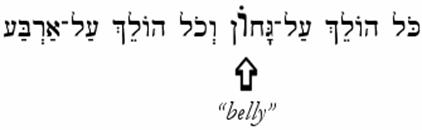
Vayikra (Leviticus) 11:42 Whatsoever goeth upon the belly, and whatsoever goeth upon [all] four, or whatsoever hath more feet among all creeping things that creep upon the earth, them ye shall not eat; for they [are] an abomination.
Note that the subject of this pasuk is to “not eat”. As we spoke earlier, eating is a form of connecting. Rashi tells us a bit about this word “gachon”:
that goes on its belly: This is the snake (Torat Kohanim[13] 11:163). The word גָּחוֹן denotes “bending low” [and it is used to describe the snake] because it moves while bent, a prostrated posture, prostrated on its belly.
Rashi says that the reptile referred to is the Nachash, the type of creature which enticed Adam and Chava to eat from the forbidden fruit. In Midrashic literature this creature is often equated with the evil inclination, which is also the Satan and the Angel of Death. On the other hand, Nachash has the same gematria as Mashiach, so in some way they are the same. Why is this creature given the distinction of being placed in the exact center of the Torah? The following thoughts came to mind.
First, there have been (non-Jewish) beliefs which viewed evil as being something outside HaShem’s direct sphere of influence or management. Judaism, on the other hand, views evil as being one of the many tools that HaShem uses to manage His world. Evil is the servant of HaShem and this is reflected by positioning this servant in the exact center of the Torah.
Second, Chazal[14] teach that a person cannot escape evil by merely avoiding physicality. We must deal with evil, not run away from it.
HaShem gave us a powerful weapon against the powers of evil. This weapon is also a shield and an antidote. It is the Torah, itself.
Sukkah 52b The school of R. Ishmael taught, If this repulsive wretch[15] meets thee, drag him to the Beth HaMidrash. If he is of stone, he will dissolve, if of iron he will shiver into fragments. ‘If he is of stone he will dissolve’, for it is written, Ho, every one that thirsteth come ye to the water[16] and it is written, The waters wear the stones.[17] ‘If he is of iron, he will shiver into fragments’, for it is written, Is not my word like as fire? Saith the Lord, and like a hammer that breaketh the rock in pieces?[18]
Perhaps this advice for mankind is reflected here, where we find the Nachash completely surrounded by the Torah.
Now Vayikra 11:42 is the halfway point of the letters in the entire Torah. Interestingly, the vav[19] is enlarged in Torah scrolls due to its significance. If you look into the Sefer Torah, the actual scroll of the Torah written by a scribe, you will see that this middle vav stands out from all the other letters and words because it is written larger than the other letters. Its elongated form is not due to a scribal embellishment. Rather, the Torah scroll must have this elongated vav in order for it to be halachically kosher to read in the synagogue. It is an intrinsic component in the Torah’s cosmic blueprint. Now, from this supernal daat emanates the entirety of the Torah.
The sixth letter of the alef-beit is the vav. The vav is shaped like a hook (ו). A hook is something that holds two things together. This property of the letter vav, in its Hebrew usage, is referred to as the vav of connection. It is normally translated as “and” which is used to hook words together. The form of the vav can also represent a chute which connects a higher level to a lower level. The first vav in the Torah occurs in Bereshit (Genesis) 1:1:

The placement of the vav suggests two of its essential connective powers:
1. By joining heaven and earth (הארץ ואת השמים) it implies the connection between spiritual and earthly matters.
2. Since it occurs as the 22nd letter in the Torah attached to the sixth word, (et - את), it alludes to the creative connection between all of the letters. Vav is therefore the connecting force of G-d, the divine “hook” that binds together heaven and earth.
Vav is also how we write the number six. Six represents connection, exemplified by the angels in Yeshayahu’s vision, whose six wings enabled them to soar to unite and connect with HaShem:
Yeshayahu (Isaiah) 6:1-3 In the year that king Uzziah died I saw also the Lord sitting upon a throne, high and lifted up, and his train filled the temple. 2 Above it stood the seraphim: each one had six wings; with twain he covered his face, and with twain he covered his feet, and with twain he did fly. 3 And one cried unto another, and said, Holy, holy, holy, is HaShem of hosts: the whole earth is full of his glory.
Six also represents the six orders of the Mishna. Through learning Torah, one connects with HaShem.
Commenting on a verse in Shir ha-Shirim celebrating the beloved’s belly as being like “a heap of wheat,” the midrash notes that the belly is in the center of the body, “just as Torat kohanim is in the middle, with two books before it and two after it”
Midrash Rabbah - The Song of Songs VII:7 THY BELLY IS LIKE A HEAP OF WHEAT. This refers to the book of Leviticus. Just as the belly is in the middle between the heart above and the legs below, so the book of Leviticus has two books before it and two after it.
According to our midrash, the belly, of Vayikra 11:42, also speaks of the connection or midpoint of the “belly”. Thus, we see that our pasuk is really focused on connecting. And indeed, from a halakhic perspective, this book is the central and richest one in the entire Torah. Through the mitzvot, one might say, we hear HaShem’s voice calling to us. So, that vav is the belly button of the Torah, literally! If we want to connect to the Torah, then we need to connect with Vayikra (Leviticus) 11:42. In this verse we can connect with Mashiach and with HaShem. This is the place of connection. The Talmud goes on to tell us about several “middles”:
Kiddushin 30a The early [scholars] were called Soferim because they used to count all the letters of the Torah. Thus, they said, the waw in gachon[20] marks half the letters of the Torah; darosh darash,[21] half the words; we-hithggalah,[22] half the verses. The boar out of the wood [mi-ya’ar] doth ravage it:[23] the ‘ayin of ya’ar marks half of the Psalms.[24] But he, being full of compassion, forgiveth their iniquity,[25] half of the verses.
One of the minor tractates of the Talmud, Soferim 9:2, also speaks about this special vav.
As an aside, gachon is a peculiar word which uniquely suggests the middle of the body. Gachon is only used twice in all of the Torah. Once, there in Leviticus, and yet only one other time aside from that, and that’s in:
Bereshit (Genesis) 3:14 And HaShem God said unto the serpent, Because thou hast done this, thou art cursed above all cattle, and above every beast of the field; upon thy belly (gachon) shalt thou go, and dust shalt thou eat all the days of thy life: 15 And I will put enmity between thee and the woman, and between thy seed and her seed; it shall bruise thy head, and thou shalt bruise his heel.
So far, we have Rashi telling us that the serpent, in Vayikra 11:42, is like the Nachash of Bereshit 3. Now Nachash - נחש (gematria of 358) and Mashiach - משיח (gematria of 358) share the same gematria. Thus, we are at the ultimate connection point of the Torah speaking about a significant connection point, the belly, and looking at a Nachash that equals Mashiach, while speaking against connecting, by eating. I feel that there is much more to this then what meets the eye.
Mashiach comes to rectify what the original snake caused. The original snake caused us to enter exile, and Mashiach will come to take us out of exile for good.
In the Psalms
The Soferim also calculated the midway points in the book of Tehillim. The ayin (ע)of the word ya’ar, in the verse “The boar of the field ravages it. . .” (80:14), is the middle letter of Tehillim:
יד יְכַרְסְמֶנָּה חֲזִיר מִיָּעַר; וְזִיז שָׂדַי יִרְעֶנָּה.
Tehillim (Psalms) 80:14 The boar out of the wood doth waste it, and the wild beast of the field doth devour it.
Rashi comments on this special ayin:
from the forest: Heb. מיער – miyaar (meaning: out of the wood). The “ayin” is suspended (as though it were written with an “aleph”). If Israel is worthy, the enemies are like the beasts of the river, which have no strength to climb out upon the dry land; but when retribution is decreed upon them, he (sic) grows strong as the beast of the forest, which destroys and kills. The boar of the forest is Esau, as is written (Dan. 7:7): “It devoured and broke in pieces and the rest it trampled with its feet.” And it (the swine) has some signs of purity. Esau, too, has the merit of his fathers.
In closing, we started by looking at this pasuk in Tehillim:
Tehillim (Psalms) 119:66 Teach me good discernment and knowledge; for I have believed in Thy commandments.
At this point, we should be able to grasp that Torah knowledge is something that is internalized and has become a part of us. It is not just knowing facts, it is connecting with the Torah in a way that modifies our behavior and causes us to seek HaShem and His will.
Ketubim: Tehillim (Psalms) 119:73-96
|
JPS |
Targum |
|
73. YOD ¶ Your hands made me and fashioned me; enable me to understand, and I shall learn Your commandments. |
73. YOD. Your hands made me and established me; give me insight and I will learn Your commandments. |
|
74. Those who fear You will see me and rejoice for I hoped for Your word. |
74. Those who fear You will see me and be glad; for I have waited long for Your word. |
|
75. I know, O Lord, that Your judgments are just, and in faith You afflicted me. |
75. I know, O LORD, for Your judgments are righteous/ generous and You have afflicted me in truth. |
|
76. May Your kindness be [upon me] now to comfort me, as Your word to Your servant. |
76. Now let Your kindness be for my comfort, according to Your word to Your servant. |
|
77. May Your mercy come upon me so that I shall live, for Your Torah is my occupation. |
77. Let Your mercies come to me and I will live; for Your Torah is my delight. |
|
78. May the willful sinners be shamed for they condemned me falsely; I shall converse about Your precepts. |
78. The arrogant will be ashamed, for they twisted a lie against me; I will speak of Your commandments. |
|
79. May those who fear You and those who know Your testimonies return to me. |
79. Those who fear You will turn to my teaching, and those who know Your testimonies. |
|
80. May my heart be perfect in Your statutes in order that I not be shamed. {P} |
80. Let my heart be without blemish in Your decrees, so that I may not be ashamed. |
|
81. KAPH ¶ My soul pines for Your salvation; for Your word I hope. |
81. KAPH My soul has yearned for Your redemption; I have waited long for Your word. |
|
82. My eyes pine for Your word, saying, "When will You console me?" |
82. My eyes are spent for Your word, saying, "When will You comfort me?" |
|
83. For I have become like a wineskin in smoke; I have not forgotten Your statutes. |
83. For I have become like a water-skin that hangs in the smoke; Your decrees I have not forgotten. |
|
84. How many are Your servant's days? When will You execute judgments upon my pursuers? |
84. How many are the days of Your servant? When will You pass judgment on my persecutors? |
|
85. Willful sinners have dug pits for me, which is not according to Your Torah. |
85. The malicious have dug pits for me, that you have not commanded them in Your Torah. |
|
86. All Your commandments are faithful; they pursued me in vain; help me. |
86. All Your commandments are truth; for a lie they persecuted me, help me! |
|
87. They almost destroyed me on earth, but I did not forsake Your precepts. |
87. They almost destroyed me in the land; but I have not forsaken Your commandments. |
|
88. According to Your kindness, sustain me, and I shall keep the testimony of Your mouth. {P} |
88. Sustain me according to Your kindness, and I will keep the testimony of Your mouth. |
|
89. LAMED ¶ Forever, O Lord, Your word stands in the heavens. |
89. LAMED Forever, O LORD, Your word endures in heaven. |
|
90. Your faith is to every generation; You established the earth and it endures. |
90. Your faithfulness is to every generation; You established the earth and it endures. |
|
91. For Your judgments they stand today, for all are Your servants. |
91. This day have they risen for Your judgments, for all of them are Your servants. |
|
92. Were not Your Torah my occupation, then I would have perished in my affliction. |
92. Had Your Torah not been my delight, then I would have perished in my affliction. |
|
93. I shall never forget Your precepts for through them You have sustained me. |
93. I will never forget Your commandments, for You have sustained me by them. |
|
94. I am Yours; save me for I sought Your precepts. |
94. For I am Yours, redeem me; for I have sought after Your commandments. |
|
95. Concerning me: the wicked hoped to destroy me; I shall ponder Your testimonies. |
95. The wicked waited for me to annihilate me; I will contemplate Your commandments. |
|
96. Of every finite thing I have seen the end; Your commandments are very broad. {P} |
96. To everything that began and ended I have seen an end; Your commands are very spacious. |
Rashi’s Commentary on Tehillim (Psalms) 119:73-96
74 Those who fear You will see me in prosperity and rejoice, because what was bestowed upon me will be bestowed upon them, for I am among those who fear You, and I hoped for Your word.
75 in faith You afflicted me With justice, You afflicted me.
78 for they condemned me falsely For no reason they condemned me. (I found:) I say that this deals with the embarrassment [of David] when they would say to him, “If one is intimate with a married woman, with what [method] is his death penalty?” when he [David] had not sinned.
79 May those who fear You...return to me For the Sanhedrin separated from him when he became a mezora because of that iniquity [with Bath-sheba]. Even if she was divorced, whoever puts his eyes on her, anyone who touches her, will not be guiltless.
81 pines Heb. כלתה , desires.
82 My eyes pine Heb. כלו , lit. fail. My eyes look constantly until they fail.
83 like a wineskin in smoke Like a flask of skin that dries in smoke.
84 When will You execute that I might see it in my days.
85 Willful sinners have dug pits for me Those who come to disqualify me do not do so according to the Torah.
86 All Your commandments are faithful A Moabite and not a Moabitess; but they pursue [me] to prohibit me [from entering the congregation of the Lord].
they pursued me in vain My enemies pursued me in vain.
87 They almost destroyed me I was on the earth as nothing, but I stood with my strength. Likewise (verse 95): “Concerning me, the wicked hoped to destroy me” from entering the congregation, and so (above 116:16): “You loosed my thongs.”
96 or every finite thing, etc. to search them and to debate about them.
Of every finite thing To every conclusion of a thing there is an end and a boundary, but Your commandments have no end or boundary to their conclusion.
Meditation on Tehillim (Psalms) 119:73–96
By Hakham Dr. Hillel ben David
I am repeating my introduction from the first part of this chapter of psalms for continuity.
The life of King David was devoted to the attainment of self-perfection in the service of God. Every action and every step in David’s life was calculated to bring him closer to this lofty goal. In this psalm of one hundred seventy-six verses, the lengthiest in the Book of Tehillim, David painstakingly charts the progressive stage of his determined ascent toward spiritual perfection. The psalm follows the sequence of the twenty-two letters of the Hebrew alphabet; eight verses begin with א, aleph, the next eight with ב, beit, and so on, because this psalm embodies an orderly program for achieving personal perfection. The Talmud[26] refers to this psalm a תמניא אפין, the repetition of eight. Whereas the number seven symbolizes the power of This World, which was created in seven days, eight symbolizes release from the desires of the mundane work which distract a person from his spiritual aspirations.[27]
In these verses David describes the many obstacles and danger that confronted him in his lifetime. Yet his spirit refused to be overwhelmed by sorrow, for he embraced the fount of joy, the Torah. As David followed the guiding light of G-d’s Torah, his lips burst forth in these ecstatic verses of praise for G-d’s salvation. This psalm opens with the statement: Praiseworthy are those whose way is wholesome, who walk with the Torah of HaShem. It goes on to cite scores of examples of how David strived to walk with G-d. In conclusion David declares: ‘I have attempted to follow You all my life HaShem. If I have failed, I beseech You not to abandon me! I have strayed like a lost sheep; seek out Your servant, I have not forgotten Your commandments’.[28]
King David begins the tenth part of Psalm 119 with a statement which speaks about his creation:
Psalm 119:73 Your hands made me and fashioned me; enable me to understand, and I shall learn Your commandments.
This pasuk encouraged me to look at this as the fashioning of the Bne Israel, rather than just the fashioning of a single human being. To that end, let’s review the conception and the birth of the Jewish people. The ArtScroll Mesorah series expressed it this way:
The Redemption from Egypt was Israel's birth. As Maharal puts it, "When Israel was in Egypt and the Holy One, Blessed is He, took them out, they were surely like a fetus which had been born, as is stated in Midrash.[29] Therefore, their redemption could have come about only through God Himself and not through an angel.[30]
A prolonged birth can encounter complications. The birth of the Jewish nation was swift, before the people could sink to the fiftieth level of spiritual impurity, a point of no return. The revelation of the Divine Presence, which the Jews experienced on the night of the Exodus was essentially a gift from Heaven, an awakening initiated from Above, to rescue the Jews from the morass into which they had sunk.[31]
The Hebrew word for Egypt, Mitzrayim, means a place of confinement. Mitzrayim is likened to a womb from which the Bnei Israel emerged as a single entity. Egypt is a remez, a hint, of what the Jewish people will go through, just before the final redemption. The womb, the place of nourishment and comfort, will become a place of pain and of certain death. The womb was a place where all of our needs were met, yet somehow it has turned against us. The place of comfort has become the place of torture.
This is not torture for the sake of delivering pain. No, this is torture for the sake of revealing new life. Without this torturous birth process, there would be no way we could ever enter the new and better world. Without dying, we would have no chance at eternal life. Egypt, the womb, is the process that brings us to real life!
The mitzva of the Pesach seder is to tell our children about the miracles that HaShem used to deliver us. Yes, we tell the story, but more importantly, we tell the story of the miracles! The birth of the Bnei Israel is about miracles. It is a prophecy of our final redemption which will also be miraculous.
The imagery of Mitzrayim, during the time of the sojourning of the Bnei Israel, is the imagery of a pregnant woman about to give birth. From the days of Avraham until the beginning of the exodus, HaShem weaves the history of the beginning of the nation of Israel within the imagery of pregnancy and birth. The imagery of pregnancy and birth is reinforced with the constant refrain of the characters who are involved in pregnancy and birth. Thus, for example, we have the story of Shifra (from the same root as shofar) and Puah, two midwives[32] who are desperate to save the male children. Shifra and Puah were in fact Yocheved and Miriam, the mother and sister of Moshe Rabbeinu (Moses our teacher), respectively.[33] Chazal, our Sages, have taught that the names “Shifra” and “Puah” indicate different roles midwives play. “Shifra” stems from the Hebrew verb to swaddle or to clean a baby, while Puah comes from the Hebrew word to cry out, because a midwife tries to calm a new mother’s cries by offering her words of encouragement.
Chazal compare the passage through the Yam Suf, the Sea of Reeds, and our leaving Mitzrayim, to a birth, with similar stages. In separating the Bnei Israel, the Children of Israel, from Mitzrayim, HaShem took one nation from the midst of another nation. This separation is the separation of a baby from the womb. All of us have experienced the process of childbirth in one way or another so we know that during the birthing process, there is a long period of incubation where the two bodies, mother and child, live as one, sharing a common food supply. Suddenly, with HaShem’s help, the fetus leaves the mother’s womb, hurries down the birth canal, and becomes a separate entity, struggling to breathe on its own. And so, it was with the Bnei Israel; on that night, HaShem created a people. Am Israel was born. Israel became a nation with its own mitzvot and with its own existence. Finally free of Mitzrayim, in both body and soul, Israel was ready to leave.
The birth process began with plagues, the pains of labor. The divine intervention shook the Bnei Israel out of their Egyptian attachment and positioned them for birth. The birth began when the Bnei Israel started leaving Mitzrayim (Egypt), but as long as the Egyptians were alive, and they related to them as their masters, they were not completely detached and the birth was not complete. As they were going out, the Bnei Israel reached a terrible crisis. The Yam Suf, the Reed Sea, was in front of them, the Egyptians were bearing down behind them, and then came the decisive prosecution in Heaven: The Bnei Israel worshiped idols just as their oppressors. The birth could not proceed, posing a threat of disaster. The splitting of the Yam Suf was the final, successful birth and that was truly the moment of redemption, and birth. This birth was a picture of creation. Just as the dry land was separated from the waters just before the creation of man, so too were the waters of the Yam Suf separated from the dry land before the resurrection and birth of the Bnei Israel.
What makes the birth of Bnei Israel in Mitzrayim such a fascinating study is that it is also an accurate picture of the birth of Bnei Israel in the days of Mashiach, the Messiah. This suggests that if we carefully study the birth in the days of Moshe, then we will understand the birth pangs of Mashiach. History will repeat itself. Since these birth pangs will be some of the most difficult times that the world has experienced, it makes sense that we would want to understand what we are getting into.
When history repeats itself, our Emunah (faithful obedience) and bitachon (trust) in HaShem are being tested. We are obligated to believe that HaShem will take us out of this galut, this exile, through Mashiach. The righteous will only be gathered as a reward for their Emunah and bitachon in HaShem. But we are getting a bit ahead of ourselves. Let’s begin our study at the place where all births begin: The intimacy that leads to pregnancy.
Intercourse: The first time that Mitzrayim (Egypt) is mentioned, in the Torah, is the creation of the concept of Mitzrayim. This first use of the word Mitzrayim is found in:
Bereshit (Genesis) 12:10 And there was a famine in the land: and Abram went down into Mitzrayim to sojourn there; for the famine was grievous in the land.
Here we see that Mitzrayim was a place to procure food so that Avraham and his descendants might grow and become an independent nation. The repeated forays into Mitzrayim are a picture of marital intimacy which leads to pregnancy and birth. Israel and his progeny descended into Mitzrayim like a man descends into his wife. Yosef’s brothers, representing the penis, made three thrusts, or trips, into Mitzrayim. Notice that each trip is set in the context of procuring food and a place for growth. Let’s look at these thrusts in greater detail:
1. The first thrust was when Yosef HaTzadik’s ten brothers made their first trip to purchase food during the famine.[34] On this first trip of Yosef’s brothers, Yosef makes a startling statement:
Bereshit (Genesis) 42:9 And Joseph remembered the dreams which he dreamed of them, and said unto them, Ye are spies; to see the nakedness of the land ye are come.
This nakedness of the land is a clear allusion to the act of sexual intercourse which, metaphorically, we are viewing. This is another strong hint that this was actually the first thrust.
2. The second thrust was when Yosef HaTzadik’s ten brothers made their second trip to purchase food during the famine.[35]
3. The third thrust was when Yaaqov and his entire family went to Mitzrayim to sojourn.[36]
These repeated trips, to procure food during the famines, speak to the intercourse that was to produce the Bnei Israel in the womb of Mitzrayim. Famine: This is a lack of food. Food, by definition, is that which connects the soul to the body (see also Daat). Yosef built the support system in the womb that would support the baby when he stored the grain, the blood supply in the body of Egypt, for seven years.
The Torah alludes to the end of the period of intimacy in: Shemot (Exodus) 1:8 Now there arose up a new king over Egypt, which knew (ya’dah) not Joseph.
The word Ya'dah -יָדַע – know,[37] has a specific meaning when used by the Torah to describe relationships. It denotes knowledge, or daat, beyond simple information. It describes knowledge gleaned from the intimate and loving dimension of a relationship, usually between a husband and wife. From the Garden of Eden, Adam knew Chava and the result was the fruit of the womb, Cain. Knowledge is a connection with someone, or something, which will always bear fruit. Thus, we see that the intimacy which began with Yosef’s descent into Mitzrayim, ended when a new king arose in Mitzrayim who did not know Yosef.
Foul Odors: Intimacy brings with it a couple of foul odors. One from the woman and one from the man. The woman’s lubricant releases an odor first, while the man’s semen provides putrid drops later in the intimacy. Now, negative odors only exist where decay and death reside, therefore we need to look for sin as this is the catalyst that leads to decay and death. Since odors are non-physical, we would expect the metaphor to also be non-physical. Since the woman’s odor comes first, we need to look to the first odor (sin ascribed to Yosef) to originate in Mitzrayim (the womb) and in Yosef (the egg). Some see this when Joseph was tempted to sleep with Potiphar’s wife.[38] Note that this sin even comes in the context of illicit sexual relations, but it comes before the actual intercourse.
Now that we have seen the woman’s foul odor, let’s look at the man’s putrid drops. In this metaphorical context, the semen surrounds the sperm (Yaaqov Avinu). We, therefore, expect to see this metaphorically as the brothers’ sin. This sin will become apparent to the world[39] in the process of the pelvic thrusts (the brother’s repeated forays into Mitzrayim to procure food). This odor (sin) will also be revealed as something that will preserve life, much as a woman’s lubricant becomes that which smooths the way for a new life to be brought into the world.
Bear in mind that the repeated thrusts are designed to produce friction. Metaphorically this friction is reflected in the accusations that Yosef repeatedly brings against his brothers. So here is the man’s odor (Yosef’s brothers’ sin):
Bereshit (Genesis) 45:4 And Joseph said unto his brethren: 'Come near to me, I pray you.' And they came near. And he said: 'I am Joseph your brother, whom ye sold into Egypt. 5 And now be not grieved, nor angry with yourselves, that ye sold me hither; for God did send me before you to preserve life.
Trimesters: The normal gestation period for the sons of Adam is forty weeks. This gestation period is normally broken down into three parts which are called trimesters. The first trimester is from conception to the end of week thirteen, the second trimester is from week fourteen till the end of week twenty-six, and the third trimester is from week twenty-seven till the end of the pregnancy. Thus, we see that each trimester is thirteen weeks long. Those who wish to explore the meaning and significance of thirteen may wish to examine my study on thirteen. The first trimester is defined as the time from conception until the fetus has a functioning placenta and the sex of the fetus has begun to be differentiated. During this time, most women have ceased menstruating. This trimester is also distinguished externally by the changes in the mother’s body including breast changes, tiredness, nausea and vomiting, frequent urination, and many more symptoms. More importantly, the mother will begin to show that she is pregnant from the growth in her womb. The womb will be the size of grapefruit at this stage. Additionally, the midwife can begin to feel abdominal palpitations by placing her hand on the belly of the mother.
The second trimester is defined as the time from when the sexual organs have begun differentiation, until the fetus looks similar to what he or she will look like at birth. This trimester will find the mother experiencing sleeping problems and she will begin noticing Braxton Hicks contractions. At the end of the second trimester, the fetus will measure about ten inches and will frequently practice their kicking movements. The fetus at this point can be felt by the mother and by the midwife. The baby has a chance of survival if born during this trimester.
The third trimester is defined as the time from when the fetus looks similar to what he or she will look like at birth, until the baby is born. During this trimester, the mother will need to urinate frequently and her belly will look like it’s ready to explode. Towards the end of this trimester, most babies will have become positioned for birth with their head down.
The trimesters used by Chazal and also by doctors and midwives in their description of a pregnancy also speak to the Egyptian exile. Conceptually, we can also view the trimesters of the pregnancy of Bnei Israel as follows:
First trimester: From the descent into Mitzrayim until the death of Yosef HaTzadik. This trimester begins with the descent of the seventy souls of Yaaqov into Mitzrayim. At this stage their presence can just barely be felt as “palpitations”.
Second trimester: From the death of Yosef HaTzadik until the hard labor inflicted by Paro on the Bnei Israel. At this stage, the growth of Bnei Israel is noticeable and begins to come to the attention of a Paro who knew not Yosef.
Third trimester: From the hard labor inflicted by Paro on the Bnei Israel until the crossing of the Yam Suf.
The Conception: The gestation of a human being takes forty weeks (or two hundred and eighty days). Since we were in Mitzrayim for 210 years (thirty weeks) we left early, seventy years early. Which is very interesting because the conception began when the seventy members of Yaacov’s family descended into Mitzrayim.[40] On a Pshat level, we see that Yaakov and his family, of seventy, were connecting together for the first time in Egypt. This gives us a superficial understanding of seventy. Although there were seventy souls in the family of Yaakov, the singular form of the word “soul” (nefesh) is used to describe them, as the Midrash explains.[41]
Yosef HaTzadik’s, the egg, is prepared: When Yosef HaTzadik was sent out by his father - Israel, it was with the expressed intent of finding the status of his brothers, as was indicated by a cryptic conversation[42] which occurs shortly after Yosef HaTzadik was sent by his father. Sperm is seed. Seed is quintessentially a collection of memories. This sperm contained the memories of Yaaqov. Yosef, the egg, is equated to Yosef HaTzadiq, the sperm, by the Torah.[43] Yosef HaTzadik, like an egg, was sent to prepare a place for a child in Mitzrayim.[44] It is the nature of seed that it must apparently die and begin to decompose in secret, before it can sprout and bear fruit. This was seen with Joseph’s apparent death.[45] Sperm is the male seed. By definition, this means that it gives to the female egg. The male is primarily a giver as we can see from marriage intimacy. If Yosef was the egg, then who was the sperm? Yosef gives food and shelter to his father and brothers. This makes Yaaqov Avinu the receiver. Thus, we would say that Yaaqov is the female component, the egg, if you will.
When the sperm and the egg meet, we see the ecstatic moment. We see also that this meeting is for the purposes of preserving life. This happened when Joseph revealed himself to his brothers and when he met his Father.[46] After the ecstatic moment, the brothers (the penis) goes flaccid. They are completely overcome and everything goes out of them. After the ecstatic moment, the sperm must be transported, via the semen, to the uterus for implantation. This transport is exemplified in Paro’s wagons which were sent to fetch Yaaqov and his family.[47] Yosef, representing the egg, initiates the transport mechanism, the semen, whereby the sperm is transported to its place of implantation. The wagons, metaphorically, are the semen, the transport mechanism for the sperm. Yosef provided the wagons, as we saw above.
When the sperm and the egg meet, we see a new life has begun. This is pictured by the meeting between Joseph and his father, Yaaqob, where Yoseph fell on his neck.[48] The neck is the portion of the anatomy that represents the connection between the higher world (of the head) and the lower world (of the body). The Temple is called the neck because it is the connection between the world we live in and the higher world where HaShem dwells. Thus, the neck is synonymous with connection. Thus, we see that the sperm (Yaaqov) and the egg (Yosef) have connected. In this connection, the sperm is absorbed into the egg and dies.
Now that the sperm and the egg have met, there is yet one more task that must be accomplished: The egg must be implanted in the womb. This implanting of Israel is seen when Israel comes to sojourn in Mitzrayim.[49] Thus the male component, the seed, sperm, is implanted in the female component, the egg; and the two components together become embedded in the uterus (Mitzrayim) to begin the pregnancy.
Womb: The womb (uterus) is an organ that shelters the fetus and provides for its nourishment. In return, the fetus causes the womb to grow and develop. The womb is the strongest muscle in the human body. At the end of the pregnancy, it is at its greatest size and strength. Mitzrayim, Egypt, is the womb which sheltered the Bnei Israel during a critical period of growth and development. Mitzrayim was the greatest nation of the world, at this time.[50] The womb provides the best environment and nourishment the body has to offer. The developing child need do nothing except study Torah[51] and grow in size and in strength. Thus, we see that Mitzrayim was the perfect womb for the development and growth of Bnei Israel.
The growth and development of the womb is depleted once the baby is born. Thus, the building up of the womb is transitory. The Bnei Israel built up the womb of Mitzrayim even as they grew, by literally building buildings.[52]
The Talmud and Midrash indicate that all of the labor of the Bnei Israel in the building up of Mitzrayim, did not produce any lasting edifice.[53] Thus we learn that the womb which supports the growing child is destined to collapse and return to its former self after the baby is born. The growth of the womb induced by the child, will not last. Mitzrayim, the epitome of galut, exile, is destined to become a shadow of itself as the Bnei Israel are born and leave the womb. The womb has value only whilst it is occupied and nurturing the child within. After the child is born, the womb no longer has value. History has shown that Mitzrayim rose to its pinnacle of power and influence in the days when the Bnei Israel dwelt and grew there. After the Bnei Israel left, the greatness of Mitzrayim also departed. Mitzrayim has never again risen to even a shadow of the greatness that it experienced when the Bnei Israel dwelt there.
The Pregnancy: The 400 years of galut, starting with the birth of Yitzchak, promised to Avraham is an allusion to the forty weeks of pregnancy. The actual pregnancy in Mitzrayim lasted 210 years, yet the galut, exile, began when Yitzchak, Avraham’s seed, was born.[54] The Torah treats the exile of Avraham and his seed as though it all took place in Mitzrayim. The time spent in Mitzrayim, including the slavery, can be seen as a period of pregnancy; the Bnei Israel were growing within the "womb" of another nation, Mitzrayim.
As the fetus grows within the womb, the woman groans and cries in pain and discomfort, just as the Bne Israel did in Mitzrayim.[55]
The Placenta – The Afterbirth: The placenta is a temporary organ present only in the woman during gestation. The placenta is composed of two parts, one of which is genetically and biologically part of the fetus, the other part of the mother. The placenta (also known as afterbirth) is an organ that connects the developing fetus to the uterine wall to providing protection to the fetus through the transfer of antibodies, to allow nutrient uptake, to provide thermo-regulation to the fetus, waste elimination, and gas exchange via the mother's blood supply, fight against internal infection and produce hormones to support pregnancy. The placenta provides oxygen and nutrients to growing babies and removes waste products from the baby's blood. The placenta attaches to the wall of the uterus, and the baby's umbilical cord develops from the placenta. The umbilical cord is what connects the mother and the baby.
The placenta is an apt description of the guards. There were Egyptian guards / army and Hebrew guards. The Hebrew guards later integrated into the fetus. The Egyptian guards / army formed an interface between the Bnei Israel and HaShem. The Egyptians effectively hid the hand of HaShem by seemingly providing the shelter and support that was needed during their stay in Mitzrayim. The placenta which is expelled from the mother’s body shortly after the birth of the child, is an apt description of the Egyptian army which were washed up on the shore of the Yam Suf.[56]
This wealth that was collected from the Egyptians on the shores of the Yam Sum is like the stem cells that are collected from the placenta and umbilical cord. These stem cells can be used to re-grow organs. For example, stem cells have been used to re-grow the spinal cord such that one who was paralyzed is no longer paralyzed. This is a fantastic treasure!
Fetal Growth: The growth of the fetus is characterized by the descent of the family of Yaaqov to Mitzrayim and their multiplication in the land. Their phenomenal growth is mentioned several times in the Torah.[57]
The umbilical cord provides a connection between the source of nourishment, the mother, and the developing fetus. This intimate connection explains why our belly buttons are in the center, from left to right, of our bodies. However, the mother is just a façade. HaShem clearly provides the nourishment for both the mother and the developing fetus. Thus, we must conclude that the umbilical cord stretches through the mother to connect to HaShem. The gestation of the Bnei Israel is no exception. This gestation period began when Yehuda was sent ahead to prepare a ben[58] midrash.[59]
The womb is the first critical environment for formation of the child. The Talmud relates that an angel is dispatched from above to study Torah with the fetus, in utero, for the duration of the forty weeks, to adequately prepare the unborn child for his future existence. Upon birth, we are told, the angel, with a flick of a finger to the indentation of the lip, causes the child to forget all the Torah that has been learned. Though we may not remember what we have learned, nonetheless at a subconscious level the information is there, programmed into the marrow of our being, waiting to be downloaded and recalled. All it takes is the desire and willingness to put forth the effort, to access the knowledge, and to bring it to a conscious level. Thus, we see that in the pregnancy of Bnei Israel follows the same pattern as normal birth in that Torah study is an essential connection, an umbilical cord, between the Bnei Israel and HaShem.
False labor, known as Braxton Hicks contractions, are sporadic uterine contractions that actually start at about six weeks. unlike true labor, during this so-called false labor the contractions don't grow consistently longer, stronger, and closer together. Thus, we can differentiate between true and false labor.
In Mitzrayim we also have an example of false labor. The Bnei Ephraim left Mitzrayim thirty years earlier in an abortive attempt to bring the redemption. The Bnei Ephraim were slaughtered by the inhabitants of Gath and their bones left to rot in open fields.[60]
Mucus Plug: From hours, to days, before labor, the small mucus plug that has sealed the cervix throughout pregnancy may begin to stretch, then break apart as the cervix shortens and thins out in a process called effacing. Once this occurs, pink-tinged mucus, or bloody show, may be discharged from the vagina.
Hours before the Bnei Israel left Mitzrayim, they put blood on the doorposts and lintels of their houses. This blood marked the opening of a house, a womb if you will, which protected the firstborn.[61]
This blood on the opening of their houses was the mucus plug that protected the firstborn during his time of growth in the womb Mitzrayim. The next morning those in the house will begin the birth process as they position themselves in the womb of Mitzrayim.
The Midwife: A midwife is a health care practitioner, who is not a physician, who provides prenatal care to expecting mothers, attends the birth of the infant and provide postpartum care to the mother and infant. Moshe personified the midwife as he was given the responsibility before HaShem for delivering the Bnei Israel.[62] The midwife must be close to family of the one being delivered in order to gain their trust. Moshe was of the tribe of Levi and, therefore, close to his tribal brethren.
Labor is divided into three stages:
1. The first stage begins with the onset of contractions and ends when the cervix is fully dilated (to ten centimeters).
2. The second stage involves delivery of the baby.
3. The third stage entails delivery of the placenta and membranes, or afterbirth.
The purpose of labor is to prepare the womb and the baby for delivery. There are several things that must be accomplished for successful delivery:
1. The baby must be positioned in the womb.
2. The cervix must become dilated to 10 cm.
3. Contractions must become stronger.
The labor and birth pangs are seen in the plagues.
Each of the ten plagues occurred in ten months and lasted four weeks each, for a total of forty weeks.
The first plague was that of blood, for the womb cannot open without bleeding first. For if the blood would not come out first, the child would choke and drown in the blood, which correlates to the powers of impurity. Blood issuing from the womb is associated with the powers of impurity since their issuance always causes the woman to focus on herself, and self-awareness is the antithesis of Divine consciousness.
Next was the plague of frogs. The word for “frog” [tzefardeia] can be seen as constructed of the words for “a bird of knowledge” [tzipor dei’a]. These are the seventy voices of the woman giving birth, which correspond to the seventy words in Psalm 20, which begins, “May G-d answer you on the day of pain.” [These voices] are thus alluded to by a bird, referring to the [sounds women make like] birdcalls and chirps when giving birth.
[The analogue of] the plague of darkness [is as follows]. It is known that during the first trimester, the fetus is in the lower chamber [of the womb], during the middle trimester, it is in the middle chamber, and during the last trimester, it is in the upper chamber. At birth, it rolls down and dwells in darkness and great pain. Darkness was the ninth plague. The plague of the firstborn corresponds to the subjugation of the [evil inclination’s ancillary] powers of impurity that ruled within the womb. If this would not occur, they would kill the fetus. Even though they made the fetus grow, thus is their way: they descend to entice and ascend to accuse.[63]
The ten plagues are the contractions that a woman experiences in the run up to the birth of the child. In the active phase, contractions occur about 3 minutes apart, last about 45 to 60 seconds. In the transition phase, contractions occur every two to three minutes and last 60 to 90 seconds. this is the phase where we have a plague that lasts 1 week (1 minute) followed by three weeks (3 minutes) of quiet.[64] The plagues were the forces that caused the Egyptians to expel the Bnei Israel.[65] It is well known that a woman is ready to deliver after she reaches ten centimeters of cervix dilation. In the same way, the birth of the Bnei Israel was ready to proceed after ten plagues. Thus, the ten plagues allude to this ten-centimeter dilation.
A woman in the final stages of childbirth goes through a death experience. This is evident from her screams, her pain, and the fact that women do occasionally die in childbirth. We see this same agony in Mitzrayim at the time of the last plague and as the Bne Israel are leaving Mitzrayim. The death of the firstborn was surely a death experience.[66]
Breaking of the Water: Chazal have taught us that the birth of the Bnei Israel took place on Pesach when we left Mitzrayim in the days of Moshe. Birth or rebirth is always associated with water: The fetus is surrounded by amniotic fluids, the mother’s water breaks as a sign of imminent birth, and therefore the mikveh required for conversion, features immersion in water. This breaking of the water, for the Bnei Israel, is seen on the seventh day of Pesach at the splitting of the Yam Suf, the Reed Sea. This breaking of the water is even more incredible when we realize the enormity of the words of the Bnei Israel as they stood on the threshold of the Yam Suf and the breaking of that water when they asked Moshe if there were no graves in Mitzrayim.[67]
The Hebrew word for grave, in Shemot (Exodus) 14:10, is also the Hebrew word for womb. Kever means grave and it also means womb. Thus, the Bnei Israel can see that they stand at a critical crossroad which will simultaneously represent their birth as a nation, Am Israel, and their rebirth at Techiyat HaMeitim, the resurrection of the dead.
The downward pressure of the baby's head against the amniotic sac may cause these membranes to rupture. The breaking of the water can occur as a trickle or a gush of odorless, colorless amniotic fluid. Once the sac has broken, labor is imminent, often beginning spontaneously within 12 to 24 hours. In fact, in many women, the membranes don't rupture until labor is already underway. As the Jews were standing by shore of the Yam Suf watching their enemy come closer, they did not know what to do. Suddenly, Nachshon ben Aminadab, of the tribe of Judah, jumped into the Yam Suf with full confidence that HaShem would save him. As he touched the water, it parted and allowed the Jews to pass through. It was Nachshon's faith in HaShem that led to Bnei Israel's being saved.[68] As the head (prince) of the tribe of Yehuda, the head (leading) of the tribes of the Bnei Israel, jumped into the Yam Suf causing it to break (split), so too does the pressure of the baby’s head cause the breaking of the water of the womb.
The Crowning: Crowning is the part of the birth process where the baby's head is first seen. For the Bnei Israel, the crowning is when the head of the Bnei Israel first became visible at Freedom Valley (Pi HaChiroth), the Mouth of Freedom.[69] On the third day of the Exodus, HaShem told Moshe to inform the Israelites that they were to turn around and camp by Freedom Valley (Pi HaChiroth. This was the coastal city of Pithom where the Israelites had previously worked as slaves (1:11). Now, when the Israelites returned there, they renamed the city Pi HaChiroth, literally Mouth of Freedom. In the same place where they had been slaves, they were now able to celebrate their freedom. (Rashi)
 Birth Canal: The Hebrew word for
Egypt, Mitzrayim, is related to the term meitzar[70], which refers to boundaries and
limitations and comes from the same verb root as birth canal. The birth canal
is in the shape of a shofar as we can see from the graphic. The imagery of shofar
and the birth canal is reinforced when we recall that the name of one of the midwives
in Mitzrayim was called Shifra (from the same root as shofar). Seven days after
Pesach, the children of Israel crossed the Reed Sea. Keriat Yam Suf, the opening
/ splitting of the Reed Sea, was the opening of the womb. The opening of the birth
canal shaped like a shofar. A most interesting detail not generally known,[71] is that the Bnei Israel
entered and exited the Yam Suf on the same side! Tosafot tell us that the parting
of the waters happened in the shape of a shofar, a semi-circle!
Birth Canal: The Hebrew word for
Egypt, Mitzrayim, is related to the term meitzar[70], which refers to boundaries and
limitations and comes from the same verb root as birth canal. The birth canal
is in the shape of a shofar as we can see from the graphic. The imagery of shofar
and the birth canal is reinforced when we recall that the name of one of the midwives
in Mitzrayim was called Shifra (from the same root as shofar). Seven days after
Pesach, the children of Israel crossed the Reed Sea. Keriat Yam Suf, the opening
/ splitting of the Reed Sea, was the opening of the womb. The opening of the birth
canal shaped like a shofar. A most interesting detail not generally known,[71] is that the Bnei Israel
entered and exited the Yam Suf on the same side! Tosafot tell us that the parting
of the waters happened in the shape of a shofar, a semi-circle!
The Birth: When the Bnei Israel arrived on the shore, Israel emerged as a nation distinct from the host nation of Mitzrayim. The Bnei Israel were born! One of the first acts of a baby, after birth, is a heartfelt cry from the depth of its soul. Chazal have taught that this cry of the soul will surely move HaShem. Thus we see that the Bnei Israel also uttered a heartfelt cry (song) immediately after crossing the Yam Suf.[72] As we sang at the Yam Suf, so we will sing the same song when we are redeemed by Mashiach: Revelation 15:3 And they sing the song of Moshe the servant of God, and the song of the Lamb, saying, Great and marvelous are thy works, Lord God Almighty; just and true are thy ways, thou King of saints.
We see also that the words of Hoshea the prophet were also applied to the Mashiach ben Yosef:
Matityahu (Matthew) 2:15 And was there until the death of Herod: that it might be fulfilled which was spoken of the Lord by the prophet, saying, Out of Mitzrayim have I called my son.
Thus, we learn that the Bnei Israel, as a united nation, represent the Mashiach Ben Yosef. The Bnei Israel are the body of Mashiach.
The After Birth: As we mentioned earlier, the Egyptians guards / army were the placenta for the Bnei Israel during their gestation in Mitzrayim. After the birth of the Bnei Israel, the placenta became the afterbirth, a worn out, useless organ that was now dead.[73] With the collapse of the placenta and its expulsion from the body, comes the realization that with the birth of the Bnei Israel, the Egyptian army is no longer needed. The Egyptians are cast out of the womb of Mitzrayim, dead.[74]
Lactation: The Mechilta says that the sefirot HaOmer period was / is a nursing period, and that Matan Torah[75] was when we were weaned. When the Bnei Israel left Mitzrayim they had their matzot, their unleavened bread, that parallels the stored food that an infant is born with. Immediately after the birth of a baby, the mother begins lactating with a special fluid called colostrum. The colostrum is gradually replaced by milk after three or four, up till twenty days. What makes this interesting is that we see a similar phenomenon in the wilderness. The Torah records that the Bnei Israel ate matza until the fifteenth day of the second month.[76] After they finished the matza, HaShem began to feed them bread (manna) from heaven.[77] Bamidbar 11:8 describes the taste of the manna as "leshad", which Onkelos translates as "kneaded" with oil, from the root "lash". But this term could also be translated as "like a breast", from the root "shad". Thus, the manna is likened to mother's milk, which is a complete food. It is the only food an infant requires, and the only food he craves; and furthermore, by eating it, he achieves closeness with his mother. Likewise, the manna was the only food the Jews needed and wanted, and it created a sense of closeness to HaShem.[78]
The manna was a highly spiritual food. When the Bnei Israel first left Mitzrayim, their minds were too coarse for them to be able to receive the Torah. HaShem therefore gave them the manna to eat in order to purify and sharpen their minds. They would then be fit to receive the Torah. The Torah was given twenty days after the manna began to fall. Eating the manna had the effect of increasing the intelligence and spiritual sensitivity of the Bnei Israel, so that in time they became known as the "generation of knowledge" (dor de'ah). This was because they were eating the manna that had been made at the twilight of creation.
The Birth Pangs of Mashiach: Torah Ohr, at the beginning of Parshat Vaera, explains that the exile is compared to pregnancy and redemption, is compared to birth. The words for the birth pangs. In Hebrew, is the same: Chevlai Mashiach [the birth pangs of the Messiah] is Chevlai laida [pain of childbirth]. The Vilna Gaon said that all the days of exile are like the duration of a pregnancy, and the final stage is comparable to the birth pangs immediately prior to birth.
Solomon declared that we can learn from the past because it is the template for the future:
Kohelet (Ecclesiastes) 1:9 The thing that hath been, it is that which shall be; and that which is done is that which shall be done: and there is no new thing under the sun.
Just as at the exodus from Egypt, HaShem made wonders and miracles for the Bnei Israel and at the same time He punished the Egyptians, history will repeat itself. As the Prophet Micah says in the words of the Prophet Micah, HaShem proclaims:
Micah 7:15 As in the days when you left Mitzrayim, I will show you wonders.
The Exodus from Mitzrayim is the prototype for the final redemption, when Mashiach will come, and slavery and suffering will be banished forever from the face of the earth.
Ashlamatah: Yeshayahu (Isaiah) 54:2-9 + 17
|
JPS |
Targum |
|
2. Widen the place of your tent, and let them stretch forth the curtains of your habitations, do not spare; lengthen your cords and strengthen your stakes. |
2. Enlarge the place of your camping, and cause the cities of your land to be inhabited; hold not back, increase the people of your armies and strengthen your rulers. |
|
3. For right and left shall you prevail, and your seed shall inherit nations and repeople desolate cities. |
3. For you will be strengthened to the south and to the north, and your sons will possess peoples and will cause desolate cities to be inhabited. |
|
4. Fear not, for you shall not be ashamed, and be not embarrassed for you shall not be put to shame, for the shame of your youth you shall forget, and the disgrace of your widowhood you shall no longer remember. |
4. Fear not, for you will not be ashamed; be not confounded, for you will not be put to shame; for you will forget the shame of your youth, and the reproaches of your widowhood you will remember no more. |
|
5. For your Master is your Maker, the Lord of Hosts is His name, and your Redeemer, the Holy One of Israel, shall be called the God of all the earth. |
5. For your Maker is your husband, the LORD of hosts is His name; and the Holy One of Israel is your Redeemer, the God of the whole earth He is called. |
|
6. For, like a wife who is deserted and distressed in spirit has the Lord called you, and a wife of one's youth who was rejected, said your God. |
6. For the Shekhinah of the LORD has summoned [you] like a wife forsaken and distressed in spirit, like a wife of youth who is cast off, says your God. |
|
7. "For a small moment have I forsaken you, and with great mercy will I gather you. |
7. "In a little anger I forsook you, but with great compassion I will bring your exiles near. |
|
8. With a little wrath did I hide My countenance for a moment from you, and with everlasting kindness will I have compassion on you," said your Redeemer, the Lord. {S} |
8. In a brief hour, for a time, I took up the face of My Shekhinah from you, but with everlasting benefits which do not cease I will have compassion on you, says the LORD, your Redeemer. {S} |
|
9. "For this is to Me [as] the waters of Noah, as I swore that the waters of Noah shall never again pass over the earth, so have I sworn neither to be wroth with you nor to rebuke you. |
9. This is like the days of Noah before me: as I swore by My Memra that the waters of the flood which were in the days of Noah should no more go over the earth, so I have sworn that my anger will not turn upon you and I will not rebuke you. |
|
|
|
|
17. Any weapon whetted against you shall not succeed, and any tongue that contends with you in judgment, you shall condemn; this is the heritage of the servants of the Lord and their due reward from Me, says the Lord. {S} |
17. no weapon that is prepared against you, Jerusalem, will prosper, and you will declare a sinner every tongue that rises against you in judgment. This is the heritage of the servants of the LORD, and their innocence before me, says the LORD." {S} |
Rashi’s Commentary on Yeshayahu (Isaiah) 54:2-9 + 17
2 and let them stretch forth far off.
lengthen your cords These are thin ropes that hang at the bottom of tents, and that are tied to stakes called ‘chevills’ in French, which are thrust into the ground.
3 shall you prevail Heb. תִּפְרֽצִי, shall you prevail.
4 your youth Heb. עֲלוּמַיִךְ, your youth.
6 who was rejected When she is rejected at times that her husband is a little wroth with her.
8 With a little wrath Heb. שֶׁצֶף. Menahem (Machbereth p. 179) interprets this as, “with kindling of wrath,” and Dunash (Teshuvoth p. 20) states, “with a little wrath,” paralleling “For a small moment have I forsaken you,” and so did Jonathan render, and with everlasting kindness that will exist forever.
9 For this is to Me [as] the waters of Noah [i.e.,] it is an oath in My hand, and He proceeds to explain His words, “as I swore that the waters of Noah shall never again pass over the earth, etc.”
17 Any weapon whetted against you Any weapon that they will whet and sharpen for you, i.e., to battle with you.
whetted Heb. יוּצַר, an expression similar to (Jos. 5:2) “sharp knives (חַרְבוֹתצֻרִים),” also (Ps. 89:44) “You have also turned the edge of his sword (צוּר חַרְבּוֹ).”
Commentary on the Ashlamata of Yeshayahu (Isaiah) 54:2-9 + 17
By: H.Ex. Adon Shlomoh Ben Abraham
Sing, O barren one, who did not bear; break forth into singing and cry aloud, you who have not been in labor! [79] The prophet Isaiah describes the song Israel will sing when Hashem brings the Jewish people back to Zion from exile in the coming Redemption. At this time, humanity will have reached a turning point in which Israel is told to begin to rejoice. Although you may be a barren woman, I beckon you to rejoice. Rejoice in your salvation despite your current situation. The city of Jerusalem, or Zion, is often portrayed as a woman, a woman who is childless, as a city without inhabitants—a city apparently that has been forsaken by her husband. Iben Ezra tells us that a land with a ruler is metaphorically described as one with a husband. God is reminding this woman to rejoice that he is still her husband, and he will protect her, and she soon will be abundant with children. The Psalms tell us he will make the barren woman abundant with children. (113:9) The Hebrew scriptures speak of five barren women, Sarah, Rebecca, Rachel, Leah, Hannah, and the city of Zion,[80] and in the Nazarene Codicil, Elizabeth and Mary are mentioned, two more for a total of eight. Isaiah 49:21 says, Rejoice, O Barren, one without children. For after the Lord will restore her children. He will say in your heart (or to oneself), Who has borne me these children?[81] The Prophets often use the metaphor of a marriage to portray the relationship between God, the Husband, and Israel, the bride. (Hos.1-3, Jer. 2-3, Isa. 49-54, Zeph. 3:14-20, and Ezekiel 16) God consoles Israel over the pains of their exile in the way that a husband conciliates the beloved wife of his youth following a brief display of anger, reassuring them that nothing will ever cause God's faithful love to depart from them or His covenant of peace to be removed. (v.5-10) [82]
The people of Israel are told: Enlarge the place of your tent, (v.2), let the curtains of your habitations be stretched out; do not hold back; lengthen your cords and strengthen your stakes. For you will spread abroad to the right and to the left, your offspring will possess the nations and your people, the desolate cities. Radak and Abarbanel say, we (the Jewish people) will need to make room for the multitudes that will flock to the homeland at the time of Redemption. The ‘place of your tent’ refers to Jerusalem, and I would posit that by implication, it is here referring to the temple also. ‘Your dwellings’ is located in the rest of the country. In Jeremiah 31:37, we see a hint and short description of this broadening, the heavens, which are unmeasurable, along with the foundations of the earth, are juxtaposed to show the ever-expanding of God's children, and in Zechariah 8:22, leading into 9:2, the ever expanding of humanity and the Kingdom rule of God, the prophets using examples in his day of great cities that come under the rulership of Hashem.
Continuing the imagery from 54:1, God gives another command. You had better lengthen your courts and increase your tents, which seems to be an echo of Moses. Hear, O Israel: you are to cross over the Jordan today, to go in and dispossess nations greater and mightier than you, cities great and fortified up to heaven. Deut. 9:1 The Lord will drive out all these nations before you, and you will dispossess nations greater and mightier than you. Every place on which the sole of your foot treads shall be yours. Your territory shall be from the wilderness to the Lebanon and from the river, the river Euphrates, to the western sea. (Deut. 11:23-24) Israel is told: “Fear not, for you will not be ashamed; be not confounded, for you will not be disgraced; (v.4). The command not to be afraid has occurred in (40:9; 41:10, 13, 14; 43:1, 5; and 44:2), the word translated ‘ashamed’ appeared in (49:23) and (50:7), and the word translated ‘ humiliated’ is used as a synonym for ‘ashamed’ in (41:11; 45:16, 17, 50:7). So, this verse serves as a summation of terms that express the reversal of past sins and their consequences.[83] It is beyond comprehension what awaits us when there is a reversal of 6,000 years of human sin and consequence. Rashi said you will burst out, flowing out to the left and right. (v.3) Radak and Iben Ezra continue this understanding, sharing that Israel will burst out or flow out into other lands and countries due to such large numbers that come in the final redemption from our exile.[84] In a small way, we have witnessed this breaking out for the last 2000 years, and now we await the return and expansion of that effort back to Zion, the city of Jerusalem, and the new rebuilt temple with Hashem's presence dwelling therein.
The first five verses of our passage leave us questioning, almost as if the listener has been caught off guard by the two commands to ‘Sing out’ and ‘to break into glad song and be jubilant’(v.1) For your master is your maker, Hashem, Master of Legions, is his name: your Redeemer is the Holy one of Israel: God of all the world will he be called. (v.5)[85] The astonishment presented before us in the text leaves us (Israel) utterly speechless as we question where all these children come from. Jerusalem is addressed as if she were a barren woman who suddenly becomes the mother of a countless number of children.[86] The theme of Zion becoming abundantly repopulated and rebuilt faster than the destroyers can destroy it also appears in (49:17-21). It seems Isaiah is drawing from (Jer. 10:17-25) where the Judeans are about to be exiled and lament the loss of their children and the destruction of their tent, which is symbolized by the temple.[87] As the master of all earthly and heavenly legions, he can do whatever he wants, Radak reminds us. As we discussed earlier, the Torah will flow from Zion, and all nations will accept the Torah of Hashem as delivered by Moses; the nations will acknowledge Hashem as God, not just of Israel but of all the world.
For your Maker is your husband, the Lord of hosts is his name; and the Holy One of Israel is your Redeemer, the God of the whole earth he is called. For the Lord has called you like a wife deserted and grieved in spirit, like a wife of youth when she is cast off, says your God. For a brief moment, I deserted[88] you, but with great compassion, I will gather you. In overflowing anger for a moment, I hid my face from you, but with everlasting love I will have compassion on you, says the Lord, your Redeemer. (V.5-8) For several hundred, if not thousands of years, religious people of the world have tried to divorce God from his people as if God practiced 20th-century divorce standards. However, Isaiah 54:5-8 tells us and supports Jeremiah 3:14 that Hashem is Israel's husband and will gather and assemble his children. The return of HaShem to Zion (the return of a husband to a wife), after his period of estrangement, will be such an earth-changing event, and from that day forth, the world as we know it will be no more. Although in one way that day after will be like the day before, yet in another way, the return of the bridegroom changes everything. A picture is also given in (Hos 2:19): “And I will espouse you forever… with goodness and with love.” Our reading is also an echo found in (Isa. 60:10): “For in anger I struck you down, but in favor I take you back in love.” It is important to notice that Hashem, in bringing together, restoring, and returning his wife, the people of Israel, to their home, is based not so much on their regret, but on His promises, faithfulness, and steadfast love.[89] Can we even imagine what will happen when our LORD and Master, Hashem of all the earth, reveals his face to us, and he, in all his glory, is NOT hidden from Israel and mankind any longer? Israel need not fear, because her husband, the ‘God of the whole earth, has called her.’ He calls for her the way a wronged spouse calls out to his wife, pleading for repentance, faithfulness, commitment, and reconciliation. “He called,” like a husband, when his wife left, and grieved in spirit, like a wife of one’s youth when she was rejected. (54:6) Although he turned away from her because of her sin and rejection of His love and faithfulness, that very same “love and faithfulness” to her allows him to not ‘forsake,’ or ‘abandon’ her. He has turned away from her because of her shameful past deeds; he has not divorced her in a modern sense of the word. He understands a wife must choose to love her husband and, in contrition and repentance, decide to return to him. Israel, as a wife, cannot or will not remain defiant. As scriptures teach in so many places, “there is always a remnant.” When she becomes grieved in spirit over the situation, Israel will come to the place where she wants the separation to end. (49:14-21).
This situation parallels Hosea 2–3, where Hashem wins Israel back and she wants the joy of marriage and family restored to her.[90] Isaiah speaks of vast numbers of returning children. Look up all around you and see they are all assembled, they are coming to you, as I live declares Hashem. (v.18) For the mountains may depart and the hills be removed, but my steadfast love (חֶסֶד ḥeseḏ) shall not depart from you. (Isa.54:19) In conversation with a wise old man many years ago about the dynamics between a man and his wife, he said, The most dangerous place in the world is between a Husband and his wife! The antisemites(anti-Israel) who attack the bride will not go unpunished, regardless of whether the attack takes the form of hateful words or increased hatred, all the way to physical attacks and actions! None of the weapons or political strategies that Iran, Hamas, Hezbollah, or anyone else may dream up will ever succeed in dislodging Israel from the palms (Isa.49:16) of Hashem nor from their God-given land.
Noah, the first man favored by Hashem, or one whom Hashem is said to have shown grace toward. [91] Ibn Ezra on Genesis 6:8:1 says GRACE. (Chen) means mercy. From it we get the word techinnah (supplication). Chen follows the paradigm of ketz (end); both have roots whose second and third letters are the same. The meaning of found grace (mercy or pity) in the eyes of the Lord is like No eye pitied thee (Ezek. 16:5). The Ramban says, when “NOAH FOUND GRACE IN THE EYES OF THE ETERNAL. The meaning thereof is that all his deeds were pleasing and sweet before Him. Similarly, Moses and the people of Israel were told of this grace (chen-favor), for thou hast found grace in My sight, and I know thee by name. (Exo.33:12-20) This is like the verses: And He gave him favor in the sight of the keeper of the prison. (Gen 39:21) And Esther obtained favor in the sight of all who looked upon her. (Esther 2:9-17) Scripture mentions this in contrast to what it said concerning his [Noah’s] generation, namely, that all their deeds brought grief before Him, blessed be He. But of Noah it says that he found grace in His eyes, and afterwards it tells why he was pleasing before G-d: because he was a perfectly righteous man.”[92]
The day of wrath that is coming at God’s appearance, part of that wrath will be directed at those who so foolishly stand between the ‘Master of Legions,’ the God of the whole earth, and his bride. In verse eight, we see a contrast between the “slight wrath” experienced by Israel in the past and the “eternal kindness” they shall experience in the near future. For like the waters of Noah, this shall be to me. The Targum and Iben Ezra point out that this phrase should be rendered as Yeshua did in Luke 17:26ff, Matt. 24:37ff. “As in the days of Noah, ‘the waters of Noah’ מֵי־נֹ֛חַ. And in the latter day, the wicked will suddenly be swept away by judgment when God will set up His theocratic kingdom of blessing on the earth. (Matt. 24:36–39). When the time arrived to judge the earth, and the Lord saw that the wickedness of man was great in the earth, and that every intention of the thoughts of his heart was only evil continually,[93] the flood came and removed the wicked, unrighteous man. The people in the day of Noah, as in the days of Yeshua and in our day, are invited to come into the ark: Metaphorically, our personal “arks” are our periods of Torah study and prayer. Just as Noah and his family were protected by the ark from the flood that raged outside it, just as we can “enter” the world of Torah study and prayer to be protected from the “flood” of worldly concerns that threatens to inundate us.[94]
The Rabbis teach that the implication is that if Noah had prayed for those of his day, the destruction would have been less, and they bring the example of Abraham praying for Sodom and Moses praying for Israel.[95] “When Moses, whose soul included the souls of all Jews, said that he wished to be erased from the Torah if the Jewish people were wiped out, he used the word מְחֵ֣נִי ‘erase me’, which contains the same letters as ‘waters of Noah’ (Exo.32:32). By offering his soul to save the Jewish people he rectified the soul of Noah, who did not pray for the people of his generation.”[96] In 1 Peter 3:20ff, we see the same connection made in relation to Yeshua giving his life to save those who are unrighteous.
Peter used the same text as the Prophet Isaiah to support his teaching. Christ (Messiah) died for sins (cf.2:21-24). The phrase “for sins” (peri hamartiōn) is used in the Septuagint regarding the sin offering for atonement. The substitutionary nature of the Messiah’s death is shown by the phrase the righteous for the unrighteous (1Pet.3:18) (dikaios hyper adikōn). Messiah the “righteous One” (dikaios), uniquely qualified to die as the substitute for (hyper, “for,” “in place of,” or “instead of”) the “unrighteous ones” (adikōn). The divine purpose of Christ’s (Messiah’s) sacrificial death was man’s reconciliation, to bring people to God.[97] Yeshua “trusted in him who judges justly” (1 Pet.2:23). Can we do anything but follow the Master's example?
As we have seen, Israel had already received this divine favor (chen), and with Yeshua, all the nations are shown divine favor (chen) and allowed to come into the ark. We see this same expression in Isaiah chapters 49-53, in the servant passages, the general to the specific, from the whole community of servants to the particular individual servant. Just as we saw in the reading of Joshua chapter 22 a few months ago. The one is responsible to, or responsible for the whole community. The individual and the community have a shared responsibility to each other; it is reciprocal. If one takes this idea and broadens it outward to the ends of the earth. The Messianic idea is that the Messiah(servant) has a responsibility to the whole community, and the whole community has a responsibility back to the Messiah servant. Specifically, this speaks of the community of the nation of Israel, but since Israel is a part of the whole community of mankind, they have a responsibility to their brothers, and this is the purpose of the exile to gather up the lost members(souls) of their nation and any others that wish to accept Hashem's grace (chen) toward them.
Hashem swore not to cover the earth with water again as he did in Noah’s day (54:9), and through the Messiah, he made a way for those to escape the coming wrath if they so choose. Isaiah was here speaking to the children of Israel, but he also knew that the children of Israel would have to open up the tent and broaden the house due to the influx of the children of Zion that was coming, and in this “bursting forth” it would flow out to engulf the whole world one day. The flood is known as ‘the waters of Noah’, and only by the merit of Noah was the destruction of the world prevented.[98] With the knowledge of Hashem comes its blessing and the wrath that comes with the blessing if one refuses or simply fails to uphold their responsibility. We could say there are two sides to a covenant, and both parties are responsible for the other per the terms of the agreement. Which seems to be just what Tzefet (Peter) is teaching. In the coming of the “son of man,” it will be as in the days of Noah, there will be those who do not come to Hashem in repentance and faith, Emunah (faithful obedience),[99] and they will receive destruction. But we are to remain steadfast, walking in God’s ways. When mankind acts in accordance with God's laws and imitates God's attribute of justice, this is our part in pursuing justice and working to bring light and establish justice in the earth.
"Behold, they may well gather (GOR YA-GUR) together, but not by Me: whoever shall gather (GAR) together against you shall fall for your sake" (v 15). According to this simple rendering of the verse, God is promising that even if the nations gather to make war against Israel, they will fall. The Targum refers to this as the war of Gog and Magog at the end of days. However, the Talmud darshans[100] the same Hebrew words of the verse differently, citing it as the scriptural basis for its teaching that "converts will not be accepted in the days of Mashiach, just as converts were not accepted in the days of David and Solomon" (Yevamoth 24b). The reason for this is that Israel's great status in those times would give the Gentiles ulterior, impure motives for converting. The DRASH is based on the threefold appearance in the verse of the root GAR, which not only means "gather" but also has the connotation of "dwell", and a GER is a convert who comes to "dwell" with Israel. Rashi (on Yevamoth) explains the Midrashic meaning of the verse as: "'One who comes to convert should dwell without Me' - i.e. during the time when I am not yet with you, i.e., during the exile. 'Only he who dwells with you.' - i.e., in your time of lowliness - ‘. shall rest (YIPOL, cf. Gen. 25:18)[101] with you, i.e., in the world to come." And "No weapon that is formed (or fashioned or devised) against you shall prosper." (v 17). [102]
Verbal Tallies
By: Hakham Dr. Hillel ben David
Devarim (Deuteronomy) 12:20 – 14:3
Tehillim (Psalms) 119:49-72 + 119:73-96
Yeshayahu (Isaiah) 54:2-9 + 17
Looking at the Hebrew of Deuteronomy 12:20 and Isaiah 54:2, what is the verbal tally (all root words) that connects these two passages?
The common theme connecting Deuteronomy 12:20 and Isaiah 54:2 is the concept of enlargement or expansion, centered on the root (רחב}.
Here is the analysis using the JPS translation, with the Hebrew roots and corresponding Strong's numbers inserted.
Devarim (Deuteronomy) 12:20 (JPS) When the Lord thy God shall enlarge (H7337) thy border, as He hath promised thee, and thou shalt say: 'I will eat flesh,' because thy soul desireth to eat flesh; thou mayest eat flesh, after all the desire of thy soul.
Yeshayahu (Isaiah 54:2 (JPS) Enlarge (H7337) the place of thy tent, and let them stretch forth the curtains of thy habitations, spare not; lengthen thy cords, and strengthen thy stakes.
The Verbal Tally (Root Connection)
The single verbal root that connects these two passages is:
- Hebrew Root: (רחב)
- Strong's Number: H7337
In both verses, this root carries the core meaning of making something wide, spacious, or large:
- Deuteronomy 12:20: Describes God's act of enlarging the geographical borders of Israel.
- Isaiah 54:2: Describes the command to the nation (personified as a barren woman) to enlarge her tent in anticipation of her future growth and multitude of children.
This verbal tally highlights the prophetic connection between the physical promise of enlarged land in the Torah (Deuteronomy) and the spiritual promise of enlarged peoplehood in the Prophets (Isaiah).
* * *
The thematic connection between Deuteronomy 12:20–14:3 and Psalms 119:49–96 revolves around two central, interconnected themes: Divine Instruction and The Life of Obedience and Hope/Comfort Amidst Adversity.
1. Divine Instruction and The Life of Obedience
Both passages are fundamentally concerned with how the devoted person relates to HaShem's commandments, laws, statutes, and precepts—collectively referred to as the Torah.
In Deuteronomy 12:20–14:3 (Torah)
This passage provides specific, practical laws for the Israelites as they settle the promised land:
The Law of the Place: The instruction to bring sacrifices and tithes only to the central place HaShem chooses (12:20–28), prohibiting the decentralized worship practices of the heathens.
The Purity of Worship: The command to utterly destroy all pagan forms of worship and not inquire about them (12:29–32).
The Purity of the Community: Laws dealing with false prophets and dreamers who would lead the people astray (13:1–19), and laws prohibiting self-mutilation (14:1–2) and defining which foods are clean and unclean (14:3).
The Command for Obedience: The entire section is framed by the command to diligently obey HaShem's instructions in order that it may go well with them (12:25, 28).
In Psalms 119:49–96 (A Meditation on Torah)
This extended section of the psalm is a meditation on the nature, value, and personal impact of HaShem's Word (Torah/Law/Precepts/Statutes):
The Psalmist dedicates his entire life to keeping HaShem's precepts (vv. 56, 60, 69).
He affirms the eternality and faithfulness of HaShem's word (vv. 89–90).
He recognizes that HaShem's laws are righteous and give him understanding (vv. 75, 96).
2. Hope and Comfort Amidst Adversity
While Deuteronomy is prescriptive, Psalms 119 is experiential, showing that the purpose of the commandments given in the Torah is to sustain the faithful through life's challenges.
In Deuteronomy 12:20–14:3 (The Source of Blessing)
The promise attached to obedience is blessing and expansion:
Expansion/Provision: The passage opens with HaShem's promise to enlarge Israel's borders and provide an abundance of meat for their desire (12:20).
Well-being: Obedience ensures that it will "be well with thee, and with thy children after thee" (12:25, 28). The law is the foundation of a stable, blessed existence.
In Psalms 119:49–96 (The Source of Comfort)
The Psalmist reflects on the personal comfort he draws from the Law during suffering:
Comfort in Affliction: The Psalmist explicitly states that HaShem's word is his comfort in his suffering and preserves his life (vv. 50, 92).
Steadfastness Against the Wicked: He is mocked and persecuted by the arrogant and wicked (vv. 51, 61, 69, 78), but he refuses to turn from HaShem's Law. His commitment to the commandments is his shield and anchor.
Hope in the Word: He seeks HaShem's favor and relies on the word/promise (דָּבָר, davar) HaShem gave him as his source of hope (vv. 49, 74, 81).
Thematic Synthesis: The Deuteronomic text provides the content (the specific laws) of the divine instruction that defines a holy life in the promised land, while the Psalm 119 text explores the attitude and experience of the faithful individual who is sustained by this very instruction during hardship. Both passages underscore that the ultimate blessing—be it national security and provision (Deuteronomy) or personal comfort and preservation (Psalms)—is inextricably linked to unwavering, heartfelt adherence to the Word of HaShem.
* * *
The connection between the Torah seder and the Ashlamata, though seemingly strictly verbal, is in addition eschatological. The messianic kingdom, rather than the related contents of the Torah lesson, is the dominant theme of the Ashlamata.
What is the eschatological message of Yeshayahu (Isaiah) 54:2-9 + 17?
The eschatological message of Isaiah 54:2-9, 17, as understood in Jewish sources, centers on the final and complete restoration of the Jewish people (Zion/Israel), characterized by:
1. Demographic and Geographic Expansion (vv. 2-3)
Israel, personified as a barren woman, is commanded to enlarge her tent, in anticipation of a vast, overwhelming increase in her children. This refers to the ingathering of the exiles (Kibbutz Galuyot) back to the Land of Israel, which will be so numerous that they will spread out and inherit the nations and settle desolate cities.
2. Eternal Covenant and Divine Compassion (vv. 4-9)
The period of exile and apparent rejection is described as a brief moment of divine wrath or "widowhood" (v. 4). The eternal future promises:
Reconciliation: HaShem is the faithful Husband and Redeemer of Israel, never having divorced her.
Irrevocable Peace: HaShem swears an oath, comparable to the Covenant with Noah (v. 9), that He will never again punish Israel with the same anger or rebuke, establishing an everlasting kindness and covenant of peace.
3. Unassailable Vindication and Righteousness (v. 17)
In the Messianic Era, the restored people of HaShem will possess absolute security:
Security: "No weapon formed against you shall prosper".
Vindication: Any verbal attack or legal accusation against them will be condemned. The ultimate reward is that their righteousness is seen as coming from HaShem.
Nazarean Talmud
Sidra of D’varim (Deuteronomy) 12:20 – 14:3
“Sabbath “Ki Yarchiv” - “When will enlarge”
By: Hakham Dr. Eliyahu ben Abraham
|
School of Hakham Shaul’s Tosefta Luqas (LK) |
School of Hakham Tsefet’s Peshat Mordechai (Mk)
|
|
“Tsefet, Tsefet, behold, Satan has demanded permission[103] to sift you like wheat,[104] but I have prayed for you, that your faithful obedience may not fail. And you, once you have repented (Teshubah - turned back, strengthen your brothers.” But he said to him, “Master, I am ready to go with you both to prison and to death!” And he said, “I tell you, Hakham Tsefet, the Temple crier will not call out today until you have denied three times that you know me!” |
And when they had sung the final Psalms of the Pesach Seder (The Hallel),[105] they went out to Har Zeytim (Mount of Olives). And Yeshua said to them (his talmidim), all of you will find an occasion to be offended[106] (scandalized) because of me this night. For it is written, "O sword, awaken against My shepherd and against the man who is associated with Me! Says the Lord of Hosts. Smite the shepherd, and the flock shall scatter, and I will return My hand upon the little ones" (Zech 13:7).[107] But after I am raised, I will go before you into the Galil. But Tsefet said to him, although all will find an occasion to be offended (scandalized), I will not. And Yeshua said to him, Amen ve amen I say to you that today, in this night, before the Temple crier calls out twice, you will deny our association three times. But he (Tsefet) spoke the more zealously, If I should die with you, I will not deny my association with you in any way. They (the rest of the talmidim) also said the same. |
|
¶ And he came out (from the Pesach Seder) and proceeded as was his tradition[108] to the Har Zeytim (Mount of Olives); and the talmidim also followed Him. When he arrived at the place, he said to them, "Pray that you may not enter into testing."[109] And he withdrew from them about a stone's throw, and he prostrated himself and began to pray, saying, "Father, if You are willing, remove this cup (hour of Divine appointment) from Me; yet not My will, but Yours be done." Now a messenger from the heavens appeared to him, strengthening Him. And being in agony He was praying very fervently; and His sweat became like drops of blood, falling down upon the ground. When he rose from prayer, he came to the disciples and found them sleeping from sorrow, and said to them, "Why are you sleeping? Get up and pray that you may not enter into testing." |
Mar 14:32 And they came into the place called Gat Shamni (grove of olive trees);[110] and he (Yeshua) said to his talmidim,[111] “you sit here praying the evening Shema until I finish praying[112] the evening Shema.” And he took Tsefet, Yaakov and Yochanan with him and he was filled with dread and troubled while praying. And he said to them (Tsefet, Yaakov and Yochanan), “My soul is deeply distressed,[113] even to the point of death; stay here and remain vigilant in constant prayer.”[114] And going a little farther, he fell on the ground (prostrated himself) and praying that if it were possible, the hour might pass from him.
And he said, “Abinu, our Father, all things are possible for You; please may it be Your will to remove this cup (hour of Divine appointment) from me if possible; yet not my will, but Your will (be done).”[115]
And he (Yeshua) came after reciting VeAhabta – (Deut 6:4—9 and found them (the three) sleeping, and he said to Tsefet, “Shimon are you asleep? Could you not remain vigilant in prayer for one hour? Keep vigilant and pray that you do not enter into testing; your spirit is truly filled with zeal, but your soul (flesh) is weak (causes you to stumble).”
And he went away and continued praying, reciting the VeHayah – Deut 11:13—21 the next words of the evening Shema. And he came again and found them (the three) sleeping for their eyes were tired; and they did not know what to say to him. And after concluding the final blessing of the Shema he came the third time and said to them, “are you still asleep and resting? Enough! (I have finished) the evening Shema. The hour has arrived; the Son of Man (the prophet) is betrayed into the hands of sinners. Get up and let us go. The one who has handed me over is here.” |
Nazarean Codicil to be read in conjunction with the following Torah Seder
|
Dt. 12.20-13.12 |
Ps 119. 49-96 |
Is 54:2-9 + 17 |
Mordechai 14:26-42 |
1 Luqas 22:31-34 & Lk 22:39-46 |
Commentary to Hakham Tsefet’s School of Peshat
Will our master teach us about G-d’s loving-kindness towards the Gentiles who possess the Nefesh Yehudi?
“And when they had sung the final Psalms of the Pesach Seder (The Hallel),” should be understood to read that they sang Psalms 116—118 and 136 the grand Hallel.
The Eternal Graciousness of G-d
Psalm 136
1 Give thanks to the L-rd because He is good, for His kindness is eternal. 2 Give thanks to the G-d of the angels, for His kindness is eternal. 3 Give thanks to the Lord of lords, for His kindness is eternal. 4 To Him Who performs great wonders alone, for His kindness is eternal. 5 To Him Who made the heavens with understanding, for His kindness is eternal. 6 To Him Who spread out the earth over the water, for His kindness is eternal. 7 To Him Who made great luminaries, for His kindness is eternal. 8 The sun to rule by day, for His kindness is eternal. 9 The moon and stars to rule at night, for His kindness is eternal. 10 To Him Who smote the Egyptians with their firstborn, for His kindness is eternal. 11And He took Israel from their midst, for His kindness is eternal. 12 With a strong hand and with an outstretched arm, for His kindness is eternal. (Jewish Publication Society)
This Psalm is the final Psalm of the Passover Ceremony. We refer to this Psalm as the “Grand Hallel.” Its theme is the loving-kindness of G-d towards Yisrael. However, Jewish commentators on this particular Psalm reveal that there is more to the loving-kindness of G-d that meets the eye.
“For He is Good. An aspect of His goodness is that He punishes man for his sins, each according to his own level of prosperity. The rich man may lose an expensive bull, while the pauper will be deprived of a crust of bread.[116]”
“Ki L’Olam Chasdo. For enduring forever is His kindness. Homiletically, this can be rendered: His kindness is to the world. Selfish motives can prompt man’s kindness, but G-d acts for the sake of the world.[117]”
We view the eternal Graciousness of G-d from the cosmic and eternal measure of His plan. Humanity tends to see things from the vantage point of the earthly mundane perspective. While Eretz Yisrael is His focal point, G-d will not neglect the rest of His creation.
The Jewish people, being delivered from Mitzrayim, why have we been sentenced to live in this Diaspora for nearly two millennia?
“They went out to Har Zeytim (Mount of Olives)”
This place, the “Mount of Olives,” seems to be one of Yeshua’s favorite locations for revealing future events.[118]
The previous pericope of Mordechai allows us to use the hermeneutic principle of contiguity for further elucidation of our present materials.
Mar 14:22 “And Yeshua received bread (the afikomen) and said Ha-Motsi and broke it, and he gave it to them and said, Receive this, it is analogous of my Jewish body politic.”
Mar 14:27 And Yeshua said to them (his talmidim), All of you will find an occasion to be offended because of me this night. For it is written, "O sword, awaken against My shepherd and against the man who is associated with Me! says the Lord of Hosts. Smite the shepherd, and the flock shall scatter, and I will return My hand upon the little ones" (Zech 13:7).
The “broken body” and “flock” become analogous to the Jewish people, which will soon be sent to the farthest and most remote ends of the earth. This “Diaspora” is necessary to effect a repair for the atrocities committed by the Gentiles in their own lands. When blood is spilled on the land, tikkun is requisite.[119] Here we will use the hermeneutic law of Ḳal va-ḥomer[120] to show that if the spilling of blood contaminates Eretz Yisrael, “how much the more” the spilling of blood in Gentile lands also contaminates the whole earth. Therefore, the earth (i.e, the lands of the Gentiles) needs the reparation of Jewish presence and Halakhah to effect that Tikkun, since G-d is not only the G-d of Israel but also G-d of the whole earth (Psalms 24:1).
The Ramban[121] translates D’varim 35:33 “Do not cause unfaithfulness to the land.” He then goes on to explain that “unfaithfulness” is doing the opposite of the Torah and becoming involved in sins of idolatry, bloodshed, and sexual immorality. When the land becomes contaminated in the ways mentioned above, the Shekinah of G-d will not dwell in that land. They effected Tikkun for the lands where murder has gone unpunished, returning the Divine Presence to that land. In light of His Eminence Rabbi Dr. Hillel ben David’s thesis on the “Brain,” we would expect that the greater dispersion of the Jews will be to the Occident or western world (the world of the West suffers greater damage than the eastern part of the world).
Thus, we must expect the Diaspora of the Jewish people to affect a greater measure of tikun for Gentile “unfaithfulness” in the Western world. This idea of “faithfulness” is fostered by our present pericope.
Mar 14:27, 30-31 And Yeshua said to them (his talmidim), All of you will find an occasion to be offended because of me this night. But Tsefet said to him, Although all will find an occasion to be offended, I will not. And Yeshua said to him, Truly I say to you that today, in this night, before the Temple crier calls out twice, you will deny our association three times. But he (Tsefet) spoke the more zealously, If I should die with you, I will not deny my association with you in any way. They (the rest of the talmidim) also said the same.
Yeshua predicts the “unfaithfulness” of the Talmidim this present evening before the Temple crier can make two-time announcements. Hakham Tsefet, remembering the details of that evening, has incorporated them into our present pericope with good reason. Herein, we find a positive connection to D’varim 7.3.
D’varim 7:3 You will not intermarry with them; you will not give your daughter to his son, and you will not take his daughter for your son. 4 For he will turn away your son from following Me, and they will worship the gods of others, and the wrath of the LORD will be kindled against you, and He will quickly destroy you. 5 But so will you do to them: You will demolish their altars and smash their monuments, and cut down their asherim trees, and burn their graven images with fire. (Rashi)
Hakham Tsefet verbalizes the appropriate “faithfulness” we should have towards G-d and His Messiah. Hakham Tsefet is cautioning his audience to beware of their level of association with the Gentiles, wherever they go. Hakham Tsefet can use his own “unfaithfulness” to teach a lesson to those about to enter the Diaspora. Scholars are quick to castigate the talmidim in their comments about “true disciples who deny themselves.”[122] However, we believe it is evident enough that Hakham Tsefet is demonstrating the loving-kindness of G-d that is extended to us even when we fail.
Healy translates verse 26 “All of you will have your faith shaken.”[123] If we then translate Mary Healy’s “faith” (Hebrew: “Emunah”) into “faithfulness,” the picture becomes very clear. Each of the talmidim would have their “faithfulness shaken.” Healy further explains the Greek word σκανδαλίζω skandalizo to mean, “Fall away.”[124] In other words, Yeshua is telling his talmidim that their perceived “faithfulness” will be shaken. We often have a false view of our “faithfulness,” which is tested and shaken to validate our measure of faithful obedience.
A lexical note here is apropos. Sometimes translators do complicated and painful gymnastics when trying to translate a Greek or Hebrew word into English. The Greek word σκανδαλίζω skandalizo has a very English equivalent – in fact, almost a transliteration of the Greek – SCANDALIZED! Therefore, verse 26 should be correctly translated “All of you will have your faithful obedience scandalized.”
When the “shepherd of my community,” of Zechariah 13:7, a reference to the Messiah,[125] is smitten, it follows that the “sheep” of that dispersed community. Thus, the pericope of Mordechai makes a direct verbal connection with the Torah Seder now.
D’varim 7:2. And the Lord, your God, will deliver them to you, and you will smite them. You will utterly destroy them; neither will you make a covenant with them, nor be gracious to them.
The community of G-d is driven into Diaspora by the directive of “smiting” the shepherd of G-d’s community. However, this dispersion is not without the promise of a return. The verse: “O sword, awaken against My shepherd and against the man who is associated with Me! Says the Lord of Hosts. Smite the shepherd, and the flock will scatter, and I will return My hand upon the little ones,” can also be translated to mean that G-d will return the authority of the priesthood to the firstborn of Israel (my little ones) by the means of the Hakhamim and Bate Din. In other words, we can see that there will be a paradigm shift in power and authority “when the shepherd is smitten, and the flock is driven into Diaspora.”
While Rashi does not see the Zekharya passage as a reference to Yisrael, Yeshua clearly does. Consequently, this is not the understanding as the two sages contradicting each other, but instead that Rashi is giving us the historical (Peshat/Literal) context of this verse of Zekharya while Yeshua is looking at one of its many prophetical (Remes/Drash/So’od) fulfillments of this verse. Yeshua sees this as a reference to the scattering of his talmidim when he will be arrested and crucified. The Master points to the fact that the talmidim would scatter immediately, and the Jewish people would scatter eventually into the Diaspora post 70 c.e. The Markan account of the talmidim’s failure to maintain their association with the Messiah is one of discretion. We saw this type of discretion in the pericope where Yeshua does not directly name Yehuda Ish Keriyoth as the one who would hand him over to the Kohen Gadol. Likewise, Hakham Tsefet singles himself out as the primary perpetrator of unfaithfulness. Scholars have suggested that this is Mordechai’s attempt to belittle Hakham Tsefet,[126] which we must totally reject.
However, Rashi equates the “little ones” with the governmental powers of the Gentile Kings and their officers. Of course, this is most fascinating because the powers of the Gentiles are subject to the authority of the prophetic voice of the Jewish sages, when we (Jewish people) live by the Governance of G-d according to His Torah. (cf. Jonah 3:1—10) And, this is the reason for the dispersion of the B’ne Yisrael throughout the Diaspora – i.e., to effect Tikun upon the lands of the Gentiles throughout the whole world.
Suppose we rebel and find it grievous to carry out with much joy and gladness the assignment of effecting Tikun upon the lands of the Gentiles and thoroughly instructing them in the Torah. In that case, G-d will send us bitter persecution like the acidic and corrosive juices inside the belly of a whale. Let us choose faithful obedience and the good life before us.
Commentary on Hakham Tsefet’s School of Peshat
Mark 14:32-42
May our Mother teach Us Concerning The Evening Shema
Our argument in this particular pericope will be to establish that Yeshua wanted to pray the evening Shema with his talmidim, specifically the chief three, Tsefet, Yaakov, and Yochanan, on this final night before his death. While some scholars suggest the possibility that the current material is a form of the “Master’s prayer”,[127] we hope to establish some factual basis for the thesis that Yeshua prayed the evening Shema by looking at the Scriptures and materials that explain the K’riat (recitation of the) Shema. However, specific to our problem are the duties relative to the night of Pesach.
שְׁמַ֖ע יִשְׂרָאֵ֑ל יְהוָֹ֥ה אֱלֹהֵ֖ינוּ יְהוָֹ֥ה אֶחָֽד
Hear, O Israel, the L-rd is our G-d, the L-rd is One.
“Blessed be the name of the glory of His kingdom forever and ever.
[VeAhabta] You will love the L-rd your G-d with all your heart, with all your soul, and with all your might. And these words which I command you today will be upon your heart. You will teach them thoroughly to your children, and you will speak of them when you sit in your house and when you walk on the road, when you lie down and when you rise. You will bind them as a sign upon your hand, and they will be for a reminder between your eyes. And you will write them upon the doorposts of your house and upon your gates.”
I do not think that we can overemphasize the value of the Shema in the first century. To say that the Shema was of principal importance to Yeshua, and by extension, the School of Hillel, would be an understatement. Some scholars question when the Shema gained its place of preeminence in Jewish life. However, it seems evident that the Shema, during the time of Yeshua, was the item of incomparability.[128] The exegesis of the School of Hillel made this statement of faith (faithful obedience) of such importance that the Shema was said on the lips of the dying Jewish people, especially when martyred, even unto this very day. Likewise, the Shema and declaration of G-d’s unity is so great that every Jew is duty-bound to declare the ONENESS of G-d. Failure to declare the ONENESS of G-d is tantamount to being a heretic.[129] Rabbi Aaron Ha Levi further states that one must recite the Shema evening and morning ALL the days of one’s life.[130]
Shema in the Mishnah
The Mishnah opens with the classic discussion on the Shema.
m. Ber. 1:1 From what time may they recite the Shema in the evening? From the hour that the priests enter [their homes] to eat their heave offering, “until the end of the first watch”— the words of R. Eliezer. But sages say, “Until midnight.” Rabban Gamaliel says, “Until the rise of dawn.” His [Gamaliel’s] sons returned from a banquet hall [after midnight]. They said to him, “We have not yet recited the Shema.[131] He said to them, “If the dawn has not yet risen, you are obligated to recite [the Shema]. “And [this applies] not only [in] this [case]. Rather, [as regards] all [commandments] which sages said [may be performed] ‘Until midnight,” the obligation [to perform them persists] until the rise of dawn.” [For example,] the offering of the fats and entrails—their obligation [persists] until the rise of dawn [see Lev. 1:9, 3:3–5]. And all [sacrifices] that eaten within one day, the obligation [to eat them persists] until the rise of dawn. If so why did sages say [these actions may be performed only] until midnight? To protect man from sin.[132]
The question of the Mishnah is multifarious in the following manner.
It first asks the question: from what time in the evening may we recite the Shema? After answering, the Mishnah poses a problem. The sons (talmidim) of Rabban Gamaliel have returned from a wedding banquet and have not recited the evening Shema. The Sages tell us that rejoicing with the bride takes precedence over other matters. The latter point brings us to the fundamental question relevant to our pericope. How late may we recite the Shema? As noted, the answer is until dawn. However, one needs to attempt to maintain the dictum of the Sages in their reciting the evening Shema before midnight if possible. The Rabbinic maxim of reciting the Shema before midnight was a fence to prohibit the Jewish people from falling into sin.
Similarly, all the offerings, including the Pesach offerings, were to be eaten before midnight.[133] Herein lies the dilemma: Yeshua and his talmidim were presented with the night of the final Passover.[134] The Talmud discusses three obligations that occur on the night of the Passover. Each of these should be discharged before midnight if possible.[135] These obligations applied to the time when the Temple was still standing and even to this very day.
- Eat the Pesach offering.
- Hallel
- K’riat Shema
Yeshua and the Shema
Mark 12:28—31 And one of the Soferim of the Pharisees approached him (Yeshua), hearing them (Yeshua and his talmidim) studying (Heb. Drash), knowing (seeing) that he (Yeshua) taught them well with hokhmah, asked him, Which is the chief Heb. Rosh Hashanah of all? And Yeshua answered him, The chief Heb. Rosh mitzvah of all is: The recitation of and compliance with: “Hear, Israel. The LORD our God is one LORD, And you will love the LORD, your God, with all your heart and with all your soul, and with all your means.” (Deut. 6:4, 5) This is the chief Heb. Rosh mitzvah. And the second is like this, “You will neither take revenge from nor bear a grudge against the members of your people; you will love your neighbor as yourself. I am the LORD.” (Lev. 19:18) There is not another mitzvah greater than these two.
Hakham Tsefet, in Mark 12:28—30 relates the importance of the Shema in Jewish life during the time of Yeshua. we have argued that the preeminence given to the Shema by Yeshua resulted in the Shema being placed first in the Mishnah code.[136] However, we would suggest that the importance of the Shema was not new to Yeshua or the School of Hillel. We would here suggest that the School of Hillel emphasized the importance of the K’riat (recitation of the) Shema. The above-cited passage relates just how deeply seated the K’riat Shema is in Yeshua’s persona. The “Unity of G-d” is found in the mitzvot, which were of utmost importance during the first and second century. The declaration of the Shema established the Unity of G-d as a unique singularity. Secondly, the Shema established the election of the B’ne Yisrael as G-d’s chosen people.
“By this injunction, the Jewish people are commanded to believe in the Unity of God; that is to say, to think that the Creator of all things in existence and their First Cause is One. This injunction is contained in His words (exalted be He),” “Hear O Israel: the Lord our God, the Lord is One. (De. 6:4)[137]
Mark Nanos, in his work on the Igeret (letter) of Hakham Shaul to the Romans, suggests that the premise for Hakham Shaul’s letter is the Shema.[138] Herein, this demonstrates the importance of the Shema as related to Yeshua’s talmidim. Likewise, it reflects the preeminence of the Shema in the School of Hillel, of which Hakham Shaul could also brag as being central to his spiritual heritage.[139] Consequently, Yeshua, as a member of the School of Hillel authenticates the preeminence of the Shema in the life of the Jewish people.[140]
Shema
The above-cited Mishnah[141] obligates the Jewish people with the responsibility of saying the Shema twice daily. These problems compound when some preeminent event, such as the Pesach Seder, interferes with the scheduled reading of the Shema.. Of course, this is a classic example of the complications we face with the arrangement of the Triennial Torah reading cycle. Festivals take preeminence over many other details, interrupting the schedule with their ascendency. However, the Jewish people are still duty-bound by the Torah to recite the Shema twice daily, regardless of the interruption. Here we see the dilemma Yeshua and his talmidim faced on the evening discussed by Hakham Tsefet. Therefore, Yeshua is obligated to say the Evening Shema before midnight, or no later than dawn. If Yeshua is to keep the rabbinic fence of reciting the evening Shema before midnight, he must accomplish three things that night. Each of these things was to be performed before midnight by a rabbinic dictum.
- Eat the Pesach offering.[142]
- Hallel
- K’riat Shema
Yeshua addresses the above-cited obligations, resolving them through action as if an actor on the stage.[143]
Hermeneutic Principle Rov
By the hermeneutic principle of Rov and Severah, we can determine that Yeshua recited the Evening Shema on the evening of our present pericope.
Now being forced to use the principles of Rov, Ḳal va-ḥomer: “Argumentum a minori ad majus” or "a majori ad minus"; corresponding to the scholastic proof a fortiori and Gezerah shavah: Argument from the analogy, of Biblical passages containing synonyms or homonyms are subject, however much they differ in other respects, to identical definitions and applications.
- The Torah commands the Jewish people to recite the Shema twice daily by the Torah itself.
- Again, the Torah instructs the Jewish people in how and when to recite the Shema by the Mishnah, Tosefta, and Jerusalem and Babylonian Talmud by Rabbinic dictum.
- The Jerusalem Talmud states that it would be preferable for a person who studies without performing the mitzvot never to have been created.[144]
While there are some variants to the above-cited materials, the consensus is that we must recite the Shema twice daily. By the hermeneutic principle of Rov, we see that the greater community of the B’ne Yisrael recited the Shema twice daily. Therefore, “how much the more,” we must conclude that Yeshua would have recited the Shema on this final evening in accordance with Torah, Mishnah, and both Talmud Jerusalem and Babylonian.
When you lie down
The Mishnah, Berakhot, goes into some detail to demonstrate that the words of the Torah “when you lie down” are a reference to time and not to position.
m. Berakhot 1:3 The House of Shammai say, “In the evening everyone should recline in order to recite [the Shema] and in the morning they should stand, “as it says [in the passage of the Shema], When you lie down and when you rise (Dt. 6:7).” But the House of Hillel say, “Everyone may recite according to his own manner [either reclining or standing], “as it says, And as you walk by the way (ibid.).” If it is so [that one may recite however he wishes] why does [the verse] say, When you lie down and when you rise? [It means you must recite the Shema] at the hour that people lie down [night] and at the hour that people rise [in the morning]. Said R. Tarfon, “I was coming along the road [in the evening] and reclined to recite the Shema as required by the House of Shammai. And [in doing so] I placed myself in danger of [being attacked by] bandits.” They said to him, “You are yourself responsible [for what might have befallen you], for you violated the words of the House of Hillel.”
The Mishnah weighs Hillel’s thoughts and logic against the logic of Shammai. Because the text of the scripture says, “when you lie down and when you rise up,” Shammai has deduced that K’riat Shema should be said either lying or standing. Hillel furthers the logic of the text by saying, “you walk by the way.” This logic demonstrates the fact that one may need to recite the Shema while “on the way.” Therefore, one recited the Shema in the manner that is appropriate for him. Hillel’s logic continues with a hermeneutic on the text. One should recite the Shema at the appropriate time. The logic demonstrated here by Hillel is consistent with his seven rules of Peshat hermeneutics. Hillel’s logic is exemplified in the case of Rabbi Tarfon in the related Mishnah to demonstrate the idea of good common logic and that a person is not entitled to endanger himself for the sake of rabbinic dicta. Here, the logic of Hillel elucidates the problematic phraseology of the Torah. For further discussion on this Mishnah, see our further explanation, albeit brief in the Mishnah of Hillel. Hillel’s logic summarizes that the Shema is recited in its appropriate time rather than in any particular state.
Three Times
Yeshua comes to the trio of Hakham Tsefet, Yaakov, and Yochanan three times.[145] Why does Yeshua return these three times to his talmidim, encouraging them to pray and keep on praying?
m. Ber 2:1 One who was reading [the verses of the Shema] in the Torah and the time for the recitation [of the Shema] arrived: If he directed his heart [towards fulfilling the obligation to recite the Shema], he fulfilled his obligation [to recite]. And if [he did] not [direct his heart], he did not fulfill his obligation. “At [the breaks between] the paragraphs [of the Shema] one may greet [his fellow] out of respect, “and respond [to any greeting extended to him]. “But in the middle [of a paragraph] one may greet [only] out of fear, “and may respond [to any greeting extended to him]”— the words of R. Meir. R. Judah says, “In the middle [of a paragraph] one may greet [only] out of fear “and may respond out of respect. “At [the break between] the paragraphs, one may greet out of respect, “but may respond to the greeting of any man.”[146]
The subject material for the cited Mishnah is Kavanah or intention, and the possibility of interruptions after each recitation of each paragraph of the Shema to greet someone. Yeshua fully understands the meaning of “directing his heart” towards the recital of the Shema. His return to his talmidim is to ensure that they fully say the Shema with the appropriate intention.
The Cup
There is a great deal to say concerning the use of “cup” (potērion) in the Nazarean Codicil and Tanakh. However, we will abbreviate the materials into as concise a statement as possible. The following lexical information will illuminate the idea of a “cup” being used in Scripture.
The cup stands, by metonymy, for what it contains.[147] To potērion touto ‘this cup’: in an analogous sense, of impending affliction (as in Mark 10.38f.). In the context, ‘this cup’ and ‘the hour’ (in the previous verse) refer to the same experience.[148] 1 a cup, a drinking vessel. 2 metaph. One’s lot or experience, whether joyous or adverse, divine appointments, whether favorable or unfavorable, are likened to a cup which God presents one to drink: so of prosperity and adversity.[149]
The “cup” is synonymous with “hour” or appointed time and purpose.[150] Therefore, the “cup” (hour — appointed time) is NOT the sins of humanity! The “cup” is death and the associated shame of being identified as a sinner and criminal. Yeshua has lived his life as a model Tsadiq. The people who viewed his embodiment of the Torah will now view him as a sinner, criminal, and traitor. His body will hang on a tree naked as a spectacle of sin and shame. These things, for the Jewish Tsadiq, are unbearable. The “cup” can also be indicative of the life (purpose) we are destined to live.[151] We are but “vessels” filled with the content of our mission in life. Yeshua’s “cup,” “Divine Appointment,” was that of the messianic mission.
It is not “death” or “fear” that Yeshua dreads in his prayer of sorrow; it is the shame his oppressors will expose him to in the process. Yeshua has prayed, “May it be Your will” that the “hour,” “cup” might cease to exist. However, he submits perfectly to the mission of G-d for his life. The “hour” arrives in verse 41 and Yeshua willingly embraces it.
“And he said to them, This is analogous of my life (the blood) of the renewal of the Covenant, which is poured out for the many (the Gentiles).” (Mar 14:24)
The Mishnah attests to the structure of the final prayer of the Pesach evening[152] by tacitly discussing the structure of the evening and morning Shema.
m. Berakhot 1:4 In the morning, one recites two blessings before it [the Shema] and one after it. [The two before are “Who Creates Light” and “Everlasting Love.” The one after is “True and Certain.”]
And in the evening, two before it and two after it.
[The two before are, “Who Causes Evening to Pass,” and “Everlasting Love.”
The two after are, “True and Certain,” and “Lie Us Down in Peace.”] One is a long [blessing, i.e., “True and Certain”] and one is a short [blessing, i.e., “Lie Us Down”]. Wherever they said to recite a long [blessing], one is not permitted to recite a short one. [Where they said] to recite a short [blessing], one is not permitted to recite a long one. [Where they said] to seal [the blessing with the formula, “Blessed are you, Lord, our God, King of the Universe], one may not fail to seal. [Where they said] not to seal, one may not seal.[153]
Please note the “two blessings which are said before the Evening Shema itself. The titles are similar to the language used by Yeshua in this pericope of Mordechai. The titles of the blessings, recited before the Shema, are “Who Causes Evening to Pass,” and “Everlasting Love.”[154]
Abinu
The phrase, Abinu (Our Father) used here, is a term of endearment relating to the closeness of the relationship possessed by the Jewish people with G-d. Rabbi Akiva would later pen the words “Avinu Malkenu” as an invocation before the ark of the synagogue.[155] Scholars suggest that Yeshua may be the originator of this phrase within Judaism.[156] This is not to say that Yeshua saw himself as any type of deity by use of this expression. Actually, this phrase taught the Jewish people to find within themselves the election forwarded by the Shema.
We believe that this phrase relates to the blessing before the Shema, “Everlasting Love.” The term “Abinu, Our Father” is an expression equating the “Everlasting” love of G-d to His people. We cannot believe that Yeshua was trying to establish some special relationship between himself and G-d. Yeshua was expressing the reality of the relationship indicated in the Shema itself.[157]
We have placed this section here because the loving-kindness[158] of G-d is found throughout the K’riat Shema. The phrase “Abinu, Our Father” might also be equated with the final blessing of the Evening Shema, “Everlasting love,” which begins “Hash-kiybenu Abinu,” Our Father, make us to lie down in peace...
Vigilance in Prayer
Mar 14:37 And he (Yeshua) came and found them (the three) sleeping, and he said to Tsefet, "Shimon, are you asleep? Could you not remain vigilant in prayer for one hour?” 38 "Keep vigilant and pray that you do not enter into testing; your spirit is truly filled with zeal, but your (the) soul (flesh) is weak (causes you to stumble)."
“And it will be — if you vigilantly obey My commandments…[159]
The “blessing” after the Shema reveals the similarity between the blessings of the Shema and the present pericope of Mordechai.
While Yeshua was able to recite all of the Shema before midnight on the Pesach Evening, He concluded with the phrase “Enough” (meaning, “I have finished”) as a way of telling us that he accomplished the prayer.
The final “blessings” of the Shema relate special qualities of G-d such as His faithfulness, strength and the vengeance He poured out on the wickedness of Egypt for their abuse of G-d’s firstborn son, Yisrael.
Our Father; make us lie down in peace, our King, raise us [again] to good life and peace. And spread over us the shelter of Your peace, and direct us, our King, to better ourselves through Your good counsel; and deliver us speedily for Your Name's sake. Shield us, and remove from us the scourge of enemies, pestilence, sword, sickness, trouble, evil, famine, sorrow, destruction and plague. Shatter and remove adversity from before us and from behind us, and in the shadow of Your wings shelter us. Guard our going out and our coming in for life and peace for now and forever. For, You are the Almighty, Who is our Protector and Rescuer from all evil and the fear of night. Blessed are You, Adonay, Who guards His people Yisrael from all evil, forever, Amen.[160]
b. Ber 61b The hour at which they brought R. Aqiba out to be put to death was the time for reciting the Shema. They were combing his flesh with iron combs while he was accepting upon himself [in the recitation of the Shema] the yoke of the Kingdom of Heaven. His disciples said to him, “Our master, to such an extent?” He said to them, “For my whole life I have been troubled about this verse, ‘With all your soul’ [meaning] even though he takes your soul. I wondered when I would have the privilege of carrying out this commandment. Now that it has come to hand, should I not carry it out?” He held on to the word, “One,” until his soul expired [as he said the word] “one.” A bat kol came forth and said, “Happy are you, Rabbi Aqiba, that your soul expired with the word ‘one.’”
The above-cited Talmud passage possesses elements of Remes that we are not able to divulge in this P’shat commentary. Nevertheless, we can derive some P’shat from this text. Rabbi Akiva understood adequately that the Shema’s words, “with all your soul,” revealed the mitzvah that one should be willing to die for the sake of “Kiddush HaShem.”[161] Likewise, Rabbi Akiva understood that he would accomplish this event the moment he was ready to die for the sanctification of HaShem. This is true even if one does not actually suffer martyrdom; it is the psychological readiness to surrender one's life that constitutes the mitzvah.[162]
Yeshua’s recital of the Shema demonstrates his genuine intention to suffer death for the sake of Heaven’s will and plan. Yeshua never asked for death for the sake of Heaven to be avoided. However, we would also interject that the “passion” of the Master formed a precedent for the Akiva martyrdom event. What we are suggesting is that Rabbi Akiva gained his inspiration to recite the Shema at his time of death because of Yeshua’s suffering and recital of the Shema in Gat Shamni.
Blessing After Torah Study
Barúch Atáh Adonai, Elohénu Meléch HaOlám,
Ashér Natán Lánu Torát Emét, V'Chayéi Olám Natá B'Tochénu.
Barúch Atáh Adonái, Notén HaToráh. Amen!
Blessed is Ha-Shem our GOD, King of the universe,
Who has given us a teaching of truth, implanting within us eternal life.
Blessed is Ha-Shem, Giver of the Torah. Amen!
“Now unto Him who is able to preserve you faultless, and spotless, and to establish you without a blemish,
before His majesty, with joy, [namely,] the only one GOD, our Deliverer, by means of Yeshua the Messiah our Master, be praise, and dominion, and honor, and majesty, both now and in all ages. Amen!”
Next Shabbat: Kislev 9, 5786
Shabbat “Banim Atem” - “You are children”
|
Shabbat |
Torah Reading: |
Weekday Torah Reading: |
|
בָּנִים אַתֶּם |
|
Saturday Afternoon |
|
Reader 1 – Devarim 14:1-21 |
Reader 1 – Devarim 16:18-20 |
|
|
Reader 2 – Devarim 14:22-29 |
Reader 2 – Devarim 16:21-17:1 |
|
|
“Hijos sois” |
Reader 3 – Devarim 15:1-11 |
Reader 3 – Devarim 17:2-4 |
|
|
Reader 4 – Devarim 15:12-23 |
|
|
Devarim (Deuteronomy) 14:1- 16:17 |
Reader 5 – Devarim 16:1-8 |
Monday & Thursday Mornings |
|
Tehillim (Psalms) 119:97-152 |
Reader 6 – Devarim 16:9-12 |
Reader 1 – Devarim 16:18-20 |
|
Ashlamata Yeshayahu (Isaiah) 63:8-16 + 65:9 |
Reader 7 – Devarim 16:13-17 |
Reader 2 – Devarim 16:21-17:1 |
|
N.C.: Mark 14:43-65 + Lk 22:47-62 |
Maftir – Devarim 16:15-17 |
Reader 3 – Devarim 17:2-4 |
Contents of the Torah Seder
· Against Heathen Rites – Deut. 14:1-2
· Clean and Unclean Beats, Fishes, and Birds – Deut. 14:3-21
· Tithes – Deut. 14:22-29
· The Year of Release (Sabbatical Year) And Debts – Deut. 15:1-6
· The Israelite is warned against letting the approach of the Year of Release hinder him from helping his needy brother – Deut. 15:7-11
· The Release of Slaves – Deut. 15:12-18
· Of Firstlings – Deut. 15:19-23
· The Three Pilgrimage Festivals – Deut. 16:1-8
· The Feast of Weeks – Deut. 16:9-12
· The Feast of Tabernacles – Deut. 16:13-15
· Conclusion – Deut. 16:16-17
Reading Assignment:
|
The Torah Anthology: Yalkut Me’Am Lo’Ez By: Rabbi Yitzchaq Behar Argueti - Portion Ekev Rabbi Shmuel Yerushalmi – Portion Re’eh and Shoftim Translated and edited by M. and S. Sprecher With assistance from Rabbi Matis Blum Published by: Moznaim Publishing Corp. (New York, 1992) Vol.17 – Deuteronomy – III – “Gratitude and Discipline” pp. 149-190 |
Ramban: Deuteronomy Commentary on the Torah Translated and Annotated by Rabbi Dr. Charles Chavel Published by Shilo Publishing House, Inc. (New York, 1976) pp. 168 - 191 |

Hakham Dr. Hillel ben David
Hakham Dr. Eliyahu ben Abraham
Edited by HH Paqid Adon Ezra ben Abraham
A special thank you to HH Giberet Giborah bat Sarah and Giberet Sarai bat Sarah for their diligence in proof-reading.