|
12210 Luckey Summit San Antonio, TX 78252 United States of America © 2025 E-Mail: gkilli@aol.com |
|
Esnoga Bet El 102 Broken Arrow Dr. Paris TN 38242 United States of America © 2025 E-Mail: waltoakley@charter.net |
Triennial Cycle (Triennial Torah Cycle) / Septennial Cycle (Septennial Torah Cycle)
|
Three and 1/2 year Lectionary Readings |
Third Year of the Triennial Reading Cycle |
|
Sivan 6/7, 5785 - June 2-3, 2025 |
Third Year of the Shmita Cycle |
Candle Lighting and Habdalah Times: https://www.chabad.org/calendar/candlelighting.htm

Chag Shabuoth 5785 / Festival of Weeks / Pentecost 2025
We wish all of our students and friends and their loved ones, together with all of our most noble and beloved Jewish brothers and sisters and all Torah Scholars a most joyful and happy Chag Sameach Shabuoth!
For more information on this festival, please read the following studies:
https://www.betemunah.org/shavuot.html; & https://www.betemunah.org/freedom.html
Roll of Honor:
This Commentary comes out weekly and on the festivals thanks to the great generosity of:
His Eminence Rabbi Dr. Hillel ben David and beloved wife HH Giberet Batsheva bat Sarah
His Eminence Rabbi Dr. Eliyahu ben Abraham and beloved wife HH Giberet Dr. Elisheba bat Sarah
His Honor Paqid Adon David ben Abraham
His Honor Paqid Adon Ezra ben Abraham and beloved wife HH Giberet Karmela bat Sarah
His Excellency Adon Luqas Nelson
His Honor Paqid Adon Tsuriel ben Abraham and beloved wife HH Giberet Gibora bat Sarah
Her Excellency Giberet Sarai bat Sarah & beloved family
His Excellency Adon Barth Lindemann & beloved family
His Excellency Adon John Batchelor & beloved wife
His Excellency Adon Yehoshua ben Abraham and beloved wife HE Giberet Rut bat Sarah
His Excellency Adon Michael ben Yosef and beloved wife HE Giberet Sheba bat Sarah
Her Excellency Giberet Prof. Dr. Emunah bat Sarah & beloved family
His Excellency Adon Robert Dick & beloved wife HE Giberet Cobena Dick
His Excellency Adon Ovadya ben Abraham and beloved wife HE Giberet Mirit bat Sarah
His Excellency Adon Brad Gaskill and beloved wife Cynthia Gaskill
His Excellency Adon Shlomoh ben Abraham
His Excellency Adon Yaakov ben David
His Excellency Adon Bill Haynes and beloved wife HE Giberet Diane Haynes
Her Excellency Giberet Krysta Wallrauch & beloved family
For their regular and sacrificial giving, providing the best oil for the lamps, we pray that GOD’s richest blessings be upon their lives and those of their loved ones, together with all Yisrael and her Torah Scholars, amen ve amen!
Also, a great thank you and great blessings be upon all who send comments to the list about the contents and commentary of the weekly Torah Seder and allied topics.
If you want to subscribe to our list and ensure that you never lose any of our commentaries, or would like your friends also to receive this commentary, please do send me an E-Mail to gkilli@aol.com with your E-Mail or the E-Mail addresses of your friends. Toda Rabba!
Blessings Before Torah Study
Blessed are You, Ha-Shem our GOD, King of the universe, Who has sanctified us through Your commandments, and commanded us to actively study Torah. Amen!
Please Ha-Shem, our GOD, sweeten the words of Your Torah in our mouths and in the mouths of all Your people Israel. May we and our offspring, and our offspring's offspring, and all the offspring of Your people, the House of Israel, may we all, together, know Your Name and study Your Torah for the sake of fulfilling Your delight. Blessed are You, Ha-Shem, Who teaches Torah to His people Israel. Amen!
Blessed are You, Ha-Shem our God, King of the universe, Who chose us from all the nations, and gave us the Torah. Blessed are You, Ha-Shem, Giver of the Torah. Amen!
Ha-Shem spoke to Moses, explaining a Commandment. "Speak to Aaron and his sons and teach them the following Commandment: This is how you should bless the Children of Israel. Say to the Children of Israel:
May HaShem bless you and keep watch over you; - Amen!
May HaShem make His Presence enlighten you, and may He be kind to you; - Amen!
May HaShem bestow favor on you and grant you peace. – Amen!
This way, the priests will link My Name with the Israelites, and I will bless them."
These are the Laws for which the Torah did not mandate specific amounts: How much growing produce must be left in the corner of the field for the poor; how much of the first fruits must be offered at the Holy Temple; how much one must bring as an offering when one visits the Holy Temple three times a year; how much one must do when performing acts of kindness; and there is no maximum amount of Torah that a person must study.
These are the Laws whose benefits a person can often enjoy even in this world, even though the primary reward is in the Next World: They are: Honoring one's father and mother; doing acts of kindness; early attendance at the place of Torah study -- morning and night; showing hospitality to guests; visiting the sick; providing for the financial needs of a bride; escorting the dead; being very engrossed in prayer; bringing peace between two people, and between husband and wife; but the study of Torah is as great as all of them together. Amen!
Order of Service:
Evening Vigil - Sunday Evening June 1, 2025 – Sivan 6, 5785
Tikun Leil Shabuot - a Night of Vigil and Study for Shabuot (Pentecost) - We have a custom on the night of Shabuot to stay awake all night and study the Torah. It is called the 'tikkun' of the night of Shabuot. A tikkun implies a repair. We stay up to “repair” the damage. Our Sages in the Midrash tell us that the Israelites went to sleep on that all-important night, and when Ha-Shem came down onto Mt. Sinai, the people were sleeping.
Frantically, Moses had to wake them up telling them that the “groom” (Ha-Shem) is here already awaiting his “bride” (Israel). How could this happen? How could they have slept? Our sages explain that the Israelites didn't just go to sleep like any other night. They thought that the Torah would be given to them through prophecy, and like most prophets, Ha-Shem appears to them in a dream-like appearance. They thought that the happiness of the holiday and its meal, together with a pleasant sleep would create a happy feeling in order to receive the prophecy. Moshe had to wake them and tell them that Torah is not like prophecy. One must be fully awake with a clear head and a sharp logic. He taught them that otherwise we wouldn't be able to learn and study the Torah with clarity. Receiving the Torah is greater than prophecy! The Talmud (Baba Batra 12) says that a Hakham is greater than a prophet. We must utilize all of our senses to learn Torah. Therefore, it had to be initially received with clarity. This is why the Torah makes a point that they “stood” (vayityatzvu) at Mt. Sinai.
The whole experience at Mt. Sinai is referred to as Ma'amad Har Sinai, the standing at Har Sinai, to imply that they stood on their own two feet and used their clear senses. Therefore, we stay up all night to study Torah, to be awake with open eyes and an open mind. Ha-Shem gave man an unbelievably powerful intellect. Man can develop almost anything. We see this all the time with man's scientific and technological advances which are mind boggling. Why did Ha-Shem do this? Because the Torah in itself is mind boggling! He gave us a great mind to meet the challenge of Torah study. Let's grab that opportunity!
Texts for study: Psalms 119 & 2 Lukas (Acts) 2:1-47
Questions for reflection:
- In 2 Lukas 2:1 we literally read in the Greek “And in the day of the Pentecost being fulfilled, they were all with one accord at the same place.” Why does the text need to emphasize the facts that the Talmidim were “all with one accord” and “at the same place”? The text says “the day of Pentecost being fulfilled,” does this mean that we are no longer to observe Shabuot since it has been fulfilled? Were the Disciples not allowed to have differences of opinion, and to sit in the Temple each one with their own families and friends? And by saying: “they were all with one accord at the same place” what does Hakham Shaul want to teach by the hand of his scribe Dr. Lukas (Hillel)?
- Where is the antecedent in the Torah for the statement in 2 Lukas 2:2 – “and there came suddenly out of the heaven a sound as of a bearing violent wind, and it filled all the temple where they were sitting”?
- Is there any antecedent in the Torah (Pentateuch) for the statement in 2 Lukas 2:3-4 – “and there appeared to them divided flames, as it were of fire; it sat also upon each one of them, and they were all filled with the Holy Spirit, and began to speak with other languages, according as the Spirit was giving them to declare”?
- Why is fire a symbol of the Holy Spirit, and what is the meaning of this symbol as explained in the Hebrew Scriptures? And what does it mean “to be immersed (baptized) with fire?
- Why is the festival of Pentecost associated with the 70 languages of the Gentiles and most importantly with Hebrew?
- Why did this miracle happened to the Talmidim and to the rest of the Jews congregated in the Temple for this solemn occasion? And what does this incident have to say about some of the gifts required to be a Hakham (Rabbi)? [Notice that the phrase: “and they were all filled with the Holy Spirit” is a technical term in Judaism to indicate that a person or persons have mastered and fulfilled all requirements to be ordained a Rabbi.]
- If we understand the term “Holy Spirit” as it appears in many Bible translations to mean “the Orally Breathed Torah” i.e. “Torah SheBeAlPeh – Torah From the Mouth” how would this change our normal understanding of the text of 2 Lukas 2:3-4? And what therefore means “to be immersed (baptized) into the Holy Spirit”?
- Why did the Jewish people in the Temple asked the Talmidim “What shall we do, men, brethren?” (2 Lukas 2:37), and not “what shall we believe?” What are the quantitative and qualitative differences between “believing” and “doing”?
- Hakham Tsefet answered (2 Lukas 2:38) “Return, and be immersed each of you on the authority of Yeshuah the Messiah, to remission of sins, and you will receive the gift of the Holy Spirit.” The word in Hebrew is “Shuv” which means “return,” and since all in the audience were Jews celebrating the feast of Pentecost, to what did the Jewish audience understood they needed to return? Why does it state “the gift of the Holy Spirit,” if before two conditions are mentioned (return and immerse) in order to receive it?
- In 2 Lukas 2:41 we read: “then those, indeed, who did gladly receive his (Hakham Tsefet’s) word were immersed, and there were added on that day, as it were, three thousand souls.” The text says that they “did gladly receive his (Hakham Tsefet’s) word.” Since all the audience were Jews from many places in the world who had come in obedience to the Word to celebrate Shabuot, how come now the text says that “did gladly receive Hakham Tsefet’s word”? Did Hakham Tsefet added anything that was not already mentioned in the Tanakh (Hebrew Scriptures)? What is significant about “three thousand souls”? Why not “one thousand, or six thousand?
- Why did this miracle of flames of fire and speaking in different languages happened in the Temple at Jerusalem and not in Rome, Athens or Alexandria? And was there any church started on this day as some say? So, what is the significance of this very special day for us?
- After mentioning this miracle at Shabuot in the Temple, the text now says (2 Lukas 2:44-45): “and all those faithfully obeying were at the same place, and had all things common, and the possessions and the goods they were selling, and were parting them to all, according as anyone had need.” Why is the theme of community intimately related here to the act of receiving the Holy Spirit? How is this related to Psalm 133? How did the Talmidim understand the relationship between the degree of indwelling of the Holy Spirit and the degree of community bonding? Thus, what does the commandment to celebrate Shabuot really entails (make a succinct list)?
- In 2 Lukas 2:46 we read: “Daily also continuing with one accord in the temple, breaking also at every house bread, they were partaking of food in gladness and sincerity of heart.” Why did the Talmidim found it necessary to continue “with one accord in the Temple” and not in a new church? And why does the text emphasize the word “daily,” had they not work to do to earn a living? Who was “daily” at the Temple? All who were added to the Nazarean group or only some of them? Why were they “daily” in the Temple and not in the street proclaiming their message?
- What commandments are taught to be obeyed by all who call themselves disciples of the Master of Nazareth in this reading of Acts 2:1-47?
- Why does Smikha (ordination) to be a Rabbi is so intimately connected to the festival of Shabuot? And in relation to this subject, what is one of the main purposes of “Tikun Leil Shabuot” (Lit. “Reparation of the Night of Pentecost”)?
- Why were the Talmidim not expelled from the Temple (since they attended “daily” there for many years)?
- According to Psalm 119:1-8 why is the study of Torah so vital for any human being? And why was the Study of Torah so essential for the Talmidim that they went daily to the Temple to teach and study Torah?
- The Temple is called in Hebrew Bet Hamiqdash (House of Holiness). What relationship is there between strophe Bet in Psalm 119:9-16 and the Temple or the individual’s home (household)?
- Why does the local Nazarean Synagogue should be the key and central passion to any follower of the Master of Nazareth? The Esnoga is symbolized by the word Delet (Door), what does Psalm 119:25-32 have to teach regarding the Esnoga and its importance to the life of a follower of the Master of Nazareth?
- The Holy Spirit is known as G-d’s agent in bringing life (Hebrew Chai – starting with the Hebrew letter Chet). What does Psalm 119:57-64 has to say about living a life in the Holy Spirit?
- The Hebrew letter Yod is the first letter of G-d’s name and also of Messiah’s name. What does Psalm 119:73-80 has to say about the Messiah ben David, and our relation to him? According to this portion who can truly call him/herself a G-d fearer and a disciple of the Messiah the Master of Nazareth?
1st Day Morning Service – Monday, June 2, 2025
|
Shabbat |
Torah Reading: |
Weekday Torah Reading: |
|
שָׁבוּעוֹת |
|
Saturday Afternoon |
|
Shabuot |
Reader 1 – Shemot 19:1-6 |
Reader 1 – Bamidbar 15:1-7 |
|
Weeks |
Reader 2 – Shemot 19:7-13 |
Reader 2 – Bamidbar 15:8-15 |
|
Shemot (Exodus) 19:1 – 20:23 |
Reader 3 – Shemot 19:14-19 |
Reader 3 – Bamidbar 15:1-15 |
|
Bamidbar (Numbers) 28:26-31 |
Reader 4 – Shemot 19:20 – 20:14 |
|
|
Ashlamatah: Yehezchel (Ezekiel) 1:1-28; 3:12 |
Reader 5 – Shemot 20:15-23 |
Monday & Thursday Mornings |
|
Tehillim (Psalms) 68:1-36 |
Maftir – Bamidbar 28:26-31 |
Reader 1 – Bamidbar 15:1-7 |
|
|
Reader 2 – Bamidbar 15:8-15 |
|
|
Ruth 3:8 – 4:22 |
|
Reader 3 – Bamidbar 15:1-15 |
Blessings Before Torah Study
Blessed are You, Ha-Shem our G-d, King of the universe, Who has sanctified us through Your commandments, and commanded us to actively study Torah. Amen!
Please Ha-Shem, our G-d, sweeten the words of Your Torah in our mouths and in the mouths of all Your people Israel. May we and our offspring, and our offspring's offspring, and all the offspring of Your people, the House of Israel, may we all, together, know Your Name and study Your Torah for the sake of fulfilling Your delight. Blessed are You, Ha-Shem, Who teaches Torah to His people Israel. Amen!
Blessed are You, Ha-Shem our G-d, King of the universe, Who chose us from all the nations, and gave us the Torah. Blessed are You, Ha-Shem, Giver of the Torah. Amen!
Ha-Shem spoke to Moses, explaining a Commandment. "Speak to Aaron and his sons, and teach them the following Commandment: This is how you should bless the Children of Israel. Say to the Children of Israel:
May Ha-Shem bless you and keep watch over you; - Amen!
May Ha-Shem make His Presence enlighten you, and may He be kind to you; - Amen!
May Ha-Shem bestow favor on you, and grant you peace. – Amen!
This way, the priests will link My Name with the Israelites, and I will bless them."
These are the Laws for which the Torah did not mandate specific amounts: How much growing produce must be left in the corner of the field for the poor; how much of the first fruits must be offered at the Holy Temple; how much one must bring as an offering when one visits the Holy Temple three times a year; how much one must do when performing acts of kindness; and there is no maximum amount of Torah that a person must study.
These are the Laws whose benefits a person can often enjoy even in this world, even though the primary reward is in the Next World: They are: Honoring one's father and mother; doing acts of kindness; early attendance at the place of Torah study -- morning and night; showing hospitality to guests; visiting the sick; providing for the financial needs of a bride; escorting the dead; being very engrossed in prayer; bringing peace between two people, and between husband and wife; but the study of Torah is as great as all of them together. Amen!
Rashi & Targum Pseudo Jonathan for: Shemot (Exodus) 19:1 – 20:23
|
Rashi |
Targum Pseudo-Jonathan |
|
1. In the third month of the children of Israel's departure from Egypt, on this day they arrived in the desert of Sinai. |
1. ¶ In the third month of the Exodus of the sons of Israel from the land of Mizraim, on that day, the first of the month, came they to the desert; |
|
2. They journeyed from Rephidim, and they arrived in the desert of Sinai, and they encamped in the desert, and Israel encamped there opposite the mountain. |
2. for they had journeyed from Rephidim and had come to the desert of Sinai and Israel encamped there in the desert, of one heart, near to the mountain. |
|
3. Moses ascended to God, and the Lord called to him from the mountain, saying, "So shall you say to the house of Jacob and tell the sons of Israel, |
3. And Mosheh on the second day went up to the summit of the mount; and the LORD called to him from the mount, saying, This will you speak to the men of the house of Yaakov, and instruct the house of Israel. JERUSALEM: And Mosheh went up to seek instruction from before the LORD; and the Word of the LORD anticipated him from the mountain, saying, Thus will you speak to the men of the house of Yaakov, and teach the congregation of the sons of Israel. |
|
4. You have seen what I did to the Egyptians, and [how] I bore you on eagles' wings, and I brought you to Me. |
4. You have seen what I did to the Mizraee; and how I bare you upon the clouds as upon eagles' wings from Pelusin, to take you to the place of the sanctuary, there to solemnize the Pascha; and in the same night brought you back to Pelusin, and from thence have brought you near, to (receive) the doctrine of My Law. JERUSALEM: You have seen what vengeance I have taken of the Mizraee, and (how) I bare you upon the light clouds as upon eagles' wings, and brought you near to the doctrine of My Law. |
|
5. And now, if you obey Me and keep My covenant, you shall be to Me a treasure out of all peoples, for Mine is the entire earth. |
5. And now, if you will truly hearken to My Word and keep My covenant, you will be more beloved before Me than all the peoples on the face of the earth. JERUSALEM: And now, if you will truly hearken to the voice of My Word, and will keep My covenant, you will be unto My Name a distinct people, and beloved as a precious treasure above all peoples; for all the earth is to the Name of the Lord. |
|
6. And you shall be to Me a kingdom of princes and a holy nation. These are the words that you shall speak to the children of Israel." |
6. And before Me you will be crowned kings, and sanctified priests, and a holy people. These are the words you will speak to the sons of Israel. JERUSALEM: And to My Name will you be kings and priests and a holy people. These are the words you will speak. |
|
7. Moses came and summoned the elders of Israel and placed before them all these words that the Lord had commanded him. |
7. ¶ And Mosheh came that day, and called the elders of the people, and set in order before them all these words which the LORD had commanded. JERUSALEM: And Mosheh came and called the Sages of Israel and set in order before them all these words which the Word of the LORD had commanded him. |
|
8. And all the people replied in unison and said, "All that the Lord has spoken we shall do!" and Moses took the words of the people back to the Lord. |
8. And all the people responded together, and said, All that the Lord has spoken we will do. And Mosheh carried back the words of the people before the LORD. JERUSALEM: And all the people answered together in the fullness of their heart, and said, All that the Word of the Lord hath spoken, we will do. And Mosheh returned the words of the people in prayer before the LORD. |
|
9. And the Lord said to Moses, "Behold, I am coming to you in the thickness of the cloud, in order that the people hear when I speak to you, and they will also believe in you forever." And Moses relayed the words of the people to the Lord. |
9. ¶ And the LORD said to Mosheh, Behold, on the third day I will reveal Myself to you in the depth of the cloud of glory, that the people may hear while I speak with you, and may believe in you forever. And Mosheh delivered the words of the people before the LORD. JERUSALEM: And the Word of the LORD said to Mosheh, Behold, My Word will be revealed to you in the thickness of the cloud, that the people may hear while I speak with you, and may also believe forever in the words of the prophecy of you, My servant Mosheh. And Mosheh delivered the words of the people in prayer before the LORD. |
|
10. And the Lord said to Moses, "Go to the people and prepare them today and tomorrow, and they shall wash their garments. |
10. And the LORD said to Mosheh on the fourth day, Go unto the people, and prepare them today and tomorrow; let them wash their raiment, |
|
11. And they shall be prepared for the third day, for on the third day, the Lord will descend before the eyes of all the people upon Mount Sinai. |
11. and be prepared On the third day; for on the third day the LORD will reveal Himself to the eyes of all the people, upon the Mount of Sinai. |
|
12. And you shall set boundaries for the people around, saying, Ô Beware of ascending the mountain or touching its edge; whoever touches the mountain shall surely be put to death.' |
12. And you will set limits for the people that they may stand round about the mountain, and will say, Beware that you ascend not the mount, nor come near its confines; whoever comes near the mount will be surely put to death. |
|
13. No hand shall touch it, for he shall be stoned or cast down; whether man or beast, he shall not live. When the ram's horn sounds a long, drawn out blast, they may ascend the mountain." |
13. Touch it not with the hand; for he will be stoned with hailstone or be pierced with arrows of fire; whether beast or man, he will not live. But when the voice of the trumpet is heard, they may go up (forwards) towards the mount. JERUSALEM: No man will touch it with the hand; for stoned he will be stoned, or fiery arrows will flee against him; whether beast or man, he will not live. When the trumpet sounds, they may go up toward the mountain. |
|
14. So Moses descended from the mountain to the people, and he prepared the people, and they washed their garments. |
14. And Mosheh went down that day to the people, and prepared the people, and they blanched their clothes. |
|
15, He said to the people, "Be ready for three days; do not go near a woman." |
15, And he said to the people, be ready for the third day; abstain from the marriage-bed. JERUSALEM: And he said to the people, be ready for the third day; abstain from the marriage-bed. |
|
16. It came to pass on the third day when it was morning, that there were thunder claps and lightning flashes, and a thick cloud was upon the mountain, and a very powerful blast of a shofar, and the entire nation that was in the camp shuddered. |
16. ¶ And it was on the third day, on the sixth of the month, in the time of the morning, that on the mountain there were voices of thunders, and lightnings, and mighty clouds of smoke, and a voice of a trumpet exceeding loud; and all the people in the camp trembled. |
|
17. Moses brought the people out toward God from the camp, and they stood at the bottom of the mountain. |
17. And Mosheh brought forth the people from the camp to meet the glorious Presence of the LORD; and suddenly the LORD of the world uprooted the mountain, and lifted it in the air, and it became luminous as a beacon, and they stood beneath the mountain. |
|
18. And the entire Mount Sinai smoked because the Lord had descended upon it in fire, and its smoke ascended like the smoke of the kiln, and the entire mountain quaked violently. |
18. And all the mount of Sinai was in flame; for the heavens had overspread it, and He was revealed over it in flaming fire, and the smoke went up as the smoke of a furnace, and all the mountain quaked greatly. JERUSALEM: And all mount Sinai sent up smoke, because the glory of the Shekinah of the LORD was revealed upon it in flame of fire. |
|
19. The sound of the shofar grew increasingly stronger; Moses would speak, and God would answer him with a voice. |
19. And the voice of the trumpet went forth, and grew stronger: (then) Mosheh spoke, and was answered from before the LORD with a gracious and majestic voice, and with pleasant and gracious words. |
|
20. The Lord descended upon Mount Sinai, to the peak of the mountain, and the Lord summoned Moses to the peak of the mountain, and Moses ascended. |
20. And the LORD revealed Himself on mount Sinai upon the summit of the mountain, and the LORD called unto Mosheh from the summit of the mount, and Mosheh went up. |
|
21. The Lord said to Moses, "Go down, warn the people lest they break [their formation to go nearer] to the Lord, and many of them will fall. |
21. And the LORD said to Mosheh, Descend, and warn the people, lest they come directly before the LORD to gaze, and many of them fall. |
|
22. And also, the priests who go near to the Lord shall prepare themselves, lest the Lord wreak destruction upon them." |
22. The priests, also, who approach to minister before the LORD, must be sanctified, lest the LORD destroy them. |
|
23. And Moses said to the Lord, "The people cannot ascend to Mount Sinai, for You warned us saying, ‘Set boundaries for the mountain and sanctify it.' " |
23. And Mosheh said before the LORD, The people cannot come up to mount Sinai, because You did instruct us, saying, Make limits to the mount, and sanctify it. |
|
24. But the Lord said to him, "Go, descend, and [then] you shall ascend, and Aaron with you, but the priests and the populace shall not break [their formation] to ascend to the Lord, lest He wreak destruction upon them." |
24. And the LORD said to him, Go down, and then ascend, you and Aharon with you; but let not the, priests or the people directly come up to gaze before the LORD, lest He slay them. |
|
25. So Moses went down to the people and said [this] to them. |
25. And Mosheh went down from the mountain to the people, and said to them, Draw near and hear the Law with Ten Words. JERUSALEM: And Mosheh went down from the mountain to the people, and said to them, draw near and receive the Ten Words. |
|
|
|
|
1. God spoke all these words, to respond: |
1. ¶ And the LORD spoke all these words, saying: JERUSALEM: And the Word of the LORD spoke all the excellency of these words saying: |
|
2. "I am the Lord, your God, Who took you out of the land of Egypt, out of the house of bondage. |
2. The first word, as it came forth from the mouth of the Holy One, whose Name be blessed, was like storms, and lightnings, and flames of fire, with a burning light on His right hand and on His left. It winged its way through the air of the heavens, and was made manifest unto the camp of Israel, and returned, and was engraven on the tables of the covenant that were given by the hand of Mosheh, and were turned in them from side to side: and then called He, and said: Sons of Israel My people, I am the LORD your God, who brought you out free from the land of Mizraim, from the house of the bondage of slaves. |
|
3. You shall not have the gods of others in My presence. |
3. ¶ The second word which came forth from the mouth of the Holy One, whose name be blessed, was like storms, and lightnings, and flames of fire. A burning light was on His right hand and on His left and was borne through the air of the heavens, returned, and was made manifest unto the camp of Israel; it returned, and was engraven on the tables of the covenant, and was turned in them from side to side. Then called He, and said, House of Israel, My people, You will have no other God beside Me. |
|
4. You shall not make for yourself a graven image or any likeness which is in the heavens above, which is on the earth below, or which is in the water beneath the earth. |
4. ¶ You will not make to yourselves image or figure, or any similitude of what is in the heavens above, or on the earth beneath, or in the waters under the earth. |
|
5. You shall neither prostrate yourself before them nor worship them, for I, the Lord, your God, am a zealous God, Who visits the iniquity of the fathers upon the sons, upon the third and the fourth generation of those who hate Me, |
5. You will not bow down to them, or worship before them; for I the LORD your God am a jealous God and an avenger, punishing with vengeance, recording the guilt of wicked fathers upon rebellious children unto the third and unto the fourth generation of them who hate Me; |
|
6. and [I] perform loving kindness to thousands [of generations], to those who love Me and to those who keep My commandments. |
6. but keeping mercy and goodness for thousands of generations of the righteous who love Me, and who keep My commandments and My laws. |
|
7. You shall not take the name of the Lord, your God, in vain, for the Lord will not hold blameless anyone who takes His name in vain. |
7. ¶ My people of the house of Israel, Let no one of you swear by the name of the Word of the LORD your God in vain; for in the day of the great judgment the LORD will not hold guiltless anyone who swears by His name in vain. |
|
8. Remember the Sabbath day to sanctify it. |
8. ¶ My people of the house of Israel, Remember the day of Shabbath, to sanctify it. |
|
9. Six days may you work and perform all your labor, |
9. Six days you will labour, and do all your service: |
|
10. but the seventh day is a Sabbath to the Lord, your God; you shall perform no labor, neither you, your son, your daughter, your manservant, your maidservant, your beast, nor your stranger who is in your cities. |
10. but the seventh day is (for) rest and quietude before the LORD your God: you will not perform any work, you, and your sons, and your daughters, and your servants, and your handmaids, and your sojourners who are in your cities. |
|
11. For [in] six days the Lord made the heaven and the earth, the sea and all that is in them, and He rested on the seventh day. Therefore, the Lord blessed the Sabbath day and sanctified it. |
11. For in six days the Lord created the heavens, and the earth, and the sea, and whatever is therein, and rested on the seventh day: therefore, the Lord has blessed the day of Shabbat and sanctified it. |
|
12. Honor your father and your mother, in order that your days be lengthened on the land that the Lord, your God, is giving you. |
12. ¶ My people, the house of Israel, Let every man be instructed in the honour of his father and in the honour of his mother: that your days may be multiplied upon the land which the LORD your God gives you. |
|
13. You shall not murder. You shall not commit adultery. You shall not steal. You shall not bear false witness against your neighbor. |
13. ¶ My people, the sons of Israel, You. will not be murderers; you will not be companions of or partakers with murderers: in the congregations of Israel there will not be seen a murderous people; neither will your sons rise up after you and teach one another to take part with murderers: for on account of the guilt of murder the sword comes forth upon the world. My people of the house of Israel, Be you not adulterers, nor companions nor partakers with adulterers: nor in the congregations of Israel will there be seen an adulterous people, that your sons may not arise after you to teach one another to have part with adulterers: for through the guilt of adultery death comes forth upon the world. Sons of Israel My people, You will not be kidnapers, nor companions to kidnapers: there will not be seen in the congregations of Israel a kidnaping people; that your sons may not arise after you to teach one another to have part with kidnapers: for on account of the guilt of kidnaping famine comes forth upon the world. Sons of Israel My people, You will not testify against your neighbours a testimony of falsehood, nor be companions or partakers with those who bear false witness nor will there be seen in the congregations of Israel a people who testify a testimony of falsehood; neither will your sons arise after you to teach one another to have part with those who testify falsehood: for because of the guilt of false testimony the clouds go up and the rain comes not down, and dryness cometh upon the world. |
|
14. You shall not covet your neighbor's house. You shall not covet your neighbor's wife, his manservant, his maidservant, his ox, his donkey, or whatever belongs to your neighbor." |
14. Sons of Israel My people, You will not be covetous companions or partakers with the covetous: nor will there be seen in the congregations of Israel a covetous people; that your sons may not arise after you to teach one another to have part with the covetous: neither will any among you covet the wife of his neighbour, nor his servant, nor his handmaid, nor his ox, nor his ass nor anything that belongs to his neighbour; because through the guilt of covetousness the government breaks in upon the possessions of men to take them, and the wealthy are made poor, and slavery comes upon the world. |
|
15. And all the people saw the voices and the torches, the sound of the shofar, and the smoking mountain, and the people saw and trembled; so, they stood from afar. |
15. ¶ And all the people saw the thunders, and were turned back, every one as he heard them coming forth from the midst of the lights, and the voice of the trumpet as it will raise the dead, and the mountain smoking; and all the people saw and drew back, and stood twelve miles off. JERUSALEM: And all the people saw the thunders and the lights, and the sound of the trumpet, and the mountain smoking; and the people saw and trembled, and stood afar off. |
|
16. They said to Moses, "You speak with us, and we will hear, but let God not speak with us lest we die." |
16. And they said to Mosheh, Speak you with us, and we can hear; but let it not be spoken with us any more from before the LORD, lest we die. |
|
17. But Moses said to the people, "Fear not, for God has come in order to exalt you, and in order that His awe shall be upon your faces, so that you shall not sin." |
17. And Mosheh said to the people, Fear not; for the glory of the LORD is revealed to try you, whether His fear is before your faces, that you may not sin. |
|
18. The people remained far off, but Moses drew near to the opaque darkness, where God was. |
18. And the people stood twelve miles off; but Mosheh drew near to the height of the darkness where was the glory of the LORD. |
|
19. The Lord said to Moses, "So shall you say to the children of Israel, You have seen that from the heavens I have spoken with you. |
19. And the LORD said to Mosheh, Speak thus to the sons of Israel: You have seen that from the heavens I have spoken with you; |
|
20. You shall not make [images of anything that is] with Me. Gods of silver or gods of gold you shall not make for yourselves. |
20. sons of Israel, My people, you will not make [images], that you may worship, the likeness of the sun or the moon or the stars, or the planets, or the angels who minister before Me; idols of silver, nor idols of gold, you will not make to yourselves. |
|
21. An altar of earth you shall make for Me, and you shall slaughter beside it your burnt offerings and your peace offerings, your sheep and your cattle. Wherever I allow My name to be mentioned, I will come to you and bless you. |
21. An altar of earth you will make to My Name, and sacrifice upon it your burnt offerings and your sanctified oblations from your sheep and from your oxen. And in every place where My Shekinah will dwell, and you worship before Me, there will I send My blessing upon you, and will bless you. JERUSALEM: An altar grounded in the earth will you make unto My name, and will offer upon it your burnt offerings and sacred oblations, your sheep and your oxen. In every place in which ye shall memorialize My holy Name, My Word will be revealed to you, and bless you. |
|
22. And when you make for Me an altar of stones, you shall not build them of hewn stones, lest you wield your sword upon it and desecrate it. |
22. But if you will make an altar of stones unto My Name, you will not build them sculptured; for if you lift up iron, from which the sword is made, upon the stone, you will profane it. JERUSALEM: But if you make an altar of stones unto My Name, you will not build it with sculptured ones, because the sword is made of iron. If you work with iron upon it, you will profane it. |
|
23. And you shall not ascend with steps upon My altar, so that your nakedness shall not be exposed upon it.' " |
23. And you, the priests, who stand to minister before Me, will not ascend to My altar by steps, but by (sloping) ramps; that your shame may not be seen thereupon. JERUSALEM: You also, the priests, the sons of Aharon, who stand and minister beside Mine altar, will not ascend by steps unto Mine altar, lest your shame be disclosed upon it. |
Rashi’s Commentary for: Sh’mot (Exodus) 19:1 – 20:23
Chapter 19
1 on this day On the New Moon (Mechilta, Shab. 86b). It could have said only, “on that day.” What is the meaning of "on this day"? That the words of the Torah shall be new to you, as if they were given just today.-[from Tanchuma Buber, p. 73]
2 They journeyed from Rephidim Why did [Scripture] have to repeat and explain from where they had journeyed? Did it not already state (Exod. 17:1) that they were encamped in Rephidim? It is known that they journeyed from there. But [it is repeated] to compare their journey from Rephidim to their arrival in the Sinai desert. Just as their arrival in the Sinai desert was with repentance, so was their journey from Rephidim with repentance.-[from Mechilta]
and Israel encamped there Heb. וַיִּחַן, [the singular form, denoting that they encamped there] as one man with one heart, but all the other encampments were [divided] with complaints and with strife.-[from Mechilta]
opposite the mountain [This means] to its east. And wherever you find [the word] “opposite (נֶגֶד),” it means facing the eastern side.-[from Mechilta] [This signifies that they were facing west, toward the eastern side of Mount Sinai.]
3 Moses ascended on the second day (Shab. 86a), and all his ascents were early in the morning, as it is said: “And Moses arose early in the morning” (Exod. 34:4).
So shall you say With this language and in this order.-[from Mechilta]
to the house of Jacob These are the women. Say it to them in a gentle language.-[from Mechilta]
and tell the sons of Israel The punishments and the details [of the laws] explain to the males, things that are as harsh as wormwood. -[Mechilta, Shab. 87a]
4 You have seen This is not a tradition that you have. I am not sending you this [message] with words; I am not calling witnesses to testify before you, but you [yourselves] have seen what I did to the Egyptians. They were liable to Me for many sins before they attacked you, but I did not exact retribution from them except through you.-[from Mechilta]
and [how] I bore you Heb. וָאֶשָּׂא. This is [alluding to] the day that the Israelites came to Rameses-because the Israelites were scattered throughout the land of Goshen. And in a short time, when they came to start on their journey and leave, they all gathered in Rameses (Mechilta).
on eagles’ wings Like an eagle, which carries its young on its wings, for all other birds place their young between their feet since they fear another bird flying above them. The eagle, however, fears only man, lest he shoot an arrow at it, because no other bird flies above it. Therefore, it places them [its young] on its wings. It says, “Rather the arrow pierce me and not my children.” I [God] too did that: “Then the angel of God…moved, …And he came between the camp of Egypt, etc.” (Exod. 14:19, 20), and the Egyptians shot arrows and catapult stones, and the cloud absorbed them.-[from Mechilta]
and I brought you to Me As the Targum [Onkelos renders: and I brought you near to My service]. [This is to avoid ascribing corporeality to God.]
5 And now If now you accept upon yourselves [the yoke of the commandments], it will be pleasant for you in the future, since all beginnings are difficult.-[from Mechilta]
and keep My covenant which I will make with you concerning the observance of the Torah.
a treasure Heb. סְגֻלָּה, a beloved treasure, like “and the treasures (וּסְגֻלַּת) of the kings” (Eccl. 2:8), [i.e., like] costly vessels and precious stones, which kings store away. So will you be [more of] a treasure to Me than the other nations (Mechilta). Now don’t think (lit., and do not say) that you alone are Mine, and [that] I have no others besides you. So what else do I have, that [My] love for you should be made evident? For the whole earth is Mine, but they [the other nations] mean nothing to Me.
6 And you shall be to Me a kingdom of princes Heb., מַמְלֶכֶת כּֽהֲנִים , princes, as it is said: “and David’s sons were chief officers (כּֽהֲנִים) “ (II Sam. 8:18). -[from Mechilta]
These are the words No less and no more.-[from Mechilta]
8 and Moses took the words of the people back… on the next day, which was the third day, for he ascended early in the morning (Shab. 86a). Did Moses [really] have to [bring back to God an] answer? Rather, the text comes to teach you etiquette from Moses-he did not say, “Since He Who sent me knows, I do not have to reply.”-[from Mechilta]
9 in the thickness of the cloud Heb. בְּעַב הֶעָנָן , in the thickness of the cloud, and that is the opaque darkness (עֲרָפֶל) [mentioned in Exod. 20:18].-[from Mechilta]
and…in you forever Also in the prophets who will follow you.-[from Mechilta]
And Moses relayed, etc.-on the following day, which was the fourth day of the month.-[from Jonathan]
the words of the people, etc. [Namely] a response to this statement I have heard from them [the Israelites], that they want to hear [directly] from You. [They maintain that] there is no comparison between one who hears [a message] from the mouth of the messenger and one who hears [it] from the mouth of the king [himself]. [They say,] “We want to see our King!”- [from Mechilta]
10 And the Lord said to Moses If [it is] true that they compel [Me] to speak with them, go to the people.
and prepare them Heb. וְקִדַָּשְׁתָּם , and you shall prepare them (Mechilta), that they should prepare themselves today and tomorrow.
11 And they shall be prepared Separated from women.-[from Mechilta]
for on the third day which is the sixth of the month, and on the fifth [of the month], Moses built the altar at the foot of the mountain, and the twelve monuments, the entire episode stated in the section of וְאֵלֶה הַמִּשְׁפָּטִים (Exod. 24), but there is no sequence of earlier and later incidents in the Torah.-from Mechilta]
before the eyes of all the people-[This] teaches [us] that there were no blind [persons] among them, for they were all cured.-[from Mechilta]
12 And you shall set boundaries Set boundaries for them as a sign that they should not come nearer [to the mountain] than the boundary.
saying The boundary says to them, “Beware of going up from here on,” and you shall warn them about it.
or touching its edge Even the edge of it.
13 or cast down From here [it is derived] that those liable to death by stoning are [first] cast down from the stoning place, which was as high as two heights [of a man].-[from Sanh. 45a]
cast down-Heb. יִיָרֶה , shall be cast down to the earth, like “He cast (יָרָה) into the sea” (Exod. 15:4).
When the ram’s horn sounds a long, drawn-out blast-When the ram’s horn sounds a long, drawn-out blast,this is the sign of the Shechinah’s withdrawal and the cessation of the voice [of God]. As soon as the Shechinah withdraws, they are permitted to ascend [the mountain].-[from Mechilta]
the ram’s horn Heb. הַיוֹבֵל . That is a shofar of a ram, for in Arabia, they call a ram “yuvla.” And this shofar was from Isaac’s ram [the ram that Abraham sacrificed instead of Isaac]. (Pirkei d’Rabbi Eliezer, ch. 31).
14 from the mountain to the people [This] teaches [us] that Moses did not turn to his [own] affairs, but [went directly] from the mountain to the people.-[from Mechilta]
15 Be ready for three days For the end of three days. That is the fourth day, for Moses added one day of his own volition. This is the view of Rabbi Jose [who says that the Torah was given on the seventh of Sivan]. According to the one who says that the Ten Commandments were given on the sixth of the month, however, Moses did not add anything, and “for three days” has the same meaning as “for the third day.” [from Shab. 87a]
do not go near a woman [to have intimacy with her] for all these three days [of preparation], in order that the women may immerse themselves on the third day and be pure to receive the Torah. If they have intercourse within the three days, the woman could [involuntarily] emit semen after her immersion and become unclean again. After three days have elapsed [since intercourse], however, the semen has already become putrid and is no longer capable of fertilization, so it is pure from contaminating the [woman] who emits it.-[from Shab. 86a]
16 when it was morning [This] teaches [us] that He preceded them [on Mount Sinai], which is unconventional for a flesh and blood person to do, [i.e.,] having the teacher wait for the pupil. And so we find in Ezekiel (3:22, 23), “‘Arise, go out to the plain, etc.’ So I arose and went out to the plain, and behold, there the glory of the Lord was standing.”-[from unknown Midrashic source]
17 toward God [This expression] tells [us] that the Shechinah came out toward them like a bridegroom going out toward a bride. This is [the meaning of] what is stated: “The Lord came from Sinai” (Deut. 33:2), and it does not say, “came to Sinai.”-[from Mechilta]
at the bottom of the mountain According to its simple meaning, at the foot of the mountain. Its midrashic interpretation is, however, that the mountain was uprooted from its place and turned over them like a vat.-[from Shab. 88a]
18 the entire Mount Sinai smoked Heb. עָשַׁן . This word עָשַׁן is not a noun, because the “shin” is vowelized with a “pattach.” But [it is] the past tense of a [singular] verb in the form פָּעַל , like אָמַר , said, שָׁמַר , watched, שָׁמַע , heard. Therefore, its targum is תָּנַן כּוֹלֵית, and [Onkelos] did not translate תְּנָנָא [which would mean: was all smoke]. All [instances of] עָשָׁן in Scriptures are vowelized with a “kamatz” because they are nouns.
the kiln-[used for the baking] of lime. I could think that it means [Mount Sinai smoked] like the kiln and no more. Therefore, [to clarify this,] Scripture states: “[the mountain was] blazing with fire up to the heart of the heaven” (Deut. 4:11) [meaning that the fire was far greater than in a lime kiln]. Why then does the Torah say “kiln”? In order to explain to the [human] ear what it is able to hear, [i.e., to give the reader a picture that can be imagined]. He gives the creatures [humans] a sign familiar to them. Similar to this [is the description in reference to God:] “He shall roar like a lion” (Hos. 11:10). Who but Him gave strength to the lion? Yet the Scriptures compare Him to a lion? But we describe Him and compare Him to His creatures in order to explain to [humans] what the ear is able to hear. Similar to this [is], “And its sound [the voice of God] was like the sound of abundant waters” (Ezek. 43:2). Now who gave the water a sound but He? Yet you describe Him and compare Him to His creatures in order to explain to [humans] what the ear is able to hear.- [from Mechilta]
19 grew increasingly stronger It is customary for mortals that the longer one blows long notes [on a horn], the weaker and fainter its sound becomes. Here, however, it constantly grew stronger. Now why at the beginning was this so [i.e., a weak sound]? In order to let their ears hear what they were able to hear [and not shock them suddenly].-[from Mechilta]
Moses would speak When Moses would speak and make the Decalogue heard to Israel-for they heard from the mouth of God only “I am…” and “You shall not have” (Mak. 24a)—the Holy One, blessed be He, would assist him [Moses] by giving him strength so that his voice would be strong and audible.- [from Mechilta]
would answer him with a voice [This means] He would answer him concerning the voice, [and not with a voice. The ב in בְקוֹל is used], similar to [the ב in בָאֵשׁ in the phrase:] “that will answer with fire” (I Kings 18:24). [ בָאֵשׁ means] concerning the fire, [i.e., signifying] to bring it [the fire] down [from Heaven].- [from Mechilta]
20 The Lord descended upon Mount Sinai I may think that He actually descended upon it. Therefore, Scripture says: “You have seen that from the heavens I have spoken with you” (Exod. 20:19). This teaches that [He did descend although still in the heavens,] He bent down the upper heavens and the lower heavens and spread them upon the mountain like a spread on a bed, and the Throne of Glory descended upon them [the upper heavens and the lower heavens].- [from Mechilta]
21 warn the people Heb. הָעֵד. Warn them not to go up the mountain.
lest they break their position [i.e., their ranks] because of their longing for God, to see [Him], and they move too close to the side of the mountain.
and many of them will fall Heb. וְנָפַל. Whatever [number] falls from them, let it be even a single person, to Me it is considered [as if] many [have fallen].-[from Mechilta]
lest they break Heb. יֶהֶרְסוּ. Every [expression of] הֲרִיסָה [denotes] the separation of the collection of [the parts of] the building. Likewise, those who separate from the position of people break up that position.
22 And also, the priests [I.e.,] also the firstborn, who perform the [divine] service.- [from Zev. 115b]
who go near to the Lord to offer up sacrifices (targumim), they too shall not rely on their importance to ascend the mountain.
shall prepare themselves They shall be ready to stand on their position.
lest the Lord wreak destruction Heb. יִפְרֽץ, an expression of a breach. [This means] He will kill some of them and [thus] make a breach in them [their completeness].
23 The people cannot I do not have to warn them because today they have already been warned for three days, and they cannot ascend [the mountain] since they have no permission.
24 Go, descend And warn them a second time. We admonish a person before the act [he is to perform], and we admonish him again at the time of the act [when it is to be performed]. [from Mechilta]
and [then] you shall ascend, and Aaron with you, but the priests I might think that they too shall be with you, [that the verse should be rendered: and you shall ascend, and Aaron with you, and the priests, but the people…]. Therefore, the Torah states: “and you shall ascend” [the pronoun is meant for emphasis, in order to exclude the priests]. Consequently, you must say that you [shall have] a partition for yourself, Aaron [shall have] a partition for himself, and the priests [shall have] a partition for themselves. Moses went closer than Aaron, and Aaron closer than the priests, but the people shall altogether not break their position to ascend to the Lord.- [from Mechilta]
lest He wreak destruction upon them-Heb. .יִפְרָץ Although יִפְרָץ is vowelized with a short “kamatz,” it has not changed from its grammatical construction. So is the way of every word vowelized with a “melupum” (“cholam”); when it comes next to a “makkaf,” its vowelization changes to a short “kamatz.” [Hence, the word יִפְרֽץ -which in this case appears with a “makkaf,” a hyphen, is changed to .יִפְרָץ]
25 and said [this] to them this warning. [Apparently, Rashi understands “and said to them” to mean that Moses said something to them. Since the object is obscure, Rashi inserts “this warning,” to clarify that the verse means that Moses relayed to the Israelites God’s warning to keep their distance from the mountain.]
Chapter 20
1 God spoke-Heb. אֱלֹהִים . [The word] אֱלֹהִים always means “a judge.” [This Divine Name is used here] because there are some sections in the Torah [that contain commandments] that if a person performs them, he receives a reward, but if not, he does not receive any punishment for them. I might think that so it is with the Ten Commandments. Therefore, Scripture says: “God (אֱלֽהִים) spoke,” [signifying God’s role as] a Judge, [Whose function is] to mete out punishment [when the Ten Commandments are not obeyed]. [from Mechilta]
all these words [This] teaches [us] that the Holy One, blessed be He, said the Ten Commandments in one utterance, something that is impossible for a human being to say [in a similar way]. If so, why does the Torah say again, “I am [the Lord, your God (verse 2)]” and “You shall have no…” (verse 3)? Because He later explained each statement [of the Ten Commandments] individually.- [from Mechilta]
to respond Heb. לֵאמֽר, lit., to say. [This] teaches [us] that they responded to the positive [commandments], “Yes,” and to the negative [commandments], “No.”-[from Mechilta]
2 Who took you out of the land of Egypt The taking [you] out [of Egypt] is sufficient reason for you to be subservient to Me. Alternatively, [God mentions the Exodus] since He revealed Himself on the sea as a valiant warrior, and here He revealed Himself as an old man full of mercy, as it is said: “and beneath His feet was like the form of a brick of sapphire” (Exod. 24:10). That [brick] was before Him at the time of the enslavement [to remember the Israelites’ suffering when they made bricks as slaves], “and like the appearance of the heavens” (Exod. 24:10), [i.e., there was joy before Him] when they were redeemed. Since I change in [My] appearances, do not say that they are two [Divine] domains, [but] I am He Who took you out of Egypt and [I am He Who performed the miracles] by the sea (Mechilta). Alternatively, [God mentions the Exodus] since they [the Israelites] heard many voices [during the revelation], as it is said: “And all the people saw the voices” (verse 15), [meaning that] voices came from four directions and from the heavens and from the earth, [so] do not say that there are many domains (Exod. Rabbah 5:9). And why did He say [this] in the singular [possessive], אֱלֹהֶיךָ? In order to give Moses an opening to offer a defense in the incident of the calf. This is [the meaning of] “Why, O Lord, should Your anger be kindled against Your people?” (Exod. 32:11). You did not command them, “You shall not have the gods of others before Me,” but [You commanded] me alone (Exod. Rabbah 43:5).
out of the house of bondage Literally, out of the house of slaves. [I.e.,] from Pharaoh’s house, where you were slaves to him. Or perhaps [Scripture] means only: from the house of slaves, that they were slaves to [other] slaves? Therefore, Scripture says: “and He redeemed you from the house of bondage, from the hand of Pharaoh, king of Egypt” (Deut. 7:8). Consequently, you must say that they were slaves to Pharaoh, but not slaves to [other] slaves.-[from Exod. Rabbah 43:5]
3 You shall not have Why was this said? Since it says, “You shall not make for yourself, etc.” I know only that one may not make [graven idols, etc.] How do I know that one may not keep what was already made? Therefore, Scripture states: “You shall not have.” -[Mechilta]
the gods of others Heb. אֱלֹהִים אֲחֵרִים, which are not gods, but that others have made them for gods over themselves. It is impossible to interpret this passage to mean: gods other than I, since it is a disgrace for Heaven to call them gods along with Him. Alternatively: strange gods, for they are strange to their worshippers. They cry out to them, but they do not answer them, and it appears as if it [the god] were a stranger, who never knew him [the worshipper].-[from Mechilta]
in My presence Heb. עַל-פָּנָּי [This means] as long as I exist [signifying forever. God states this so] that you should not say that only that generation was commanded [prohibited] concerning idolatry.-[from Mechilta]
4 a graven image Heb. .פֶּסֶל [It is called by this name] because it is sculpted (נִפְסָל) .
or any likeness The likeness of anything that is in the heavens.
5 a zealous God Heb. קַנָּא , zealous to mete out punishment. He does not forgo retaliating by forgiving the sin of idolatry. Every [expression of] קַנָּא means enprenemant in Old French, zealous anger. He directs His attention to mete out punishment.
of those who hate Me As the Targum [Onkelos paraphrases: when the sons continue to sin following their fathers, i.e.], when they cling to their fathers’ deeds.-[from Sanh. 27b]
6 perform loving-kindness that a person does, to pay the reward until the two-thousandth generation. It is thus found that the measure of reward [from God] exceeds the measure of [His] retribution by [the ratio of] one to five hundred, for this one is for four generations, and that one is for two thousand [generations]. -[from Tosefta Sotah 4:1]
7 You shall not take the name of the Lord, your God, in vain You shall not swear in vain by the name of the Lord, your God.-[Onkelos] לַֽשָוְא -[This word appears twice in this verse.] (The second [mention of ]לַֽשָוְא is an expression of falsehood, as the Targum [Onkelos] renders: לְֽשִיקְרָא, as it says [in Shavuot 21a]: “What constitutes a vain oath? If one swears contrary to what is known, [for example, saying] about a stone pillar that it is [made of] gold. (The first [mention of לַֽשָוְא is an expression of vanity, as the Targum [Onkelos] renders: [ לְמַגָּנָא ].) This [refers to] one who swears for no reason and in vain, [for example making an oath] concerning [a pillar] of wood, [saying] that it is wood, and concerning [a pillar] of stone, [saying] that it is stone.-[from Shevuoth 29a, Mechilta]
8 Remember Heb. זָכוֹר [The words] “remember (זָכוֹר) “ and “keep (שָׁמוֽר) “ (Deut. 5:12) were pronounced with one utterance. Similarly [the statements], “Those who profane it shall be put to death” (Exod. 31:14) and “And on the Sabbath day, two lambs” (Num. 28:9) [were said in one utterance], and similarly, “You shall not wear shaatnez,” and “You shall make tzitzith for yourself” (Deut. 22:11, 12). Similarly, [the phrases] “The nakedness of your brother’s wife [you shall not uncover]” (Lev. 18:16), [and] “Her brother-in-law shall come in to her” (Deut. 25:5) [were said in one utterance]. This [occurrence of God saying two phrases simultaneously in one utterance] is the meaning of what is said: “God spoke one thing, I heard two” (Ps. 62:12) (Mechilta). [The word] זָכוֹר is in the פָּעוֹל form, an expression of ongoing action, like “[Let us engage in] eating and drinking אָכוֹל וְשָׁתוֹ) )” (Isa. 22:13), [and] “walking and weeping הָלוֹךְ וָּבָכֽה) )” (II Sam. 3:16), and this is its interpretation: Pay attention to always remember the Sabbath day, so that if you chance upon a beautiful thing, you shall prepare it for the Sabbath (Mechilta).
9 and perform all your labor When the Sabbath arrives, it shall seem to you as if all your work is done, that you shall not think about work.
10 neither you, your son, your daughter These are young children. Or perhaps it refers to adult children? You must admit that they have already been warned [to observe the Sabbath]. Rather, [this word] comes only to warn adults concerning young children resting [from work] (Mechilta). This is the meaning of what we learned [in the Mishnah]: If a young child comes to extinguish [a fire on the Sabbath], you may not allow him [to do so] since you are responsible for his resting [from work] (Shab. 121a).
11 and He rested on the seventh day As if [it were] possible, He ascribed rest [even] to Himself to teach (as an example) from Him of kal vachomer [a fortiori] reasoning for man, whose work is with toil and fatigue, that he must rest on the Sabbath. [I.e., although God does not and did not actually rest, He had His cessation of creating recorded as rest, so that humans would learn that if God, Whose work is accomplished without any toil or fatigue, rested on the Sabbath, surely people, whose work is accomplished only with hard work and fatigue, must rest on the Sabbath.]-[from Mechilta]
blessed…and sanctified it He blessed it with manna to double it on the sixth day—”double bread”—and He sanctified it with manna, that it did not fall then [on the Sabbath].-[from Mechilta]
12 in order that your days be lengthened If you honor [your parents], your days will be lengthened, and if not, they will be shortened. The words of the Torah are written briefly; they are explained by deriving the negative from the affirmative and the affirmative from the negative.-[from Mechilta]
13 You will not commit adultery Adultery applies only [to relations] with a married woman, as it is said: “[And a man who commits adultery with the wife of a[nother] man, who commits adultery with the wife of his neighbor,] [both] the adulterer and the adulteress shall be put to death” (Lev. 20:10); [and it says,] “[You are] the adulterous wife, who, instead of her husband, takes strangers” (Ezek. 16:32). [In both these verses, the term “adultery” is used in reference to the extramarital relations of a married woman.]
You will not steal The text refers to kidnapping. [The verse] “You will not steal” (Lev. 19:11) refers to stealing money. Or perhaps this one [verse] refers only to stealing money and the one written further (in Lev.) refers to kidnapping? You must admit that [the meaning of] a statement is derived from its context. Just as [the former two commandments] “You shall not murder” [and] “You shall not commit adultery” refer to capital sins, “You shall not steal” also refers to a capital sin [i.e., a sin punishable by death].-[from Sanh. 86a]
15 And all the people saw [This] teaches [us] that there was not one blind person among them. From where do we know that [there was] no mute person among them? The Torah states: “And all the people replied” (Exod. 19:8). From where do we know that there was no deaf person among them? The Torah states: “We will do and hear” (Exod. 24:7). [from Mechilta]
the voices They saw what was audible, which is impossible to see elsewhere.-[from Mechilta d’Rabbi Shimon ben Yochai]
the voices Emanating from the mouth of the Almighty. Many voices, voices coming from every direction, and from the heavens, and from the earth.-[Rashi above, verse 2]
and trembled Heb. וַיָנֻעוּ נוֹעַ means only trembling.-[from Mechilta]
so they stood from afar They were drawing backwards twelve mil, as far as the length of their camp. The ministering angels came and assisted them [in order] to bring them back, as it is said: “Kings of hosts wander; yea they wander” (Ps. 68:13). [from Shab. 88b]
17 in order to exalt you To magnify you in the world, so that your name should circulate among the nations, that He in His glory revealed Himself to you.-[from Mechilta]
to exalt נַסוֹת , an expression of exaltation and greatness, similar to “lift up a banner (נֵס) “ (Isa. 62:10); “will I raise My standard (נִסִי) “ (Isa. 49:22); “and like a flagpole (וְכַנֵּס) on a hill” (Isa. 30:17), which is upright. [Thus all these words signify “raising up.”]
and in order that His awe By way of the fact that you saw that He is feared and dreaded, you will know that there is none beside Him and you will fear him.
18 drew near to the opaque darkness Within three partitions: darkness, cloud, and opaque darkness, as it is said: “And the mountain was burning with fire unto the heart of the heavens, darkness, cloud, and opaque darkness” (Deut. 4:11). Opaque darkness is [synonymous with] “the thickness of the cloud,” [concerning] which He [God] had said to him [Moses], “Behold, I am coming to you in the thickness of the cloud” (Exod. 19:9). [from Mechilta]
19 So shall you say with this language.-[from Mechilta] I.e., with this exact wording and in Hebrew.-[Mechilta]
You have seen There is a difference between what a person sees and what others tell him. [Concerning] what others tell him, sometimes his heart is divided whether to believe [it or not].-[from Mechilta]
from the heavens I have spoken But another verse states: “The Lord descended upon Mount Sinai” (Exod. 19:20). The third verse comes and harmonizes them: “From the heavens He let you hear His voice in order to discipline you, and on earth He showed you His great fire” (Deut. 4:36). His glory was in heaven, His fire and His power were on the earth. Alternatively, He bent down the [lower] heavens and the highest heavens and spread them out upon the mountain. So [Scripture] says: “And He bent the heavens, and He came down” (Ps. 18:10). [from Mechilta]
20 You shall not make [images of anything that is] with Me You shall not make a likeness of my servants who serve Me on high.-[from Mechilta, R.H. 24]
Gods of silver This [statement] comes to warn about the cherubim, which you make to stand with Me [in the Temple], that they may not be [made] of silver, for if you deviate to make them of silver, they are to Me as gods.-[from Mechilta]
or gods of gold This [statement] comes to warn [us] that one shall not add [more cherubim] to [the two, which is the number God required]. For if you make four [cherubim], they are to Me as gods of gold.-[from Mechilta]
you shall not make for yourselves You shall not say, “I will make cherubim in the synagogues and in the study halls, in the manner that I make [them] in the Temple.” Therefore, it says: “you shall not make for yourselves.”-[from Mechilta]
21 An altar of earth Attached to the ground, [meaning] that it should not be built on pillars or on a block of wood (another version: [on] a base). [According to the Mechilta and Rashi on Zev. 58a, the reading is “archways.”] Alternatively, [ מִזְבַָּח אֲדָמָה means] that he [Moses] would fill the hollow of the altar with earth when they [the Israelites] encamped. [from Mechilta]
you shall make for Me That from the beginning, it shall be made in My name. [I.e., it should not be made for another purpose and then later used as an altar.]-[from Mechilta]
and you shall slaughter beside it Heb. עָלָיו, like “And beside it (וְעָלָיו) was the tribe of Manasseh” (Num. 2:20). Or perhaps עָלָיו means literally “upon it.” Therefore, Scripture says: “the flesh and the blood on the altar of the Lord, your God” (Deut. 12:27), [meaning that only the flesh and blood are to be put on the altar] but the slaughtering is not [to be performed] on top of the altar.- [from Mechilta]
your burnt offerings and your peace offerings which are from your sheep and your cattle. “Your sheep and your cattle” is the explanation of “your burnt offerings and your peace offerings.”
Wherever I allow My name to be mentioned, I will come to you and bless you Heb. אַזְכִּיר, lit., I will mention. [This should apparently read תַּזְכִּיר, you will mention. Therefore, Rashi explains that it means: whenever] I will permit you to mention My Explicit Name, there I will come to you and bless you. I will cause My Shechinah to rest upon you. From here you learn that permission was given to mention the Explicit Name only in the place to which the Shechinah comes, and that is in the Temple in Jerusalem. There permission was given to the priests to mention the Explicit Name when they raise their hands to bless the people.-[from Mechilta, Sifrei, Num. 6:23, Sotah 38a]
22 And when you make for Me an altar of stones Heb. אִם . Rabbi Ishmael says: Every [mention of] אִם in the Torah is optional except [for] three. [One of them is in this verse:] “And when (אִם) you make Me an altar of stones.” Behold, this אִם serves as an expression of כַּאֲשֶׁר, when, [meaning] and “when you make Me an altar of stones, you shall not build them of hewn stones.” [This אִם cannot mean “if,”] for it is incumbent upon you to build an altar of stones, for it is said: “[Of] whole stones shall you build” (Deut. 27:6). Similarly, “When (אִם) you lend money” (Exod. 22:24) is obligatory, for it is said: “and you shall lend him” (Deut. 15:8). This one, too, serves as an expression of כַּאֲשֶׁר, when. Similarly, “And when (אִם) you offer up a first fruits offering” (Lev. 2:14). This is the omer offering, which is [also] obligatory. Thus [all] these instances of אִם are not conditional but are definite and serve as an expression of כַּאֲשֶׁר, when.-[from Mechilta]
hewn stones-Heb. גָזִית, an expression of shearing (גְּזִיזָה), [meaning] that [the stone-cutter] hews them and cuts them (וַּמְסַתְּתָן) with iron [tools].
lest you wield your sword upon it Heb. כִּי. This [instance of] כִּי serves as an expression of פֶּן, lest, which is the same as “perhaps”. Perhaps you will wield your sword upon it.
and desecrate it Thus you have learned that if you wield iron upon it, you have desecrated it, for the altar was created to lengthen man’s days, and iron was created to shorten man’s days [because it is used to make swords]. It is improper that the “lengthener” be wielded over the “shortener” (Middoth 3:4). Moreover, the altar makes peace between Israel and their Father in heaven. Therefore, the cutter and destroyer shall not come upon it. The matter is a kal vachomer [a fortiori] conclusion-if [concerning the] stones, which neither see, hear, nor speak, because [of the fact that] they make peace, the Torah said, “You shall not wield iron upon them” (Deut. 27:5), how much more [are we certain that] one who makes peace between husband and wife, between family and family, between man and his fellow, will have no troubles befall him!-[from Mechilta]
23. And you shall not ascend with steps: When you build a ramp for the altar, do not make it with steps, eschalons in Old French, but it must be smooth and slanting. — [from Mechilta].
so that your nakedness shall not be exposed: Because due to the steps, you must widen your stride, although it would not be an actual exposure of nakedness, for it is written: “And make them linen pants” (Exod. 28:42). Nevertheless, widening the strides is close to exposing the nakedness [of the one ascending the steps], and you behave toward them [the stones] in a humiliating manner. Now these matters are a kal vachomer [a fortiori] conclusion, that if [concerning] these stones-which have no intelligence to object to their humiliation-the Torah said that because they are necessary, you shall not behave toward them in a humiliating manner. [In contrast,] your friend, who is [created] in the likeness of your Creator and who does object to being humiliated, how much more [must you be careful not to embarrass him]!-[from Mechilta]
Rashi & Targum Pseudo Jonathan for: Bamidbar (Numbers) 28:26-31
|
Rashi |
Targum Pseudo-Jonathan |
|
26. On the day of the first fruits, when you offer up a new meal offering to the Lord, on your festival of Weeks; it shall be a holy convocation for you, and you shall not perform any mundane work. |
26. Likewise on the day of your firstlings, when you offer the gift from the new produce before the LORD in your ingatherings, after the seven weeks are completed, you will have a holy convocation, no servile work will you do; |
|
27. You shall offer up a burnt offering with a spirit of satisfaction to the Lord: two young bulls, one ram, and seven lambs in the first year. |
27. but offer a burnt sacrifice to be received with favour before the LORD, two young bullocks, one ram, seven lambs of the year; |
|
28. Their meal offerings [shall be] fine flour mixed with oil; three tenths for each bull and two tenths for the ram. |
28. also their mincha of wheaten flour mingled with olive oil, three tenths for each bullock, two tenths for the ram, |
|
29. One tenth for each lamb, for all seven lambs. |
29. a tenth to a lamb; so, for the seven lambs |
|
30. One young male goat to atone for you. |
30. one kid of the goats to make an atonement for you; |
|
31. You shall offer this up besides the continual burnt offering and its meal offering they shall be unblemished for you, as well as their libations. |
31. beside the perpetual burnt offering you will make these; they will be unblemished, with their libation of wine. |
Rashi Commentary for: Bamidbar (Numbers) 28:26-31
26 On the day of the first fruits. The festival of Weeks [Shavuoth] is called the first fruits of the wheat harvest, because of the two loaves, which were the first of the wheat offerings to be brought from the new [crop]. — [Men. 84b]
Ketubim: Tehillim (Psalms) 68:1-36
|
Rashi |
Targum |
|
1. For the conductor, a psalm, a song of David. |
1. For praise, of David. A hymn and song. |
|
2. May God rise; His enemies scatter, and those who hate Him flee from before Him. |
2. God will arise, His enemies will be scattered, and His foes will flee from His presence. |
|
3. As smoke is driven away, You will drive [them] away; as wax melts before fire, the wicked will perish from before God. |
3. Just as the smoke is driven out, they will be driven; just as wax will melt in the presence of fire, the wicked will perish in the presence of God. |
|
4. And the righteous will rejoice, yea, they will exult before God and they will delight with joy. |
4. And the righteous/generous will rejoice and exult in the presence of the LORD, and they will rejoice joyfully. |
|
5. "Sing to God, sing praises to His name, praise Him Who rides in Aravoth by His name Yah, and rejoice before Him. |
5. Give praise in the presence of God, praise His glorious name; magnify the one who sits on His glorious throne in Araboth; Yah is His name; and be glad in His presence. |
|
6. O Father of orphans and Judge of widows, O God in His holy dwelling place." |
6. Father of the orphans, and judge of widows such is God in the dwelling place of His holy presence. |
|
7. God settles the solitary in a house; He takes the prisoners out at the most opportune time, but the rebellious dwell in an arid land. |
7. God, who makes matches, joining the solitary to mates; who brought out the house of Israel, who were bound in Egypt; for the correct deeds of their fathers; He redeemed them; in public procession; but Pharaoh and his armies, who refused to let them go, dwelt in thirst. |
|
8. O God, when You went out before Your people, when You marched through the wilderness, forever. |
8. O God, when You went forth in a pillar of cloud and in a pillar of fire before Your people, when You travelled in the wilderness of Jeshimon forever, when You gave the Torah to Your people, |
|
9. The earth quaked, even the heavens dripped; this is Sinai, because of God, the God of Israel. |
9. The earth shook, also the heavens dropped dew in the presence of the LORD; as for this Sinai, its smoke went up like the smoke of a furnace before the LORD, God of Israel, was manifested upon it. |
|
10. Generous rain You poured down, O God; Your heritage, which was weary, You established. |
10. When the house of Israel heard the voice of Your power, their souls flew away; at once He made to descend upon them the dew of resurrection; O God, You brought the favorable rain to Your inheritance, and You supported the assembly which was exhausted. |
|
11. Your congregation dwelt therein; You prepare with Your goodness for the poor, O God. |
11. You caused Your vigor to go back to it; You appointed a troop of angels to do good to the poor of God. |
|
12. The Lord will give out a word; they will announce it to a great multitude. |
12. The LORD gave the words of Torah to His people; truly, Moses and Aaron were proclaiming the word of God to the great army. |
|
13. Kings of hosts will wander, yea they will wander, and she who dwells in the house will divide the spoils. |
13. Kingdoms with their armies went into exile from their palaces, and the wise were exiled from their knowledge; but the assembly of Israel divides the spoil from heaven. |
|
14. If you lie between the borders-the feathers of a dove covered with silver, and its pinions with brilliant gold. |
14. The God of Israel said; If you wicked kings lay down among the rubbish heaps, the assembly of Israel, likened to a dove flying in the clouds of glory, divides the spoil of the Egyptians silver that is refined, and her treasures full of pure gold. ANOTHER TARGUM: If you wicked kings sleep in the theatres, which are likened to rubbish heaps, behold, the sons of the assembly of Israel, which are likened to the wings of a dove, are covered with the words of Torah, which are likened to silver, and her scholars, which are likened to the pinions of a young dove in pure gold. |
|
15. When the Almighty spreads out for kings therein, it will become as white as snow in darkness. |
15. When she spread her hands over the sea in prayer, Shaddai abased kingdoms, and on her account clouded over Gehinnom like snow; He delivered them from the shadow of death. ANOTHER TARGUM: Because of this, when the priests spread their hands and bless the people of Israel, Shaddai agrees with them and kings are subdued beneath them; and because of their merits, their sins are made white as snow, and Gehinnom is cooled for the wicked who have received punishment in their children and have repented of their bad deeds. |
|
16. The mountain of God is the mountain of Bashan; the mountain of peaks is the mountain of Bashan. |
16. Mount Moriah, the place where the patriarchs worshipped in the presence of the LORD, was chosen for the building of the sanctuary; and Mount Sinai for the giving of Torah; Mount Mathnan, Mount Tabor, and Carmel were disqualified, and a hump was made for them like Mount Mathnan. ANOTHER TARGUM: Mount Moriah was chosen first for the worship of the patriarchs in the presence of the LORD, and was chosen second for the building there of the sanctuary; and Mount Sinai was pulled up from there and chosen third for the Torah; Mount Buthnin was removed and set far away; Mount Tabor a miracle was performed there for Barak and Deborah; Mount Carmel miracles were performed there for Elijah the prophet. And they were racing, one against the other, and arguing one with the other. One said, "On me the presence will abide," and the other would say, "On me the presence will abide." And the LORD of the World, who sharpens the proud and rebellious with the humble, struck them down and they were disqualified. A hump was made for them like Mount Buthnin. |
|
17. Why do you lurk, you lofty mountains, for the mountain that God desired for His dwelling? Even the Lord will dwell [there] forever. |
17. God said, Why do you leap, O mountains? It is not My will to give the Torah on proud, contemptuous mountains. Behold, Mount Sinai which is humble; the word of the LORD desires to place His presence upon it; but in the highest heaven the LORD will abide forever. |
|
18. God's chariot is twice ten thousand times thousands of angels. The Lord was among them at Sinai in His holiness. |
18. The chariots of God are two myriads of burning fire, two thousand angels guiding them; the presence of the LORD rests on them, on the mountain of Sinai, in holiness. |
|
19. You ascended on high, you took captives; you took gifts to be among men, and also rebellious ones for Yah God to dwell. |
19. You ascended to the firmament, O prophet Moses; you captured captives, you taught the words of Torah, you gave gifts to the sons of men, and even the stubborn who are converted turn in repentance, and the glorious presence of the LORD God abides upon them. |
|
20. Blessed is the Lord; every day God lavishes upon us our salvation forever. |
20. Blessed be the LORD, every day He weighs us down, adding commandments to commandments; the mighty one, who is our redemption and our helper forever. |
|
21. God is to us the God of salvations, but God the Lord has the ways to death. |
21. God is for us might and redemption; and from God the LORD death and loss of breath are inflicted on the wicked through suffocation. |
|
22. Indeed God will wound His enemies' head, the hairy pate of him who goes with his guilt. |
22. Truly God will break the heads of His enemies, He will make fall out the hair of the man who keeps walking in his sins. |
|
23. The Lord said, "I shall restore from Bashan; I shall restore from the depths of the sea. |
23. The LORD says, "I will bring back the righteous/ generous who have died and been eaten by wild beasts from Buthnin; I will bring back the righteous/generous who have drowned in the depths of the sea." |
|
24. In order that your foot may wade through blood; the tongue of your dogs will have its portion from the enemies." |
24. So that they will see the punishment of the wicked, they will dip their feet in the blood of the slain; the tongue of the wild beast will grow fat from their plumpness, some of them will be sated on the enemies. |
|
25. They saw Your ways, O God, the ways of my God, my King in sanctity. |
25. The house of Israel has seen the paths of Your presence on the sea, O God; they say, "The paths of God, king of all the world in holiness!" |
|
26. Singers went first, minstrels afterwards, in the midst of maidens playing timbrels. |
26. They rose up early and uttered a song after Moses and Aaron who were playing melodies before them, in the midst of the righteous/generous women who were with Miriam playing timbrels. |
|
27. In congregations bless God the Lord, from the womb of Israel. |
27. In the midst of the assemblies, bless God, exalt the LORD, O fetuses in the bellies of their mothers, O seed of Israel! |
|
28. There Benjamin the youngest rules over them; the princes of Judah pelt them with stones, as do the princes of Zebulun and the princes of Naftali. |
28. There Benjamin, least of the tribes, who first of all went into the sea-- because of this, he received kingship; and after them went down the princes of Judah; the tribes stoned them with stones, and they received dominion after them; the princes of Zebulun were their merchants, and the princes of Naphtali were their warriors. |
|
29. Your God has commanded your strength; show this strength, O God, which You have wrought for us. |
29. God has commanded your strength; be strong, O God, abide in this sanctuary You have made for us! |
|
30. From Your Temple, which is over Jerusalem, kings will bring You tribute. |
30. From Your temple You will accept sacrifices; Your presence abides on Jerusalem; from their palaces the kings will bring to You sacrifices. |
|
31. Rebuke the people of the forest, the congregation of mighty bulls among people like calves, submitting himself for pieces of silver; he scatters peoples, they always desire battles. |
31. Rebuke the armies of sinners, shatter them like reeds, the assembly of warriors who trust in calves, the idols of the Gentiles. His favour is toward the people who are occupied willingly in the Torah, which is purer than silver. Scatter the peoples who desire to wage war! |
|
32. Gifts will be brought from Egypt; Cush will cause his hands to run to God. |
32. The children of Ham, the Osmani, will come from Egypt to be converted; the children of Cush will run to spread their hands in prayer before God. |
|
33. Kingdoms of the earth, sing to God, sing praises to the Lord forever. |
33. O kingdoms of the earth, sing praise in the presence of the LORD, sing praise to the LORD forever. |
|
34. To Him Who rides on the heaven of heavens of old; behold, He gives forth with His voice a voice of strength. |
34. To the one who sits on his throne in the heaven of heavens; in the beginning He, by His command, gave through His voice the voice of the spirit of prophecy to the prophets. |
|
35. Attribute strength to God; over Israel is His pride, and His strength is in the skies. |
35. Ascribe the glory of strength to God, whose excellence is over Israel, and whose strength is in heaven. |
|
36. You are feared, O God, from Your Sanctuary; the God of Israel-He gives strength and power to the people; blessed be God. |
36. Fearful is God, from Your sanctuary; the mighty one of Israel has given strength and might to His people. Blessed be God! |
Rashi’s Commentary on Tehillim (Psalms) 68:1-36
2 May God rise; His enemies scatter Amalek and his ilk.
3 As smoke is driven away as it is driven away. As the smoke is driven away so will You drive [them] away.
from before God From before the Ark in the days of Moses. (And it came to pass when the Ark traveled, that Moses said, “Arise, O Lord, and Your enemies will scatter.” Shem Ephraim) And when it rested, he would say, “Return, O Lord, etc.”
4 and they will delight with joy And this is the joy, and so will they say, “Sing to God, etc.”
5 praise Heb. סולו, an expression of praise. Similarly (Job 28:16): “It cannot be praised (תסלה) with the jewelry of Ophir”; (Lam. 4:2), “worth their weight (המסלאים) in fine gold.”
by His name Yah By the name י־ה, which is an expression of fear, as we translate it דחילא, fear (below 118:14): “My might and my praise is the fear of the Lord (י־ה).” Likewise (Exod. 17:16): “For a hand is on the throne of the Lord (י־ה),” in the Targum: [And he said, “This is stated with an oath from below the fear of the Shechinah on the throne of His glory, etc.] Similarly (Isa. 26:4): “for in Yah the Lord,” is paraphrased by the Targum: for then You will be redeemed by the word of the fear of the Lord, the Strongest of the world.” The Psalmist says, “Praise Him, fear Him, and rejoice.” This resembles what is said elsewhere (above 2:11): “and rejoice with quaking.”
6 O Father of orphans And this is the praise that You shall praise before Him: the entire matter until the end of the psalm.
Father of orphans Who became a father to Israel, who are orphans, as it is said (Lam. 5:3): “We were orphans without a father.”
and Judge of widows Who performed the judgment of Jerusalem, concerning which it says (Lam. 1:1): “was like a widow.”
7 settles the solitary in a house Israel, who were spread out. He gathered together each one from the place where he was lost and settled them in a complete household and a complete nation.
He takes the prisoners out at the most opportune time He took Israel out of Egypt in the month that is best suited for travelers, neither hot nor cold.
but the rebellious The Egyptians.
dwell in an arid land Their land remained arid and thirsty. I found [this].
8 when You marched When You stepped with your step.
forever There You showed me that this is Your way forever: for every distress, redemption.
9 this is Sinai That too quaked because of the Lord God of Israel.
10 Generous rain You poured down This too You did for us: if we needed rain, You lifted them and poured upon us constantly rains of generosity and blessing.
Your heritage, which was weary, You established When the heritage of Your land was weary and thirsty for rain, You established it [Your heritage]. I found:
Your heritage which was weary Which is called your heritage, and which is weary; i.e., sometimes it is so.
11 Your congregation dwelt therein Heb. (חיתך). Your congregation has dwelt therein, as (II Sam. 23:11): “and the Philistines gathered together their camp (sic) into a troop (לחיה).” Another explanation: The congregation of Israel is known as the animal and the beast of the Holy One, blessed be He.
You prepare with your goodness When they left Egypt, You led them around in the desert for forty years because the Canaanites rose and cut down the trees. During the interim, when they tarried in the desert, they rose and rectified it all.
12 The Lord will give out a word; they will announce it to a great multitude Heb. אמר, [like] מאמר, statement. He will yet roar with [His] voice to allow the hosts of the great nations to hear it. Now what is the word? The kings of the hosts of nations will wander, yea they will wander. They will wander and be cast out of the land of Israel, and the congregation of Israel, who is the dweller of the house, will divide their spoils, as it is said (Isa. 23:18): “And her commerce and her hire shall be holy, etc.”
14 If you lie between the borders, etc. All this is the word. He says to them, “If you had lain between your borders and had enjoyed pleasures, this My dove, My congregation, whose feathers are covered with silver.” Now what is the silver, and what is the gold?
(15) When the Almighty spreads out, etc. When the Holy One, blessed be He, explained His Torah, with which the kings are “snowed and whitened” in a land of the Shadow of Death and darkness then its feathers (dove’s feathers) were covered with the desire and yearning for the Torah and [its] Commandments.
the feathers of a dove Plumes in French.
and its pinions Its wings, with which it flies.
with brilliant gold Heb. בירקרק חרוץ. Dunash the son of Labrat interpreted חרוּץ as gold. Therefore, the Psalmist juxtaposed it to silver, and ירקרק חרוץ is the gold brought from the land of Havilah and from the land of Cush; very good gold, neither yellow nor red. Therefore, it is called ירקרק, as (Lev. 13:42): “reddish white (לבן אדמדם),” which is neither white nor red. Therefore, it is doubled: אדמדם, ירקרק.
15 kings These are the Torah scholars, as it is said (Prov. 8:15): “Kings reign with me.”
When...spreads out Heb. בפרש, an expression of (Deut. 22:17): “and they will spread out (ופרשו) the garment”; they clarify the matter as a new garment.
16 The mountain of God is the mountain of Bashan And where did He spread it out? On Mt. Sinai, which is the mountain of God and is near Bashan on the eastern side of the Jordan.
the mountain of peaks The special mountain among the mountains.
peaks Heb. גבננים, an expression of mountains, because of their height, as (Ezek. 16:24): “and you built for yourself a platform (גב).” Any high thing is called גַב.
17 Why do you lurk, you lofty mountains All this refers back to “The Lord will give out a word.” He says further to them, “Why do you lurk (תרצדון), you lofty mountains?” Why do you lurk, you lofty mountains, to destroy the mountain that God desired for His dwelling, to cause His Shechinah to rest upon it? That is the Temple Mount. Even He will dwell there forever. Its sanctity is a perpetual sanctity. After it was chosen for His dwelling, the Shechinah did not rest elsewhere. I saw in the works of Rabbi Moshe Hadarshan that רצד is “ambush” in Arabic. But Menachem (p. 166) explained תרצדוּן like תרקדוּן, you prance. That expression, too, fits the context.
18 God’s chariot, etc. This too refers back to the “The Lord will give forth a word,” to mention the love of His people. Even when God’s chariot of “twice ten thousand times thousands of” brilliant “sharpened” angels appeared, and the Lord was among them at Sinai with His holiness, there too, you, the leader of His people, Moses the son of Amram ascended on high and took captives.
19 and also rebellious ones for Yah God to dwell Also you brought about that the Holy One, blessed be He, rested in the Tabernacle of the Torah, and you took gifts from the celestial beings to give them to the sons of men, also among a people who were rebellious and were rebelling against Him and provoking Him.
20 Blessed is the Lord, etc. This is part of the song mentioned above: “Sing to God.”
lavishes upon us He will give us a great salvation, [greater] than any burden, as much as we can carry. (I found:
every day...lavishes upon us He always behaves in this manner to us, that for every distress there is a salvation.)
21 God is to us the God of salvations God is our Savior, but He has many paths, i.e., kinds of death. תוצאות means, ways to death. However, He does not lay them upon us, but with them He wounds the head of His enemies.
22 the hairy pate The pate of Esau, who is a “hairy man,” and who always goes with his guilt.
23 The Lord said, “I shall restore from Bashan” For so He promised to restore us from the mighty ones of Bashan and from the islands of the sea.
24 In order that your foot may wade through blood When He crushes the head of the enemy, our feet will wade through their blood. תִּמְחַץ is an expression of splitting into the blood, as (Jud. 5:26): “she split (ומחצה)and penetrated his temple,” like בָּקְעָה, she split. This is Mishnaic Hebrew: “and the pilgrims were wading (בוקעים) up to their knees in blood.” Another explanation: תִּמְחַץ The name of a vessel with which they draw wine from the pit is called מַחַץ, in Tractate Avodah Zarah (72b).
from the enemies From the blood of the enemies.
will have its portion Heb. מנהו, its sustenance will be, as we say (Suc. 39b): “How do we know that מן is an expression of food?” For it is written (Dan. 1:10): “who appointed (מנה) your food, etc.”
25 They saw Your ways, O God That is to say, it is fitting that You save these people, for when they saw Your ways in Your sanctity in the sea, singers came first to sing before You the Song of the Sea, and after them came the minstrels these are the angels.
26 in the midst of maidens playing timbrels With Miriam and her maidens, who took the timbrel in her hand, and they said with their praise...
27 In congregations bless God, the Lord, from the womb of Israel Even the fetuses in their mothers’ wombs recited the Song.
28 There Benjamin the youngest became the ruler over them.
rules over them Heb. רֽדֵם, like רֽדָם, with a “kamatz.” From there, he merited to become king because he descended first into the sea, and so did Samuel say to Saul (I Sam. 15:17): “Even if you are small in your own eyes, are you not the head of the tribes of Israel?” which Jonathan paraphrases: The tribe of Benjamin crossed the sea at the head of all the other tribes.
the princes of Judah pelt them with stones They envy them and throw stones at them, and so do the princes of Zebulun and the princes of Naftali. So, he says to him, “Your God has commanded your strength.” Another explanation: רִגְמָתָם is the equivalent of רִקְמָתָם, their embroidery, their embroidered garments, an expression of purple (ארגמן). In this way Menachem associated it (p. 161).
29 show this strength, O God, etc. Now the Psalmist returns to his prayer that he prayed, “Let God rise, and let His enemies scatter.” Show Your strength, O God, and strengthen Yourself, for You have wrought all these for us.
30 From Your Temple, which is over Jerusalem, etc. And since the kings will see the glory of Your temple, which is over Jerusalem, they will bring You a gift and a tribute.
31 Rebuke the people of the forest This is Ishmael [Esau], who is compared to the “boar from the forest,” which dwells among the reeds (below 80:14).
the congregation of mighty bulls, among peoples like calves A people that has become fat and thick like mighty bulls among the other nations, which are merely like calves as compared to them.
submitting himself for pieces of silver They do not submit themselves to any person unless he persuades them with money.
he scatters peoples They scattered the tribes, as it is said: (Deut. 33:3): “Also He loves the peoples,” and they always desire battles. They want to fight with us.
32 Gifts will be brought (Then, when You destroy Esau and the King Messiah arises, they will bring you gifts from Egypt and from Cush. Parshandatha) Then, when You scatter the enemy, and the King Messiah arises in the future, they will bring you gifts from Egypt and from Cush. Menachem interpreted חשמנים as the name of a province, the dwellers of Hashmonah (p. 96), but the commentators interpret it as an expression of a gift.
33 sing to God Who showed His greatness and redeemed His people.
34 behold He gives forth Heb. יתן, behold He gives.
36 You are feared, O God, from Your Sanctuary Because You destroyed it, You are feared. If He did not show favoritism to His [own] Sanctuary, surely [He will] not [show favoritism] to the wicked of the heathens. The Midrash Aggadah explains: Do not read: מִמִּקְדָּשֶׁיךָ, “from Your Sanctuaries,” but מִמְּקֻדְּשֶׁיךָ, “from Your hallowed ones.” When the Holy One, blessed be He, executes justice upon the righteous, He is feared, elevated, and praised. Similarly, it is said (Lev. 10:3): “Through those near to me I will be sanctified.” [Also] (Exod. 29:43), “and it will be sanctified with My honor” [i. e., with My honored ones]. With the death of Aaron’s two sons (Zev. 115b). Our Rabbis, however, expounded on the entire psalm until (verse 20): “Blessed is the Lord; every day” as referring to the giving of the Torah; (verse 10) “generous rain” refers to the giving of the Torah, and (verse 11) “Your congregation dwelt therein,” means that they became engrossed in Torah (Mid. Ps. 68 with variations). But as for me I feel uncertain in explaining the expression ישבוּ as meaning that they became engrossed in Torah. Also, my heart is uneasy at explaining (verse 17) “the mountain that God desired for His dwelling” as referring to Mt. Sinai, because He did not desire it for His dwelling and [did] not [want] to dwell there forever, whereas here it is written: “Even the Lord will dwell there forever.” Likewise (verse 13): “Kings (מלכי) of hosts,” he explained as “angels (מלאכי)of hosts,” which is not the language of Scripture.
Meditation from the Psalms
Tehillim (Psalms) 68:1-36
By: Hakham Dr. Hillel ben David
April 1, 2017 - Nisan 5, 5777
The theme of this composition is the Revelation at Sinai, which the psalmist describes with unsurpassed eloquence and ecstasy. This Revelation at Sinai affected the whole world; it was a cataclysmic event, an upheaval second only to the Creation in its colossal proportions.
Midrash Rabbah - Exodus 29:9 God came down to Sinai to give the Decalogue so that the world shall not totter,[1] as it says, The earth trembled, the heavens also dropped at the presence of God.[2]
Tehillim (Psalms) 68:9 The earth trembled, the heavens also dropped at the presence of God; even Sinai trembled at the presence of God, the God of Israel.
From this traumatic transformation, Israel emerged as the Chosen People, a nation rising heavenward in obedience to the Divine summons; and as this one nation ascended, the seventy alien societies fell, eternally estranged, for they had rejected G-d’s invitation to join His ranks.
As G-d drew closer to Israel, the nations recoiled further from the Jewish people; each fresh outpouring of Divine love for the sacred nation was met with a new wave of bitter hatred from the Gentiles. The Talmud explains[3] that Mount Sinai (סיני) received this name because it is the source of the nations’ hatred (שנאה) for the Jews. It also was called Chorev (חורב), the Talmud continues, because from this mountain, devastation (חורבן), descended upon the nations. Therefore, the opening verses of this psalm describe the Gentiles’ many attempts to surround and destroy Israel.
The Gaon of Vilna[4] designates this as the Song of the Day for the second day of Shavuot, which is the festival commemorating the Sinaitic Revelation.[5]
The superscription of this psalm attributes authorship to David. This psalm was composed by David as a prayer for success in all his wars, even as HaShem had brought about great deliverance for our patriarchs. For His is the power and the might to do what He wants.[6]
Some perceive this psalm as relating to Sanncherib and his army. David foresaw prophetically that Sanncherib would wage war against King Hezekiah, and he prayed for his defeat.[7] Others say that it was composed about the war of Gog and Magog, when the nations will gather against HaShem’s redeemers.[8]
Another interpretation is that the psalm was composed by David when he was forced to wage war against the children of Ammon. Ammon had “sent and hired Aram of Bet-rechob, and Aram of Tzoba, ... and King Ma’acha and Ish-tob,” and David found himself fighting in front and in the rear.[9] He prayed for HaShem to rise up against them and cause them to flee, for there was no natural way that the Israelites could otherwise be saved. His prayer was answered. Aram fled before Israel and David smote their commander Shobach. Then all the other kings made peace with David. Accordingly, part of the present psalm is a prayer and part of it is a song of exultation.[10]
When the war against these enemies took place, most of David’s army was comprised of the tribes of Judah, Benjamin, Zebulun and Naphtali. Their valor and might were displayed in the fighting, and for this reason they are mentioned here.[11] The proof of their valor is that His enemies were scattered.[12]
Some say that David pleaded on behalf of his people in their future exile. May HaShem bestow His lovingkindness upon them, even as He had shown His wonders in the past, from the time of the exodus from Egypt until the present. Thus David speaks of a “psalm” and a “song”, one for the past and one for the future.[13]
Our chapter of Psalms has an enigmatic phrase:
Tehillim (Psalms) 68:18 The chariots of God are myriads, even thousands upon thousands; the Lord is among them, as in Sinai, in holiness. 19 Thou hast ascended on high, Thou hast led captivity captive; Thou hast received gifts among men, yea, among the rebellious also, that HaShem God might dwell there.
I would like to see what Chazal teach about the enigmatic phrase: Thou hast led captivity captive. Let’s start by looking at what the Midrash says about this phrase.
Ketubim Midrash Psalm 68:11 You have gone up on high, you have led captivity captive; you have received gifts for men (Ps. 68:19). These words are to be read in the light of what Scripture says elsewhere: A wise man goes up to the city of the mighty, and brings down the strength wherein it trusts (Prov. 21 :22). This wise man is Moses, of whom it is said “And Moses went up unto God” (Ex. 19:3); the words you have received gifts for men refer to the Torah which was bestowed upon Israel as a gift, at no cost. The words The rebellious dwell but in a parched land (Ps. 68:7) refer to the nations of the earth who were unwilling to accept the Torah; on the other hand, in the words Yes, among the rebellious also, that the Lord God might dwell among them (ibid. 68:19), among the rebellious refers to the children of Israel who had also been rebellious, but among whom, the presence of God came to dwell after they accepted the Torah.
From this midrash we learn that the one who has gone up on high, is Moshe. And the received gifts for men is the Torah.
Rashi and Targum[14] maintain that the phrase, “Thou hast ascended on high, Thou hast led captivity captive; Thou hast received gifts among men” refers to Moses, whose ascent on Mount Sinai was considered as an entry into the heavens. When the ministering angels complained to the Holy One, Blessed be He, that a mortal did not belong among them, G-d replied, ‘He ascended to take the Torah’. The angels argued, ‘This precious treasure, which was hidden away for the equivalent of 974 generations before the world was created, should not be given to mortal man’.
G-d then summoned Moses to counter the arguments of the angels. Moses reasoned with them, ‘Angels do not need the Torah. You have no parents to honor, no possibility of conforming to the requirements of kashrut, and no Egyptian bondage to remember’.
The holy angels admitted the truth of Moses' words and consented to allow the Torah out of the heavenly domain, since its precepts apply only to man and to his world.
Yet, one could still reasonably ask: Moshe led captivity captive – who, or what, are these captives? Let’s proceed by examining another midrash, the Midrash Tanchuma.
Midrash Tanhuma-Yelammedenu for Shemot (Exodus) 31:18 And he gave unto Moses, when he had made an end of speaking with him (Exod. 31:18). Scripture says elsewhere in reference to this verse: Thou hast ascended on high, thou hast led captivity captive. Thou hast received gifts among men (Ps. 68:19). Normally a man accepts gifts of silver and gold and garments from his neighbor in the hope that he might win his neighbor’s affection, but you Moses have taken captivity captive, that is, you have captured the Torah, which is in the midst of My heart.25 Hence, Thou hast led captivity captive. Thou hast received gifts among men.
Ah ha! Here we see that the captive is the Torah! Moshe captured the Torah. This begs two more questions: Why did the Torah need to be captured, and why is it called ‘captivity’?
Midrash Rabbah - Exodus 28:1 AND MOSES WENT UP UNTO GOD (XIX, 3). It is written, Thou hast ascended on high, Thou hast led captivity captive (Ps. LXVIII, 19). What is the meaning of ‘Thou hast ascended’? -Thou hast been exalted, because thou didst wrestle with angels on high.[15] Another explanation of ‘Thou hast ascended on high’: No creature on high has prevailed as Moses did. R. Berekiah said: The length of the Tablets was six handbreadths; two were-could we but speak thus! -in the hands of Him who called the world into being; two handbreadths were in the hands of Moses, and two handbreadths separated the two pairs of hands. Another explanation of ‘ Thou hast ascended on high, thou hast led captivity captive’: One who enters a city usually takes away something unnoticed and unprized by the inhabitants, but Moses ascended on high and took away the Torah on which all had their eyes[16] -hence: ‘Thou hast ascended on high, thou hast led captivity captive’: Lest you think that because he captured it, he took it gratis,[17] the Psalmist adds: Thou hast received gifts among men (ib.), that is, it was given to him for a price.[18] Lest you think that he actually paid in money, the Psalmist assures us that it was ‘gifts’, namely, that it was given to him as a gift.[19] At that moment, the angels wished to attack Moses, but God made the features of Moses resemble those of Abraham and said to the angels: ‘Are you not ashamed to touch this man to whom you descended [from heaven] and in whose house you ate?’[20] God said to Moses: ‘It is only for the sake of Abraham that the Torah is given to you,’ as it says, ‘Thou hast received gifts among men’ (be-adam).
From the above midrash we learn that this Torah was HaShem’s prized possession and that Moshe had to contend with the angelic forces who wanted this prized Torah to be theirs. This explains our question as to why the Torah needed to be captured and why the Torah was a captive, as it was held closely by HaShem and coveted by the angels. As our midrash explains that Moshe took it ‘gratis’ and it was given to him as a gift. This gift was obviously highly prized by both HaShem and His angels. Now, this provokes another question: Why didn’t the Torah remain in the angels’ possession? How could Moshe possibly wrest it away from this, given how powerful they are?
The following midrash comes to provide answers to our questions:[21]
Midrash Rabbah - The Song of Songs VIII:15 So when the Holy One, blessed be He, sought to give the Torah to Israel, the ministering angels tried to thrust Israel away, and they thrust themselves before the Holy One, blessed be He, and said: ‘Sovereign of the Universe, it is Thy happiness, Thy majesty, Thy honour that Thy law should be in the heaven.’ He replied to them: ‘You have no concern with it. It is written therein, And if a women have an issue of her blood many days.[22] Is there any woman among you? So you have no concern with it. Further it is written therein, When a man dieth in a tent.[23] Is there death among you? So you have no concern with it.’ And so the Scripture praises him [Moses] with the words, Thou hast ascended on high, thou hast taken thy captive,[24] [25] on which R. Aha said: This refers to the rules which apply to human beings, such as those relating to men and women with an issue, unclean women, and women in childbirth. So ‘you have no concern with it’. The Rabbis make a comparison with a king who gave his daughter in marriage to someone in another country. The people of his country said to him: ‘Your majesty, it accords with your honour and it is only right that your daughter should be in the same country with you.’ He said to them: ‘What does it matter to you?’ They replied: ‘Perhaps later you will visit her and stay with her on account of your love for her.’ He then replied: ‘I will give my daughter in marriage out of the country, but I will reside with you in this town.’ So when the Holy One, blessed be He, announced His intention of giving the Torah to Israel, the ministering angels said to the Holy One, blessed be He: ‘Sovereign of the Universe, Thou art He whose (asher) majesty is over the heaven; it is Thy happiness (ishureka), Thy glory, and Thy praise that the Torah should be in the heaven.’ He said to them: ‘What does it matter to you?’ They said: ‘Perhaps to-morrow Thou wilt cause Thy Divine Presence to abide in the lower world.’ Then the Holy One, blessed be He, replied to them: ‘I will give My Torah to the dwellers on earth but I will abide with the celestial beings. I will give away My daughter with her marriage portion to another country in order that she may pride herself with her husband in her beauty and charm and be honoured as befits a king’s daughter. But I will abide with you in the upper world.’ Who stated this clearly? Habakkuk, as it says, His glory covereth the heavens, and the earth is full of His praise (Hab. III, 3). R. Simon said in the name of R. Joshua b. Levi: Wherever God made His law to abide, there He made His Divine Presence to abide. Who stated this clearly? David, as it is written, Let them praise the name of the Lord, for His name alone is exalted; His glory is on earth and in heaven (Ps. CXLVIII, 13)-first on earth and then in heaven.[26]
Now we know that the battle Moshe waged against the angels was a battle that he was equipped to win, that is, he had a battle of wits and proved to the angels that this Torah did not speak to the angels, but rather this Torah spoke to men and their needs. We need to contemplate this idea for a bit. This Torah was given to men, by Moshe, because it provided the details that we needed in order to have an abundant and eternal life. That is why it was called a gift! That is why HaShem, in His love, gave it to us ‘gratis’.[27]
At this point it is worthwhile jumping genres and looking at what the Zohar says this captive was (remember that at the Drash level it was called Torah):
The Zohar interprets the captive as the Shechinah:
Zohar on Numbers 4:21 - 7:89 AND IT CAME TO PASS ON THE DAY THAT MOSES HAD MADE AN END (Khalloth), ETC. R. Jose taught: This was the day when the bride [Tr. note: Khalloth (= ending) suggests Khallah (= bride = Shekinah).] entered under the canopy, and it was by the hands of Moses that she entered there.’ R. Judah remarked: ‘And did She then delay until that time to enter into Her place? Is it not written: “And Moses was not able to enter the tent of meeting”, etc. (Ex. XL, 35)?’ Said R. Isaac: ‘The Torah is not written in chronological order. [Tr. note: v. T.B. Pesachim, 6b, et passim.] Again, “Khalloth” (making an end) is the same as “Khallath” (the bride of) Moses. Assuredly she was the “khallah”, bride of Moses. So we learn that R. Simeon explained the verse: “Thou hast ascended on high; thou hast led captivity captive”, etc. (Ps. LXVIII, 19), as follows. When the Holy One, blessed be He, said to Moses, “Put off thy shoes from off thy feet” (Ex. III, 5), the mountain shook. Said Michael to the Holy One, blessed be He: Lord of the Universe! Art Thou about to annihilate man? Is it not written, “Male and female created he them, and blessed them” (Gen. v, 2), so that blessing is only found in the association of male and female? But now Thou biddest him to separate from his wife. The Holy One replied: Indeed, Moses has already fulfilled the command of bearing children. Now I desire him to espouse, as it were, the Shekinah, and thus for his sake the Shekinah will descend to dwell with him. This is what is meant by “Thou hast ascended on high; Thou hast led captivity captive”, to wit, the Shekinah, who was, as it were, espoused to thee. In regard to Joshua, whose face shone as the face of the moon, [Tr. note: Cf. T.B. Baba Bathra, 75a.] it is written: “Put off thy shoe (singular) from off thy foot” (Jos. v, I5), for the reason that he separated himself from his wife only at certain times, inasmuch as the Shekinah was not espoused to him in the same degree, he not being so much deserving of her. So it is written: “And Joshua fell on his face to the earth” (Ibid. v, 14). But here we read of her being the bride of (KHLLTH) Moses in all truth. Happy was the portion of Moses, whose Master delighted in his glory above all the rest of mankind.’
The sod level Zohar calls the ‘captive’, the Shechinah. Now, let’s jump to the remez level and see what this ‘captive’ is called. His Eminence Hakham Dr. Eliyahu ben Avraham translates and interprets the following passage from the Nazarean Codicil.
Ephesians 4:8 – 14 Therefore, He (God) says, “When he (Moshe Rabbenu) ascended[28] up on high,[29] he led captivity captive and gave gifts to men You have received gifts among men, yes, among the rebellious also, that the Lord God might tabernacle – Shakan there.” (Ps. 68:18) And truly he (Moshe/Messiah) gave some to be[30] Masoretim[31] (catechists/evangelists), and some to be Chazanim (Cantors – Apostles of the congregation), and some to be prophets (Darshanim/Magidim),[32] and some to be pastors (Parnasim), and some to be [school] teachers/translators)[33] - (Moreh/Meturgeman), for the perfecting (making stand)[34] of the saints/Tsadiqim[35], for the work of the ministry, for the building up of the congregation of Messiah. And this until we arrive all into the unanimity of faithful obedience and of the intimate knowledge (Da’at) of the son of G-d,[36] to a royal man/woman of complete maturity,[37] to the measure of the stature of the fullness[38] of Messiah (of becoming in complete unity with Messiah); so that we no longer may be infants, tossed to and fro and carried about by every wind[39] (fashion) of teaching, in the dishonesty of men, in cunning craftiness, leading to the scheming of deception.[40]
In context, the writer to the Ephesians, Hakham Shaul, puts Yeshua in the context of the ‘Moshe’. This reinforces what we have learned previously that Yeshua = Torah and add the understanding of Chazal that Moshe = Torah.
In the Ephesian’s passage above, the KJV translators added a parenthetical remark to help understand the text: 9 (Now that he ascended, what is it but that he also descended first into the lower parts of the earth? 10 He that descended is the same also that ascended up far above all heavens, that he might fill all things.) What makes this remark interesting is that it exactly parallels what is taught by our Sages that, “Every descent is only for the purpose of ascent”.
Now, Every Jewish soul in its life cycle, in a particular body, has descended in order to afford it the opportunity to do certain specific mitzvot and thus realize its potential. Its yeridah (decent) is for the sole purpose of a subsequent aliyah (ascent) and, as everything physical is a reflection of its spiritual counterpart, so it is with everything. Every descent is for the purpose of an ascent. Indeed, there is no ascent without a prior descent. This is true of souls, of nations, and of each individual in his own life.[41]
In the remez passage of Ephesians we see all Jews, AKA the body of Mashiach, in the role of leading captivity captive. This is an awesome hint that there is a lot more to this understanding of our chapter of Tehillim!
Finally, we have an additional sod level understanding of the phrase, “He led captivity captive” that speaks in very mystical terms that put another perspective on our understanding.
As late as the beginning of the nineteenth century we find a fervent “believer” in Prague commenting in connection with the verse in Psalms 68, “Thou hast ascended on high, Thou hast led captivity captive,” that the captive in question is the spiritual Torah of atzilut,[42] which is called a “prisoner” because it was captured by Moses and forced to dwell in the prison cell of the material Torah of beriah:[43] Such is the case with the inner Torah, for the outer is in opposition to the inner . . . and must be annihilated before the inner can be freed. And just as a woman from Ishmael [i.e., from a Muslim country] feels as though she has been freed from her confinement when she comes to Edom [i.e., a Christian country] ... so continuing [to live] in Israel under the Torah of beriah is called captivity, nor can she be given in marriage under the Torah of beriah but only in Edom, whereas in Israel one must remain a virgin, and [he who is able to, let him] understand.
This chapter of Tehillim is quite intriguing and I wish I had another twenty pages to write about Gog u’Magog. For the sake of having mercy, I will save those comments for another time. Suffice it to say that we live is perilous times that are described in the Talmud:
Sotah 9:15 With the advent of the footsteps of Mashiach, insolence will increase and prices will soar; the vine will yield its fruit, yet wine will be dear; the government will turn to heresy and no one will rebuke them; the meeting place of scholars will be used for immorality; Galilee will be destroyed, Gavlan will be desolate, and those who dwell on the borders will wander about begging from town to town without being pitied; the wisdom of the scholars will degenerate, those who fear sin will be despised, and the truth will be lacking; youths will put old men to shame, elders will rise in deference to the young, a son will revile his father, a daughter will rise up against her mother, a daughter-in-law against her mother-in-law, and a man's enemies will be the members of his household; the face of the generation will be like the face of a dog; a son will not feel ashamed before his father.
So upon whom can we rely? -- Upon our Father Who is in heaven.
Therefore, let us rely upon HaShem!
By now, it should be clear that David’s look at our Torah portion’s opening pasuk, where Moshe is descending with the two Luchot,[44] forms the centerpiece of his commentary in our chapter of Tehillim. Thus it does not surprise us that the verbal tally of “went down (descended)”[45] forms the verbal tally between our Torah and Ashlamata this week.
Ephesians 4:1-16
Ephesians 4:1 ¶ I therefore, the prisoner of the Lord, beseech you that ye walk worthy of the vocation wherewith ye are called,
2 ¶ With all lowliness and meekness, with longsuffering, forbearing one another in love;
3 Endeavouring to keep the unity of the Spirit in the bond of peace.
4 There is one body, and one Spirit, even as ye are called in one hope of your calling;
5 One Lord, one faith, one baptism,
6 One God and Father of all, who is above all, and through all, and in you all.
7 But unto every one of us is given grace according to the measure of the gift of Christ.
8 Wherefore he saith, When he ascended up on high, he led captivity captive, and gave gifts unto men.
9 (Now that he ascended, what is it but that he also descended first into the lower parts of the earth?
10 He that descended is the same also that ascended up far above all heavens, that he might fill all things.)
11 And he gave some, apostles; and some, prophets; and some, evangelists; and some, pastors and teachers;
12 For the perfecting of the saints, for the work of the ministry, for the edifying of the body of Christ:
13 Till we all come in the unity of the faith, and of the knowledge of the Son of God, unto a perfect man, unto the measure of the stature of the fulness of Christ:
14 That we henceforth be no more children, tossed to and fro, and carried about with every wind of doctrine, by the sleight of men, and cunning craftiness, whereby they lie in wait to deceive;
15 But speaking the truth in love, may grow up into him in all things, which is the head, even Christ:
16 From whom the whole body fitly joined together and compacted by that which every joint supplieth, according to the effectual working in the measure of every part, maketh increase of the body unto the edifying of itself in love.
Ephesians 4:7-8 But unto every one of us is given grace according to the measure of the gift of Mashiach. 8 Wherefore he saith, When he ascended up on high, he led captivity captive, and gave gifts unto men.
Tehillim (Psalms) 68:19 You ascended on high, you captured captives you took gifts for man.
What gift did Moshe take for man?[46]
When Moshe went up to heaven to take the Torah, the angels opposed him.[47] After he succeeded in proving that the Torah is meant for man and not for angels, they still insisted that the esoteric teachings of the Torah (penimiut haTorah) remain with them. The one who revealed the esoteric teachings of Torah was Hakham Shimon ben Yochai. He authored the Zohar, which is the basis of the Kabbalah.
The word shevi, captive, is an acronym for his name (Shimon ben Yochai). In speaking of Moshe, King David says, “You ascended on high” and “shavita — you captured — shevi — the captive” — that is, he seized from the angels the neshamah of Shimon ben Yochai, which they wanted to keep in captivity for themselves, and brought it as a gift for man on earth. In the next portion of Ephesians we will see that Mashiach performed a similar function on behalf of the righteous.
As we read the following Ashlamata, note the four faces and how they connect with the banners of the tribes in the following diagram:
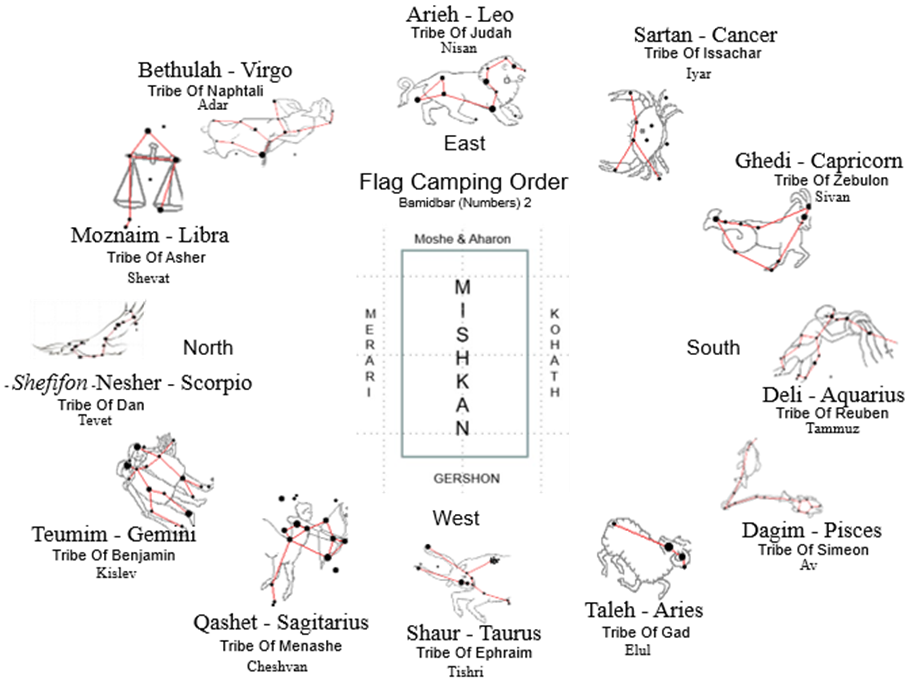
Ashlamatah: Yehezchel (Ezekiel) 1:1-28; 3:12
|
Rashi |
Targum |
|
1. Now it came to pass in the thirtieth year in the fourth [month] on the fifth day of the month, as I was in the midst of the exile by the river Chebar- the heavens opened up, and I saw visions of God. |
1. It was in the thirtieth year from the lime that Hilkiah the High Priest found the Book of the Torah in the Temple, in the court under the entrance; during the night, after the beginning of moonlight: in the days of Josiah son of Amon king of the tribe of the House of Judah; on the fifth day of the month of Tammuz. The prophet said: "I was among the exiles on the river Chebar, the heavens opened, and I beheld, in the prophetic vision that rested upon me, a vision of the glory of the Shekinah of the LORD, |
|
2. "On the fifth of the month"-that is the fifth year of King Jehoiachin's exile. |
2. On the fifth of the month, it being the fifth year of the exile of King Joiakin, |
|
3. The word of the Lord was [revealed] to Ezekiel the son of Buzi, the priest, in the land of the Chaldeans, by the river Chebar, and the hand of the Lord came upon him there. |
3. The word of prophecy from before the LORD was with Ezekiel, son of Buzi the priest, in the land of Israel, and again once more He spoke with him in the country of [he land of the Chaldeans on the river Chebar; and there the spirit of prophecy from before the LORD rested upon him, |
|
4. And I saw, and behold, a tempest was coming from the north, a huge cloud, and a flaming fire with a brightness around it; and from its midst, it was like the color of the chashmal from the midst of the fire. |
4. And I saw, and behold, a whirlwind came from the north, a large cloud, and a flaming fire, surrounded by splendor: and from the midst of the cloud, and from the midst of the whirlwind. something similar to Hashmal from the midst of the fire, |
|
5. And from its midst was the likeness of four living beings, and this is their appearance; they had the likeness of a man. |
5. And from the midst of it, the likeness of four creatures: their appearance they had the likeness of a man, |
|
6. And [each] one had four faces, and [each] one had four wings. |
6. Each had four faces and each and every one of the faces had four faces, sixteen faces to each creature, the number of faces of the tour creatures being sixty-four. Each had four wings and each and every one of the faces had four wings, sixteen wings to every single face, sixty-four wings to every single creature: the number of wings of the four creatures being two hundred and fifty-six. |
|
7. And their legs were straight legs, and the soles of their feet were like a round foot, and they sparkled like the color of burnished copper. |
7. Their feet were straight feet, and the soles of their feet were like round soles. and when they moved, they would shake the earth. and they shone like burnished bronze. |
|
8. And human hands were beneath their wings on their four sides, and their faces and their wings were [the same] to all four of them. |
8. Hands like the hands of a man were fashioned for them from beneath their wings on their four sides, with which to lake out burning coals of fire from among the cherubim underneath the expanse, which was over their heads, placing them into the hands of the seraphim to sprinkle on the place of the wicked, to destroy the sinners who transgress His Word. And their faces and their wings were the same on the four of them. |
|
9. Their wings joined one to the other; they did not turn when they walked; each one would go toward the direction of his face. |
9. Their wings were directed towards one another. They did not turn as they went each creature went straight ahead, |
|
10. And the likeness of their faces was the face of a man, and the face of a lion was on their right, to the four of them, and the face of an ox to their left, to the four of them, and the face of an eagle [was] to the four of them. |
10. And the likeness of their faces the face of a man and the face of a lion were fashioned on the right side of the four of them: the face of an ox was fashioned on the left side of the four of them: and the face of an eagle on the four of them. |
|
11. And so were their faces. And their wings were extended upward; each one had two wings joined to each other, and two covering their bodies. |
11. Their faces and their wings were spread out above; each had two directed towards the other; and two covering their bodies. |
|
12. Now each one would go toward the direction of his face; wherever would be the will to go, they would go; they did not turn as they walked. |
12. Each creature went straight ahead; they went to whatever place they wished to go; they did not turn as they went. |
|
13. And the likeness of the living beings; their appearance was like fiery coals, burning like the appearance of firebrands; it was going among the living beings; and there was a brightness to the fire and from the fire came forth lightning. |
13. As to the likeness of the creatures, their appearance was like burning coals of fire; like the appearance of flaming fiery torches between the creatures; and there was brightness to the fire, and from the fire there went forth lightning. |
|
14. And the living beings would run and return, like the appearance of the sparks. |
14. And the creatures, when they are sent to do the will of their Master who makes His Shekinah dwell on high above them. are like the eye seeing a bird on the wing. They turn and circle the world; and the creatures return together, quickly, like a flash of lightning. |
|
15. And I saw the living beings, and behold, one wheel [was] on the ground beside the living beings for its four faces. |
15. And I beheld the creatures, and behold, one wheel was placed just below the heavenly heights, beside the creatures, on its four sides. |
|
16. The appearance of the wheels and their work was like the appearance of crystal, and the four of them had one likeness, and their appearance and their workings were as a wheel would be within a wheel. |
16. The appearance of the wheels and the way they were made were like a precious stone, the four of them having one likeness; and their appearance and their operation was as though it were a wheel within a wheel. |
|
17. When they went, they went toward their four sides; they did not turn when they went. |
17. When they went, they would go on their four sides, they did not turn as they went. |
|
18. And they had backs, and they were very high, and they were dreadful, and their eyebrows were full of eyes round about-[so it was] to the four of them. |
18. Their backs were set opposite the expanse of the sky, and they were tall and awesome, their backs being full of eyes round about all four of them. |
|
19. And when the living beings would go, the wheels would go beside them; and when the living beings would lift themselves off the ground, the wheels would lift themselves. |
19. When the creatures went, the wheels went correspondingly, and when the creatures rose to just below the heavenly heights the wheels also rose. |
|
20. Wherever there was the will to go, they would go; there was the will to go, and the wheels would lift themselves correspondingly to them, for the will of the living being was in the wheels. |
20. Wherever they wished to go, there they would go, according to their will; and the wheels rose correspondingly, for a spirit like that of the creatures was in the wheels. |
|
21. When they [the living beings] would go, they [the wheels] would go, and when they would stand, they would stand, and when they would lift themselves up from the ground, the wheels would lift themselves correspondingly to them, for the will of the living being was in the wheels. |
21. When they would move, they would move; and when they stood still, they would stand; and when they rose to just below the heavenly heights, the wheels would rise correspondingly; for a spirit like that of the creatures was in the wheels. |
|
22. And there was a likeness over the heads of the living beings, of an expanse like the color of the severe frost extended over their heads above. |
22. The likeness above the heads of the creatures was a firmament, like a mighty ice field, inclined towards their heads from above. |
|
23. And beneath the expanse, their wings were straight, one [pointed] toward the other; this one had two that covered, to here, and that one had two that covered, to here, their bodies. |
23. And underneath the firmament their wings were extended one towards the other; each had two covering them: each had two covering their bodies. |
|
24. And I heard the sound of their wings, like the sound of many waters like the voice of the Almighty-when they went; the sound of stirring, like the sound of a camp; when they would stand, they would let down their wings. |
24. And I heard the sound of their wings, like the sound of many waters, like a sound from before Shaddai; as they went, the sound of their words were as though they were thanking and blessing their Master, the ever-living King of the worlds; like the sound of the hosts of the angels on high; when they stood still, their wings became silent. |
|
25. And there was a voice above the expanse that was over their heads; when they stood still, they would let down their wings. |
25. And at such time when it was His will to make the Dibbur audible to His servants the prophets of Israel, there was a voice which was heard from above the firmament which was above their heads. When they stood still, their wings became silent before the Dibbur. |
|
26. And above the expanse that was over their heads, like the appearance of a sapphire stone, was the likeness of a throne, and on the likeness of the throne, was a likeness like the appearance of a man upon it above. |
26. And above the firmament which was over their heads there was like the appearance of a precious stone, the likeness of a throne; and above the likeness of the throne there was the likeness of the appearance of Adam above it from on high. |
|
27. And I saw like the color of chashmal like the appearance of fire within it round about, from the appearance of his loins and above; and from the appearance of his loins and below, I saw [a thing] like the appearance of fire, and there was a brightness round about it. |
27. I saw something like the Hashmal, like the appearance of fire from the midst of it round about, an appearance of glory which the eye is unable to see, and such that it is impossible to look at it and upward; an appearance of glory which the eye is unable to see, and such that it is impossible to look at it and downwards I saw what appeared to be fire; and it was surrounded by splendor. |
|
28. Like the appearance of the rainbow that is in the cloud on a rainy day, so was the appearance of the brightness round about; that was the appearance of the likeness of the glory of the Lord, and when I saw, I fell on my face, and I heard a voice speaking. |
28. Like the appearance of the rainbow that is in the cloud on a rainy day, so was the appearance of splendor round about. It was the likeness of the glory of the LORD. And when I saw it, I fell upon my face, and I heard a voice which was speaking. |
|
|
|
|
3:12. And a wind lifted me up, and I heard behind me the sound of a great uproar: "Blessed is the glory of the Lord from His place." |
12. Then the spirit lifted me up, and I heard behind me a great quaking sound, for they were offering praise and saying, “Blessed be the glory of the LORD from the place of the abode of His Shekinah.” |
Rashi’s Commentary on Yehezchel (Ezekiel) 1:1-28; 3:12
1 Now it came to pass in the thirtieth year The prophet presented his words obscurely and did not tell his name, who he was; nor did he explain from what date he was counting. Therefore, the holy spirit interrupted his words in the following two verses to teach [us] who the prophet was and to teach [us] from what date he was counting. As it is said: “On the fifth day of the month that is the fifth year, etc.” These are not the words of the prophet, for he already stated that he was standing on the fifth of the month, and furthermore, from the beginning he had stated his prophecy in the first person: “and I was in the midst of the exile”; “and I saw visions of God.” And so at the end: “And I saw, and behold, a storm wind, etc.” Now these [next] two verses interrupted his words, as though someone else was speaking about him: “The word of the Lord was [revealed] to Ezekiel... and the hand of the Lord came upon him there.”
as I was in the midst of the exile i.e., outside the land of Israel.
by the river Chebar The name of the river.
visions of God Heb. מַרְאוֹת. Because he did not see with a “lucid speculum,” he calls it “visions of God,” a sort of dream, insubstantial. All the prophets also saw through a “dim speculum,” except for our teacher Moses. That is what is said (Hos. 12:11): “and to the prophets, I assumed likenesses.”
2 that is the fifth year of King Jehoiachin’s exile Thus, we may deduce that the thirty years he counted, he counted from the beginning of the jubilee [cycle]: the last jubilee commenced at the beginning of the eighteenth year of Josiah[‘s reign]; that is, the year that Hilkiah found the scroll (II Kings 22). So we learn in Seder Olam (ch. 26), that the beginning of the jubilee was that [year]. Josiah reigned thirty-one years. Subtracting from them the seventeen years that had already passed leaves fourteen years. Jehoiakim reigned eleven years; [together, that] totals twenty-five years. Jeconiah [Jehoiachin] his son, had reigned only three months when he was exiled, and the year that Ezekiel prophesied was the fifth [year] of his exile, hence the thirtieth year of the jubilee. And so we find that at the end of his prophecy, he gives a sign using the count of the jubilee [as a reference], for it says (40:1): “In the twenty-fifth year of our exile, at the beginning of the year, on the tenth of the month.” Our Rabbis said (Arachin 12a): What “year” is it that begins on the tenth of the month? You must say that this is the jubilee year [See Leviticus 25:9f.].
3 The word of the Lord was [revealed] Heb. הָיֽה הָיָה [lit. being was.] Our Sages said (Mechilta to Exod. 12:1): “[It] had already come,” because the Shechinah does not rest upon a prophet outside the [Holy] Land, except by having first rested upon him in the Land. We learned in a Baraitha of the Mechilta (Exod. 15:9): [The verse 2:1,] “Son of man, stand on your feet,” was the [actual] beginning of the Book, only there is no chronological order [in Scripture]. Others say that (12:1f.) “Son of man, compose a riddle,” is the [true] beginning of the Book. [Mechilta ends here.] I say that this prophecy was told to him before they were exiled, because it is appropriate to be said to him in the Land, for the community of the exile is not mentioned explicitly in it. It can be recognized as the beginning of his mission to them. Jonathan, too, paraphrased in that manner: The prophetic word from before the Lord was revealed to Ezekiel the son of Buzi the priest in the land of Israel; it returned a second time and spoke with him in the state of the land of the Chaldeans. Now Ezekiel was exiled with the “craftsmen and the sentries of the gates,” who were exiled with Jehoiachin.
the hand of the Lord Every expression of יַד mentioned in this Book or in any expression of prophecy is invariably an expression of compulsion, [implying] that the prophecy seizes him against his will, like a person going mad, destreze in Old French, compulsion.
4 and behold, a tempest was coming from the north That is the Chariot of the throne of the glory of the Shechinah, as it is described in this chapter (verse 28). Since it came with fury to destroy Israel, it is therefore likened to a tempest and a [storm] cloud.
coming from the north It was returning from the land of the Chaldeans, which is in the north. As it is said (Jer. 1:14): “From the north the misfortune will break forth.” And why did it go there [first]? In order to subjugate the whole world to Nebuchadnezzar, to prevent the nations from saying that He delivered His children into the hands of a lowly nation, for the Chaldeans were [considered] a lowly nation. As it is said (Isa. 23:13): “this people has never been.” So did our Sages expound on this verse in tractate Chagigah (13b).
with a brightness around it Surrounding the cloud on the outside, implying that Israel was destined to be redeemed from there [Babylonia].
it was like the color of the chashmal “Chashmal” is an angel bearing that name, and he [Ezekiel] saw [something] like the appearance of its color in the midst of the fire. And so did our Sages say: There was an incident involving a child who was expounding on the account of the Chariot. He perceived the meaning of “chashmal,” [whereupon] fire emanated from the chashmal and consumed him. They said further that the word itself is a combination: When they asked, “What is chashmal?” replied Rav Judah, “Living beings (חֶיוֹת) of fire (אֵש) that speak (מִמַלְלוֹת).” In a Baraitha we learned: Sometimes silent (חָשּׁוֹת), sometimes speaking (מִמַלְלוֹת) when the speech emanates from the mouth of the Holy One, blessed be He, they remain silent. When the speech does not emanate from the mouth of the Holy One, blessed be He, they speak; that is, they laud and praise the Lord (Chag. 13). [Possibly, “chashmal” is the name of the color resembling the color of fire, for he said, “Chashmal from the midst of the fire,” and he said (verse 27): “the color of chashmal, the appearance of fire within it found about, from the appearance of his loins and above.” And, he says in the second vision (8:2): “and from his loins and above was like the appearance of a splendor, like the color of chashmal.” An addendum that I heard.] And from the midst of it, [i.e.,] that fire, I saw something like the color of chashmal that appeared from the midst of the fire. But we do not know what it is, and the midrash that our Sages expounded on it, [defining “chashmal” as] living beings of fire that speak, does not seem to me to the context.
5 they had the likeness of a man This is surprising, because they had also the likeness of an ox, a lion, and an eagle! Apparently, since this [being] is the patron of them all [all the living beings], the prophet praises the Chariot with it. [Their human face] had the countenance of our father Jacob.
6 and each one had four faces “Each one” means that the human countenance had four faces, as did that of the lion, the eagle, and the ox, totaling sixteen [faces] to one living being. It was thus for each living being, and four wings for each of the faces, totaling sixty-four wings for each living being. This is [why] Jonathan paraphrased: two hundred fifty-six wings.
7 were straight legs [Jonathan renders]: רִגְלִין כֵּיוָנָן parallel legs, this one opposite this one. Another explanation: “straight,” meaning they had no knee joints by which to bend their legs because they do no sitting or lying. Therefore, they do not require joints like those of animals the upper joint and the lower joint by which it bends its legs to lie down.
a round foot Heb. עֵגֶל, a round foot, and so did Jonathan render it: round feet.
and they sparkled Because of their brilliance, sparks seemed to emanate from them, as we say in tractate Yoma (37b): She too [Queen Helene] made a golden candelabrum, etc. When the sun shone, sparks would [seemingly] emanate from it, etc. וְנוֹצְצִים is etincelants in French, gleaming.
like the color Heb. כְּעֵין, like מַרְאֶה, the appearance.
burnished copper Heb. קָלָל, clarified and gleaming. Menachem (Machbereth p. 155) associated it with (Lev. 2:14): “roasted (קָלוּי) in fire.”
8 And human hands were beneath their wings As the Targum paraphrases: to pick up coals of fire with them, etc. Likewise, we find in this Book (10:7): “And the cherub stretched forth his hand, etc. to the fire that was between the cherubim, and he picked it up and gave it to the hands of the one dressed in linen.” And so, [in the verse] after it, “And there appeared to the cherubim the form of a human hand, etc.” The human hands pick up the fire and give it to the cherub, and the cherub [gives it] to the messenger, in order [to allow] the coals to cool off [as they pass] from hand to hand, to mitigate Israel’s punishment.
on their four sides To the four directions of the world, for they have faces and wings in every direction.
and their faces and their wings were the same to all four of them As the Targum renders: were the same to all four of them.
9 Their wings joined one to the other Each one’s wing was spread out to the side of the other one’s wing this way [lit. to here] and that way [lit. to here] until they join and touch each other, thereby covering their faces, for the wings are spread out over the face.
they did not turn when they walked If they wished to walk in any desired direction, they did not need to turn their faces because they have faces on every side; therefore each one went in the direction of his face in the direction of the face on that side where they desired to go, they would go.
11 And so were their faces, and their wings were extended upward Had I not seen the cantillation sign of a “zakef gadol” [indicating a pause] punctuating “And so were their faces,” I would not know how to explain it, but the punctuation taught me to separate them [the words of the verse] one from the other and to place the word וּפְנֵיהֶם by itself. And so, [this] is its explanation: And they had faces and their wings were extended above their faces and covered them. How so? “Each had two wings joined to each other” to each face, their two wings were joined. On each one, the wing of this living being was stretched out towards the side of that living being, and this one’s towards the side of this one, and the face that was in between was covered by them. [A verse whose wording] is similar to the language of this verse appears again in this chapter (verse 18): “And they had backs, and they were very high, and they were dreadful.” The word וְגֲבֵּיהֶן, “and they had backs,” stands by itself.
and two covering their bodies And the two remaining wings would cover their bodies.
12 wherever would be the will Heb. רוּחַ, usually spirit, here means will: the will to go.
13 it was going among the living beings That appearance (מַרְאָה) was going among all the living beings.
there was a brightness to the fire More than [there is to] our fire.
lightning Heb. בָּרָק, flandours in Old French, lightning flashes.
14 would run and return, like the appearance of the sparks Our Sages explained (Chag. 13b): They would run and return like the flame of a furnace, which constantly shoots out of the mouth of the furnace and hastens back to enter. So, when they would thrust their heads out from under the expanse that was extended above them as is delineated in the chapter they would recoil because of the Shechinah, which is above the expanse, and they hasten to pull their heads [down].
like the appearance of the sparks Heb. הֲבָּזָק, de l’etincelle in French, and the color of their fire is like the color of the fire that emanates from between the shards within which gold is refined in a furnace. The fire that emanates from there is colored with these colors (ibid.). [Addendum Others explain הַבָּזָק as an expression of scattering, as our Sages explained it (Gen. Rabbah 50:1): “like the appearance of the bazak” R. Judah in the name of R. Simon in the name of R. Levi the son of Perata: Like one who scatters (הַבּוֹזֵק) ‘gefeth’ in a stove, i.e., he scatters ‘gefeth’ the residue of olives in a stove: it ignites quickly and raises a flame, and the flame ascends and descends, and this is the meaning of “would run and return.” Furthermore, we find in their words (Sanh. 108b, according to Aruch) בזק used as an expression of scattering: “He scattered (בָּזַק) dust on them and it turned into swords,” meaning he scattered, and so in the Mishnah (Eruvin 10:14): “We may scatter (בּוֹזְקִין) salt on the ramp so that they should not slip.” בזק may also be defined as ברק (lightning), which is an expression of searching. End of addendum, not found in (sic) all editions.]
15 one wheel [was] on the ground On the floor of the expanse.
for its four faces of each living being, or the wheel had four faces. Our Rabbis said (Chag. 13b): “This is Sandalphon [the angel], who stands on the ground yet whose head reaches up among the living beings.” From the context we learn that the wheels were four.
16 like the appearance of crystal Heb. תַּרְשִּׂישּׂ, like a precious stone named tarshish, cristal in French.
as...would be A wheel set within a wheel, crosswise. Since they go to every side, with their faces to the four directions, the wheel must roll in its four directions.
17 toward their four sides, etc. Because of the working of the wheels, he had to repeat them [i.e., the description of the living beings’ movements], to say that the wheels did not stop them because they [the living beings] too were made for that [i.e., moving in four directions].
18 And they had backs Heb. וְגַבֵּיהֶן, lit. and their backs. And they had backs.
and they were very high, and they were dreadful They were frightful to look upon. Others interpret: “they had fear,” meaning they stood in awe.
and their eyebrows Heb. וְגֲבּֽתָם, et leurs sourcils in French.
Were full of eyes round about to see in all directions, for they did not turn when they went.
19 off the ground Off the floor of the expanse, and so did Jonathan render: “off the high heavens”; meaning when they lifted themselves up from the depths to the heights.
20 the will The will of the Holy One, blessed be He.
there was the will to go It was not necessary to tell them [to go] to this side [or that] because the will of the Holy One, blessed be He, was in the living beings, and the will of the living beings was in the wheels.
21 When they would go Heb. בְּלֶכְתַּם, [i.e.,] the living beings.
they would go Heb. יֵלְכוּ [i.e.,] the wheels.
22 the severe frost Jonathan rendered: גְלִיד חֲסִין, severe frost, gelee forte in French.
23 straight Parallel.
24 like the sound of many waters I would think that the voice was low. Therefore, Scripture adds like the sound of the Almighty, like the voice delineated in the Holy Writings (Ps. 29:4f.): “The voice of the Lord is in strength, etc. The voice of the Lord breaks the cedars.”
the sound of stirring, like the sound of a camp Like the sound of their speech when they thank and bless their Master; it was like the sound of the camp of the angels on high.
when they would stand, they would let down their wings [and cease] from making a sound be heard, and Jonathan rendered: when they would stand, they would silence their wings because of the speech, [i. e., because of] the speech of the Omnipresent emanating from above their heads, to let the prophets hear His mission, as he [Ezekiel] concludes (verse 25): “And there was a voice, etc.” The Midrash Aggadah (Gen. Rabbah 65:11) states: “When they would stop praising [God] so that Israel would praise first.”
25 And there was a voice above the expanse Jonathan rendered: And at the time that there was a will before Him to make His speech heard to His servants the prophets of Israel there was a voice, and it was heard from above the expanse, from between the cherubim, from beneath the expanse that was over their heads.
they would let down their wings out of the fear of the speech.
27 And I saw like the color of chashmal No permission was granted to ponder over this verse.
within it Within it was like the appearance of fire.
28 and I fell on my face I prostrated myself.
and I heard a voice speaking And what did it say?
3:12 And a wind lifted me up After He finished His words, He commanded the wind to carry me to the place where the people of the exile were.
Commentary on the Ashlamatah of (yeḥezḳē’l ) Ezekiel 1:1-28 & 3:12
By: H.Ex. Adon Shlomoh Ben Abraham
This Parsha reading is referred to by the Sages as Ma’aseh Merkavah “The Account of the Chariot.” The first three verses give the time and place of the vision, and the remaining part of the chapter describes the vision itself in supernatural concepts, however, in human terms. Ezekiel speaks of the workings of the heavenly throne, a topic so far from human comprehension that even the Sages of the Talmud felt inadequate to interpret it. They go on to say this Parsha cannot be understood literally, nor are we equipped to glimpse their inner meaning at this time.[48] With this as our starting point, we only attempt to rehearse what our teachers who have gone before us shared. I attempt to make some associations and observations from other texts written since Ezekiel’s writing, but we make no claims of infallibility; we only hope to be informative.
Ezekiel spoke eloquently about the downward spiral of the leadership and the common people of Eretz Israel. Ezekiel reminded them of their origins and how Hashem brought them from Egypt to Sinai and from there to the Promised Land. Lest anyone think that Sinai was irrelevant to them because it happened nearly nine centuries before, and the world had changed since then. Ezekiel spoke of the Exodus and the Torah as a living, immutable heritage. God had not changed, the Torah had not changed, and Israel must not change.[49]
It has been noted that the phrase (ben adam), occurs only in Ezekiel, in whom we find it about eighty times, and in Dan. 8:17. Elsewhere, such as Numb. 23:19; Ps. 8:4; Job 25:6; Isa. 51:12; 56:2, it is used in a form to show that Hashem and man are not to be confused and that man is created from the ground (adamah) as in Gen. 2:7; 3:19. The prophet is reminded, at that very moment of his highest revelation of his Adamic-nature along with all its infirmity and limitations. The above statement is most likely the single most important thing the modern religious man should understand, Hashem and man are not to be confused, and that man is created from the ground (adamah) as in Gen. 2:7; 3:19. Scholars have noted that Ezekiel and Jeremiah are linked either by knowing and studying with each other or at least being familiar with the other’s writings. Ezekiel is believed to have quoted or alluded to Jeremiah some ten to fifteen times. Also, Ezekiel quotes about one hundred times from the five books of Moses, being a priest, he would have been most familiar with these texts.
In the fourth month. Both here and in ver. 2 the months are probably reckoned from Abib, or Nisan, the month of the Passover, with which the Jewish year began (Exod. 12:2; Neh. 2:1; Esth. 3:7), so that the fourth month, known by later Jews as Tammuz, would bring us to June or July in our calendar. [50] If our understanding is correct, Ezekiel had his vision on the fifth of Tammuz while among the exiles by the Chebar canal. It’s also interesting that when we look at our current calendar, we are reading this at this time of the year [June] and on the biblical calendar at the time of Shavuot [Sivan] or, as translated, at the time of Pentecost. Another interesting link is to be found when we look at Tammuz five, we see this is the time Moses goes up on Sinai the first time to receive the Torah. Moses also sent spies to search out the land.[51] The phrase, “The heavens were opened,” is not found elsewhere in the Tanakh except in Gen 7:11 when the windows of “the heavens were opened” and the rains began to fall when Noah entered the ark. The idea also appears in Yeshua’s baptism in the river Jordan (Matt. 3:16, John 1:51) Steven’s stoning (Acts 7:56) and in Peter’s vision of the great sheet let down from heaven (Acts 10:11). In Noah’s day this happened in the second month on the seventeenth day of the month, Iyar 17. This is the 32 days of the Omer count. Here in the opening verse of our reading, we have a connection with the theme of Noah’s flood, the Torah given at Sinai and the festival of Shavuot. [52]
“In the thirtieth year” Scholars discuss the opening verses and several opinions come forth as to the date of the vision, one is dating from the temple’s destruction and the exile of Ezekiel, another is that it alludes to Ezekiel’s age at the time of his vision, and the third choice according to the targum is that Ezekiel is about thirty years from the reforms of Josiah and the scroll found hidden in the temple under Hilkiah the Kohen Gadol. (2kings 22-23) In Jewish reckoning, thirty was the age of full maturity at that age, of the earlier Levites (Numb. 4:23, 30, 39, 43, 47) when they would have entered on their duties. Some believe that it was the normal age for the functions of the priesthood. In the case of the Nazarene Codicil [53] in Yeshua’s accounts (Luke 3:23) and of John the baptizer, it appears to have been the starting point of a prophet’s work or public ministry. According to the Targum, it was the thirtieth year from the time Hilkiah found a Torah scroll in the Temple (2kings 22:7ff) an event which caused a turnabout in the nation. The scroll was rolled to Deuteronomy 28:36 and foretells that the sin of Israel would cause Israel and its king to be exiled. Ezekiel was in a foreign land when he received his vision, which signifies that Israel remains God’s people even in exile.[54] The thirtieth year was also said to be the thirtieth year of the fifty-year (Yovel) jubilee cycle. The river Chebar, Radak thought, did not exist as a physical place, for when the letters are transposed, they spell out the three-letter root of Merkavah. He said the entire vision was a supernatural one, similar to Isaiah’s vision. Isaiah saw Hashem sitting on the throne, and at that time, the temple was still secure and standing. (Isa.6) However, Ezekiel's vision was of God on a “chariot”. One vision, the divine presence (Shechinah) was still in the temple, and the other vision shows the spirit of God was leaving or getting ready to leave the temple by the appearance of being in a chariot.[55]
We are told in (v.3) “the word of Hashem came.” The double form
indicates this is not the first time Ezekiel had heard the word of Hashem. “The hand of Hashem” was upon Ezekiel
there. This term is not telling us that God has a hand; it is a metaphor for
the might or power of God that was displayed on and to Ezekiel.[56] Behold,
a stormy wind came out of the north, a great cloud, with a fire flashing up, so
that a brightness was round about it.[57] And in this great wind or storm (v.4), destruction comes from Babylonia in
the North (Jer.1:14).[58] The vision has a storm, fire, and cloud,
so that the nation would know that in the mist of the storm of judgement and
exile, Hashem would be with his people in the fire and cloud just as in the
wilderness of Siani. Ezekiel said in the midst of the fire, something like
gleaming metal,חַשְׁמַל (ḥašmal), believed to be like amber,
a gleaming substance almost translucent, some described it as something that
shines. Rashi, based on Chagigah 13a described it as an angel in the midst of
the fire, sometimes it stands silent and other times it speaks. In the midst
of this (Hasmal) the likeness of four Chayot. The  meaning of (chayot) is obscure, with the
Targum telling us they are living creatures. Later in our reading in (v.10)
they are described as Divine beings whose exact nature is obscure. They were
bearers of the Merkavah,[59] the chariot or throne of God used when
the Shechinah (divine Presence) wanted to perform an act in exile. [60] They are described as the likeness of a
man, of a lion, an ox, and an eagle. Rashi said the human likeness was
preeminent. The likeness of the body was of a man, and the image of our
forefather Jacob. (Rashi)[61] Each Chayah had the likeness of all four
faces. In the four faces of angelic creatures, the man represents ‘intellect’,
the lion ‘physical power’, the Ox represents “the physical power of movement”
to move the divine chariot. The eagle represents the ability or power to take
flight. (Abarbanel)
meaning of (chayot) is obscure, with the
Targum telling us they are living creatures. Later in our reading in (v.10)
they are described as Divine beings whose exact nature is obscure. They were
bearers of the Merkavah,[59] the chariot or throne of God used when
the Shechinah (divine Presence) wanted to perform an act in exile. [60] They are described as the likeness of a
man, of a lion, an ox, and an eagle. Rashi said the human likeness was
preeminent. The likeness of the body was of a man, and the image of our
forefather Jacob. (Rashi)[61] Each Chayah had the likeness of all four
faces. In the four faces of angelic creatures, the man represents ‘intellect’,
the lion ‘physical power’, the Ox represents “the physical power of movement”
to move the divine chariot. The eagle represents the ability or power to take
flight. (Abarbanel)
Verse six describes them as if everyone had four faces, and every one of them had four wings. They had faces to point toward their direction of travel, and they had wings to bring that travel to pass. Abarbanel and Malbim tell us that the faces and wings represent different divine attributes and the behavior that derives therefrom, and the different permutations on the four sides represent different divine behaviors. I would add, the behaviors are played out in our world as the divine presence works to accomplish the dream of the creator. The creature is described as having straight legs together at the feet, which would resemble one leg.[62]
And they had the hands of a man under their wings on their four sides; and as for the faces and wings of them, four. The “Hands of a man” is spelled differently here in the text and is repeated[63] and could be understood as “and his hand is man” or, as Radak said, the hand of the angel was like a human hand. The hands were used to gather the coals that were handed over to be thrown on the wicked (targum and Eze. 10). The coals went through the several pairs of hands until they were thrown at the wicked people of Jerusalem and in this manner the extreme heat (judgement) of the coals would be mitigated before they were thrown at the wicked. Had the coals not been cooled, Israel would have been exterminated, heaven forbid. [64]
In verse nine, Abarbanel tells us it is a metaphor for the friendly relationship they had with each other, with no disputes or disagreements, nor pulling in different directions. Their wings were joined one to another; they turned not when they went; they went everyone straight forward. Each was working in unison with the other to carry out their mission. Then in verse twelve, they went everyone straight forward; whither the spirit was to go, they went; they turned not when they went. They would go wherever the Divine will wanted them to go. An angel or messenger has no will of its own; it exists exclusively to carry out Hashem's will.[65] This reminds me of the passage in the NC in (Matt 12:50, Mark 3:35), For whoever does the will of God, he is my brother and sister and mother[66] and (Luke 8:21). This is consistent with the way the NT [NC] speaks of the will of God—the divine will in the NT [NC] refers almost always to that of God the Father. Of the forty-nine times in the NT that θέλημα is used in reference to God or Jesus, at least forty-seven refer to the Father,[67] and only one (Eph. 5:17), or possibly two (Col 1:9) (Acts 21:14), are more ambiguous but could refer to Jesus. Moreover, one prominent feature of the relevant NT[NC] texts is that they speak of [Messiah] doing the will of his Father, thus indicating a distinction between the roles of the Father and the Son—a distinction.[68] And the living creatures ran and returned as the appearance of a flash of lightning. (v.14) The Baal Shem Tov shared homiletically, the Chayot symbolize the human soul. It longs to return to its spiritual origin, so it runs, as it were, to ascend to Hashem, but it is commanded to return to the body, because its mission is to elevate life on earth.
As Ezekiel watches the approaching storm, he sees four living creatures emerging as wheels. In 10:5 and 20 he refers to them as Cherubim. Cherubim are described as angelic beings. The first use of the word is in Gen 3:24. He drove out the man; and He placed at the east of the garden of Eden the cherubim, and the flaming sword which turned every way, to keep the way to the tree of life.[69] In our next verse 16, they appeared as ‘a wheel within a wheel’, an Ofan in the midst of an Ofan. These Ofanim could revolve and move effortlessly in any direction, and as they needed to travel, they had unrestricted movement in any direction. They travelled in the direction of their face, and the four faces moved with them. In (Exo 26:31) we are told their likeness [Cherubim] was embroidered on the curtain of the tabernacle to guard the holy of holies against any unauthorized entry. In the holy of holies, their likeness was placed on top of the ark where the tablets of the covenant were placed, and they affirmed God’s presence. It was there that Hashem would meet with Moses. (Exo.25:18-22) Rashi tells us the Ofanim have no independent capacity for movement, they only follow the divine will that controls the Chayot. The spirit of the Chayot in the Ofanim is like the soul within the body, says Malbim. Metaphorically speaking, the Ofanim represent the heavenly forces in the world. They are controlled by the Chayot, which are higher-level spiritual beings.[70] In verses 22-25 over the heads of the living creatures, there was the likeness of a firmament (expanse Gen 1:6), like the color of the terrible ice (crystal) stretched forth over their heads above. And under the firmament were their wings conformable one to the other; this one of them had two which covered, and that one of them had two which covered their bodies. When they went, I heard the noise of their wings like the noise of great waters, like the voice of the Almighty,[71] a noise of tumult like the noise of a host; when they stood, they let down their wings. For when there was a voice above the firmament that was over their heads, as they stood, they let down their wings. On a deeper level, the repetition indicates how the Divine bounty (Shefa) is transported from the upper world to the lower world. The wings, which represent the power to ascend on high, are directed up high and serve as the conduit for receiving the Bounty (Shefa)[72]
We see a similar picture in (Rev. 1:15, 4:6-8) and in Ezekiel’s vision, these spiritual beings [represented by images of the four] who were part angel, part human, and part animal were fitting representatives of [Hashem's] whole created order. Their activity affirmed the relationship of God to his creation as Lord of all things. This idea was vital in helping Ezekiel the captives in exile and the people in Judah understand that in the midst of the storms of life [and exile], God was still on his throne. He was not oblivious to their circumstances[73] Our Parsha lists ten characteristics of the cherubim. These servants of God were equipped uniquely to perform their assigned tasks. Every aspect of their appearance represented some characteristic related to the performance of those tasks.[74] In trying to understand the esoteric message being revealed to the prophet, one’s mind runs to and fro through the Torah looking for a connection. What is the image trying to convey? How can this picture reveal the workings and the glory of God as Riding, so to speak, on the Merkavah with the Chayot and the Ofanim moved and animated by the spirit of God, like the sound of many waters, like the sound of their wings, like the sound of Shaddai (Almighty). (v.24-26) In searching for an answer, commentators have discussed the connections with the temple and its imagery. My mind goes back to Genesis, where we see a correlation with God's acts of creation. Day one: Light and Day Five, fish and birds, and Day six, Land animals and humans.
|
Characteristic |
Description |
|
Form |
Appearance of a man |
|
Faces |
Four faces: lion, ox, eagle, human |
|
Legs |
Straight legs with gleaming hooves like a calf for stability and quick movement |
|
Hands |
Hands like a human hidden under the wings |
|
Movement |
Moved straight forward without turning |
|
Wings |
Four wings: two extended upward covering the face, two covering body |
|
Spirit |
Followed the Ruah (spirit/wind/breath) in their movement |
|
Appearance |
Like burnished bronze and coals of fire or torches |
|
Speed |
Movement as quick as flash of lightning |
|
Sound |
Wings made an awesome sound like rushing waters |
Our last two verses in this chapter deal with the appearance of the likeness of the glory of Hashem. Rashi does not comment on (v.26-28)[75] however, on (v.27) he says, “no permission was granted to contemplate this verse”. He goes on to say these verses represent the pinnacle of the Merkavah vision and a physical description of any sort is impossible and only comments on an elementary level.[76] Abarbanel and Metzudat emphasize the metaphoric nature of the vision. A sapphire stone in the likeness of a throne, above or upon the throne, a likeness like the appearance of a man. And I saw as the color of electrum [chashmal], as the appearance of fire round about enclosing it, from the appearance of his loins and upward; and from the appearance of his loins and downward I saw as it were the appearance of fire, and there was brightness round about him. In (v.4) above, and following the Chashmal as discussed in its context, it refers to great purity and clarity. The Hebrew word Chash and mal, i.e., to be careful [or quiet] (chash) and about what is said (mal), according to Abarbanel and Metzudat. In reality, no one seems to know the real meaning of Chashmal. Rambam (Moreh Nevuchim 3:7) writes that it’s noteworthy that the likeness of a man above the throne is divided. The upper part is left to the color of Chashmal, and the lower part is like the appearance of fire. Considering how the Sages clearly stated that the divided likeness of man does not represent God, who is above the chariot, it represents a part of creation. The Prophet likewise says [in the next verse] that the appearance was of the likeness of the glory…., but the appearance of His glory is different from Hashem Himself. All the figures in the vision refer to the glory of God, to the chariot, and not to him who rides upon the chariot, for God cannot be compared with anything.[77] In Verse 28, it is like the appearance of the bowl that would be in the clouds on a rainy day. Many of the colors of a rainbow do not exist in reality but are merely a refraction of light on water vapor. So, the prophetic vision does not actually exist in physical terms but is simply a reflection of a deep esoteric truth.[78]
When Ezekiel fell on his face, he ceased to see and is only able to hear. His physical reality no longer impeded his ability to receive; he began to understand the intense spiritual message of the [vision] prophecy. The last verse of our Parsha (3:12), Ezekiel says, Then a spirit lifted me up, and I heard behind me the voice of a great rushing: ‘Blessed be the glory of the Lord from His place.’ MaHari Kara[79] associates this with the wind [spirit] carrying Elijah about. (2 Ki 2:16) Regardless of whether the lifting up was physical, as standing a fallen person on their feet, or spiritually in Elijah being transported from one place to another, in context, both seem to have happened. Ezekiel heard the divine presence leaving its resting place above the ark of the covenant. Blessed be the glory of the Lord from His place. Our commentary says the word for blessed בָּרַךְ bāraḵ, falls short of the full meaning of the word. The source of the word is בדיכה, a spring, whose waters flow continuously. Hashem is the source from whom all blessings flow. Ezek 43:2 looks to the future when the glory of the God of Israel was coming from the east. And the sound of his coming was like the sound of many waters, and the earth shone with his glory. Ezekiel heard a sound behind him, and it is understood in Midrash Tanchuma 6 and Bereshit Rabbah 65:21 that this sound was not from behind, but “after him”. Elijah, in the voice of John, said he who is coming after me is mightier than I… He will baptize you with the Holy Spirit and fire. May he come speedily and in our days.
Blessing After Torah Study
Barúch Atáh Adonai, Elohénu Meléch HaOlám,
Ashér Natán Lánu Torát Emét, V'Chayéi Olám Natá B'Tochénu.
Barúch Atáh Adonái, Notén HaToráh. Amen!
Blessed is Ha-Shem our God, King of the universe,
Who has given us a teaching of truth, implanting within us eternal life
Blessed is Ha-Shem, Giver of the Torah. Amen!
“Now unto Him who is able to preserve you faultless, and spotless,
and to establish you without a blemish,
before His majesty, with joy, [namely,] the only one God, our Deliverer, by means of Yeshua the Messiah our Master, be praise, and dominion, and honor, and majesty, both now and in all ages. Amen!”
1st Day Afternoon Service – Monday, June 2, 2025 – Sivan 6, 5785
Blessings Before Torah Study
Blessed are You, Ha-Shem our G-d, King of the universe, Who has sanctified us through Your commandments, and commanded us to actively study Torah. Amen!
Please Ha-Shem, our G-d, sweeten the words of Your Torah in our mouths and in the mouths of all Your people Israel. May we and our offspring, and our offspring's offspring, and all the offspring of Your people, the House of Israel, may we all, together, know Your Name and study Your Torah for the sake of fulfilling Your delight. Blessed are You, Ha-Shem, Who teaches Torah to His people Israel. Amen!
Blessed are You, Ha-Shem our G-d, King of the universe, Who chose us from all the nations, and gave us the Torah. Blessed are You, Ha-Shem, Giver of the Torah. Amen!
Ha-Shem spoke to Moses, explaining a Commandment. "Speak to Aaron and his sons, and teach them the following Commandment: This is how you should bless the Children of Israel. Say to the Children of Israel:
May Ha-Shem bless you and keep watch over you; - Amen!
May Ha-Shem make His Presence enlighten you, and may He be kind to you; - Amen!
May Ha-Shem bestow favor on you, and grant you peace. – Amen!
This way, the priests will link My Name with the Israelites, and I will bless them."
These are the Laws for which the Torah did not mandate specific amounts: How much growing produce must be left in the corner of the field for the poor; how much of the first fruits must be offered at the Holy Temple; how much one must bring as an offering when one visits the Holy Temple three times a year; how much one must do when performing acts of kindness; and there is no maximum amount of Torah that a person must study.
These are the Laws whose benefits a person can often enjoy even in this world, even though the primary reward is in the Next World: They are: Honoring one's father and mother; doing acts of kindness; early attendance at the place of Torah study -- morning and night; showing hospitality to guests; visiting the sick; providing for the financial needs of a bride; escorting the dead; being very engrossed in prayer; bringing peace between two people, and between husband and wife; but the study of Torah is as great as all of them together. Amen!
Ruth 1:1 – 3:7
&
The Azharoth for Shabuot
An Introduction
By The Reverend Dr. David De Sola Pool
The Azharoth (Admonitions) enumerate the basic commandments of the Torah. These are traditionally 613 in number, equivalent to the numerical value of the letters of the Hebrew word Torah (611), with the addition of the first two commandments in which at Mount Sinai God himself spoke to Israel in the first person. Of these, 365 are reckoned as prohibitions and 248 as affirmative precepts. The rabbis of old point out that this should be suggestive of the constant validity of all of them on every one of the 365 days in the year for the whole body of man with its 248 parts.
On Shabuoth, the festival celebrating the giving of the whole Torah to the children of Israel, these 613 commandments are recalled. The 248 positive commandments are customarily read before afternoon service on the first day and the 365 prohibitions on the second day.
The version of the Azharoth traditionally read among Sephardim is by Solomon ibn Gabirol (1020-69), with an introduction by David ben Eleazar Bekuda, a poet of the twelfth century. Ibn Gabirol's version maintains one rhyme throughout in the last word of every one of its 255 quatrains, while within each quatrain the first three lines are also rhymed. The difficulties imposed by this extraordinary prosody and the fetters of meter and rhyme, as well as the difficulty of expressing each commandment concisely with allusive reminiscences of the Bible text, have compelled even so incomparable a master of classic Hebrew poetry as ibn Gabirol to put the commandments together without logical sequence, often with repetitions, and sometimes with words or phrases added solely to fill out the rhyme and the meter. In literal translation the subtle feeling of the poet's stylistic embellishments is inevitably lost.
The following paragraphs make no attempt at literal translation of Ibn Gabirol's version of the Azharoth. Instead they present in some ordered sequence the 613 commandments of the Torah which the poet has included in his masterly compilation.
The Positive Commandments
RELATIONS WITH GOD
Love God and serve him; cleave to him, walk in his paths, and sanctify him. Fear his anger. Acknowledge his justice, pursue his righteousness, keep his religious law, and carry out his commandments. Be perfect with him, be meek before him, and be holy. Write his words on your doorposts and on your gates.
PRAYER
Proclaim his unity morning and evening. Lay the tefillin on arm and head. Utter a hundred blessings a day and give thanks to God for your food.
PERSONAL ETHICS
Swear without falsehood and only in his name. Fulfill vows and keep the word that you have given. Give back that which has been wrongfully acquired. Free the mother bird when you take the eggs from the nest. Wear fringes of religious reminder on the border of your garment.
FAMILY RELATIONS
Honour father and mother and revere them. Be fruitful and multiply. Circumcise all male children. Redeem the first-born son and give to him a double portion in inheritance. Free the bridegroom from going forth to war in the first year of his married life. Marry the childless widow of your deceased brother or give her release through halitsah. Take in honourable marriage the woman captive of war who pleases you. Test by ordeal the wife suspected of unfaithfulness. Punish the man who slanders his wife. Cut off the hand of the publicly immodest woman.
JUSTICE
Be diligent in seeing that justice is done in all matters of human rights, property, and damages. Put to death false witnesses. Pay damages for injury done. Restore to its rightful owner property that has been found or dishonestly obtained. Have true balances, weights, and measures, and release all debts in the seventh year. Let the community sacrifice a heifer in atonement for an untraced murder.
LABOUR RELATIONS
Pay the labourer his hire on the day of his work. Proclaim freedom for bondservants at the jubilee, and at the jubilee or on his master's death free the Hebrew bond servant who has been sold for theft. Free the Hebrew bondwoman at the seventh year or at the jubilee, and the handmaid when she attains years of puberty. Respect the rights of the betrothed heathen bondwoman, and when you send your bondman free send him away well laden. A slave you may make of the Canaanite
RELATIONS WITH THE POOR
Show pity to the poor; be happy to help him, give to him generously and proportionately to your ability. Support the poor before he falls Clothe the naked. For the poor leave in the field the forgotten sheaf, the gleanings, the corner of the field, that which is dropped, and that which grows of itself in the fields in the seventh year. Comfort the poor with words. Lend to him and return his pledge and keep it not overnight.
RELATIONS WITH YOUR FELLOW MAN
Love your neighbour as yourself. Love the alien. Cheer the sick, bury the dead, and comfort the mourner. Respect the aged and rise up before him. Rebuke your neighbour for wrong done by him. Be happy in supporting your fellow man and help to raise his burdened animal Redeem those sold into bondage. Build a parapet on your roof that none may fall from the housetop.
NATIONAL ORGANIZATION
Set a king over you, and he will write for his guidance a copy of the Torah. Appoint judges and officers. Designate six cities of refuge in your land for the accidental manslayer. Assemble the people by trumpet call. Put to death the false prophet and the one who entices to idolatry and burn away idols and idolatrous groves. Proclaim on Mt. Ebal the blessings: and on Mt. Gerizim the curses and erect a national altar of plastered stones. Set out the Holy Land in its prescribed borders. Observe the law governing the sale of houses in walled cities and in open cities.
WAR
Impose the redemption tax of half a shekel in a census for war, and levy tribute on those who go out to war. Appoint a priest to guide you in war. Blot out Amalek. Spare the enemy city that surrenders. Destroy a city that lapses into idolatry and raze the captured city.
RITUAL PURITY
Segregate unclean persons, animals, liquids, and utensils. Bury excrement outside the camp. Cleanse by sprinkling him who has a running issue, and the leper, and cleanse the one who is contaminated by contact with the dead. The unclean from contact, from intercourse, from emission, must cleanse themselves by bathing at the statutory time. Avoid pollution and cleanse yourself if you have become polluted. The menstruous must cleanse herself by bathing, as must the mother of a new-born child. The priest must determine the cleanness or uncleanness of infected garments and houses.
DIETARY REGULATIONS
The fruit harvest of the first three years leave uneaten; that of the fourth year eat in the Temple, while that of the fifth and the following years may be freely eaten. Cover with dust the blood of a bird or wild animal slaughtered for food. The flesh of an animal that dies of itself may be eaten only by one who is not a Jew.
THE RELIGIOUS CALENDAR
Fix the calendar and the months of the year. Keep the Sabbath and make your Sabbath rest joyous. Sanctify your Sabbath over wine of rejoicing and kindle the lights of the Sabbath. Give Sabbath rest for your servants and your animals.
Celebrate the three festivals of pilgrimage to Jerusalem and bring their required festival offerings and make your pilgrimage festival joyous. Chant on the festivals the Hallel psalms of praise. On your festivals rejoice the widow, the orphan, the Levite, and the alien. Observe the month of Nisan and the Passover in that month. Annul all leaven on the Passover and sanctify its first and seventh days. On the eve of the festival eat the paschal lamb roasted on the fire, together with unleavened bread and bitter herbs, your loins girt and shoes on your feet. Offer the Orner sheaf of barley and count the days of the Omer for seven weeks from the Passover. Let those who are unclean on the Passover bring their paschal offering on the second Passover one month later.
Observe the Shabuoth festival of the weeks and offer your firstfruits with words of thanksgiving.
Keep holy the first day of the Succoth festival of booths, and the eighth day, observing the Eighth Day Closing Festival. Build your festival booth and wave the lulab (palm branch) cluster of four growths. Pour water on the altar on the festival of the booths.
Observe the New Year with the blowing of the Shofar, and the Day of Atonement as a solemn fast day. Bring on it the people's atonement sacrifice.
Light the lights of Hanukah and celebrate the happy holiday of Purim.
THE TEMPLE RITUAL OF SACRIFICE
Build God's House of worship according to the form he commanded. Revere the Temple. Dedicate it and its altar.
The priest must offer up the sacrifices to be burned, salt the sacrifice pinch off the neck of the dove, slay the bull or the ram, receive the blood, sprinkle it, and wave the offering and the breast. He must burn the red heifer for purification and send away the scapegoat on the Day of Atonement. He must mix and crumble the grain-offering and take a handful of it. The priest is entitled to twenty-four gifts, his portion of the thanksgiving offering, his portion of the dough which you bring as a wave-offering, the first shearing, the shoulder, and the breast sacrifices, that which is devoted, the estimated value of your vows, and a tithe of the Levite's tithe.
Twenty additional sacrificial offerings are to be brought to the altar There is the bullock for the sin-offering of the people, the offering that should be commensurate with the means of the one who brings it, and the sacrifice which varies with doubtful or certain guilt. There is the sacrifice by which he who was unclean marks his cleansing, the required fifth, the tithe of cattle, the first-born of cattle (though the first-born of the ass must be redeemed), and the tenth of an ephah of fine flour brought with each lamb. Sacrifices must be eaten in the Temple. That which is left over of the sacrifices must be burned, as must that which has become unfit.
The tithe of corn and of cattle must be taken up to Jerusalem. The tithe for the poor must also be brought, and the second tithe after the Levitical tithe must be eaten in the Temple. Confession must be made when giving the third-year tithe.
Let the priest provide the oil for anointing and for the lamps, pour out the oil of the sacrifices, prepare and provide the incense and offer it, set out the shew-bread in twin rows of six, and the two loaves of the new corn on Shabuoth,
The High Priest must marry only a virgin. He must lift his hands blessing over the people. The priest must wear special garments for Temple service, as must the High Priest for service within the Temple veil. He must conduct atonement for the people and bless the people.
THE TORAH
Revere the learned and honor the disciple of the learned. Learn and teach the Torah. The Torah must be read to all the people every three years. Teach it joyously and diligently to your children and disciples.
Write a Sefer Torah and make God's words the healing of your heart and lips.
Blessing After Torah Study
Barúch Atáh Adonai, Elohénu Meléch HaOlám,
Ashér Natán Lánu Torát Emét, V'Chayéi Olám Natá B'Tochénu.
Barúch Atáh Adonái, Notén HaToráh. Amen!
Blessed is Ha-Shem our God, King of the universe,
Who has given us a teaching of truth, implanting within us eternal life.
Blessed is Ha-Shem, Giver of the Torah. Amen!
“Now unto Him who is able to preserve you faultless, and spotless, and to establish you without a blemish, before His majesty, with joy, [namely,] the only one God, our Deliverer, by means of Yeshua the Messiah our Master, be praise, and dominion, and honor, and majesty, both now and in all ages. Amen!”