Esnoga Bet Emunah12210 Luckey Summit San Antonio, TX 78252 United States of America © 2025 E-Mail: gkilli@aol.com |
|
Esnoga Bet El102 Broken Arrow Dr. Paris TN 38242 United States of America © 2025 E-Mail: waltoakley@charter.net |
Triennial Cycle (Triennial Torah Cycle) / Septennial Cycle (Septennial Torah Cycle)
|
Three and 1/2 year Lectionary Readings |
Third Year of the Triennial Reading Cycle |
|
Shevat 24, 5785 - February 21/22, 2025 |
Third Year of the Shmita Cycle |
Candle Lighting and Habdalah Times: https://www.chabad.org/calendar/candlelighting.htm
Roll of Honor:
This Commentary comes out weekly and on the festivals thanks to the great generosity of:
His Eminence Rabbi Dr. Hillel ben David and beloved wife HH Giberet Batsheva bat Sarah
His Eminence Rabbi Dr. Eliyahu ben Abraham and beloved wife HH Giberet Dr. Elisheba bat Sarah
His Honor Paqid Adon David ben Abraham
His Honor Paqid Adon Ezra ben Abraham and beloved wife HH Giberet Karmela bat Sarah,
His Honor Paqid Adon Tzuriel ben Abraham and beloved wife HH Giberet Gibora bat Sarah
Her Excellency Giberet Sarai bat Sarah & beloved family
His Excellency Adon Barth Lindemann & beloved family
His Excellency Adon John Batchelor & beloved wife
His Excellency Adon Yehoshua ben Abraham and beloved wife HE Giberet Rut bat Sarah
His Excellency Adon Michael ben Yosef and beloved wife HE Giberet Sheba bat Sarah
Her Excellency Giberet Prof. Dr. Emunah bat Sarah & beloved family
His Excellency Adon Robert Dick & beloved wife HE Giberet Cobena Dick
His Excellency Adon Ovadya ben Abraham and beloved wife HE Giberet Mirit bat Sarah
His Excellency Adon Shlomoh ben Abraham
His Excellency Adon Ya’aqob ben David
His Excellency Adon Bill Haynes and beloved wife HE Giberet Diane Haynes
Her Excellency Giberet Krysta Wallrauch & beloved family
For their regular and sacrificial giving, providing the best oil for the lamps, we pray that GOD’s richest blessings be upon their lives and those of their loved ones, together with all Yisrael and her Torah Scholars, amen ve amen!
Also a great thank you and great blessings be upon all who send comments to the list about the contents and commentary of the weekly Torah Seder and allied topics.
If you want to subscribe to our list and ensure that you never lose any of our commentaries, or would like your friends also to receive this commentary, please do send me an E-Mail to gkilli@aol.com with your E-Mail or the E-Mail addresses of your friends. Toda Rabba!
Blessings Before Torah Study
Blessed are You, Ha-Shem our GOD, King of the universe, Who has sanctified us through Your commandments, and commanded us to actively study Torah. Amen!
Please Ha-Shem, our GOD, sweeten the words of Your Torah in our mouths and in the mouths of all Your people Israel. May we and our offspring, and our offspring's offspring, and all the offspring of Your people, the House of Israel, may we all, together, know Your Name and study Your Torah for the sake of fulfilling Your delight. Blessed are You, Ha-Shem, Who teaches Torah to His people Israel. Amen!
Blessed are You, Ha-Shem our GOD, King of the universe, Who chose us from all the nations, and gave us the Torah. Blessed are You, Ha-Shem, Giver of the Torah. Amen!
Ha-Shem spoke to Moses, explaining a Commandment. "Speak to Aaron and his sons, and teach them the following Commandment: This is how you should bless the Children of Israel. Say to the Children of Israel:
May Ha-Shem bless you and keep watch over you; - Amen!
May Ha-Shem make His Presence enlighten you, and may He be kind to you; - Amen!
May Ha-Shem bestow favor on you and grant you peace. – Amen!
This way, the priests will link My Name with the Israelites, and I will bless them."
These are the Laws for which the Torah did not mandate specific amounts: How much growing produce must be left in the corner of the field for the poor; how much of the first fruits must be offered at the Holy Temple; how much one must bring as an offering when one visits the Holy Temple three times a year; how much one must do when performing acts of kindness; and there is no maximum amount of Torah that a person must study.
These are the Laws whose benefits a person can often enjoy even in this world, even though the primary reward is in the Next World: They are: Honoring one's father and mother; doing acts of kindness; early attendance at the place of Torah study -- morning and night; showing hospitality to guests; visiting the sick; providing for the financial needs of a bride; escorting the dead; being very engrossed in prayer; bringing peace between two people, and between husband and wife; but the study of Torah is as great as all of them together. Amen!
A Prayer for Israel
Our Father in Heaven, Rock, and Redeemer of Israel, bless the State of Israel, the first manifestation of the approach of our redemption. Shield it with Your lovingkindness, envelop it in Your peace, and bestow Your light and truth upon its leaders, ministers, and advisors, and grace them with Your good counsel. Strengthen the hands of those who defend our holy land, grant them deliverance, and adorn them in a mantle of victory. Ordain peace in the land and grant its inhabitants eternal happiness.
Lead them, swiftly and upright, to Your city Zion and to Jerusalem, the abode of Your Name, as is written in the Torah of Your servant Moses: “Even if your outcasts are at the ends of the world, from there the Lord your God will gather you, from there He will fetch you. And the Lord your God will bring you to the land that your fathers possessed, and you shall possess it, and He will make you more prosperous and more numerous than your fathers.” Draw our hearts together to revere and venerate Your name and to observe all the precepts of Your Torah, and send us quickly the Messiah son of David, agent of Your vindication, to redeem those who await Your deliverance.
We pray for his Honor Adon Tzuriel ben Avraham. Mi Sheberach…He who blessed our forefathers Abraham, Isaac and Jacob, Moses and Aaron, David and Solomon, may He bless and heal His Honor Paqid Tzuriel ben Avraham, May the Holy One, Blessed is He, be filled with compassion for him to restore his health, to heal him, to strengthen him, and to revivify him. And may He send him speedily a complete recovery from heaven, among the other sick people of Yisrael, a recovery of the body and a recovery of the spirit, swiftly and soon, and we will say amen ve amen!
We pray for her Excellency Giberet Miriam bat Sarah, Mi Shebeirach… He Who blessed our holy and pure Matriarchs, Sarah, Ribkah, Rachel and Leah, may he bless and heal Giberet Miriam bat Sarah and may He send her a complete recovery to her 248 organs and her 365 sinews. Please heal her, please heal her, please heal her and strengthen her and return her to her original strength. May He send her a complete recovery of her body and her soul from the heavens among the other sick of Yisrael, and we will say Amen ve amen!
Shabbat: “V’Eleh Toldot Aharon” “And these [are the] generations [of] Aharon”
Shabbat Mevarchim HaChodesh; Proclamation of the New Moon of Adar
(Rosh Chodesh Adar – Friday/Saturday evening Feb 28/Mar 1, 2025)
|
Shabbat |
Torah Reading: |
Weekday Torah Reading: |
|
וְאֵלֶּה תּוֹלְדֹת אַהֲרֹן |
|
Saturday Afternoon |
|
“V’Eleh Tol’dot Aharon” |
Reader 1 – Bamidbar 3:1-20 |
Reader 1 – Bamidbar 27:15-17 |
|
“And these [are the] generations [of] Aharon” |
Reader 2 – Bamidbar 3:21-39 |
Reader 2 – Bamidbar 27:18-20 |
|
“Y éstas [son las] generaciones [de] Aarón” |
Reader 3 – Bamidbar 3:40-51 |
Reader 3 – Bamidbar 27:21-23 |
|
Reader 4 – Bamidbar 3:44-4:14 |
|
|
|
Ashlamatah: Yeshayahu (Isaiah) 45:19 – 46:2 + 13 Special: Shmuel alef (1 Samuel) 20:18-42 |
Reader 5 – Bamidbar 4:1-20 |
Monday & Thursday Mornings |
|
|
Reader 6 – Bamidbar 4:21-45 |
Reader 1 – Bamidbar 27:15-17 |
|
Tehillim (Psalms) 92:1-16 + 93:1-5 |
Reader 7 – Bamidbar 4:46-5:10 |
Reader 2 – Bamidbar 27:18-20 |
|
N.C.: 2 Pet 3b-16; Lk 16:14-31 |
Maftir – Bamidbar 5:5-10 |
Reader 3 – Bamidbar 24:21-23 |
Contents of the Torah Seder
· Descendants of Moses and Aaron – Numbers 3:1-4
· The Levites – Numbers 3:5-13
· The Families of the Three Sons of Levi – Numbers 3:14-24
· The Work Assigned to the Various Sons of Levi – Numbers 3:25-39
· Substitution of the Levites for the First Born – Numbers 3:40-51
· The Kohathites and their Duties – Number 4:1-15
· The Kohathites and Their Duties – Numbers 4:17-20
· The Gershonites and Merarites Their Counting and Duties – Numbers 4:21-33
· Totals of the Levitical Census – Numbers 4:34-49
· Removal of Unclean Persons from the Camp – Numbers 5:1-4
· Restitution for Wrongs – Numbers 5:5-10
Welcome to the World of Pshat Exegesis
In order to understand the finished work of the Pshat mode of interpretation of the Torah, one needs to take into account that the Pshat is intended to produce a catechetical output, whereby a question/s is/are raised and an answer/a is/are given using the seven Hermeneutic Laws of R. Hillel and as well as the laws of Hebrew Grammar and Hebrew expression.
The Seven Hermeneutic Laws of R. Hillel are as follows
[cf. http://www.jewishencyclopedia.com/view.jsp?artid=472&letter=R]:
1. Ḳal va-ḥomer: "Argumentum a minori ad majus" or "a majori ad minus"; corresponding to the scholastic proof a fortiori.
2. Gezerah shavah: Argument from analogy. Biblical passages containing synonyms or homonyms are subject, however much they differ in other respects, to identical definitions and applications.
3. Binyan ab mi-katub eḥad: Application of a provision found in one passage only to passages which are related to the first in content but do not contain the provision in question.
4. Binyan ab mi-shene ketubim: The same as the preceding, except that the provision is generalized from two Biblical passages.
5. Kelal u-Peraṭ and Peraṭ u-kelal: Definition of the general by the particular, and of the particular by the general.
6. Ka-yoẓe bo mi-maḳom aḥer: Similarity in content to another Scriptural passage.
7. Dabar ha-lamed me-'inyano: Interpretation deduced from the context.
Welcome to the World of Remes Exegesis
Thirteen rules compiled by Rabbi Ishmael b. Elisha for the elucidation of the Torah and for making halakic deductions from it. They are, strictly speaking, mere amplifications of the seven Rules of Hillel, and are collected in the Baraita of R. Ishmael, forming the introduction to the Sifra and reading as follows:
1. Ḳal wa-ḥomer: Identical with the first rule of Hillel.
2. Gezerah shawah: Identical with the second rule of Hillel.
3. Binyan ab: Rules deduced from a single passage of Scripture and rules deduced from two passages. This rule is a combination of the third and fourth rules of Hillel.
4. Kelal u-Peraṭ: The general and the particular.
5. u-Peraṭ u-kelal: The particular and the general.
6. Kelal u-Peraṭ u-kelal: The general, the particular, and the general.
7. The general which requires elucidation by the particular, and the particular which requires elucidation by the general.
8. The particular implied in the general and excepted from it for pedagogic purposes elucidates the general as well as the particular.
9. The particular implied in the general and excepted from it on account of the special regulation which corresponds in concept to the general, is thus isolated to decrease rather than to increase the rigidity of its application.
10. The particular implied in the general and excepted from it on account of some other special regulation which does not correspond in concept to the general, is thus isolated either to decrease or to increase the rigidity of its application.
11. The particular implied in the general and excepted from it on account of a new and reversed decision can be referred to the general only in case the passage under consideration makes an explicit reference to it.
12. Deduction from the context.
13. When two Biblical passages contradict each other the contradiction in question must be solved by reference to a third passage.
Rules seven to eleven are formed by a subdivision of the fifth rule of Hillel; rule twelve corresponds to the seventh rule of Hillel, but is amplified in certain particulars; rule thirteen does not occur in Hillel, while, on the other hand, the sixth rule of Hillel is omitted by Ishmael. With regard to the rules and their application in general. These rules are found also on the morning prayers of any Jewish Orthodox Siddur.
Reading Assignment:
|
The Torah Anthology: Yalkut Me’Am Lo’Ez By: Rabbi Yitzchaq Magriso Published by: Moznaim Publishing Corp. (New York, 1990) Vol.13 – “Numbers I – First Journeys” pp. 46-114. |
Ramban: Numbers Commentary on the Torah Translated and Annotated by Rabbi Dr. Charles Chavel Published by Shilo Publishing House, Inc. (New York, 1975) pp. 24 - 49 |
Rashi & Targum Pseudo Jonathan for: Bamidbar (Numbers) 3:1 – 4:16
|
Rashi |
Targum |
|
1. These are the descendants of Moses and Aaron on the day that the Lord spoke to Moses at Mount Sinai. |
1. These are the generations of Aharon and Mosheh, who were genealogized in the day that the LORD spoke with Mosheh in the mountain of Sinai. |
|
2. These are the names of the sons of Aaron: Nadab the firstborn Abihu, Eleazar, and Ithamar. |
2. ___
|
|
3. These are the names of the sons of Aaron, the anointed kohanim, whom he consecrated to serve as kohanim. |
3. And these are the names of the Bene Aharon the priests, the disciples of Moses, the Rabbi of Israel; and they were called by his name in the day that they were anointed to minister in offering their oblations. |
|
4. Nadab and Abihu died before the Lord when they brought alien fire before the Lord in the Sinai desert, and they had no children. Eleazar and Ithamar, however, served as kohanim in the presence of Aaron, their father. |
4. But Nadab and Abihu died by the flaming fire at the time of their offering the strange fire from their own tents; and they had no children. And Elazar and Ithamar ministered before Aharon their father. |
|
5. The Lord spoke to Moses saying: |
5. And the LORD spoke with Mosheh, saying: |
|
6. Bring forth the tribe of Levi and present them before Aaron the kohen, that they may serve him. |
6. Bring the tribe of Levi near, and appoint them before Aharon the priest to minister with him, (or, to do him service;) |
|
7. They shall keep his charge and the charge of the entire community before the Tent of Meeting, to perform the service of the Mishkan. |
7. and let them be divided into twenty and four parties, and they will keep his charge, and the charge of all the congregation before the tabernacle of ordinance, to perform the work of the tabernacle; |
|
8. They shall take charge of all the vessels of the Tent of Meeting and the charge of the children of Israel, to perform the service of the Mishkan. |
8. and they will have charge of all the vessels of the tabernacle of ordinance, and the charge of the sons of Israel to do the service of the tabernacle. |
|
9. You shall give over the Levites to Aaron and his sons; they shall be wholly given over to him from the children of Israel. |
9. And I have given the Levites unto Aharon and his sons; a gift are they given and delivered to him from among the sons of Israel; |
|
10. You shall appoint Aaron and his sons, and they shall keep their kehunah; any outsider [non kohen] who approaches shall be put to death. |
10. and number you Aharon and his sons, that they may keep their priesthood; and the stranger who comes near will be slain by the flame from. before the LORD. |
|
11. The Lord spoke to Moses, saying. |
11. And the LORD spoke with Mosheh, saying: |
|
12. As for Me I have taken the Levites from among the children of Israel in place of all firstborns among the children of Israel who have opened the womb, and the Levites shall be Mine. |
12. And I, behold, I have brought near the Levites from among the sons of Israel, instead of all the first-born who open the womb among the sons of Israel; and the Levites will minister before Me. |
|
13. For all the firstborns are Mine; since the day I smote all the firstborns in the land of Egypt, I sanctified for Myself all the firstborns of Israel, both man and beast they shall become Mine, I am the Lord. |
13. For every first-born among the sons of Israel is Mine, from the day when. I slew every first-born in the land of Mizraim; I have sanctified before Me every first-born in Israel; from man to animal, they are Mine: I am the LORD. |
|
14. The Lord spoke to Moses in the Sinai desert, saying: |
14. And the LORD spoke with Mosheh in the wilderness of Sinai, saying: |
|
15. Count the children of Levi according to their fathers' house according to their families. Count all males from the age of one month and upward. |
15. Number the sons of Levi according to the house of their fathers and their families; every male from a month old and upward shalt thou number them. |
|
16. So Moses counted them according to God's word, just as he was commanded. |
16. Moses therefore numbered them according to the mouth of the Word of the LORD, as he had been commanded. |
|
17. These were the names of Levi's sons: Gershon, Kohath, and Merari. |
17. And these were the sons of Levi by their names: Gershon, Kehath, and Merari. |
|
18. The names of the sons of Gershon according to their families were Libni and Shim'ei. |
18. And these are the names of the Bene Gershon, according to their families, Libni and Shimei. |
|
19. And the sons of Kohath according to their families were Amram, Itzhar, Hebron, and Uziel. |
19. And the Bene Kehath by their families, Amram, Jizhar, Hebron, and Uzziel. |
|
20. And the sons of Merari according to their families were Mahli and Mushi. These are the families of Levi according to their fathers' houses. |
20. And the Bene Merari by their families, Machli, and Mushi: these are the families of the Levites after the house of their fathers. |
|
21. For Gershon, the Libnite family and the Shim'eite family; these are the Gershonite families. |
21. Of Gershon, the family of Libni, and the family of Shemei; these are the families of Gershon. |
|
22. Their sum was made according to the number of males from the age of one month and upward; the tally amounted to seven thousand, five hundred. |
22. The sum of them, by the numbers of all the males from a month old and upward, seven thousand five hundred. |
|
23. The Gershonite families shall camp behind the Mishkan, to the west. |
23. The two families who spring from Gershon will encamp after the tabernacle westward; |
|
24. The prince of the father's house of the Gershonites is Eliasaph the son of Lael. |
24. and the Rab of the house of the fathers set over the two families will be Eliasaph bar Lael. |
|
25. The charge of the sons of Gershon in the Tent of Meeting [included] the Mishkan, the Tent, its cover, and the screen for the entrance to the Tent of Meeting. |
25. And the charge of the Bene Gershon in the tabernacle of ordinance will be the tent, and the covering that overspreads and the hanging of the door of the tabernacle of ordinance, |
|
26. The hangings of the courtyard, the screen at the entrance to the courtyard, which is around the Mishkan and the altar, its ropes, as well as all the work involved. |
26. and the curtains of the court, and the hanging which is at the gate of the court by the tabernacle, and the altar round about, and the cords of it, for all the service thereof. |
|
27. For Kohath, the Amramite family, the Izharite family, the Hebronite family, and the Uzielite family; these are the families of Kohath. |
27. Of Kehath was the family of Amram, and the family of Izbar, and of Hebron, and Uzziel: these are the families of Kehath, |
|
28. The number of all males from the age of one month and upward amounted to eight thousand six hundred, the keepers of the charge of the holy. |
28. the numbers eight thousand six hundred, keeping the charge of the sanctuary. |
|
29. The families of the sons of Kohath shall camp to the south side of the Mishkan. |
29. The four families that spring from Kehath will encamp by the south side of the tabernacle; |
|
30. The prince of the father's house of the Kohathite families is Elizaphan the son of Uziel. |
30. the Rab will be Elizaphan bar Uzziel, |
|
31. Their charge [included] the ark, the table, the menorah, the altars, and the holy utensils with which they would minister, and the screen and all the work involved. |
31. and their charge, the ark, the table, the candelabrum, the altars, the vessels of the sanctuary wherewith they minister, and the veil, and that which pertains to its service. |
|
32. The prince over all the princes of the Levites shall be Eleazar the son of Aaron the kohen, the appointment of all the keepers of the charge of the Holy. |
32. And the Amarkol set over the chiefs of the Levites will be Elazar bar Aharon the priest, who inquires by Urim and Thumim; and under his hand will they be appointed who keep the charge of the sanctuary. |
|
33. For Merari, the Machlite family and the Mushite family; these are the families of Merari. |
33. Of Merari, the families of Machli and Mushi, ___ |
|
34. Their tally according to the number of males from the age of one month and upward was six thousand two hundred. |
34. ___ their number six thousand two hundred, |
|
35. The prince of the father's house of the Merarite families is Zuriel the son of Abihail; they shall camp on the north side of the Mishkan. |
35. and the Rab Zeruel bar Abichael: they will encamp by the tabernacle northward; |
|
36. The appointment of the charge of the sons of Merari [included] the planks of the Mishkan, its bars, its pillars, and its sockets, all its utensils, and all the work involved. |
36. and that delivered to their charge will be the boards of the tabernacle, its bars, pillars, and sockets, and all (that pertains to) the service thereof. |
|
37. Also the pillars of the surrounding courtyard, their sockets, their stakes, and their ropes. |
37. The pillars of the court also round about, their sockets, pins, and cords. |
|
38. Camping in front of the Mishkan, in front of the Tent of Meeting to the east were Moses, Aaron and his sons, the keepers of the charge of the Sanctuary as a trust for the children of Israel; any outsider who approaches shall be put to death. |
38. But they who encamp before the tabernacle of ordinance eastward (will be) Mosheh and Aharon, and his sons; keeping charge of the sanctuary and of Israel; and the stranger who draws near will be slain by flaming fire from before the LORD. |
|
39. The sum of the male Levites according to their families, from the age of one month and upward, counted by Moses and Aaron according to the word of the Lord, was twenty two thousand. |
39. The sum of the Levites whom Mosheh and Aharon numbered by the mouth of the Word of the LORD was twenty-two thousand. |
|
40. The Lord said to Moses: Count every firstborn male aged one month and upward of the children of Israel, and take the number of their names. |
40. And the LORD said unto Mosheh, Number all the first-bon males among the sons of Israel, from a month old and upward, and take the number of their names. |
|
41. And you will take the Levites for Me I am the LORD instead of all firstborns among the children of Israel. And [take] the Levites' animals instead of all the firstborn animals of the children of Israel. |
41. And bring near the Levites before me -- I am the LORD -- instead of all the firstborn among the sons of Israel, and all the cattle of the Levites instead of all the firstling cattle of the children of Israel. |
|
42. So Moses counted every firstborn of Israel, as the LORD had commanded him. |
42. And Mosheh numbered, as the LORD commanded him, |
|
43. The firstborn males aged one month and upward, according to the number of names, was twenty two thousand, two hundred and seventy three. |
43. all the firstborn of the sons of Israel: the sum of their number was twenty-two thousand two hundred and seventy-three. |
|
44. The LORD spoke to Moses, saying: |
44. And the LORD spoke with Mosheh, saying: |
|
45. Take the Levites instead of all the firstborns among the children of Israel and the Levites' animals instead of their animals, and the Levites will be Mine I am the LORD. |
45. Bring near the Levites instead of every first-born among Israel, and the cattle of the Levites instead of their cattle, that the Levites may minister before Me: I am the LORD. |
|
46. As for the two hundred and seventy three of the children of Israel who required redemption, who are in excess of the Levites, |
46. And for the redemption of the two hundred and seventy and three of the first-born of the Bene Israel, who are more (than the number of) the Levites, |
|
47. you will take five shekels per head, according to the holy shekel, by which the shekel is twenty gerahs. |
47. you will take of each five shekels by poll, in the shekel of the sanctuary will you take, twenty mahin to the shekel. |
|
48. You will give the money to Aaron and his sons, in redemption for the firstborns who are in excess of them. |
48. And thou shalt give the Shekel unto Aharon, and to his sons, as the redemption of them who are more than they. |
|
49. So Moses took the redemption money for those in excess of those redeemed by the Levites. |
49. And Mosheh took the redemption (money) of them who were above those who were released by the Levites, |
|
50. He took the money from the firstborn of the children of Israel; one thousand, three hundred and sixty five of the holy shekels. |
50. ___ one thousand three hundred and sixty-five shekels; |
|
51. Then Moses gave the money of those redeemed to Aaron and his sons, in accordance with the word of the LORD, as the LORD had commanded Moses. |
51. and Mosheh gave the redemption silver to Aharon, and to his sons, according to the mouth of the Word of the LORD, as the LORD commanded Mosheh. |
|
Ch. 4 |
|
|
1. The LORD spoke to Moses and Aaron saying: |
1. And the LORD spoke with Mosheh, saying: |
|
2. Make a count of the sons of Kohath from among the children of Levi by their families, according to their fathers' houses. |
2. Take the account of the sons of Kehath from among the Bene Levi, |
|
3. From the age of thirty until the age of fifty, all who enter the service, to do work in the Tent of Meeting. |
3. from thirty years and upwards to fifty years, everyone who comes by the band to do the work in the tabernacle of ordinance. |
|
4. The following is the service of the sons of Kohath in the Tent of Meeting-the Holy of Holies. |
4. This is the service of the Bene Kehath, in the tabernacle of ordinance (with) the most holy things. |
|
5. When the camp is about to travel, Aaron and his sons will come and take down the dividing screen; with it, they will cover the Ark of the Testimony. |
5. But whenever the camp is to be removed, Aharon and his sons will enter, and unloose the veil that is spread, and cover up the Ark of the Testimony, |
|
6. They will place upon it a covering of tachash skin and on top of that they will spread a cloth of pure blue wool. Then they will put its poles in place. |
6. and put over it the covering of hyacinthine skin, and overspread it with a wrapper of twined work, and inset its staves. |
|
7. They will spread a cloth of blue wool on the Show Table and they will place on it the forms, spoons, supports, and covering frames; the continual bread can then be placed upon it. |
7. And over the table of the presence bread they will spread a wrapper of purple, and set upon it the vials, and the spoons, and the vases, and the libation cups; but the bread will be upon it evermore. |
|
8. They will spread upon them a cloth of crimson wool and cover that with a covering of tachash skin. Then they will put its poles into place. |
8. And they will spread upon it a wrapper of scarlet, and cover it with a covering of hyacinthine skin, and inset its staves. |
|
9. They will take a blue cloth and cover the menorah for lighting and its lamps, its tongs, and its scoops, and all its oil vessels used in performing its service. |
9. And they will take a purple wrapper, and cover the candelabrum that lights, and its lamps, its tongs, its snuff-dishes, and all the vessels of service by which they attend it. |
|
10. They will put it and its vessels into a covering of tachash skin and place it on a pole. |
10. And they will put it and all its vessels in a covering of hyacinth skin, and place it upon a rest. |
|
11. They will spread a cloth of blue wool over the golden altar and cover it with a covering of tachash skin, and then set its poles in place. |
11. And upon the golden altar they will spread a purple vest, and cover it with a covering of hyacinth skin, and inset its staves. And they will take all the vessels, of the service with which they minister in the sanctuary, and wrap them in a covering of hyacinth skins, |
|
12. They will then take all the vessels used in the Holy, put them into a cloth of blue wool, cover them with a covering of tachash skin, and put them onto a pole. |
12. and place it upon a beam. |
|
13. They will remove the ashes from the altar and spread a cloth of purple wool over it. |
13. And they will remove the cinders from the altar, and overspread it with a covering of crimson. |
|
14. They will place on it all the utensils with which they minister upon it: the scoops, the forks, the shovels, and the basins-all the implements of the altar. Then they will spread over it a covering of tachash skin and set its poles into place. |
14. and put upon it all its vessels with which it is served, the cinder-holders, flesh-hooks, prongs, and basins, even all the vessels of the altar, and spread upon it a covering of hyacinth skin, and inset its staves. |
|
15. Aaron and his sons will finish covering the Holy and all the vessels of the Holy when the camp is set to travel, and following that, the sons of Kohath will come to carry [them], but they will not touch the sacred objects for [then] they will die. These are the burden of the sons of Kohath for the Tent of Meeting. |
15. And after Aharon and his sons have completed to cover the sanctuary, and all the vessels thereof, when the camp is to go forward, then the sons of Kehath may enter in to carry: but they will not touch any holy thing, lest they die by the flaming fire. This is the burden of the sons of Kehath in the tabernacle of ordinance. |
|
16. The charge of Eleazar the son of Aaron the kohen: oil for lighting, the incense of spices, the continual [daily] meal offering, and the anointing oil; the charge for the entire Mishkan and all that is in it, of the Holy and its furnishings. |
16. And that delivered to Elazar bar Aharon the priest will be the oil for the light, the aromatic incense, the perpetual mincha, the oil of anointing, and the custody of all the tabernacle, and whatever is in it in the sanctuary and its vessels. |
Rashi & Targum Jonathan for: Bamidbar (Numbers) 4:17 – 5:10
|
Rashi |
Targum Pseudo Yonathan |
|
17. The Lord spoke to Moses and Aaron saying: |
17. And the LORD spoke with Mosheh, saying: |
|
18. Do not cause the tribe of the families of Kohath to be cut off from among the Levies. |
18. You will not give occasion for the tribe of the family of Kehath to perish among the Levites. |
|
19. Do this for them, so they should live and not die, when they approach the Holy of Holies. Aaron and his sons shall first come and appoint each man individually to his task and his load. |
19. But this appointment, make you for them, that they may live the life of the just, and die not by the flaming fire; they will turn away their eyes from the Most Holy Place at the time they approach thither. Aharon and his sons will enter and appoint them man by man to his service and his burden. JERUSALEM: And the Levites will not go into gaze when the priests cover the vessels of the holy house, lest they die. |
|
20. They shall not come in to see when the holy [vessels] are being wrapped up, lest they die. |
20. But they will not go into gaze, when the priests go in to cover the vessels of the sanctuary, that they die not by the flaming fire. |
|
21. The Lord spoke to Moses saying: |
21. AND the LORD spoke with Mosheh, saying: |
|
22. Take a census of the sons of Gershon, of them too, following their fathers' houses, according to their families. |
22. Take the account of the Bene Gershon also, ___
|
|
23. From the age of thirty years and upward, until the age of fifty years you shall count them, all who come to join the legion, to perform service in the Tent of Meeting. |
23. from thirty years to fifty years, of all who come by bands to do the work of the tabernacle of ordinance. |
|
24. This is the service of the Gershonite families to serve and to carry. |
24. And this is the service of the family of Gershon, to serve and to carry. |
|
25. They shall carry the curtains of the Mishkan and the Tent of Meeting, its covering and the tachash skin covering overlaid upon it, and the screen for the entrance to the Tent of Meeting. |
25. They will carry the curtains of the tabernacle, the tabernacle of ordinance, its covering, and the hyacinth covering which is upon it above; and the hanging of the gate of the tabernacle of ordinance; |
|
26. The hangings of the courtyard, the screen at the entrance of the gate of the courtyard, which is around the Mishkan and the altar, their ropes, all the work involved, and everything that is made for them, and thus shall they serve. |
26. and the curtains of the court, and the hanging for the gate of the court, which is by the tabernacle round about, and their cords and all the vessels of their service, and all that is delivered to them to serve with. |
|
27. All the service of the sons of Gershon shall be by the instruction of Aaron and his sons, regarding all their burden and all their service. You shall designate their entire burden as their charge. |
27. Upon the word of Aharon and his sons will be all the service of the Bene Gershon, for all their burdens and service, and of their whole work will you ordain the charge upon them. |
|
28. This is the service of the families of the sons of Gershon in the Tent of Meeting, and their charge, which was under the supervision of Ithamar, the son of Aaron the kohen. |
28. This is the ministry of the family of the Bene Gershon, in the tabernacle of ordinance; and the care of them will be in the hand of Ithamar bar Aharon the priest. |
|
29. [As for] the sons of Merari, you shall count them by their families, according to their fathers' houses. |
29. The sons of Merari will you number, ___ |
|
30. From the age of thirty years and upward until the age of fifty years, you shall count them, all who come to the legion, to perform service in the Tent of Meeting. |
30. from thirty years to fifty years, everyone who comes with the band to minister in the work of the tabernacle of ordinance. |
|
31. This is the charge of their burden for all their service in the Tent of Meeting: the planks of the Mishkan, its bars, its pillars, and its sockets. |
31. And this will be the charge of the burdens of all their service in the tabernacle of ordinance, the boards of the tabernacle, its bars, pillars, and bases; |
|
32. The pillars of the surrounding courtyard, their sockets, their pegs, and their ropes, all their implements for all the work involved. You shall designate by name the implements charged to them for their burden. |
32. the pillars of the court also round about, their pins and their cords, with all the instruments of their whole service, and all those of the charge of their burdens, you will number by their names. |
|
33. This is the service of the families of the sons of Merari for all their service in the Tent of Meeting, which was under the supervision of Ithamar the son of Aaron the kohen. |
33. This is the work of the family of Merari, according to all their service in the tabernacle of ordinance, under the hand of Ithamar bar Aharon the priest. |
|
34. Moses, Aaron, and the chieftains of the congregation counted the sons of the Kohathites, according to their families and their fathers' houses. |
34. And Mosheh and Aharon numbered the sons of Kehath by their families, and by the house of their fathers, |
|
35. From the age of thirty years and upward, until the age of fifty years, all who come to the legion, for service in the Tent of Meeting. |
35. from thirty years to fifty years; everyone who came with the band to serve in the tabernacle of ordinance; |
|
36. Their tally, according to their families: two thousand, seven hundred and fifty. |
36. and the sums of them were two thousand seven hundred and fifty. |
|
37. These are the numbers of the Kohathite families, all who served in the Tent of Meeting, who were counted by Moses and Aaron as directed by the Lord to Moses. |
37. These are the numbers of the family of Kehath, of all who ministered in the tabernacle of ordinance; whom Mosheh and Aharon numbered upon the mouth of the Word of the LORD by Mosheh. |
|
38. The tally of the sons of Gershon, according to their families and their fathers' houses. |
38. The numbers of the Bene Gershon, after the families of their father's house |
|
39. From the age of thirty years and upward, until the age of fifty years, all who come to the legion, for service in the Tent of Meeting. |
39. from thirty years to fifty years, everyone who came with the band to serve in the tabernacle of ordinance; |
|
40. Their total, according to their families and their fathers' houses: two thousand, six hundred and thirty. |
40. the sums of them were two thousand six hundred and thirty. |
|
41. These are the numbers of the families of the sons of Gershon, all who served in the Tent of Meeting, whom Moses and Aaron counted as directed by the Lord. |
41. These are the numbers of the Bene Gershon, of all who ministered in the tabernacle of ordinance, whom Mosheh and Aharon numbered upon the mouth of the Word of the LORD by Mosheh. |
|
42. The tally of the families of the sons of Merari, according to their families and their fathers' houses. |
42. And the numbers of the Bene Merari, by the families of their father's house, |
|
43. From the age of thirty years and upward, until the age of fifty years, all who all who come to the legion, for work in the Tent of Meeting. |
43. from thirty to fifty years, everyone who came with the band to the service of the tabernacle of ordinance, |
|
44. Their tally, according to their families: three thousand two hundred. |
44. were three thousand two hundred. |
|
45. These are the numbers of the families of the sons of Merari, whom Moses and Aaron counted as directed by the Lord to Moses. |
45. These are the numbers of the Bene Merari, whom Mosheh and Aharon numbered upon the mouth of the Word of the LORD by Mosheh. |
|
46. All the numbers whom by Moses, Aaron, and the chieftains of Israel counted the Levites according to their families and their fathers' houses, |
46. The whole sum of the Levites whom Mosheh and Aharon and the princes of Israel numbered, |
|
47. from the age of thirty years and upward until the age of fifty years, who are fit to perform the service for the service and the work of carrying, in the Tent of Meeting. |
47. from thirty to fifty years, all coming by bands to fulfil the charge and service of the porterage of the tabernacle of ordinance, |
|
48. Their tally: eight thousand, five hundred and eighty. |
48. was eight thousand five hundred and eighty. |
|
49. As directed by the Lord, they were appointed by Moses, each man to his service and his burden; they were counted as the Lord had commanded Moses. |
49. By the mouth of the Word of the LORD were they numbered by Mosheh, every man according to his service and burden; and the numbering of them was as the LORD commanded Mosheh. |
|
Ch. 5 |
|
|
1. The Lord spoke to Moses saying: |
1. And the LORD spoke with Mosheh, saying: |
|
2. Command the children of Israel to banish from the camp all those afflicted with tzara'ath or with a male discharge, and all those unclean through [contact with] the dead. |
2. Command the sons of Israel to send away from the camp everyone who is leprous, or who has an issue, or is unclean by having defiled himself (by touching) the dead. |
|
3. Both male and female you shall banish; you shall send them outside the camp, and they not defile their camps, in which I dwell among them. |
3. From a male to a female you will send them away, and separate them without the camp, that they may not defile their tents; for the Shekinah of My Holiness dwells among you. |
|
4. The children of Israel did so: they sent them outside the camp; as the Lord had spoken to Moses, so did the children of Israel do. |
4. And the sons of Israel did so and sent them away from the camp; as the LORD had commanded Mosheh, so did the sons of Israel. |
|
5. The Lord then spoke to Moses saying: |
5. And the LORD spoke with Mosheh, saying: |
|
6. Tell the children of Israel: When a man or woman commits any of the sins against man to act treacherously against God, and that person is [found] guilty, |
6. Say to the children of Israel: A man or a woman who commits any human sin, in acting perversely before the LORD, and has become guilty; |
|
7. they shall confess the sin they committed and make restitution for the principal amount of his guilt, add its fifth to it, and give it to the one against whom he was guilty. |
7. they will make confession of their sins which they have committed. If he has extorted money from his neighbour, he will restore (the amount of) his sin in the principal thereof, and add to it a fifth of its value, and give (both) principal and fifth to him against whom he has sinned. |
|
8. But if the man has no kinsman to whom to make restitution, the debt which is restored to the Lord, [is to be given] to the kohen. [This is] besides the atonement ram through which expiation is made for him. |
8. And if the man (has died and) has no kinsman to whom the debt may be rendered, the debt to be restored (will he render) before the LORD; he will give it to the priest, besides the ram for his atonement, by which atonement is to be made for him. |
|
9. Every offering of all the children of Israel's holy things which is brought to the kohen, shall be his. |
9. And every separation of all consecrated things of the children of Israel which they bring to the priest will be his. |
|
10. Everyone's holy things shall belong to him; whatever a man gives to the kohen shall be his. |
10. The consecrated tithe, also, of any man will be his, that his substance may not fail; whatever a man gives unto the priest will be his. |
Rashi’s Commentary for: Bamidbar (Numbers) 3:1 - 4:16
1 These are the descendants of Moses and Aaron Yet only the sons of Aaron are mentioned. However, they are considered descendants of Moses because he taught them Torah. This teaches us that whoever teaches Torah to the son of his fellow man, Scripture regards it as if he had begotten him - [Sanh. 19b]
on the day that the Lord spoke to Moses they became his descendants, because he taught them what he had learned from the Almighty.
4 in the presence of Aaron During his lifetime. [Num. Rabbah 2:26, Lev. Rabbah 20:11, Pesikta d’Rav Kahana p. 173b]
6 that they may serve him What form does this service take? “They shall keep his charge” (verse 7). Since guarding the Sanctuary so that no stranger (non- kohen) should come near is his obligation, as it says, “You, your sons, and your father’s house with you, shall bear the iniquity of the Sanctuary” (Num. 18:1), and these Levites assisted him this was the service.
7 They shall keep his charge Any office to which a person is appointed and [the duty] he is bound to carry out, is Mishmeret in Scripture and in Mishnaic idiom, as in reference to Bigthan and Teresh [where it says], “But my duty is not similar to your duty” (Meg. 13b), [meaning that the hours of my service do not coincide with those of yours]. Similarly [we find the word used in the clause], “The watches (Mishmerot) of the kehuna and of the Levites.”
8 the charge of the children of Israel All of them were bound [to take care of] the needs of the Sanctuary, but the Levites were in their stead, as their agents. Thus, in reward, they [the Levites] take tithes from them [the Israelites], as it says, “for it is your reward, in exchange for your service” (Num. 18:31).
9 Given over to him for assistance.
from the children of Israel Heb. מֵאֵת בְּנֵי יִשְׂרָאֵל, like from among the children of Israel, that is to say, they have been singled out for this purpose from the rest of the congregation by the decree of the Omnipresent, and He gave them to him, as it says, “And I have given the Levites, they are... given” (Num. 8:19).
10 You shall appoint Aaron... [The word s«ep¦T is] an expression of appointment, not of counting.
They shall observe their kehunah [This refers to] receiving the blood [in a basin], dashing the blood, burning [the fats], and other rites entrusted to the priests.
12 As for Me I have taken—As for Me; what right do I have to them?
from among the children of Israel That the Israelites should have to hire them for My service? I gained My right to them through the [Israelite] firstborns, taking them [the Levites] in their place. For [originally] the service was performed by the firstborns, but when they sinned by [worshipping] the [golden] calf, they became disqualified. The Levites, who had not committed idolatry, were chosen in their stead. [Midrash Aggadah]
15 From the age of one month and upward When he is no longer in the category of [possible] premature birth, he is counted among those called, “keepers of the holy charge.” R. Judah the son of R. Shalom said: That tribe is accustomed to being counted from the womb, as it says, “whom she bore to Levi in Egypt”; as she entered the gate of Egypt, she bore her [Jochebed], yet she [Jochebed] was counted as one of the seventy souls. For if you count their total, you find only sixty-nine, but she completed the number. [Mid. Tanchuma, Bamidbar 16]
16 according to God’s word Moses said to the Holy One, blessed is He, “How can I enter their tents to know the number of their sucklings?” The Holy One, blessed is He, replied to him, “You do yours, and I will do Mine.” Moses went and stood at the entrance to the tent, and the Divine Presence preceded him. A heavenly voice then emanated from the tent, saying, “There are this many babies in this tent.” That is why it says, “according to God’s word.” [Num. Rabbah 3:9]
21 For Gershon, the Libnite family That is to say, from Gershon, those counted were the Libnite family and Shim’eite family; their numbers were so many and so many.
25 the Mishkan The bottom curtains.
the Tent The curtains made of goats’ hair, which served as the roof.
its cover Ram skins and tachash.
the screen for the entrance This is the curtain.
26 and its ropes of the Mishkan and the tent, but not of the courtyard.
29 The families of the sons of Kohath shall camp to the south Near them was the division of Reuben, who camped to the south. Woe to the wicked, woe to his neighbor! This explains why Dathan, Abiram, and two hundred and fifty men were smitten with Korah and his congregation, for they were drawn into the dispute along with them. [Tanchuma, Bamidbar 12]
31 the screen This refers to the dividing curtain [at the entrance to the Holy of Holies], for it is also known as [a screen, as in the phrase] “the screening dividing curtain” (Ex. 40:21).
32 The prince over all the princes of the Levites He was appointed over all of them. In what regard was he prince over them?...
the appointment of all the keepers of the charge of the Holy They were all appointed by him.
38 Moses, Aaron and his sons Near them was the division of the camp of Judah, next to whom camped Issachar and Zebulun. It is good for the righteous, and it is good for his neighbor; because they were neighbors of Moses, who was engaged in Torah study, they became great Torah scholars, as it says, “Judah is my lawgiver” (Ps. 60:9). The descendants of Issachar were those “who had understanding of the times” (I Chron. 12:32) ... the two hundred heads of the Sanhedrin, “and from Zebulun came those who wield the scribe’s quill” (Jud. 5:114). [Tanchuma 12]
39 counted by Moses and Aaron There are dots over the word וְאַהֲרֹן to show that he was not included in the sum of the Levites. [Bech. 4a]
twenty-two thousand But when you count them individually, you will find another three hundred: the descendants of Gershon were seven thousand, five hundred; the descendants of Kohath were eight thousand, six hundred, and the descendants of Merari, six thousand, two hundred. Why were they not included with the rest to redeem the firstborn, thus exempting the two hundred and seventy-three firstborns who were in excess [of the number of Levites] from redemption (see verses 46-48)? Our Sages in Tractate Bechorot (5a) answer that those three hundred Levites were firstborns, and it was enough that they exempt themselves from redemption.
40 Count every firstborn male aged one month and upward From the time he is no longer categorized as possibly a premature birth.
45 and the Levites animals... The Levites’ animals did not redeem the clean firstborn animals of the Israelites, but their firstborn donkeys. One lamb belonging to a Levite could exempt many firstborn donkeys of an Israelite. The proof is that [Scripture] counts the excess number of [firstborn] men, but not the extra animals. [Bech. 4b]
46 As for the two hundred and seventy-three of the children of Israel who required redemption The firstborn among them who require redemption—these are the two hundred and seventy-three in excess of the Levites; from them you shall take five shekels per head. Such was the sale [price] of Joseph, the firstborn of Rachel, [for the price was] twenty silver pieces [i.e., twenty dinarim, four of which equal a sela]. [Gen. Rabbah 84:18]
49 in excess of those redeemed by the Levites Those remaining after the Levites had redeemed them with their very selves.
50 one thousand, three hundred and sixty-five This is the sum total, at five shekels per head: for two hundred firstborn, a thousand shekels. For seventy firstborn, three hundred and fifty shekels; for three firstborn, fifteen shekels. He [Moses] said, “How shall I do it? If I tell a firstborn to give five shekels, he will tell me, 'I am one of those redeemed by the Levites.’” What did he do? He brought twenty-two thousand slips [of paper] and wrote on them, “Levite.” [Then] two hundred and seventy-three slips and wrote on them, “five shekels.” He jumbled them and put them into an urn and told them, “Come and take your slips according to lot.” [Sanh. 17a]
2 Make a count Count those among them who are fit for the service of carrying, and are from the age of thirty until the age of fifty. One under thirty has not reached the peak of his strength; from this our Sages said, “At thirty for [full] strength” (Avoth 5:21). Over the age of fifty, one’s strength begins to wane.
4 The Holy of Holies The holiest of all—the ark, the table, the menorah, the altars, the dividing curtain, and the service utensils.
5 Aaron and his sons shall come They shall put each vessel into its holder specified for it in this section. The Levite sons of Kohath need only carry them.
When the camp is about to travel When the cloud withdraws, they know that they are to travel.
7 forms, spoons, supports, and covering frames I have already described [these] in [the chapter dealing with] the work of the Mishkan.
covering Heb. הַנָסֶךְ, from the term מָסָךְ [a screen] as it is written, with which they are covered (יֻסַּךְ) " (Ex. 25:29).
9 its tongs A type of tweezers with which the wick was drawn to the desired direction.
its scoops Heb. מַחְתֹּתֶיהָ, a sort of small spoon, with a level bottom, not rounded. It had no wall in the front, only at its sides, and he uses it to rake the ashes from the [menorah] lamps when he cleans them.
its lamps Heb. נֵרֹתֶיהָ, loces in Old French, in which the oil and wicks are placed.
10 into a covering of tachash skin A type of [large] sack.
12 all the vessels used in the Holy That is, within the Mishkan [as opposed to the courtyard], which is holy. These are the incense vessels with which they ministered on the inner altar.
13 They shall remove the ashes from the altar The copper altar.
They shall remove remove the ashes from upon [the altar].
and spread a purple cloth over it The fire that descended from heaven crouched under the cloth like a lion during their travels, but it did not burn it because they covered it with a large copper pot.
14 scoops Heb. מַחְתֹּת, with which they raked (חוֹתִין) the coals during the separation of the ashes. It was shaped like a three-sided pan, and the coals were gathered up with its front end.
forks Heb. מִזְלָגֹת, copper hooks used to prod the limbs on the altar and turn them over, so they would be consumed properly and quickly.
shovels Heb. יָעִים. These were shovels, in Old French, videl, which were made of copper and used to sweep the ashes off the altar.
15 the covering of the Holy The ark and the altar.
vessels of the Holy The menorah and the service utensils.
they will die If they touch [the sacred objects] they are punishable by death at the hands of heaven.
16. The charge of Eleazar who was assigned to carry them: the oil, the incense, and the anointing oil.
the continual [daily] meal offering His duty was to issue orders, to urge [the other workers] so that it be sacrificed at the time of their encampment.
the charge for the entire Mishkan He was also appointed over the load [assigned to] the children of Kohath, to direct each man as to his task and burden, and this is [what the verse means when it says] ....
the... Mishkan and all that is in it All the items mentioned above, in this section. But the burden of the sons of Gershon and Merari, which did not consist of the Holy of Holies, was by order of Ithamar, as written in the portion of Naso.
Rashi’s Commentary for: Bamidbar (Numbers) 4:17 - 5:10
18 Do not cause... to be cut off Do not cause them to die.
20 They shall not come in to see when the holy [vessels] are being wrapped up In their covering, as I explained above in this section: They shall spread such and such a cloth over it, and cover it with such and such a cover. The wrapping up of it [mentioned here] is identical with the covering [mentioned above].
22 Take a census of the sons of Gershon, of them too As I commanded you with regards to the children of Kohath, to see how many there are who have reached the category of [those fit for] service.
25 the curtains of the Mishkan The ten lower ones.
and the Tent of Meeting The curtains of goat hair made as a tent over it.
its covering The ram skins dyed red.
the screen for the entrance The screen on the east side.
26 which are around the Mishkan That is to say, the hangings and the screen of the courtyard, which shelter and protect the Mishkan and the copper altar all around.
and everything that is made for them As the Targum [understands it]: everything that is given over to them, that is, to the sons of Gershon.
27 by the instruction of Aaron and his sons Which of the sons was appointed over them? [The answer is:] “under the supervision of Ithamar the son of Aaron the priest” (verse 28).
32 pegs and ropes of the pillars, since the pegs and ropes of the hangings were included in the burden assigned to the sons of Gershon. There were pegs and ropes for the bottom of the curtains and the hangings so that the wind should not lift them up, and there were pegs and ropes for the pillars all around, from which to hang the hangings from their upper edge with poles and rods, as was taught in [the Baraitha] Melecheth HaMishkan.-[ch. 5]
47 to perform the service for the service This refers to the music with cymbals and harps, which is a service for another service [the sacrifices].
and the work of carrying As it [the phrase] means literally.
49 They were counted as the Lord had commanded Moses Those that were counted were as commanded, from the age of thirty years until the age of fifty years.
Chapter 5
2 Command the children of Israel This section was said on the day the Mishkan was erected, and eight sections were said on that day, as it is stated in Tractate Gittin, in the chapter entitled: HaNizakin (60a, b).
to banish from the camp At the time of their encampment, there were three camps: within the hangings [of the courtyard of the Mishkan] was the camp of the Shechinah. The encampment of the Levites surrounding it—as described in the portion of Bamidbar Sinai (1: 50)—was the Levite Camp; from there until the edge of the camp of the divisions, on all four sides, was the Israelite camp. Anyone afflicted with tzara’ath was expelled from all [three] of them. One with a discharge was allowed into the Israelite camp, but banned from the [other] two. And one defiled by a dead body was permitted even into the Levite [camp], and is banished only from the [camp] of the Shechinah. Our Sages derived all this from the verses [as appears] in Tractate Pesachim (67a, b).
who are unclean through [contact with] the dead - Targum [Onkelos renders:] דִמְסָאָב לִטְמֵי נַפְשָׁא דֶאֱנָשָׁא I believe that it [the word טְמֵי] is Aramaic for human bones. There are many such examples in Gen. Rabbah (78:1; see 10:3, 28:3), such as: “Hadrian, שְׁחִיק טַמְיָא,” [meaning] may his bones be ground [to dust]. [Since only one reference reads שְׁחִיק טַמְיָא, while the others שְׁחִיק עֲצָמוֹת, I believe that Rashi means that there are many places in Gen. Rabbah where these two expressions, both referring to Hadrian, are interchangeable.]
6 to act treacherously against God [Scripture] repeats the section [dealing with] a thief who swears falsely, which is stated in parshath Vayikra: “... and acts treacherously against God by falsely denying to his fellow...” (Lev. 5:21). It is repeated here because two new matters are introduced. The first is that it is written: “they shall confess,” which teaches us that he [the thief] is not required to pay a fifth and [bring] a guilt [offering] when incriminated by two witnesses, until he admits to the deed himself, and the second [matter] is that what is stolen from a proselyte must be given to the kohanim. - [Sifrei Naso 1:13]
7 for the principal amount of his guilt This is the principal amount on which he has sworn [falsely].-[B.K. 110a]
to the one against whom he was guilty The one to whom he is liable. - [Keth. 19a] [I.e., if the payee owes this amount to a third party, the thief must pay the third party.]
8 But if the man has no kinsman For the claimant who made him swear has died, and has left no heirs. to whom to make restitution when this one decided to confess his sin. Our Sages say: Is there any man in Israel who has no kinsman—either a son, a daughter, a brother, or some other relative from his father’s family—all the way back to our father Jacob? Rather, this is [referring to] a proselyte who died, leaving no heirs. - [Sifrei Naso 1:23, B.K. 109a, Sanh. 68b] [since a proselyte is judged as a newborn, without relationship to those born prior to his conversion.]
the debt which is restored Heb. הָאָשָׁם הַמּוּשָׁב. The ["debt" (הָאָשָׁם) refers to the] principal and ["which is restored" (הַמּוּשָׁב) refers to] the fifth. - [B.K. 110a]
to the Lord, [is to be given] to the kohen God assumes ownership and gives it over to the kohen [on duty] in that watch. - [B.K. 109b]
besides the atonement ram mentioned in [parshath] Vayikra (Lev. 5:25), which he is required to bring.
9 Every offering Heb. תְּרוּמָה. Rabbi Ishmael said: Is the terumah brought to the kohen? Does he not go around the granaries seeking it? So what does the clause “brought to the kohen” mean? These are the first fruits, of which it is stated, “you shall bring to the House of the Lord, your God” (Exod. 23:19), but I do not know what to do with them. Therefore, Scripture states: “to the kohen, [it] shall be his.” Scripture teaches us regarding the first fruits, that they are to be given to the kohen. - [Sifrei Naso 1:30].
10 A man’s holy things belong to him Since the kohen’s and the Levite’s gifts are [explicitly] stated, one might think that they can come and appropriate them forcefully. Therefore, Scripture states: “Everyone’s holy things belong to him,” which informs us that their benefit [to give them to whichever kohen it pleases him] belongs to the owner. They [the Sages] deduced many other expository explanations from it [this clause] in the Sifrei (Naso 1:31-34). An Aggadic interpretation: “Everyone’s holy things belong to him” [means,] if one withholds his tithes and does not give them [to the kohen or Levite], those tithes shall be his, for eventually his field will produce only a tenth of its usual yield. - [See Midrash Tanchuma, R’eh 10, Pesikta d’Rav Kahana p. 96a, Tos. Ta’anith 9a. See also Tanchuma Buber, vol. 1, p. 126, §5, fn. 6. Apparently, Rashi and the Tosafists had a variant reading of one of these midrashim, which attributes this idea to our verse.]
whatever a man gives to the kohen The gifts to which he is entitled.
shall be his [He shall have] much wealth. - [Ber. 63a]
Ketubim: Tehillim (Psalms) 92:1-16
|
Rashi |
Targum |
|
1. A song with musical accompaniment for the Sabbath day. |
1. A psalm and song that the first Adam uttered concerning the Sabbath day. |
|
2. It is good to give thanks to the Lord, and to sing to Your name, O Most High. |
2. It is good to give thanks in the presence of the LORD, and to praise your name, O Most High. |
|
3. To declare in the morning Your kindness and Your faith at night. |
3. To recount Your goodness in the morning, and Your truth in the nights, |
|
4. Upon a ten- stringed harp and upon a psaltery, with speech upon a harp. |
4. According to the harp of ten strings, and according to the lyre, upon the murmuring of harps. |
|
5. For You have made me happy O Lord, with Your work; with the work of Your hands I shall exult. |
5. For you have made me glad, O LORD, by your works; I will rejoice in the works of your hands. |
|
6. How great are Your works, O Lord! Your thoughts are very deep. |
6. How great are Your works, O LORD; Your thoughts are very deep. |
|
7. A boorish man does not know; neither does a fool understand this. |
7. A foolish son of man will not know it, and a fool will not comprehend this. |
|
8. When the wicked flourish like grass, and all workers of violence blossom, only to be destroyed to eternity. |
8. While the wicked flourish like grass and all workers of deceit blossom, God is going to destroy them forever. |
|
9. But You remain on high forever, O Lord. |
9. But You are high and supreme in this age, O LORD, and You are high and supreme in the age to come. ANOTHER TARGUM: And You, Your hand is supreme to punish the wicked in the age to come, in the great day of judgment, O LORD; and You, Your hand is supreme to give a good reward to the righteous/ generous in the age to come, O LORD. |
|
10. For behold Your enemies, O Lord, for behold Your enemies will perish; all workers of violence will scatter. |
10. For, behold, Your enemies, O LORD, for behold, Your enemies will perish in the age to come; and all the workers of deceit will be separated from the band of the righteous/generous. |
|
11. But You have raised my horn like that of a wild ox; to soak me with fresh oil. |
11. You have raised up my might like a wild-ox; you have anointed me with moist anointing oil of the leafy olive. |
|
12. My eye has gazed upon those who stare at me [with envy]; when evildoers rise up against me, my ears hear [them]. |
12. And my eye has looked on the perdition of my oppressors; my ear has heard the sound of the destruction of those who stand against me to do harm. |
|
13. The righteous one flourishes like the palm; as a cedar in Lebanon he grows. |
13. The righteous/generous man will grow fruit like the palm-tree, like the cedar in Lebanon he will grow and produce roots. |
|
14. Planted in the house of the Lord, in the courts of our God they will flourish. |
14. His sons will be planted in the sanctuary of the LORD; in the court of the house of our God they will flourish. |
|
15. They will yet grow in old age; fat and fresh will they be. |
15. Again like their fathers they will produce sons in old age; they will be plump and juicy. |
|
16. To declare that the Lord is upright, my rock in Whom there is no injustice. |
16. So that the inhabitants of the earth might tell it, for the LORD is upright; my strength, and there is no wrong in Him. |
Rashi’s Commentary for: Tehillim (Psalms) 92:1-16
1 A song with musical accompaniment of the Levites.
for the Sabbath day that they would recite on Sabbaths, and it deals with the world to come, which is entirely Sabbath.
3 To declare in the morning Your kindness At the time of the Redemption.
and Your faith at night And during the distress of the exile, to believe in You that You will keep Your promise, all this is splendid and good.
4 Upon a ten-stringed harp and upon a psaltery Heb. עָשׂוֹר, a harp of ten strings.
7 A boorish man does not know What is stated below.
8 When the wicked flourish like grass they do not know that their flourishing is only to destroy them to eternity, for He recompenses His enemies to their face to destroy them.
9 But You remain on high In all Your judgments, You have the upper hand, for all justify Your judgments.
11 to soak me with fresh oil Heb. בלתי. To soak me with the oil of dominion. בַלֹתִי is like (Num. 15:9): “mingled (בלולה) with oil.”
12 upon those who stare at me Heb. בשורי, at those who stare at me, as (5:9): “those who lie in wait for me (בשוררי).”
when evildoers rise up against me About the wicked who rise up against me, my ears heard from behind the “veil” that they will not succeed in destroying us [perhaps, David and his men]. So I heard.
13 The righteous one flourishes like the palm, etc. Like the palm that produces fruit, and like the cedar insofar as its trunk renews itself.
14 Planted The righteous will be [planted] in the house of the Lord.
15 will...grow Heb. ישגה, will grow.
fat Heb. דשנים, They will be fat and fresh, and then they will declare that the Lord is upright.
Ketubim: Tehillim (Psalms) 93:1-5
|
Rashi |
Targum |
|
1. The Lord has reigned; He has attired Himself with majesty; yea the Lord has attired Himself, He has girded Himself with might. The world also is established that it cannot be moved. |
1. The LORD is king, He has put on greatness; the LORD has put on strength and girded Himself; also, He made strong the world, so that it will not be shaken. |
|
2. Your throne is established of old; You are from everlasting. |
2. Your throne is established from the beginning; from eternity You are God. |
|
3. The rivers have raised, O Lord, the rivers have raised their voice; the rivers have raised their depths. |
3. The rivers lift up, O LORD, the rivers lift up their voice in song; the rivers will receive a reward for their praise. |
|
4. More than the voices of great waters and more than the mightiest breakers of the sea, is the Lord mighty on high. |
4. The LORD is more to be praised in the highest heavens than the sound of many waters, the praiseworthy waters, the breakers of the great sea! |
|
5. Your testimonies are very faithful to Your house, the dwelling of holiness, O Lord, to the length of days. |
5. Your testimonies are very true, beautiful and holy for Your sanctuary, O LORD, for length of days. |
Rashi’s Commentary for: Tehillim (Psalms) 93:1-5
1 The Lord has reigned They will say in the future.
The world also is established When He reigns, the earth will rejoice.
3 The rivers have raised, O Lord This is an expression of a cry and a plaint: Woe, O Lord, behold! Your enemies, who flood like rivers, have raised their voice and roar, and the lowness of the depths of their locks they will raise and lift on high constantly to be haughty against You. Every expression of דכא is an expression of depth and lowness.
4 More than the voices of great waters, etc. I know that more than the voices of great waters, which roar over us, and more than the mightiest breakers of this sea, You are mighty, O Lord, and Your hand is powerful over them.
5 Your testimonies which Your prophets prophesied and promised concerning Your house, which is the dwelling of holiness.
are very faithful to Your house and to the length of days He looks forward to them, and although it has been a long time, they are very faithful to God.
dwelling Heb. נאוה, like (83:13): “the dwellings נְאוֹת of God,” an expression of נָוֶה. You should know [that this is so] because no instance of נָאוָה has a pronounced “aleph,” for they are an expression of נוֹי beauty, but this one has an “aleph” which is pronounced.
Meditation from the Psalms
Psalms 92:1-16
By: H.Em. Rabbi Dr. Hillel ben David
The Pesikta notes0F[1] that the initial letters of the first four Hebrew words of our chapter of Psalms form the Hebrew word: למשה, by Moses, for this is the third of the eleven chapters of Psalms which he composed.
Moses dedicated this psalm, the third in the series of eleven, to the tribe of Judah. Judah1F[2] had been named by his mother, Leah, for she said,2F[3] “This time let me gratefully thank HaShem”.3F[4]
It is both unreasonable and unwise to pass judgment on a work of art before it has been completed; even a masterpiece may look like a grotesque mass of strokes and colors, prior to its completion. Human history is G-d’s masterpiece. Physical creation was completed at the end of the sixth day, but the spiritual development of mankind will continue until this world ends, at the close of the sixth millennium. Thus, it is both unfair and impossible to judge G-d’s equity before the denouement of human history, despite the fact that history appears to be a long series of tragic injustices.
On the seventh day of the first week of creation, on the Shabbat,4F[5] Adam surveyed G-d’s completed work and he was stirred to sing of the marvelous perfection which his eyes beheld.
Similarly, when the panorama of human history is completed, the seventh millennium will be ushered in as the day of everlasting Shabbat. At that time all Adam’s descendants will look back and admire G-d’s completed masterpiece.
This psalm speaks of man’s bewilderment as he observes the inequity which is apparent in this world. It also tells of the joy he will experience when the inequities are resolved.
Therefore, the Talmud5F[6] prescribes this as the Song of the Day6F[7] for the Shabbat, both in the song of the Levites in the Holy Temple and in the universal Shabbat liturgy.7F[8]
This psalm speaks of the significance of Shabbat, because of this, I would like to expound a bit on some interesting perspectives surrounding Shabbat. This psalm is also dedicated to the future world, which is described as שבת שכולו יום - yom sheculo Shabbat, the day which is completely Shabbat, for ordinary weekdays will not exist in that totally sacred world.
When is the Shabbat?8F[9]
The Shabbat is the anniversary of the seventh day of creation.
OK, but when is the Shabbat? The Shabbat can be found on most calendars by noting the seventh day of any week. Usually is the far-right column on the calendar. Additionally, you can ask any religious Jew and he will know because his ancestors spent forty years in the desert, in the days of Moshe, collecting manna on every day except the Shabbat when there was no manna to collect.
The Shabbat begins Friday at sundown and ends at sundown on Saturday. The Shabbat is therefore NOT the same as Saturday, which begins and ends at midnight. The Succah is one Mitzvah into which you can enter, even with your boots. However, you can walk out of the Succah, but you spend every instant, all 25 hours, immersed in the Shabbat.
Shabbat is the seventh day of the week.9F[10] This is no accident. Shabbat connects the six days of the week. All of the other days revolve around it. It serves as the center for the three days before it and the three days after it. Even though the seventh appears to be the final element in a linear progression, it is actually the core around which everything else revolves. Shabbat is a taste of shamayim, the next world, because on Shabbat you connect with your labors of the other six days. We do not go anywhere or do anything on Shabbat.10F[11] This is a taste of what it means to be there,11F[12] to be in shamayim.12F[13]
When the Torah wishes to give a name to the first day of the week, it gives it a name that describes its relationship to Shabbat, “the first day of Shabbat”, “the second day of Shabbat”, etc. And so, it goes for the other six days. The sixth day is called “Erev Shabbat”, the eve of the Shabbat. Thus, Shabbat connects the six days of the week. The following chart illustrates how the days revolve around Shabbat.
|
|
|
|
|
|
|
|
|
Tuesday 3rd day |
Monday 2nd day |
Sunday 1st day |
Shabbat 7th day |
Friday 6th day |
Thursday 5th day |
Wednesday 4th day |


When we are called “the nation that sanctifies the Seventh”, we can understand this to refer to the Jewish people sanctifying that which is at the core, the Shabbat. Shabbat (as well as other “time-sevens” such as the Sabbatical year of Shmita) are about resting and relying on HaShem. This hints to us that the core is about reliance on HaShem, but that the other six, be they days of the week, the six years prior to Shmita, etc. are about a struggle that stays centered on the core. [Working the six days of the week with an eye toward Shabbat in a way that is holy and spiritual even though it is “ordinary”; working the fields in compliance with Torah, leaving the gleanings, the corners, etc. for six years with the central realization that HaShem is the ultimate Provider not only during the Shmita year, but all of the other years as well]. Zayin - ז, the Hebrew letter with a gematria of seven (7), seems to speak to us about the tension and paradox between struggle and letting go, finding balance between our effort, active trust in HaShem, and our passive trust in HaShem to provide our needs.
The Sages teach us that there are five things that we should strive to accomplish on Shabbat:
|
Shabbat Activity |
Each of these seven is used for connection |
|
Eat the best food of the week.13F[14] |
Food connects the soul to the body. |
|
Engage in marital relations.14F[15] |
Marital intimacy connects two physical bodies. |
|
Rest.15F[16] |
Rest allows us to connect with the six days of work. |
|
Pray.16F[17] |
Prayer allows us to connect with HaShem. |
|
Study Torah. |
Torah study allows us to connect with a transcendent world. |
 Shabbat
is the day of connection,17F[18]
as seven is always associated with connection. Consider that every physical
object has seven parts. Six sides: front, back, top, bottom, left and right,
and a seventh which is the center that connects the six disparate sides.
Shabbat
is the day of connection,17F[18]
as seven is always associated with connection. Consider that every physical
object has seven parts. Six sides: front, back, top, bottom, left and right,
and a seventh which is the center that connects the six disparate sides.

 Six
things of equal size, for example circles or apples, exactly fit around a
seventh circle (in the center) of the same size. So, if you draw a circle of
any particular size, you can draw exactly six circles of the same size around
that central circle, no more and no less (if you want them all to touch). This
idea relates to the concept that the seventh is actually at the center and is
the focus of the other six.
Six
things of equal size, for example circles or apples, exactly fit around a
seventh circle (in the center) of the same size. So, if you draw a circle of
any particular size, you can draw exactly six circles of the same size around
that central circle, no more and no less (if you want them all to touch). This
idea relates to the concept that the seventh is actually at the center and is
the focus of the other six.
The connecting of the six attributes at the center of the shape fundamentally reveals the nature of seven. It is used for connection.
The Torah commands us to keep the Shabbat holy.18F[19] How do we keep the Shabbat Holy?
If you look throughout the entire Bible, you will never find the place where HaShem defines how we are to keep the Shabbat holy.19F[20] So, how do we keep the Shabbat holy?
Our Sages have told us that the way to keep Shabbat holy is to light two candles20F[21] just before Shabbat begins, make Kiddush21F[22] on a cup of wine22F[23] after Shabbat starts, have a cup of havdalah wine23F[24] just before the end of Shabbat, and finally we are to kindle the Havdalah candle right after Shabbat ends. This is how we are to sanctify24F[25] the Shabbat and set it apart from the six work days.
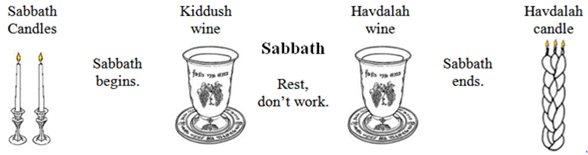
The following graphic illustrates these actions:
Since kindling a fire is forbidden on the Shabbat, we kindle the Shabbat candles before Shabbat begins. For the same reason, we kindle the havdalah candle after the end of the Shabbat. Between these two kindlings, we take Kiddush wine25F[26] at the beginning of the Shabbat and again we take havdalah wine26F[27] just before the end of the Shabbat.
The candles lit on Erev Shabbat27F[28] are lit during the day, eighteen minutes prior to sundown. The havdalah candle is lit during the night, forty-two minutes after sundown. On the fourth day G-d created the sun, moon, and stars. The sun governs the day (Erev Shabbat candle); the moon governs the night (the havdalah candle). The fourth command (corresponding to the fourth day), of the ten commands, is to sanctify the seventh day which we do by lighting the Erev Shabbat candles and the havdalah candle.
The seventh millennium, when all will be Shabbat, is ushered in with the Erev Shabbat candles which are lit eighteen minutes prior to sundown, even as HaShem will have a period of time, known as the time of Jacob’s trouble, when HaShem will bring fire on His enemies, just before the beginning of the Shabbat millennium. In a corresponding manner, HaShem will destroy His enemies and renew the earth after the Shabbat millennium, even as we light the havdalah candle, forty-two minutes after sundown, after the Shabbat.
An interesting thought: On the Kiddush of the festivals, we say the following:
Vayikra (Leviticus) 23:2-3 Speak to the Children of Israel, and tell them these are the festivals that they shall keep holy. For six days, work may be performed, but on the seventh day, it is a complete rest day, a holy occasion; you shall not perform any work. It is a Shabbat to the Lord in all your dwelling places.
Why is Shabbat inserted into the middle of the festivals?
The Vilna Gaon28F[29] explains that on all the festivals certain types of food related activity are permitted, whereas on Shabbat all melachot29F[30] are forbidden. However, on one Yom Tov no melacha is permitted – Yom Kippurim30F[31] – which is also known as שַׁבָּתוֹן שַׁבַּת – Shabbat Shabbaton, the same terminology that the Torah uses for a regular Shabbat. Thus, the pasuk can be rendered:
On six days melacha is permitted – the first and last days of Pesach (2), one day of Shavuot (3), one day of Rosh HaShana (4), one day of Succoth (5), one day of Shemini Atzeret (6). However, the seventh is the holy of holiest, no melacha is permitted, not even cooking, this is Yom Kippurim!31F[32]
What ‘work’ is forbidden on the Shabbat?
Most Americans see the word “work” and think of it in the English sense of the word: physical labor and effort, or employment. Under this definition, turning on a light would be permitted, because it does not require effort, but a Hakham, a Rabbi, would not be permitted to lead Shabbat services, because leading services is his employment. Jewish law prohibits the former and permits the latter. Many Americans therefore conclude that Jewish law doesn’t make any sense.
The problem lies not in Jewish law, but in the definition that Americans are using. The Torah does not prohibit “work” in the 20th century English sense of the word. The Torah prohibits “melacha” (מְלָאכָה), which is usually translated as “work,” but does not mean precisely the same thing as the English word. Before you can begin to understand the Shabbat restrictions, you must understand the word “melacha”.
Melacha generally refers to the kind of work that is creative, or that exercises control or dominion over your environment. The word may be related to “Melech” (king; מלך). Avodah (permitted labor) comes from the root eved - slave. The quintessential example of melacha is the work of creating the universe, which G-d ceased from nothing on the seventh day. Note that G-d’s work did not require a great physical effort: he spoke, and it was done.
The word melacha is rarely used in scripture outside of the context of Shabbat and holiday restrictions. The only other repeated use of the word is in the discussion of the building of the sanctuary and its vessels in the wilderness, in Shemot (Exodus) Chapters 31, 35-38. Notably, the Shabbat restrictions are reiterated during this discussion,32F[33] thus we can infer that the work of creating the sanctuary had to be stopped for Shabbat. From this, our Hakhamim concluded that the work prohibited on Shabbat is the same as the work of creating the sanctuary. They found 39 categories of forbidden acts, all of which are types of work that were needed to build the sanctuary. These are the labors defined as melacha:33F[34]
Sowing, Plowing, Reaping, Binding sheaves, Threshing, Winnowing, Selecting, Grinding, Sifting, Kneading, Baking, Shearing wool, Washing wool, Beating wool, Dyeing wool, Spinning, Weaving, Making two loops, Weaving two threads, Separating two threads, Tying, Untying, Sewing two stitches, Tearing, Trapping, Slaughtering, Flaying, Salting meat, Curing hide, Scraping hide, Cutting hide up, Writing two letters, Erasing two letters, Building, Tearing a building down, Extinguishing a fire, Kindling a fire, Hitting with a hammer, Taking an object from the private domain to the public, or transporting an object in the public domain.34F[35]
Abstaining from melacha on Shabbat is a loyalty test from The King. It is the yardstick of a covenant. That is why the penalty for intentionally breaking the Shabbat is death!
Carrying the weight of water is burdensome. But, if you scuba dive and immerse yourself in the water, then bearing the weight of the water becomes a pleasure. Even so, one immersed in Torah and Shabbat will never find it’s commands to be burdensome. HaShem says that the Shabbat is a precious gift stored away in His treasury for the Jewish people.
A Taste of the Olam HaBa: Shabbat is the culmination, the end-point, of all of our labors. It is a taste of the next world.35F[36] There is an idea that all spiritual realities have at least one tangible counterpart in the physical world so that we can experience them. Shabbat is one sixtieth of the pleasure of the Olam HaBa.36F[37]
“It is good to thank G-d” -- you better believe it! As Adam and mankind have learned the hard way:
Because Adam blamed Chava for breaking the command not to eat of the Tree of the Knowledge of Good and Evil; and in the process, denied the good that HaShem had done for him, the decree of expulsion resulted. Expulsion from Gan Eden, the Garden of Eden, was the first ever exile of mankind, and the “root” of all exiles and oppressions to follow, especially for the Jewish people. Therefore, showing HaShem gratitude is a crucial key to ending this exile.
This is why Shabbat is likened to one-sixtieth of the Olam HaBa,37F[38] a time when we shall be able to fully appreciate HaShem’s gift of life to us. On Shabbat, by abstaining from certain “creative activities”, we are compelled to sit back and look at all that HaShem does to keep us going, and if we don’t do that, then we deny both the opportunity of Shabbat and HaShem’s good, just as Adam did.
Hence, the Sages are telling us that, as much as Shabbat is like the Olam HaBa (and it is), still, the experience is so minimal that it is as if it is not there at all? In other words, even if Shabbat is the most wonderful experience, still the Olam HaBa will become infinitely better. Shabbat is, therefore, a taste of the Olam HaBa.
It would be too difficult to relate to these abstract, spiritual things, if we could never have any direct experience of it. So, sleep is a sixtieth of the death experience; a dream is a sixtieth of prophecy. Shabbat is a sixtieth of the experience of the next world. We have these experiences in order that we should understand those things that HaShem has promised.
Why specifically a sixtieth? What is unique about the proportion of one in sixty? One who has sensitive ear will hear something very beautiful here. One in sixty is that proportion which is on the borderline of perception: in the laws of kashrut (permitted and forbidden foods) there is a general rule that forbidden mixtures of foods are in fact forbidden only if the admixture of the prohibited component comprises more than one part in sixty. If a drop of milk accidentally spills into a meat dish that dish would not be forbidden if less than one part in sixty were milk, the milk cannot be tasted in such dilution. The halachic borderline is set at that point where taste can be discerned. The beautiful hint here is that Shabbat is one sixtieth of the intensity of Olam HaBa, it is on the borderline of taste: if one lives Shabbat correctly, one tastes the next world. If not, one will not taste it at all.
Shabbat is a sign: Shabbat was given as a “sign38F[39] of the covenant” to the Jews,39F[40] the ones who accepted the covenant. Shabbat is a sign,40F[41] which is, according to Exodus 31, symbolic of the eternal bond between HaShem and the Jewish people.
The Shabbat was made for all men to enjoy, when they entered the Mosaic covenant. Gentiles, and Jews, had to enter the covenant before they could enjoy the Shabbat. The Shabbat was part of the marriage contract between HaShem and Israel and a token and sign of that covenant:
Shemot (Exodus) 31:12-17 And HaShem spake unto Moses, saying, Speak thou also unto the children of Israel, saying, Verily my Shabbats ye shall keep: for it [is] a sign between me and you throughout your generations; that [ye] may know that I [am] HaShem that doth sanctify you. Ye shall keep the Shabbat therefore; for it [is] holy unto you: every one that defileth it shall surely be put to death: for whosoever doeth [any] work therein, that soul shall be cut off from among his people. Six days may work be done; but in the seventh [is] the Shabbat of rest, holy to HaShem: whosoever doeth [any] work in the Shabbat day, he shall surely be put to death. Wherefore the children of Israel shall keep the Shabbat, to observe the Shabbat throughout their generations, [for] a perpetual covenant. It [is] a sign between me and the children of Israel for ever: for [in] six days HaShem made heaven and earth, and on the seventh day he rested, and was refreshed.
This covenant, which lasts forever, is called, in Hebrew, בְּרִית עוֹלָם – an eternal covenant. Here we see Shabbat identified as a brit olam, a covenant for all time, a term used with respect to circumcision in Genesis 17:7;41F[42] here Israel is told Shabbat is a sign for all times, parallel to the covenant of Genesis 17:11. These are the only two commandments whose importance is emphasized by this sort of language.
The contract was not made with men before Moses. It was made with Israel in the days of Moses:
Devarim (Deuteronomy) 5:1-3 And Moses called all Israel, and said unto them, Hear, O Israel, the statutes and judgments which I speak in your ears this day, that ye may learn them, and keep, and do them. HaShem our G-d made a covenant with us in Horeb. HaShem made not this covenant with our fathers, but with us, [even] us, who [are] all of us here alive this day.
The Shabbat only applied to the Jew, the ger tzaddik,42F[43] and the ger toshav who was ready to convert.43F[44] It did not apply to all people. Some may quote Hakham Shaul:
Colossians 2:16 Let no man therefore judge you in meat, or in drink, or in respect of a holyday, or of the new moon, or of the Shabbat [days]: Which are a shadow of things to come; but the body [is] of Mashiach.
Hakham Shaul is not abrogating the Torah! He is not changing what HaShem did with the Israelites. He does not have the authority, or the desire, to change this. Therefore, we must conclude that the ones keeping the Shabbat are either Jews or proselytes (ger toshav).44F[45] Hakham Shaul may also have been referring to the festival Shabbats which the Gentiles may keep, except for Shemini Atzeret. Remember that the natural progression would have the Gentiles become ger toshav; the ger toshav would then convert and become a ger tzaddik.
Some may also claim that His Majesty King Yeshua changed this by saying:
Marqos (Mark) 2:27 And he said unto them, The Shabbat was made for man, and not man for the Shabbat:
We must conclude that Mashiach’s audiences were Jews and that this was not meant to apply to those who were not a part of the covenant. Again, Yeshua had neither the authority, nor the desire, to change HaShem’s covenant.
There is an important concept here, which we learn from this world. I don’t enjoy the wages and perks of another man’s wife, because I did not sign the marriage contract and because I did not do the work. The Shabbat was a “sign” for those who “signed” the covenant, and kept its provision. It was the reward, like marital intimacy, for those folks alone, much as a husband will not tolerate an interloper. All covenants, or contracts, are like this: Those who sign, and keep the provisions, enjoy the rewards. Those who don’t sign, or don’t keep the provisions, do not share in the reward.
While Jews and ger toshav will be part of the Olam HaBa, they both have different roles and functions. This does not have anything to do with enjoying the Shabbat.
So, far from being a discouragement, the Shabbat is meant to entice the Gentile to “sign” the covenant (immerse in the mikveh, brit Milah,45F[46] and agree, before a Bet Din, to keep the covenant). It is a reward for the man who loves HaShem and is willing to do what it takes. It is NOT for any Tom, Dick, or Harry who decides he wants it. That is outright adultery,46F[47] and theft, and it negates the covenant.
Since circumcision and Shabbat represent special signs between HaShem and Israel, they do not apply to other nations. “A gentile who observed Shabbat deserves death”,47F[48] and a non-Jew whose foreskin is removed, is still considered halachically uncircumcised: “All gentiles are uncircumcised”.48F[49]
Sanhedrin 58b Resh Lakish also said: A heathen who keeps a day of rest, deserves death, for it is written, And a day and a night they shall not rest,49F[50] and a master has said: Their prohibition is their death sentence.50F[51] Rabina said: Even if he rested on a Monday. Now why is this not included in the seven Noachian laws? — Only negative injunctions are enumerated, not positive ones.51F[52]
The Maharsha explains52F[53] that the Shabbat is, metaphorically, a bride.53F[54] Indeed, the Talmud refers54F[55] to the Shabbat as a bride and the Shabbat is greeted in the same way that a bride is greeted. This imagery was immortalized by Rabbi Shlomo Alkabetz55F[56] in his classical liturgical song, Lecha Dodi, which is sung just before the reception of the Shabbat. Rabbi Avraham Sperling writes,56F[57] based on this allegorical comparison, that Shabbat is the female companion to the Israelite nation. The Jewish Nation is married to Shabbat. Therefore, when a non-Jew follows the rules of Shabbat, it is as if he is committing adultery with the married bride Shabbat, and so he is liable for the death penalty. However, before the giving of the Torah at Mount Sinai, Shabbat did not yet have any marital connection to the Jewish Nation, and therefore, the patriarchs of the Jewish Nation, even if they had the halachic status of Noachides, were allowed to observe the laws of Shabbat in its entirety.
Maimonides writes57F[58] that the prohibition of a gentile observing Shabbat is a part of the general prohibition for gentiles not to innovate novel laws.58F[59] Rabbi David Ibn Zimra59F[60] explains60F[61] that according to Maimonides gentiles are not allowed to keep the Shabbat as if they were commanded to do so, rather they are only allowed to observe it as means of acquiring merits, but not as a means of fulfilling a commandment because they have no such commandment. In light of this, Rabbi Moshe Sofer61F[62] explains the words of an enigmatic Talmudic passage,62F[63] which states that if a non-Jew rests on Shabbat, he has fulfilled the commandment of resting. A non-Jew is only allowed to rest when doing so as part of a “religious service”, however, a non-Jew can rest and get the reward for fulfilling the commandment of Shabbat in doing so. This is true if the gentile personally accepts upon himself not to worship idols. Keeping Shabbat and abstaining from idols are really the same because Shabbat is testimony63F[64] to the fact that HaShem created the world, while idolatry denies this truism. Therefore, a gentile who specially avowed not to worship idols (ger toshav) is also obligated to keep Shabbat and thereby has no prohibition of resting.64F[65] Perhaps the patriarchs of the Jewish nation before the Sinaitic Revelation had the status of such Noachides, and were thus able to observe properly the Shabbat.
Finally, it is worth noting that the beginning of our psalm, the first eight pesukim, speaks of the primary duties of Aaron and his sons, the Priests, along with the Levites, in the Temple, on the Shabbat. These concords well with the Torah’s mention of HaShem’s selection of the priests and the Levites to minister before Him. Their secondary duty was to teach the Bne Israel the Torah. Through this teaching, the Priests and the Levites were to enable the Bne Israel to distance themselves from idolatry, which is the theme of our Ashlamata.
Now since Moses oversaw conveying HaShem’s word to the Priests and the Levites, it is fitting that he should author our psalm for the Shabbat day.
Ashlamatah: Yeshayahu (Isaiah) 45:19 – 46:2 + 13
|
JPS Rashi |
Targum |
|
18. ¶ For so said the Lord, the Creator of heaven, Who is God, Who formed the earth and made it, He established it; He did not create it for a waste, He formed it to be inhabited, "I am the Lord and there is no other. |
18. ¶ For thus says the LORD, who created the heavens (he is God!), who founded the earth and made it—He established it; He did not create it for nothing, but He established it to increase the sons of men upon it! “I am the LORD, and there is no other. |
|
19. Not in secret did I speak, in a place of a land of darkness; I did not say to the seed of Jacob, Seek Me, in vain; I am the Lord, Who speaks righteousness, declares things that are right. |
19. I did not speak in secret in a place of a land of darkness; I did not say to the seed of the house of Jacob, ‘Seek My fear for nothing.' I the LORD speak truth, declaring what is right. |
|
20. Assemble and come, approach together, you survivors of the nations; those who carry their graven wooden image and pray to a god who does not save, do not know. |
20. Assemble yourselves and come, draw near together, you who are delivered of the peoples! They have no knowledge who carry about their wooden image, and beseech from a god who cannot save. |
|
21. Declare and present, let them even take counsel together; who announced this from before, [who] declared it from then? Is it not I, the Lord, and there are no other gods besides Me, a just and saving God there is not besides Me. |
21. Declare and draw near, take counsel together! Who announced this long ago and declared it of old? Was it not I, the LORD? And there is no other god besides me, a God who is virtuous and a Savior; there is none except Me. |
|
22. Turn to Me and be saved, all the ends of the earth, for I am God, and there is no other. |
22. Turn to My Memra and be saved, all those at the ends of the earth! For I am God, and there is no other. |
|
23. By Myself I swore, righteousness emanated from My mouth, a word, and it shall not be retracted, that to Me shall every knee kneel, every tongue shall swear." |
23. By My Memra I have sworn, before Me has gone forth in virtue a word that will not be void. Before Me every knee will bow, every tongue will swear. |
|
24. But to me did He say by the Lord righteousness and strength, to Him shall come and be ashamed all who are incensed against Him. |
24. Only in the Memra of the LORD has He promised me to bring virtues, and He is strong in His Memra; all the Gentiles who were stirred up against His people will give thanks and be ashamed of their idols. |
|
25. Through the Lord shall all the seed of Israel find righteousness and boast. |
25. In the Memra of the LORD all the seed of Israel will be justified and glorified. |
|
|
|
|
1. Bel squats; Nebo soils himself; their idols were to the beasts and to the cattle; what you carry is made a load, a burden for the weary. |
1. Bel kneels, Nebo is hewn down, their images are a likeness of beasts and cattle; the burdens of their idols are heavy upon those who carry them, and they are weary. |
|
2. They soiled themselves, yea they squatted together, they could not deliver the burden, and they themselves have gone into captivity. {P} |
2. They are cut off and hewn down together, they cannot save those who carry them, but those who serve them go into captivity. {P} |
|
3. Hearken to Me, the house of Jacob, and all the remnant of the house of Israel, who are borne from birth, carried from the womb. |
3. “Attend to My Memra, those of the house of Jacob, and all the remnant of the house of Israel, who have been beloved more than all the peoples, cherished more than all the kingdoms. |
|
4. And until old age I am the same, and until you turn gray I will carry; I have made and I will bear and I will carry and deliver. {S} |
4. Even to eternity I am He, and to the age of the ages My Memra endures. I have created every man, I scattered them among the peoples׳, I will also forgive their sins and will pardon. {S} |
|
5. To whom shall you liken Me and make Me equal and compare Me that we may be alike? |
5. Whom will you liken before Me and make equal and compare before Me in? |
|
6. Those who let gold run from the purse and weigh silver with the balance; they hire a goldsmith and he makes it a god, they kneel, yea they prostrate themselves. |
6. Behold, the Gentiles collect gold from a purse, and weigh out silver in a balance, hire a goldsmith, and he makes it into a god; then they worship it and are subjugated. |
|
7. They bear it, on the shoulder they carry it, and they put it in its place and it stands, from its place it does not move; yea he cries to it and it does not answer; from his distress it does not save him. {S} |
7. They lift it upon their shoulders, they carry it, they set it in its place, and it stands there; is not possible for it to budge from its place. He even beseeches from it, and it does not answer or save him from his trouble. {S} |
|
8. Remember this and strengthen yourselves, take to heart, you transgressors. |
8. Remember this and strengthen yourselves, recall to mind, O rebels. |
|
9. Remember the first things of old, that I am God and there is no other; I am God and there is none like Me. |
9. Remember the former things which were of old; for I am God, and there is no other God besides me, |
|
10. [I] tell the end from the beginning, and from before, what was not done; [I] say, 'My counsel shall stand, and all My desire I will do.' |
10. declaring from the beginning the end and from ancient times things not yet done, saying, ‘My counsel will stand, and I will accomplish all My pleasure, |
|
11. [I] call from the east a swift bird, from a distant land the man of My counsel; yea I spoke, I will also bring it; I formed it, I will also do it. {S} |
11. Who promised to gather the exiles from the east, to bring openly, like a swift bird from a far land, the sons of Abraham, My chosen. I have spoken, and I will bring it to pass; I have purposed, and I will do it. {S} |
|
12. Hearken to Me, you stout-hearted, that are far from righteousness/generosity. |
12. Attend to My Memra, you stubborn of heart, you who are far from innocence: |
|
13. I have brought near My righteousness, it shall not go far, and My salvation (Heb. Yeshua) shall not delay, and I will give salvation (Heb. Yeshua) in Zion, to Israel, My glory. {S} |
13. My innocence/generosity is near, it is not far off, and My salvation will not be checked, I will put a saviour in Zion, for Israel My celebrity. {S} |
Rashi’s Commentary on Yeshayahu (Isaiah) 45:19 – 46:2 + 13
18 He did not create it for a waste but He formed it to be inhabited.
19 Not in secret did I speak When I gave the Torah, and I did not say for naught and in vain to the seed of Jacob, Seek Me, but to receive great reward.
I am the Lord Who speaks righteousness Since I commenced to speak to them concerning My righteousness, to inform them of the giving of their reward, afterwards I told them things that are right, My statutes and My laws, for before the giving of the Torah it was said to them, “And now, if you heed, etc., you shall be for Me a treasure...a kingdom of priests, etc.” (Ex. 19:5f.).
20 approach Heb. הִתְנַגְּשׁוּ, an expression of approaching (הַגָּשָׁה) and the ‘nun’ is attached to it, as one says “they were struck (הִתְנַגְּפוּ)”; “they will be struck (יִתְנַגְּפוּ).”
you survivors of the nations who survived the sword of Nebuchadnezzar.
who carry their graven wooden image...do not know to understand knowledge.
21 who announced this from before Who of your idols is it that announced from before that your God brought salvation, each one to its worshipers?
Is it not I, the Lord, and there are no other For I announce what I am destined to do for My people, and I fulfill My words.
22 Turn to Me and abandon your graven images, all the ends of the earth, and, thereby, you shall be saved.
23 By Myself I swore and righteousness emanated from My mouth to accept all those who return to Me. I spoke a word, and it will not be retracted. What is the righteousness that emanated from My mouth? That to Me shall every knee kneel, and I will accept them, as the matter is stated (Zeph. 3:9): “For then will I change for the people a pure language, to call all of them in the name of the Lord...”
24 But to me did He say by the Lord Heb. אַךְ בַה' לִי אָמַר [lit. but by the Lord to me He said]. This verse is inverted, and thus is its interpretation: But to me did He say by the Lord righteousness and strength. Although all the nations shall prostrate themselves before Him [correct reading according to Warsaw edition, K’li Paz, and mss.], but to me alone, the congregation of Israel, has been promised by the Lord righteousness and strength, and other nations shall not be included in my glory.
to Him shall come and be ashamed etc. All who were incensed against the Holy One, blessed be He, shall come to Him to regret what they did in their lifetimes and be ashamed.
all who are incensed Heb. כֹּל הַנֶּחֱרִים בּוֹ, all who are incensed.
25 Through the Lord...find righteousness and boast Through the promise of the support of His love they shall find righteousness and boast of His strength.
boast Heb. וְיִתְהַלְלוּ, porvantir in O.F.
Chapter 46
1 Bel squats; Nebo soils himself The deities of Babylon squatted and soiled themselves. This is an expression of ridicule of the idols, like one who suffers from diarrhea and does not manage to sit down on the seat in the privy before he discharges with a splash.
Bel squats; Nebo soils himself Heb. כָּרַע בֵּל קֹרֵס נְבוֹ. Akropid sei Bel; konkiad sei Nebo. Bel squats; Nebo soils himself. So I heard in the name of Rabbenu Gershom, the Light of the Diaspora.
their idols were The images of the forms of Bel and Nebo were to the beasts and the cattle, compared to the beasts and the cattle, which soil and dirty themselves with their droppings.
what you carry is made a load, a burden The feces in their bowels are heavy to bear like a burden for a weary man. Therefore, they soiled themselves and squatted together, the soiling with the squatting.
2 they could not deliver the burden to discharge the feces in their bowels as others discharge, in the normal manner.
deliver Heb. מַלֵּט, an expression of discharging from an embedded place. Comp. (supra 34:15) “There, the owl has made its nest, and she has laid eggs (וַתְּמַלֵט),” he has discharged her egg. Comp. also (infra 66:7) “And she has been delivered (וְהִמְלִיטָה) of a male child.” Jonathan, however, did not render these verses in this manner.
3 who are borne from birth Since you were born in the house of Laban the Aramean, I bore you on My arms, for since then, adversaries stand up against you in every generation and not like the idolaters (other nations [K’li Paz and mss.]) who are laden and carry their Gods, as is mentioned above, but you are laden and borne in My arms.
4 And until old age that you have aged and your strength is depleted, that you have no merit, I am the same with My mercy and with My trait of goodness to save you and to bear you and to carry you and deliver you. Since he says regarding their deity, that it is carried and also that it cannot deliver its burden, he says, “But I bear others, and I will deliver My burden.”
5 and compare Me Heb. וְתַמְשִׁלֻנִי. Comp. (Job 30:19) “And I have become like (וָאֶתְמַשֵּׁל) dust and ashes.” An expression of comparison.
that we may be alike That I and he be alike, one to the other.
6 Those who let gold run from the purse Heb. הַזָּלִים, an expression of (Ps. 146:18) “Water runs (יִזְּלוּ).”
with the balance Heb. קָנֶה, the bar of a scale, called flael in O.F.
8 Remember this what I wish to say.
and strengthen yourselves Heb. וְהִתְאשָׁשׁוּ. Comp. (supra 16:7) “For the walls (לַאֲשִׁישֵׁי) of Kir-hareseth.”
take to heart, you transgressors And what do I say to you to remember and to take to heart?
9 Remember the first things of old that you have seen that I am God and there is no other; I am God and there is none like Me.
10 [I] tell the end from the beginning The Egyptian exile and its redemption I announced in the Covenant between the Parts, before they came about.
11 [I] call from the east a swift bird Heb. עַיִט. From the land of Aram, which is in the east, I called Abraham to Me to take counsel with Me. עַיִט Comp. (Dan. 2:14) “Answered with counsel (עֵיטָא) and discretion”; (ibid. 6:8) “All the presidents of the kingdom have taken counsel (אִתְיָעֲטוּ).” Alternatively, it can be interpreted as an expression of a bird. I called him to hasten after Me like a bird that flies and wanders from its place.
rom a distant land I called My man of counsel, and with him I took counsel between the parts concerning the four exiles, as it is explained in Gen. Rabbah (44:17) “And behold, a fear, great darkness was falling upon him.” [“Fear” refers to Babylon... “Darkness” refers to Media, who darkened the eyes of Israel with fasting. “Great” refers to Greece... “Was falling upon him” refers to Edom..., etc.]
yea I spoke with him concerning the exiles and their redemption; I will also bring it.
12 stout-hearted You who have strengthened your heart among the heathens (the nations [Parshandatha, K’li Paz]) and have clung to Me.
that are far from righteousness For it has been a long time for you, and I have not demonstrated to you My righteousness to redeem you.
13 I have brought near My righteousness from now on, and it will not be far off.
Commentary on the Ashlamatah of Yeshayahu (Isaiah) 45:19 - 46:2 + 13
By: H.Ex. Adon Shlomoh Ben Abraham
Our parsha begins with; I did not speak in secret nor at a site in the land of darkness, I did not say to the stock of Jacob, seek me in that empty wasteland. I am the LORD who foretold reliably, who announces what is true. Come and gather together, draw near you remnants of the nations. Scholars tell us that this 45th chapter begins with an address to Cyrus the Persian King, whom God was going to use to bring salvation through this rule, to the exiled people of Hashem and the whole world. And through Cyrus, the Exiles would return to Jerusalem and the people of the world would recognize God at work fulfilling his promises and being faithful to his word. In this process, the nations would join Israel and worship, the one true God. We know that Cyrus is referred to as the LORD’s - Anointed one. In Hebrew, the word is Mashiah often translated as “Messiah”.
At this point, we should ask and think why would God refer to a Gentile king of Persia as his anointed one - his Messiah? We would think it would be David who would be his anointed one or another of his descendants. According to Isaiah, a Davidic king does not play a significant role in the expected restoration (55:3.)[66] God promised David his descendants would rule Israel forever as an enduring royal dynasty. Some commentators question why this has not happened and feel compelled to compensate for it. “Here, Isaiah extends that promise to the nation as a whole. The restored Judean commonwealth will have no one human king, for all its members will have royal status. Thus, Isaiah transforms the older Davidic covenant by democratizing it. Some have suggested the prophet saves the Davidic promise employing this transformation, for the more natural reading of the Davidic promise in 2 Sam.7 and Ps. 89, which proved incorrect in light of the fall of the Davidic dynasty to the Babylonians in 586 BCE.[67] I think this might be looking at one side of the coin without looking at the other side of it.
What is interesting? This Cyrus, God would hold his right hand, he will tread down nations and he would uncover these lower ones, and no gate would stay shut before him. Any hill that comes up, you're going to level them. The same thing is repeated in (v.13). I will rouse him up for the victory and level the roads before him. He will rebuild my city and let my exiled people go. Our reading is coming on the heels of “Comfort ye, Comfort ye my people. Speak tenderly to Jerusalem for A voice cries out through the desert. A road the Lord leveled in the wilderness, the highway for our God.” (Isa.40:1-3)
Another note of Interest, our reading is bracketed or sandwiched between two entities to be destroyed. It starts by mentioning Egypt's wealth and Nubia (Cush) merchandise I'll pass over to you and it will be yours. (v.14). This Is the area South of Egypt, Referred to as Ethiopia. In modern translations maybe as far down as today's Sudan. And the end of our reading (46:1-2) it says Bel—bows down and Nebo stoops. The same as the Phoenician Baal—i.e., lord, the chief god of Babylon; to it was dedicated the celebrated tower of Babylon—the God of Babylon versus the God of Israel. Here we see the same story that has plagued humanity for thousands of years. The central contrast is between a God who carries his people and the gods who must be carried, by those who worship them.
Egypt was the ruling empire that God destroyed when he saved his people. Radak tells us that in the historical situation, Sennacherib was about to attack Jerusalem when he got word that the Cushites were planning to attack Assyria. He turned on the Cushites in a pre-emptive attack and routed them and the Egyptians along with the Sabeans, their allies. He gathered all the plunder and then headed to Jerusalem to attack them, and it did not turn out as he planned. He lost the battle and all the plunder he had gathered, and the booty was left with the Jews. The prisoners of war became proselytes because they recognized that Israel’s God was the true one, and Abarbanel tells us of a similar thing that happened in the Hasmonean period.[68] Babylon is spoken of in the Bible as representing Idolatry in all its forms, and Babylon is seen as existing to the end when Babylon will completely be destroyed with all her evil ways (Rev.18:1ff) and humanity will worship HaShem in truth. So, we seem to have a similar ideal of bookending both the beginning and ending of our parsha.
The prophet speaking for God calls on the last remnant of humanity left at the end of history after all the wars and upheavals, after all the challenges of the pagan nations. “Turn to me and be saved, all the ends of the earth! For I am God, and there is no other”. [69] HaShem tells us, “I did not speak in secret, nor was I hiding, in a land of darkness; I did not say to the offspring of Jacob, Seek me in vain.’ I the Lord speak the truth; I declare what is right.” (v.19) The Rabbis teach us that when God appeared at Mt. Siani and made a public appearance he did so, in the open before the whole world when he gave us his Torah as a “handbook for living”. Although, we see his attention is for the whole human race in general his word to Moses is for the Jewish Nation in particular.[70] Abarbanel states, “The commandments are not empty; rather they are filled with righteousness and morality”. The nations of the world did not heed God’s call and continued to chase after their powerless gods. For the last 2000 years, Hashem has been working to move the gentile world closer to the true worship of their creator. I believe we are nearing the time when Hashem is going to do something else that will cause the nations of the world to wake up and notice Israel and the Jews in a different light. We see our reading broken up into four events or points of interest.
A.) The gathering of the nations (vs. 20).
Here we have a description of the nations, “a challenge to the idolaters, HaShem is the only God who can fulfill His prophecies; therefore, all the nations will acknowledge Him (vv. 22,23). The religion of Israel is to become the religion of the whole world. This anticipation finds its fulfillment in the Christian dispensation, and thus Paul applies the latter part of the v. to (Messiah) in Phil 2:10,11”[71] Dummelow wrote this in 1936 before he had to work the Jewish nation back into his theology and he seems to have pulled up short. We see that v.11 tells us “Every tongue will confess that Yeshua Messiah is Lord to the glory of God the Father. Here is the classic mistake theologians make, instead of the nations going to the Jews (whom Yeshua said have salvation), they misread it through their theological bifocals and get the Jews coming to the nations for salvation. Christians misunderstand Jesus' role and, in their Idolatry, make him into his own father.
Adam Clarke who lived until 1832 does somewhat better when he commented on v.22-23 and said; “This verse and the following contain a plain prediction of the universal spread of the knowledge of God through (Messiah); and so the Targum appears to have understood it; see Rom. 14:11; Phil. 2:10. The reading of the Targum is remarkable, viz., אתפנו למימרי ithpeno lemeymri, look to my Word, ὁ Λογος, the Lord Jesus.”[72] However, it is an important example to follow, the Jewish people have never confused Moses with God, although Moses was the greatest prophet that has lived.
Assemble yourselves and come; draw near together, you survivors of the nations! They have no knowledge; they carry about their wooden idols and keep praying to a god that cannot save them. (v. 20) The nations are praying to a false representation of the ONLY true God, having their understanding darkened. It has been said that at the root of Idolatry, man creates God in his image, instead of man allowing God's image to be created in him. The nations “have no knowledge”, they carry about idols that they've made, and they pray to a God that cannot save them. What do we learn from this? What we learn, is that the powerless God the nations have created and that they support and carry about while falsely praying to it is not a God, but a distorted image of God which the nations have created of the one true God. If this is a true statement, then ALL the nations are worshipping the one true God in the wrong way with the wrong understanding, which seems to be just what the Samaritans were doing in the first century.
Yeshua in John 4:23 of the Nazarene Codicil, tells the Samaritan women at the well; You worship what you do not know;[73] we worship what we know, for salvation is [74] from the Jews. But the hour is coming, and it is now here when the true worshipers will worship the Father in spirit and truth, for the Father is seeking such people to worship him. God is spirit, and those who worship him must worship in spirit and truth.” The Bible tells us there is only one nation that God ever revealed himself to. That is the nation of Israel, through Moses, in Egypt and at the Red Sea, and with the giving of the Torah at Mount Sinai. What I understand Yeshua was saying is that the nations are soon moving closer to the correct worship of the Father. Humanity has moved closer, but we are not quite there, yet.
B.) The defeat of the idols and the victory of monotheism (vs. 21).
Declare and present your case; let them take counsel together! Who told this long ago? Who declared it of old? Was it not I, the Lord (HaShem)? And there is no other god besides me, a righteous God and a Savior; there is none besides me. In the earlier verse, the nations are told to assemble and draw near, what are they to draw near too? Come and reason, debate and do a forensic search to see if what was said long ago is not indeed, the truth. Are the nations to draw near to the people of God, Judah?
C.) HaShem’s invitation to all the world (vs. 22).
Turn to me and be saved, all the ends of the earth! For I am God and there is no other. Humanity is closer than it was, but not quite to the place to do the hard work of research to seek out and find the one true God, which is the God revealed to Israel at Mt. Siani. As shown earlier the nations are to draw near; In context, I would suggest that the nations are the ones to draw near to God’s people -- those he has revealed himself to, those told to be a light to the nations.[75] Gentiles (nations) are invited to submit willingly—to turn to HaShem and away from their gods—and accept the salvation being offered to them. But, whether willingly or unwillingly, they will submit: every knee will bend, every tongue swears an oath of allegiance (v.23)
D.) The confession of the nations (vss. 24–25).
Only in the LORD (HaShem) is there righteousness and strength. Rashi renders this as Only to me, the Jewish people, has God promised generosity and power. In the Lord (HaShem) all the offspring of Israel shall be justified and shall glory.” Although the nations will recognize the truth at the end of days. The nations will approach God individually, hence the singular, בּוֹא “will or shall come”[76] Those who fought and were at odds with God and fought against him and his Torah, to him shall they come and be ashamed all who were incensed against him. According to this all who anger him or are against him refers to those who fought against his people because the enemies of Israel are the enemies of God.[77]
Our Parsha started with the Idolatry of Egypt and is now ending with the Idolatry of Babylon. R’ Schwab[78] notes that it’s important to understand that although the idols of Isaiah’s era, and indeed the very powerful temptation of idolatry, have long since been eliminated from Jewish life, the exhortations of the prophet Isaiah are still relevant. There are always new temptations that have a powerful influence on people. Some political, some sexual, some economic, some theological. All have harmed the spiritual life of Israel. When Isaiah calls upon his people to take to heart that only the Torah is valid and whatever opposes it is vain, he speaks to everyone in every age.[79]
All the idols were loaded onto the beast and carried away. The idols could not protect the people, nor could they protect themselves. Therefore, the people and the beast with the idols on them were carried into captivity. Isaiah goes on to instruct those who have wavered in their faithfulness to stand firm, for God has said, my plan will stand, and I will carry out my every desire. (46:10). I bring near my righteousness; it is not far off, and my salvation will not delay; I will put salvation in Zion. (46:13) All events follow from God’s words and purpose, from revelation and sovereignty. All that is taking place must be recognized from the perspective that the prophet outlines; the future lies under the same purpose and the same activity as the past. HaShem has said, for I am God, and there is no other; I am God, and there is none like me, declaring the end from the beginning”.[80]
We are living in a time when those with ears to hear and eyes to see are, I believe witnessing HaShem’s hand at work with his Jewish children and those of the offspring of Jacob along with those who have survived from among the nations. Earlier in (paragraph 3) We mention that the backstory to our reading was the positioning of Cyrus for a certain job. Cyrus was chosen for a special high office with a certain goal to accomplish. God told him, “I will hold your right hand, to subdue nations, to loosen the loins of kings, to open doors and gates that may not be shut.” I will go before the and make crooked paths straight. I will break in pieces the doors of brass. Cut asunder the bars of iron; give you treasures of darkness, hidden riches of secret places. That thou mayest know that I am the LORD, who call thee by thy name, the God of Israel. For the sake of Jacob my servant, AND Israel my elect. (v.1-4)
What was Cyrus’ purpose? One purpose is told in (45:6) that people may know, from the rising of the sun (east) and from the west, that there is none besides me; I am the Lord, and there is no other…. I form light and create darkness; I make well-being and create calamity; I am the Lord, who does all these things. “Shower, O heavens, from above, and let the clouds rain down righteousness; let the earth open, that salvation and righteousness may bear fruit; let the earth cause them both to sprout; I the Lord have created it. Woe to him who strives with him who formed him, a pot among earthen pots![81]
Professor Gerhard Von Rad tells us when Cyrus is set in his position, The new turn given to world-history by Cyrus has set events in motion that are swiftly leading to the end (Isa.51:5; 46:13) and Isaiah was alluding to the new political direction given to history by Cyrus… He compares Cyrus to Nebuchadnezzar in Jer.27:5ff. The events of history are changing, but Israel is still the object of these world-wide historical designs of HaShem. Von Rad continues: the effects of Cyrus on Israel had political effects upon the world around her and the Gentiles are to become aware and by their own accord come to Israel. When we see, the world news today are we seeing another Cyrus, that in a messianic role will bring both Israel and the nations closer in relationship to HaShem.[82] This year 2025/5785 we have seen amazing events one after the other, I believe they shall continue and Israel is at the forefront of what HaShem is about to accomplish in the earth. Could the modern-day Cyrus, bring earth turning events to the world that will bring in the Messianic age and a new state of being for the nation of Israel?
Special Ashlamatah for Shabbat Mevarchim
Rashi & Targum Pseudo Jonathan for: Shmuel alef (I Samuel) 20:18-42
|
Rashi |
Targum Pseudo Jonathan |
|
18. And Jonathan said to him, "Tomorrow is the new moon, and you will be remembered, for your seat will be vacant. |
18. And Jonathan said to him: “Tomorrow is the (New) Moon, and you will be sought out, for your dining place will be empty. |
|
19. And for three days, you shall hide very well, and you shall come to the place where you hid on the day of work, and you shall stay beside the traveler's stone. |
19. And at the third (day) of the Moon you will be sought out very much, and you will go to the place where you hid yourself on the weekday, and you will dwell near "Stone Coming." |
|
20. And I shall shoot three arrows to the side, as though I shot at a mark. |
20. And I am to shoot three arrows with the bow so as to hit for myself at the target. |
|
21. And behold, I shall send the youth, (saying,) 'Go, find the arrows.' If I say to the youth, 'Behold, the arrows are on this side of you,' take it and come, for it is well with you, and there is nothing the matter, as the Lord lives. |
21. And behold I will send the young man: `Go, get the arrows.' If indeed I say to the young man: `Behold the arrow is on this side of you; take it and bring (it),' then there is peace for you and nothing evil as the Lord lives. |
|
22. But, if I say thus to the youth, 'Behold, the arrows are beyond you,' go! For the Lord has sent you away. |
22. And if thus I say to the young man: `Behold the arrow is beyond you,' go, for the Lord has rescued you. |
|
23. And (concerning) the matter which we have spoken, I and you, behold, the Lord is between me and you forever." |
23. And the word that we have spoken - I and you - behold the Memra of the Lord is a witness between me and you forever." |
|
24. And David hid in the field, and when it was the new moon, Saul sat down to the meal to eat. |
24. And David hid in the field, and it was the (New) Moon. And the king sat down at the food to eat. |
|
25. And the king sat upon his seat, as at other times, upon the seat by the wall, and Jonathan arose, and Abner sat down beside Saul, and David's place was vacant. |
25. And the king sat down upon his seat as at other times, upon the seat that was prepared for him near the wall. And Jonathan stood up, and Abner sat down by the side of Saul, and the place of David was empty. |
|
26. And Saul did not say anything on that day, for he thought, "It is an incident; he is not clean, for he is not clean." |
26. And Saul did not speak anything on that day, for he said: “Perhaps an accident has happened to him, and he is not clean; or perhaps he went on the road, and we did not invite him.” |
|
27. And it was, on the morrow of the new moon, the second (day of the month), that David's place was vacant, and Saul said to Jonathan, his son, "Why has not the son of Jesse come to the meal either yesterday or today?" |
27. And on the day after that, which is the intercalation of the second month, the place of David was empty, and Saul said to Jonathan his son: “Why has the son of Jesse not come both yesterday and today for food?” |
|
28. And Jonathan answered Saul, "David asked leave of me (to go) to Bethlehem. |
28. And Jonathan answered Saul: “David earnestly requested from me to go unto Bethlehem. |
|
29. And he said, 'Let me go away now, for we have a family sacrifice in the city, and he, my brother, commanded me, and now, if I have found favor in your eyes, let me slip away now, and see my brothers. ' He, therefore, did not come to the king's table." |
29. And he said: ‘Send me away now, for they have begun an offering of holy things for all our family in the city, and my brother commanded me. And now if I have found favour in your eyes, let me get away now and see my brothers.' Therefore he did not come to the table of the king.” |
|
30. And Saul's wrath was kindled against Jonathan, and he said to him, "You son of a straying woman deserving of punishment! Did I not know that you choose the son of Jesse, to your shame and to the shame of your mother's nakedness? |
30. And the anger of Saul was strong against Jonathan, and he said to him: “You son of an obstinate woman whose rebellion was harsh, do I not know that you love the son of Jesse to your disgrace and to the disgrace of the shame of your mother? |
|
31. For all the days that the son of Jesse is living on the earth, you and your kingdom will not be established. And now, send and take him to me, for he is condemned to death." |
31. For all the days that the son of Jesse is alive upon the earth, neither you nor your kingdom will be established. And now send and bring him unto me, for he is a man deserving killing.” |
|
32. And Jonathan answered Saul his father, and said to him, "Why should he be put to death? What has he done?" |
32. And Jonathan answered Saul his father and said to him: “Why will he be killed? What did he do?” |
|
33. And Saul cast the spear upon him to strike him; and Jonathan knew that it had been decided upon by his father, to put David to death. |
33. And Saul lifted up the spear against him so as to strike him, and Jonathan knew that it was determined from his father to kill David. |
|
34. And Jonathan arose from the table in fierce anger; and he did not eat any food on the second day of the new moon, for he was grieved concerning David, for his father had put him to shame. |
34. And Jonathan arose from the table in strong anger, and he did not eat food on the day of the intercalation of the second month, for he grieved over David, for his father shamed him. |
|
35. And it was in the morning, that Jonathan went out at David's appointed time, and a small boy was with him. |
35. And in the morning Jonathan went forth to the field at the time that David said to him, and a small boy was with him. |
|
36. And he said to his boy, "Run, find now the arrows which I shoot." The boy ran; and he shot the arrow to cause it to go beyond him. |
36. And he said to his young man: “Run, get the arrows that I am shooting.” The young man ran, and he shot the arrow beyond him. |
|
37. And the lad came up to the place of the arrow, which Jonathan had shot. And Jonathan called after the lad, and said, "Isn't the arrow beyond you?" |
37. And the young man came unto the place of the arrow that Jonathan shot, and Jonathan called after the young man and said: “Is not the arrow beyond you?” |
|
38. And Jonathan called after the lad, "Quickly, hasten, do not stand!" And Jonathan's lad gathered up the arrows, and came to his master. |
38. And Jonathan called after the young man: “Hurry, in haste; do not delay.” And Jonathan's young man was gathering the arrows, and he came unto his master. |
|
39. And the lad knew nothing; only Jonathan and David knew the matter. |
39. And the young man did not know anything. Only Jonathan and David knew the matter. |
|
40. And Jonathan gave his weapons to his boy, and said to him, "Go, bring (them) to the city." |
40. And Jonathan gave his armor to the young man that was his, and he said to him: "Go, bring it to the city." |
|
41. The lad departed, and David arose from (a place) toward the south; and he fell upon his face to the ground three times, and prostrated himself three times. And they kissed one another, and wept one with the other, until David exceeded. |
41. And the young man went, and David arose from the side of “Stone Coming” that is opposite the south, and he fell upon his face upon the ground, and he bowed down three times, and they kissed each man his fellow, and they wept each man his fellow until David exceeded. |
|
42. And Jonathan said to David, "Go in peace! (And bear in mind) that we have sworn both of us in the name of the Lord, saying, 'May the Lord be between me and you, and between my descendants and your descendants forever.' " |
42. And Jonathan said to David: “Go in peace, for the two of us have sworn by the name of the LORD saying, ‘May the Memra of the LORD be a witness between me and you, and between my sons and your sons forever.’” And he arose and went, and Jonathan entered the city. |
Rashi’s Commentary for: Shmuel alef (I Samuel) 20:18-42
18 Tomorrow is the new moon: and it is the custom of all those who eat at the king’s table to come on the festive day to the table.
and you will be remembered: My father will remember you, and ask where you are.
for your seat will be vacant: for your seat in which you sit, will be vacant, and so did Jonathan render: and you will be sought, for your seat will be vacant.
and you will be remembered: [ונפקדת is] an expression of remembering.
will be vacant: [יפקד is] an expression of lacking.
19 And for three days you shall hide very well: And you shall triple the days, and then you shall descend very much, i.e., when the third day arrives, you shall descend into a secret place, and hide very well, for then they will seek you. And you shall come to this secret place, wherein you are hiding today, which is a workday. And so did Jonathan render: on the weekday, for he hid on that day, as it is stated: (infra v. 24) “And David hid in the field;” immediately, “and it was the new moon” on the morrow.
the travelers’ stone: (Heb. ‘even-ha azel,’ lit., the going stone, i.e.) a stone which was a sign (a landmark) for travelers.
Ha-azel: those who go on the road. And so did Jonathan render: even atha, the stone which was a sign.
20 to the side, I shall shoot: This is not a ‘mappiq-heh’ (aspirate ‘heh’).צדה is to be interpreted like לצד, to a side, for every word which requires a ‘lamed’ as a prefix, the Scripture gives a ‘he’ as a suffix. (Jeb. 13b) At the side of that stone, I shall shoot arrows to a mark, so that the youth will not understand, and this sign shall be for you to divine whether you must flee.
21 And behold, I shall send, etc.: And it is customary for one who seeks an arrow which has been shot, to go to the place where he sees the arrow flying, but he cannot ascertain exactly. Sometimes he searches for it, and the arrow is beyond him, and sometimes he goes beyond the arrow and searches for it, and you shall have this sign.
If I say to the youth… take it and come: you yourself emerge from your hiding place, and take it, and come to me, for you have not to fear, for it is well with you. The Holy One Blessed be He, desires that you be here, and even if I have heard evil from Father.
22 But, if I say thus… Go! For the Lord has sent you away: The Holy One Blessed be He tells you to flee and escape.
23 And concerning the matter which we have spoken: the covenant which we made together.
behold, the Lord is between me and you: as Witness concerning that matter.
25 the seat by the wall: at the head of the couch beside the wall.
and Jonathan arose: He got up from his place, since it is not proper for a son to recline beside his father. Since their custom was to eat reclining on couches and David would recline between Jonathan and Saul, now that David did not come, Jonathan did not recline until Abner sat down beside Saul, and afterwards, Jonathan sat beside Abner. And if you say that he did not sit at all, the Scripture states: (infra v. 34) “And Jonathan arose from the table,” implying that he had been sitting.
26 It is an incident: He has experienced a seminal emission.
he is not clean: and he has not yet immersed himself, for had he immersed himself for the uncleanness of his emission, he would not have to wait until sunset in order to eat ordinary food.
for he is not clean: This clause gives the reason for the matter; i.e., since he is not clean, he, therefore, did not come, lest he contaminate the feast.
27 on the morrow of the new moon: on the morrow of the renewal of the moon.
the second: on the second day of the month.
29 and he, my brother, commanded me: The eldest of the house, commanded me that I be there. And he is my brother Eliab.
let me slip away: ‘Escamoter’ in French. I shall go away for one day and come back.
30 a straying woman, deserving of punishment: (בן נעות המרדות) An expression of straying and wandering, נע ונד, a gadding woman. Just as you say זעוה from זע, and the ‘tav’ is for the construct state, for it is connected to the word המרדות.
deserving of punishment: (Heb. המרדות), who deserves to be chastised and disciplined. Another explanation is as follows: When the men of Benjamin grabbed the girls of Shiloh, who came out to dance in the vineyards (Jud. 21:21), Saul was bashful, and did not want to grab [a girl], until she came herself, behaving insolently, and pursued him.
straying woman: because of the vineyards. And that is a winepress, like (the Talmudical passage): Purge the winepress (which was used for forbidden wine) (Ab. Zarah 74b); His winepresses will drip with wine (Targum Onkelos, Gen. 40:12) …. (The last three words of Rashi are incomprehensible, and are probably erroneous. The correct version is unknown to us.)
34 he was grieved (lit.) to David: concerning David.
for his father had put him to shame: concerning David.
35 at David’s appointed time: at the time which David had set for him.
36 to cause it to go beyond him.: The arrow went beyond the boy.
41 from a place toward the south: (lit., from by the south. Jonathan renders:) from the side of the travelers’ (or sign) stone which was toward the south.
until David exceeded: He cried more.
42 Go in peace: And the oath which we have sworn, may the Lord be witness thereon forever.
Verbal Tallies
By: Hakham Dr. Hillel ben David
Bamidbar (Numbers) 3:1 – 5:10; Yeshayahu (Isaiah) 45:19 – 46:2 + 13
The verbal tally between the Torah and the Ashlamata centers on the word ‘spoke / spoken’.
Bamidbar (Numbers) 3:1 Now these are the generations of Aaron and Moses in the day that HaShem spoke <01696> with Moses in mount Sinai.
Yeshayahu (Isaiah) 45:19 Not in secret did I speak <01696>, in a place of a land of darkness; I did not say to the seed of Jacob, Seek Me, in vain; I am the Lord, Who speaks <01696> righteousness, declares things that are right.
The thematic connection between the double Torah portions and our chapter of Psalms (92) revolves around the service in the Beit HaMikdash (Temple). Where the Torah speaks of the Levites and the priests, the psalm speak of the service performed in the Beit HaMikdash particularly on the Sabbath.
The thematic connection between Numbers chapter 4 and Psalms chapter 93 speak of the covering of HaShem and the covering of the Mishkan.
Bamidbar (Numbers) 4:5 when the camp setteth forward, Aaron shall go in, and his sons, and they shall take down the veil of the screen, and cover the ark of the testimony with it; 6 and shall put thereon a covering of sealskin, and shall spread over it a cloth all of blue, and shall set the staves thereof.
Tehillim (Psalms) 93:1 HaShem reigneth; He is clothed in majesty; HaShem is clothed, He hath girded Himself with strength; yea, the world is established, that it cannot be moved.
Nazarean Talmud
Sidrot of Bamidbar (Numbers) 3:1-5:10
“V’Eleh Toldot Aharon” “And these [are the] generations [of] Aharon”
By: H. Em Rabbi Dr. Eliyahu ben Abraham
|
School of Hakham Shaul Tosefta Luqas (Lk)
|
School of Hakham Tsefet Peshat 2 Tsefet (2 Pet)
|
|
Luke 16:14-18 Now some of the P’rushim (Pharisees), who desired to be wealthy, heard all these things, and they ridiculed[83] him. And he said to them, “You are the ones who justify yourselves in the sight of men, but God knows your hearts! For what is considered exalted[84] among men is an abomination in the sight of God. “The Written Torah and the prophets were until Yochanan (John); from that time on the kingdom/governance (sovereignty) of God through the Hakhamim and Bate Din as opposed to human kings has been proclaimed, and everyone is urgently pressed into it. But it is easier for the heavens and earth to pass away than for one stroke of a letter of the Torah (Oral and Written) to become invalid.” Luqas 16:19-31 Whoever gives his wife a “get” bill of divorce (except for sexual immorality) and marries another commits adultery, and whoever marries her who receives a “get” from her husband (because of adultery) commits adultery. Now a certain man was rich, and dressed himself in purple cloth and fine linen (as a symbol of his wealth and power),[85] feasting in merriment[86] every day[87] in radiance.[88] And a certain poor[89] man named Eliezer (Lazarus), covered with wounds, thrust out[90] of his, the rich man’s doorway,[91] and was longing to be filled with what fell from the table of the rich man. But even the dogs came and licked his wounds.[92] And now it happened that the poor man died, and he was carried away by the angels to Abraham’s bosom. And the rich man also died and was buried. And from the darkness of the pit of Sheol[93] he lifted up his eyes as he was in torment and saw Abraham from a distance, and Lazarus at his side. And he called out and said, ‘Father Abraham, have mercy on me, and send Lazarus so that he could dip the tip of his finger in water and cool my tongue, because I am suffering pain in this flame!’ But Abraham said, ‘Child, remember that you received your good things during your life, and Eliezer (Lazarus) likewise bad things. But now he is comforted here, but you are suffering pain. And in addition to all these things, a great chasm has been established between us and you, so that those who want to pass over from here to you are not able to do so, nor can they pass over from there to us.’ So he said, ‘Then I ask you, father, that you send him to my father’s house, for I have five brothers, so that he could warn them, so that they also should not come to this place of torment!’ But Abraham said, ‘They have Moshe and the Nebi’im; they must hear them.’[94] And he said, ‘No, father Abraham, but if someone from the dead goes to them, they will do teshubah (repent)!’ But he said to him, ‘If they do not hear Moshe and the Nebi’im, neither will they be convinced if someone rises from the dead.’ ” |
2 Pet 2:3b-9 Whose (the pseudo prophets and teachers of v.1) judgment legal decision .i.e. sentence of long ago did not stop and their destruction does not slumber.[95] For if G-d was not lenient with the sinning messengers[96] (magidim) and chained them in pits[97] of darkness (Gehinom) giving them up to judgment where they are kept (watched and guarded).[98] And the ancient primal world [He, i.e. God] did not spare, but Noach the eighth, of righteousness/generosity a herald He, i.e. God guarded (watched over and protected) when the ungodly world was flooded; And the cities of Sodom (Heb. Sedom) and Gomorrah (Heb. Amorah) having reduced to ashes catastrophically, He, i.e. God condemned them, as an example[99] (sign) to those profane (ungodly) ones. And righteous/generous Lot,[100] from oppression by the Lawless (atheistic) in licentious conduct He, i.e. God rescued (set free from destruction). But the act of seeing what he saw and hearing what he heard while residing among them day by day tormented his pious (righteous/generous) soul with their activities of Lawlessness. The LORD knows when (and how) to rescue the righteous/generous from trials and tests. He also knows how to and punish the wicked by keeping (guarding) them for the Day of Judgment. 2 Pet 2:10-16 And specially those false teachers and prophets who walk after the Yetser HaRa (Heb. for “Evil inclination”) in defiled desires, and despise authority. They are audacious, arrogant, and they are not afraid to speak Lashon Hara against the Torah Sages, Whereas the true messengers (angels), being greater in strength and power, do not bring Lashon Hara against them, the Torah Sages in the LORD’s presence.[1] But they act like animals without logic or reason, born to be captured and destroyed, speak Lashon Hara of things they do not understand and to be destroyed in their corruption. Bearing the result of injustice (Lawlessness - unrighteousness – conduct contrary to a Torah Teacher) they consider them (the Holy festivals) days of pleasure and luxurious living. They are defiled, blemishes delighting, in deceitfulness as they feast together with you. Having eyes (minds) full of adultery, (as an affront to God) unable to cease from their sin, baiting (beguiling) un-established souls (persons) having a mind full of greedy desire, children of a curse! Having forsaken the straightway of the Torah, they were lead after the way of Balaam son of Beor who loved the profits of evil doing (Lawlessness); Now (he) had his own rebuke for his unlawfulness: by a voiceless (female) ass who spoke in a man’s voice hindering the madness of the prophet. |
Commentary to Hakham Tsefet’s School of Peshat
Divine Providence:
For if G-d was not lenient with the sinning messengers (magidim) and chained them in pits of darkness (Gehinom) giving them up to judgment where they are kept (watched and guarded).[101]
Divine Providence includes G-d’s interaction with His creation. The Peshat view of the Nazarean mind as expressed in the writings of Hakham Tsefet makes it abundantly clear that not only is G-d involved in creation, He guides it through His constant preservation.[102] The Rambam posits five different views of “Divine Providence.” The first four “theories” take into account the views of secular wisdom and philosophy. After refuting these “theories,” the Rambam postulates a fifth, which agrees with the Sages and their view of the Torah.
Fifth Theory: This is our theory, or that of our Law. The theory of man's perfectly free will is one of the fundamental principles of the Law of our Teacher Moses, and of those who follow the Law.
According to this principle, man does what is in his power to do, by his nature, his choice, and his will; and his action is not due to any faculty created for the purpose. All species of irrational animals likewise move by their own free will. This is the Will of God; that is to say, it is due to the eternal divine will that all living beings should move freely, and that man should have power to act according to his will or choice within the limits of his capacity. Against this principle we hear, thank God, no opposition on the part of our nation.
Another fundamental principle taught by the Law of Moses is this: Wrong cannot be ascribed to God in any way whatever; all evils and afflictions as well as all kinds of happiness of man, whether they concern one individual person or a community, are distributed according to justice; they are the result of strict judgment that admits no wrong whatever.
Even when a person suffers pain in consequence of a thorn having entered into his hand, although it is at once drawn out, it is a punishment that has been inflicted on him [for sin], and the least pleasure he enjoys is a reward [for some good action]; all this is meted out by strict justice; as is said in Scripture, "all his ways are judgment" (Deut. xxxii. 4); we are only ignorant of the working of that judgment.[103]
The final view is based on the principal of “mida kneged mida” (measure for measure). Each pain is the result of some error on man’s part just as each pleasure is a blessing for the good deeds of the Tsadiq. This principle is attested to by Hakham Tsefet’s words…
And the ancient primal world [He, i.e. God] did not spare, but Noach the eighth, of righteousness/generosity a herald He, i.e. God guarded (watched over and protected) when the ungodly world was flooded;
Noach as the herald of righteous generosity merited the reward of Divine preservation. The world that rejected the behavior and teachings of Noach merited destruction; this world was flooded. The same is true of Sodom and Amorah (Gomorrah) and their lack of chesed.
Nature - Creation of the non-human world: The animal world
An interesting conclusion to the providence of G-d arises when we take the time to look at the way G-d governs creation. In a paraphrase, Josephus declared that the P’rushim (Pharisees) believed in “Divine Providence.”[104] Urbach further notes…
The term Hashgacha 'Providence' was, as we know, invented by the Tibbonides;[105] the Sages did not coin a similar word, but found the theme of Providence mentioned in the Torah and iterated in the Prophets and mentioned yet again in the Hagiographa, and they devoted much time to studying its ways, to discerning its quiddity and to probing its significance.
There are two aspects to Providence: one involves the government of the world, the control of nature, and the provision of the needs of all mankind.
The “government of the world” is an amazing aspect of G-d’s sovereignty.
Please take note that the “vegetable” – “animal” kingdom have a governing mazal (constellation-angel).[106] Therefore, G-d does not extend the same protection to the beasts as He does to man. Entire species of animals have a purpose decreed by God, who guides their development, sustains their population, or decrees their extermination. In general, God has established nature, governed by the mazal, in such a manner that it sustains every species. G-d “Himself supervises the angelic Agents who are appointed to maintain the existence and function of all that exists, giving them power to do their tasks.”[107] Again, this statement is reiterated by Hakham Tsefet in the present pericope in telling us the sinning “angels” were judged in antiquity.
Humankind and Providence:
As noted above humankind’s interaction with the Cosmos is met with “mida kneged mida” (measure for measure). Each action influences creation resulting in a cause and effect. With regard to humankind, in general the spheres (angelic intermediaries) also maintain the existence and function of their activities. This does not eliminate their free will. However, as the Mishnah posits, “All is foreseen, and freedom of choice is granted. The world is judged with goodness, but in accordance with the amount of man's positive deeds.”[108]
For humankind and the Tsaddiq, a question often arises as to why the ungodly often lead very prosperous lives. The issue is posited in this week’s Tosefta of Luqas. As the Sages have concluded, the reward of the Tsaddiq is not in abundant earthly treasures. The Tsaddiq understands that this present life is the precursor to the “ever coming world.”
Both Hakham Tsefet and Hakham Shaul play off the idea of Pesach and Chag HaMatzoth. Likewise, they both show how G-d interacts with the Tsaddiq living among the ungodly.
Providence and the Jewish people:
Our father Abraham has taught his children how they must relate to the present world. The interjection of the narrative of Eliezer (Lazarus) is more in line with oppression, rather than some poor beggarly soul laying at a “rich man’s gate.” The narrative implies that Eliezer (Lazarus) is “thrust out” of the gate or doorway of the “rich man.” The common link between Lot and Eliezer (Lazarus) is their interaction with the ungodly. Yet in the case of both Lot and Eliezer (Lazarus) it would appear that, the reward for their righteous/generous lives is in the Olam HaBa (ever coming world). Lot wanted to emulate the lifestyle of Abraham. Nonetheless, his eyes constantly caused him problems. He looked at the plains of the Yarden (Jordan) and its rich green fields and made his choice based on greed.[109]
However, his nephew Lot did not employ Abraham’s lesson. Abraham’s vision in B’resheet 15[110] proved to Abraham that the Jewish people are not subject to the intermediaries. However, the text of Hakham Tsefet clarifies the issue for us. So long as the B’ne Yisrael makes their will after the will of the Divine,[111] they are not subject to the powers of the intermediaries. Yet, we learn a powerful story from the events of these pericopes. The “hands of G-d” did not deliver Lot. He was delivered by the hands of His Agents the intermediaries. Why? Could it be because Lot chose a path other than G-d’s? In the Pesach Seder, we learn that G-d Himself redeemed the B’ne Yisrael. So, what is the difference?
Faithful obedience!!!
Questions for Understanding and Reflection
- From all the readings for this Shabbat which verse, or verses impressed your heart and fired your imagination?
- From all the Tanakh: which particular verse or passage taught you about the role of Messiah as described in the Nazarean Codicil readings for this week?
Blessing After Torah Study
Barúch Atáh Adonai, Elohénu Meléch HaOlám,
Ashér Natán Lánu Torát Emét, V'Chayéi Olám Natá B'Tochénu.
Barúch Atáh Adonái, Notén HaToráh. Amen!
Blessed is Ha-Shem our God, King of the universe,
Who has given us a teaching of truth, implanting within us eternal life.
Blessed is Ha-Shem, Giver of the Torah. Amen!
“Now unto Him who is able to preserve you faultless, and spotless,
and to establish you without a blemish,
before His majesty, with joy, [namely,] the only one God, our Deliverer,
by means of Yeshua the Messiah our Master, be praise, and dominion,
and honor, and majesty, both now and in all ages. Amen!”
Next Shabbat: Shabbat Rosh Chodesh Adar & Shabbat Shekalim
Sabbath of the New Moon for the Month of Adar
(Friday Evening February 28th – Saturday Evening the 1st of March, 2025)
|
Shabbat |
Torah Reading: |
Weekday Torah Reading: |
|
יִפְקֹד יְהוָה |
|
Saturday Afternoon |
|
“Yifqod Adonai” |
Reader 1 – Bamidbar 27:15-17 |
Reader 1 - Devarim 24:19-22 |
|
“Let Appoint the LORD” |
Reader 2 – Bamidbar 27:18-20 |
Reader 2 - Devarim 25:1-4 |
|
“Ponga el SEÑOR” |
Reader 3 – Bamidbar 27:21-23 |
Reader 3 - Devarim 25:5-7 |
|
Bamidbar (Numbers) 27:15 - 28:25 Shemot (Exodus) 30:1-38 |
Reader 4 – Bamidbar 28:1-9 |
|
|
Ashlamatah: Yeshayahu (Isaiah): Is 66:1-24 Melachim bet (II Kings) 11:17-1217 |
Reader 5 – Bamidbar 28:10-14 |
Monday and Thursday Mornings |
|
|
Reader 6 – Bamidbar 28:15-18 |
Reader 1 - Devarim 24:19-22 |
|
Reader 7 – Bamidbar 28:19-25 |
Reader 2 - Devarim 25:1-4 |
|
|
|
Maftir – Bamidbar 28:23-25 |
Reader 3 - Devarim 25:5-7 |
Contents of next week’s Torah Seder
· Joshua Appointed Successor of Moses – Numbers 27:15-23
· Daily Offerings – Numbers 28:1-8
· Additional Offerings for the Sabbath – Numbers 28:9-10
· New Moon Offerings – Numbers 28:11-15
· Pesach offerings – Numbers 28:16-25
Next week’s reading Assignment:
|
The Torah Anthology: Yalkut Me’Am Lo’Ez By: Rabbi Yitzchaq Magriso Published by: Moznaim Publishing Corp. (New York, 1983) Vol.14 – “Numbers II – Final Wonderings” pp. 265-285. |
Ramban: Numbers Commentary on the Torah Translated and Annotated by Rabbi Dr. Charles Chavel Published by Shilo Publishing House, Inc. (New York, 1971) pp. 331 - 337 |

Hakham Dr. Hillel ben David
Hakham Dr. Eliyahu ben Abraham
Edited by His Honor Paqid Adon Ezra ben Abraham
A special thank you to HH Giberet Giborah bat Sarah and Giberet Sarai bat Sarah for their diligence in proof-reading.