Esnoga Bet Emunah12210 Luckey Summit San Antonio, TX 78252 United States of America © 2025 E-Mail: gkilli@aol.com |
|
Esnoga Bet El102 Broken Arrow Dr. Paris TN 38242 United States of America © 2025 E-Mail: waltoakley@charter.net |
Triennial Cycle (Triennial Torah Cycle) / Septennial Cycle (Septennial Torah Cycle)
|
Three and 1/2 year Lectionary Readings |
Third Year of the Triennial Reading Cycle |
|
Tevet 18, 5785 - January 17/18, 2025 |
Third Year of the Shmita Cycle |
Candle Lighting and Habdalah Times: https://www.chabad.org/calendar/candlelighting.htm
Roll of Honor:
This Commentary comes out weekly and on the festivals thanks to the great generosity of:
His Eminence Rabbi Dr. Eliyahu ben Abraham and beloved wife HH Giberet Dr. Elisheba bat Sarah
His Honor Paqid Adon David ben Abraham
His Honor Paqid Adon Ezra ben Abraham and beloved wife HH Giberet Karmela bat Sarah,
His Honor Paqid Adon Tzuriel ben Abraham and beloved wife HH Giberet Gibora bat Sarah
Her Excellency Giberet Sarai bat Sarah & beloved family
His Excellency Adon Barth Lindemann & beloved family
His Excellency Adon John Batchelor & beloved wife
Her Excellency Giberet Leah bat Sarah & beloved mother
His Excellency Adon Yehoshua ben Abraham and beloved wife HE Giberet Rut bat Sarah
His Excellency Adon Michael ben Yosef and beloved wife HE Giberet Sheba bat Sarah
Her Excellency Giberet Prof. Dr. Emunah bat Sarah & beloved family
His Excellency Adon Robert Dick & beloved wife HE Giberet Cobena Dick
His Excellency Adon Ovadya ben Abraham and beloved wife HE Giberet Mirit bat Sarah
His Excellency Adon Brad Gaskill and beloved wife Cynthia Gaskill
His Excellency Adon Shlomoh ben Abraham
His Excellency Adon Ya’aqob ben David
His Excellency Adon Bill Haynes and beloved wife HE Giberet Diane Haynes
For their regular and sacrificial giving, providing the best oil for the lamps, we pray that GOD’s richest blessings be upon their lives and those of their loved ones, together with all Yisrael and her Torah Scholars, amen ve amen!
Also a great thank you and great blessings be upon all who send comments to the list about the contents and commentary of the weekly Torah Seder and allied topics.
If you want to subscribe to our list and ensure that you never lose any of our commentaries, or would like your friends also to receive this commentary, please do send me an E-Mail to gkilli@aol.com with your E-Mail or the E-Mail addresses of your friends. Toda Rabba!
Blessings Before Torah Study
Blessed are You, Ha-Shem our GOD, King of the universe, Who has sanctified us through Your commandments, and commanded us to actively study Torah. Amen!
Please Ha-Shem, our GOD, sweeten the words of Your Torah in our mouths and in the mouths of all Your people Israel. May we and our offspring, and our offspring's offspring, and all the offspring of Your people, the House of Israel, may we all, together, know Your Name and study Your Torah for the sake of fulfilling Your delight. Blessed are You, Ha-Shem, Who teaches Torah to His people Israel. Amen!
Blessed are You, Ha-Shem our GOD, King of the universe, Who chose us from all the nations, and gave us the Torah. Blessed are You, Ha-Shem, Giver of the Torah. Amen!
Ha-Shem spoke to Moses, explaining a Commandment. "Speak to Aaron and his sons, and teach them the following Commandment: This is how you should bless the Children of Israel. Say to the Children of Israel:
May Ha-Shem bless you and keep watch over you; - Amen!
May Ha-Shem make His Presence enlighten you, and may He be kind to you; - Amen!
May Ha-Shem bestow favor on you and grant you peace. – Amen!
This way, the priests will link My Name with the Israelites, and I will bless them."
These are the Laws for which the Torah did not mandate specific amounts: How much growing produce must be left in the corner of the field for the poor; how much of the first fruits must be offered at the Holy Temple; how much one must bring as an offering when one visits the Holy Temple three times a year; how much one must do when performing acts of kindness; and there is no maximum amount of Torah that a person must study.
These are the Laws whose benefits a person can often enjoy even in this world, even though the primary reward is in the Next World: They are: Honoring one's father and mother; doing acts of kindness; early attendance at the place of Torah study -- morning and night; showing hospitality to guests; visiting the sick; providing for the financial needs of a bride; escorting the dead; being very engrossed in prayer; bringing peace between two people, and between husband and wife; but the study of Torah is as great as all of them together. Amen!
A Prayer for Israel
Our Father in Heaven, Rock, and Redeemer of Israel, bless the State of Israel, the first manifestation of the approach of our redemption. Shield it with Your lovingkindness, envelop it in Your peace, and bestow Your light and truth upon its leaders, ministers, and advisors, and grace them with Your good counsel. Strengthen the hands of those who defend our holy land, grant them deliverance, and adorn them in a mantle of victory. Ordain peace in the land and grant its inhabitants eternal happiness.
Lead them, swiftly and upright, to Your city Zion and to Jerusalem, the abode of Your Name, as is written in the Torah of Your servant Moses: “Even if your outcasts are at the ends of the world, from there the Lord your God will gather you, from there He will fetch you. And the Lord your God will bring you to the land that your fathers possessed, and you shall possess it, and He will make you more prosperous and more numerous than your fathers.” Draw our hearts together to revere and venerate Your name and to observe all the precepts of Your Torah, and send us quickly the Messiah son of David, agent of Your vindication, to redeem those who await Your deliverance.
We pray for his Honor Adon Tzuriel ben Avraham. Mi Sheberach…He who blessed our forefathers Abraham, Isaac and Jacob, Moses and Aaron, David and Solomon, may He bless and heal His Honor Paqid Tzuriel ben Avraham, May the Holy One, Blessed is He, be filled with compassion for him to restore his health, to heal him, to strengthen him, and to revivify him. And may He send him speedily a complete recovery from heaven, among the other sick people of Yisrael, a recovery of the body and a recovery of the spirit, swiftly and soon, and we will say amen ve amen!
We pray for her Excellency Giberet Miriam bat Sarah, Mi Shebeirach… He Who blessed our holy and pure Matriarchs, Sarah, Ribkah, Rachel and Leah, may he bless and heal Giberet Miriam bat Sarah and may He send her a complete recovery to her 248 organs and her 365 sinews. Please heal her, please heal her, please heal her and strengthen her and return her to her original strength. May He send her a complete recovery of her body and her soul from the heavens among the other sick of Yisrael, and we will say Amen ve amen!
Shabbat: “VeKhi Tim’Keru” “And when you will sell”
|
Shabbat |
Torah Reading: |
Weekday Torah Reading: |
|
וְכִי-תִמְכְּרוּ |
|
Saturday Afternoon |
|
“And when you make a sale” |
Reader 1 – Vayiqra 25:14-16 |
Reader 1 – Vayiqra 25:35-38 |
|
Reader 2 – Vayiqra 25:17-19 |
Reader 2 – Vayiqra 25:39-43 |
|
|
“Y cuando vendiereis” |
Reader 3 – Vayiqra 25:20-22 |
Reader 3 – Vayiqra 25:44-46 |
|
Vayiqra (Leviticus) 25:14-34 |
Reader 4 – Vayiqra 25:23-25 |
|
|
Ashlamatah: Yeshayahu (Isaiah) 24:2-8; 13-15 |
Reader 5 – Vayiqra 25:26-28 |
Monday & Thursday Mornings |
|
|
Reader 6 – Vayiqra 25:29-30 |
Reader 1 – Vayiqra 25:35-38 |
|
Tehillim (Psalms) 88:1-19 |
Reader 7 – Vayiqra 25:31-34 |
Reader 2 – Vayiqra 25:39-43 |
|
N.C.: 2 Pet 1:5-7; Lk 14:25-33 |
Maftir – Vayiqra 25:31-34 |
Reader 3 – Vayiqra 25:44-46 |
Contents of the Torah Seder
· Selling to fellow Jew - Leviticus 25:14-17
· Exhortation – Leviticus 25:18-23
· Redemption of Land – Leviticus 25:24-28
· Redemption of Houses – Leviticus 25:29-34
Welcome to the World of Pshat Exegesis
In order to understand the finished work of the Pshat mode of interpretation of the Torah, one needs to take into account that the Pshat is intended to produce a catechetical output, whereby a question/s is/are raised and an answer/a is/are given using the seven Hermeneutic Laws of R. Hillel and as well as the laws of Hebrew Grammar and Hebrew expression.
The Seven Hermeneutic Laws of R. Hillel are as follows
[cf. http://www.jewishencyclopedia.com/view.jsp?artid=472&letter=R]:
1. Ḳal va-ḥomer: "Argumentum a minori ad majus" or "a majori ad minus"; corresponding to the scholastic proof a fortiori.
2. Gezerah shavah: Argument from analogy. Biblical passages containing synonyms or homonyms are subject, however much they differ in other respects, to identical definitions and applications.
3. Binyan ab mi-katub eḥad: Application of a provision found in one passage only to passages which are related to the first in content but do not contain the provision in question.
4. Binyan ab mi-shene ketubim: The same as the preceding, except that the provision is generalized from two Biblical passages.
5. Kelal u-Peraṭ and Peraṭ u-kelal: Definition of the general by the particular, and of the particular by the general.
6. Ka-yoẓe bo mi-maḳom aḥer: Similarity in content to another Scriptural passage.
7. Dabar ha-lamed me-'inyano: Interpretation deduced from the context.
Welcome to the World of Remes Exegesis
Thirteen rules compiled by Rabbi Ishmael b. Elisha for the elucidation of the Torah and for making halakic deductions from it. They are, strictly speaking, mere amplifications of the seven Rules of Hillel, and are collected in the Baraita of R. Ishmael, forming the introduction to the Sifra and reading as follows:
1. Ḳal wa-ḥomer: Identical with the first rule of Hillel.
2. Gezerah shawah: Identical with the second rule of Hillel.
3. Binyan ab: Rules deduced from a single passage of Scripture and rules deduced from two passages. This rule is a combination of the third and fourth rules of Hillel.
4. Kelal u-Peraṭ: The general and the particular.
5. u-Peraṭ u-kelal: The particular and the general.
6. Kelal u-Peraṭ u-kelal: The general, the particular, and the general.
7. The general which requires elucidation by the particular, and the particular which requires elucidation by the general.
8. The particular implied in the general and excepted from it for pedagogic purposes elucidates the general as well as the particular.
9. The particular implied in the general and excepted from it on account of the special regulation which corresponds in concept to the general, is thus isolated to decrease rather than to increase the rigidity of its application.
10. The particular implied in the general and excepted from it on account of some other special regulation which does not correspond in concept to the general, is thus isolated either to decrease or to increase the rigidity of its application.
11. The particular implied in the general and excepted from it on account of a new and reversed decision can be referred to the general only in case the passage under consideration makes an explicit reference to it.
12. Deduction from the context.
13. When two Biblical passages contradict each other the contradiction in question must be solved by reference to a third passage.
Rules seven to eleven are formed by a subdivision of the fifth rule of Hillel; rule twelve corresponds to the seventh rule of Hillel, but is amplified in certain particulars; rule thirteen does not occur in Hillel, while, on the other hand, the sixth rule of Hillel is omitted by Ishmael. With regard to the rules and their application in general. These rules are found also on the morning prayers of any Jewish Orthodox Siddur.
Reading assignment
|
The Torah Anthology: Yalkut Me’Am Lo’Ez By: Rabbi Yitzchok Magriso, Translated by: Rabbi Aryeh Kaplan Published by: Moznaim Publishing Corp. (New York, 1989) Leviticus II - Vol. 12– “Holiness” pp. 250-265 |
Ramban: Leviticus Commentary on the Torah
Translated and Annotated by Rabbi Dr. Charles Chavel Published by Shilo Publishing House, Inc. (New York, 1974) pp. 440-450 |
Rashi & Targum Pseudo Jonathan for: Vayiqra (Leviticus) 25:14-34
|
Rashi |
Targum Pseudo Jonathan |
|
14. And when you make a sale to your fellow Jew or make a purchase from the hand of your fellow Jew, you shall not wrong one another. |
14. And when you sell sales to your neighbors, or you buy disposable (or moveable) goods from the hand of your neighbors, it is not allowable for a man to defraud his neighbor. |
|
15. According to the number of years after the Jubilee, you shall purchase from your fellow Jew; according to the number of years of crops, he shall sell to you. |
15. Sons of Israel, My people, if you sell a field or a vineyard, according to the sum of the number of years after the Jubilee you will buy of your neighbor; according to the number of years for gathering the produce they will sell it to you; |
|
16. The more [the remaining] years, you shall increase its purchase [price], and the fewer the [remaining] years, you shall decrease its purchase [price], because he is selling you a number of crops. |
16. according to the greatness of the amount of the years will the price be enlarged; and according to the smallness of the amount of the years the price will be diminished, because he sells to you the amount of the fruitage to be ingathered. |
|
17. And you shall not wrong, one man his fellow Jew, and you shall fear your God, for I am the Lord, your God. |
17. And you will not overreach one man his neighbor by hard words, but fear your God: I am the LORD your God. |
|
18. You shall perform My statutes, keep My ordinances and perform them then you will live on the land securely. |
18. And you will perform My statutes, and observe the order of My judgments and do them, that you may dwell upon the land securely. |
|
19. And the land will then yield its fruit and you will eat to satiety, and live upon it securely. |
19. And the land will yield her produce, and you will eat and be satisfied, and dwell upon the land in security. |
|
20. And if you should say, "What will we eat in the seventh year? We will not sow, and we will not gather in our produce!" |
20. But if you say, What will we eat in the seventh year; behold, we sow not, nor ingather even the after crop of our provision? |
|
21. [Know then, that] I will command My blessing for you in the sixth year, and it will yield produce for three years. |
21. I will command My blessing upon you from My treasures of goodness, which are in the heaven of My Presence, in the sixth year, and it will create produce that will suffice for three years. |
|
22. And you will sow in the eighth year, while [still] eating from the old crops until the ninth year; until the arrival of its crop, you will eat the old [crop]. |
22. But you will sow in the eighth year, and eat of the old produce of the sixth year until the ninth year; until the time of the incoming of the new produce, will you eat of the old. |
|
23. The land shall not be sold permanently, for the land belongs to Me, for you are strangers and [temporary] residents with Me. |
23. And the land of Israel will not be sold absolutely, for the land is Mine; for you are sojourners and guests with Me. |
|
24. Therefore, throughout the land of your possession, you shall give redemption for the land. |
24. And in all the land of your possession you will let the ground have redemption. |
|
25. If your brother becomes destitute and sells some of his inherited property, his redeemer who is related to him shall come forth and redeem his brother's sale. |
25. And if your brother has become poor and has sold his possession, his redeemer who is near of kin to him may come and redeem the sale of his brother. |
|
26. And if a man does not have a redeemer, but he gains enough means to afford its redemption, |
26. But if a man have no one who is qualified to redeem that which he has sold, and it befall to his own hand to find the price of its redemption, |
|
27. he shall calculate the years for which the land has been sold, and return the remainder to the man to whom he sold it, and [then] he may return to his inheritance. |
27. then let him count the sum of the years of its sale and give the amount to the man who bought it, and return to his possession. |
|
28. But if he cannot afford enough to repay him, his sale shall remain in the possession of the one who has purchased it, until the Jubilee year. And then, in the Jubilee year, it shall go out and revert to his inheritance. |
28. But if his hand meet not with the price that he should give him, then the property sold will (remain) in the hand of him who bought it until the year of Jubilee, and will then go out without money, and he will return to his possession. |
|
29. And when a man sells a residential house in a walled city, its redemption may take place until the completion of the year of its sale. Its [period of] redemption shall be a full year. |
29. And if a man sell a dwelling-house, in a town surrounded by a wall, it may have redemption until the completing of the year from its sale: from time to time will be its redemption. |
|
30. But if it is not redeemed by the end of a complete year, then that house which is in the city that has a wall, shall remain permanently [the property] of the one who purchased it throughout his generations. It will not leave [his possession] in the Jubilee. |
30. But if it be not redeemed at the completing of the full year, the house that is in a walled town will be confirmed absolutely to him who bought it, unto his generations: it will not go out at the Jubilee. |
|
31. But houses in open cities, which do not have a wall surrounding them, are to be considered as the field of the land. It may have redemption and shall leave [the purchaser's possession] in the Jubilee. |
31. But houses in villages which have no walls round about them, are to be accounted as tents which are spread upon the fields of the earth; they may be redeemed, and they will go out at the Jubilee. |
|
32. And, [regarding] the cities of the Levites, the houses of their inherited cities shall forever have a [right of] redemption for the Levites. |
32. But the cities of the Levites, the houses of the cities of their possession may be always redeemable by the Levites. |
|
33. And if one purchases from the Levites, whether a house or an inherited city, will leave [the possession of the purchaser] in the Jubilee, because the houses of the cities of the Levites, are their inherited property amidst the children of Israel. |
33. And when one has purchased of the Levites the house that was sold in the cities of their possession, it will go out at the Jubilee; for the houses of the Levites are their inheritance among the children of Israel. |
|
34. And a field in the open areas of their cities cannot be sold, because it is their eternal inheritance. |
34. But a field in the suburbs of their cities will not be sold for it is an everlasting possession for them. JERUSALEM: But a field in the suburbs of their cities will not be sold, because a possession … |
Rashi’s Commentary for: Vayiqra (Leviticus) 25:14 – 34
14 And when you make a sale to your fellow-Jew or make a purchase from your fellow-Jew Its simple meaning is obvious. The verse can also be expounded [to teach us the following lesson]: How do we know that when you wish to sell, you should sell to your fellow-Jew? For Scripture says, “ וְכִי תִמְכְּרוּ מִמְכָּר לַעֲמִיתֶךָ,” i.e., “And when you make a sale—sell to your fellow- Jew!” And how do we know that if you come to buy, you should buy from your fellow-Jew? For Scripture continues here: “ אוֹ קָנֹה מִיַּד עֲמִתֶיךָ,” i.e., “or when you buy—buy from your fellow- Jew!”-[Torath Kohanim 25:29] you shall not wrong This means wronging through money (see verse 17 below and Lev. 19:33). -[Torath Kohanim 25:31]
15 According to the number of years after the Jubilee, you shall purchase The following is its simple meaning, to explain the verse according to its context: [The text] comes to warn against wronging [by overcharging, thereby linking verses 14–16 together (Mizrachi)], [namely, that] when you sell or purchase land, you should be aware of how many years remain until the [next] Jubilee, and according to [that number of] years and the crops that it is fit to yield, the seller should sell and the buyer should buy. For indeed, he will eventually return it to him in the Jubilee year. Thus, if there are [only] a few years [left until the next Jubilee year], and this one sells it for a high price, the purchaser has been wronged. And if there are many years [left until the next Jubilee year], and he will eat many crops from it [until Jubilee—if the purchaser had purchased the land for a low price], the seller has been wronged. Therefore, it must be purchased according to the time [left until the next Jubilee]. And this is [the meaning of] what it says, בְּמִסְפַּר שְׁנֵי תְבוּאֹת יִמְכָּר־לָךְ, “according to the number of years of crops, he shall sell to you.” "According to the number of years of crop yields that it will remain in the hands of the purchaser, you shall sell it to him." Now, [the word שְׁנֵי can mean “years of” or can mean “two.” Thus,] our Rabbis have expounded from here (see end of this Rashi for clarification), that one who sells his field is not permitted to redeem it in less than two years, that it must remain in the purchaser’s possession for exactly two years to the day, even if there are three crops during those two years, for example, if he sold it to him with crop standing in it [and then the ensuing years brought two more yields of produce. In that case, the seller cannot redeem after one year, claiming that two years’ crops have been issued,] for the word שְׁנֵי [which could mean two, i.e., two yields] does not leave its simple meaning [that it means years,] referring to [the number of years that elapse and] specifically, years that elapse with a yield of crop, but not years of blight. [Now, if the word שְׁנֵי means “years” and not two, then how do our Rabbis expound it to mean "two years"?] Because [the term שְׁנֵי is plural, and] the minimum quantity implied by שָׁנִים is two. - [Arachin 29b; Mizrachi]
16 you shall increase its purchase You should sell it at a high price.
you shall decrease its purchase You should sell it for less money [than in the case in which many years are left until the Jubilee]. - [Mizrachi].
17 And you shall not wrong, one man his fellow-Jew Here, [as opposed to the same expression in verse 14 above (see Rashi there),] Scripture is warning against wronging verbally, namely, that one must not provoke his fellow [Jew], nor may one offer advice to him that is unsound for him but according to the mode of life or the benefit of the advisor. And if you say, "Who can tell whether I had evil intentions [when I talked to my fellow in an insulting manner? Perhaps I did so in order to make him feel remorseful and repent his ways]." (see Be’er Basadeh). Therefore, it says, "and you shall fear your God."—The One Who knows all thoughts—He knows. Concerning anything held in the heart and known only to the one who bears this thought in his mind, it says “and you shall fear your God!”-[B.M. 58b]
18 Then you will live on the land securely because it is through the transgression of [the laws of] Shemittah that the Israelites are exiled [from their land], as the verse says, “Then, the land will appease its Sabbaths. [All the days of desolation while you are in the land of your enemies -] the land will rest and appease its Sabbaths” (Lev. 26:34). And the seventy years of the Babylonian exile [when the land remained forcibly at rest], corresponded to the seventy years of Shemittah not observed by Israel, [and thus came to rectify and “appease” them]. [see Rashi Lev. 26:25 where the calculation is explained; Shab. 33a; and see II Chron. 36:21]
19 And the land will then yield [its fruit...and you will...] live upon it securely i.e., you will have no worry about a year of drought.
and you will eat to satiety There will be a blessing in it even inside your innards.
20 and will not gather in to the house [for storage (Sefer Hazikkaron)].
our produce for example, wine and fruit of the trees and aftergrowth that grew spontaneously [and that, therefore, was not sown by you]. - [Pes. 51b]
21 for three years for part of the sixth year from Nissan [when the crop is reaped] until Rosh Hashanah, for the [entire] seventh [Shemittah] year, and for the eighth [year, namely,] for they will sow [a new crop] in Marcheshvan of the eighth year and reap [this new crop] in Nissan [while still eating of the sixth year’s crop].
22 until the ninth year Until the Festival of Succoth in the ninth year, the time the crop of the eighth year is brought into the house, for throughout the summer season, it was kept in granaries in the field. In Tishrei—that is the time the crop is gathered into the house. Now, there were occasions when it would need to yield for four years, namely: in the sixth year preceding the seventh Shemittah, when they would refrain from doing work on the land for two consecutive years, the seventh year and the Jubilee year. Our verse, however, refers to all the other Shemittah years [i.e., the first through sixth cycles of Shemittah]. - [see Ned.61a]
23 The land shall not be sold [permanently] [Although this is already understood from the earlier verses in our passage (10 and 13), it is stated here] to impose a negative commandment regarding the reversion of fields to their [original] owners in Jubilee, that the purchaser must not seize [the land] forcibly [in an effort to keep it as a “permanent” sale].
permanently - לִצְמִתֻת, irreversibly. [Thus, the לֹא תִמָּכֵר לִצְמִתֻת, has the meaning of] a permanent, irreversible sale.
for the land belongs to Me [Says God:] Do not be selfish about the land [hesitating to return it to its rightful owner at Jubilee], because the land does not belong to you. - [Torath Kohanim 25:39]
24 throughout the land of your possession [The seemingly superfluous word here, “throughout,”] comes to include [the right of relatives to redeem] houses [of walled cities (Sifthei Chachamim, Rashi on Kid. 21a)] and a Hebrew slave. This matter is explained in the first chapter of Tractate Kid. (21a). And according to its simple meaning, [this] is connected to the passage that follows, that one who sells his property is permitted to redeem it after two years—either he or his relative, and that the purchaser cannot impede [this redemption].
25 If your brother becomes destitute and sells [This] teaches [us] that a person may not sell his field except when under the pressure of poverty. - [Torath Kohanim 25:41]
some of his inherited property But not all of it. [Scripture] teaches [us] proper conduct, namely, that he should leave one field for himself. - [Torath Kohanim 25:41]
and redeem his brother’s sale and the purchaser cannot impede [the redemption].
26 And if a man does not have a redeemer But is there a man in Israel who has no [relative] to redeem [his sale]? However, [Scripture means] a redeemer who is [financially] able to redeem his sale. - [Kid. 21a]
27 he shall calculate the years of his sale [The original owner asks the purchaser:] “How many years were left until the [next] Jubilee?” [He answers:] “Such-and-such [a number of years].” [The owner continues:] “And how much did I sell it to you for?” [He answers:] “For such-and-such [an amount of money].” [Continues the original owner:] “You would have eventually had to return the field to me at Jubilee.” Hence, [rather than buying actual land,] in effect, you bought [from me] a number of produce yields, according to the total for every year [remaining until Jubilee]. Now, you have eaten from it for three or four years [or whatever the amount may be]. Therefore, subtract their value from the total [i.e., from the original sale price], and take the remainder [until Jubilee]." And this is the meaning of “and return the remainder” of the purchase price over the crops he had eaten, and he shall give it to the purchaser.
the man to whom he had sold [it] [i. e., “the man to whom he—] this seller who is coming to redeem it— [had sold it.” If the first purchaser had sold it to another person for a higher price, the original owner makes the above calculation only with the first purchaser to whom he sold the field and not with the subsequent purchaser]. - [Arachin 30a; Mizrachi]
28 enough to repay him From here, [we learn] that he cannot redeem part [of a field but either all or nothing].-[Torath Kohanim 25:48, Arachin 30a, Kid. 20b; Sifthei Chachamim]
until the Jubilee year [i.e., until, but not including the Jubilee year (Torath Kohanim 25:50; Mizrachi), and hence the purchaser] must not at all enter the Jubilee year [while in possession of the field,] because the Jubilee year releases [the field from his possession] at its very onset. - [Arachin 28b and Rashi there]
29 a residential house in a walled city A house (בֵּית) within a city (עִיר) surrounded by a wall (חוֹמָה) since the days of Joshua the son of Nun. - [Sifthei Chachamim ; Torath Kohanim 25:53, Arachin 32a, b]
its redemption may take place [until the completion of the year of its sale] Since regarding a field, Scripture states that one may redeem it whenever one wishes after two years have elapsed [since the date of sale] and onwards [until Jubilee] and that within the first two years [following the sale] one may not redeem it, [Scripture found] it necessary to specify that in this case, the opposite applies, namely, that if one wishes to redeem it within the first year [following the sale], one may redeem it, while after that, one may not redeem it.
its [period of] redemption shall be [I.e., the redemption] of the house, [not the redemption of the sale or the redemption of the seller.] -[Mizrachi, Sefer Hazikkaron]
a full year Heb. יָמִים, [lit., “days,”]. The days of a full year, are called יָָמִים. Likewise, “Let the maiden stay with us a year (יָמִים) ” (Gen. 24:55).
30 then that house...shall remain permanently It shall leave the jurisdiction of the seller, and remain under the jurisdiction of the purchaser.
that has a wall Heb. אֲשֶׁר לֹא חֹמָה, [meaning “which has no wall”]. [However, Oral Tradition teaches us that] we read לוֹ, [meaning “to him” or “to it,” [hence, “a city that has a wall”]. Our Rabbis of blessed memory said: [The written version of this phrase namely, בָָּעִיר אֲשֶׁר לֹא חֹמָה teaches us that] even if [the city] does not (לֹא) have a wall now, since it had one before [from the days of Joshua, the laws of our passage still apply to it].-[Arachin 32a] [Since the word] עִיר is grammatically feminine, Scripture should have written [בָָּעִיר אֲשֶׁר] לָהּ [חֹמָה], [לָהּ being the feminine form of “to it”]. However, since לֹא had to be written inside [i.e., in the written text of the Torah, our Rabbis] set this word to be read according to the Oral Tradition as לוֹ, because they match [in pronunciation, unlike לָהּ].
It shall not leave [his possession] in the Jubilee [What does this phrase teach us? It has already stated that the house becomes the permanent property of the purchaser.] Said Rabbi Safra: [Even] if the Jubilee year occurs within the first year [of the sale,] it shall not leave [his possession without redemption]. -[Arachin31b]
31 But houses in open cities Heb. הַחֲצֵרִים, [to be understood] as it is rendered by the Targum [Onkelos, namely]: פַצִיחַיָא, meaning open towns, without a wall. There are many [instances of this term] in the Book of Joshua, [for example in the verse] (13:28),"the cities and their open towns (וְחַצְרֵיהֶם) "; [likewise in the verse], “in their open cities (בְּחַצְרֵיהֶם) and in their walled cities” (Gen. 25:16).
[But houses in open cities...] are to be considered as the field of the land They are like fields, which may be redeemed until the Jubilee and leave [the possession of the purchaser, reverting] to the [original] owners in the Jubilee if they had not been redeemed [until then].
It may have redemption immediately, if one wishes [to redeem it]. And by virtue of this element, they have a greater advantage [to the original owner] than do fields, since fields may not be redeemed until two years have elapsed [since the sale (see Rashi on verse 15 above)]. - [Arachin 33a]
and shall leave [the purchaser’s possession] in the Jubilee without payment [for regarding fields, which are required to remain with the purchaser for two years (see Rashi on verse 15 above), if the Jubilee occurs after only one year has elapsed from the sale, then the field reverts to the owner for the Jubilee year, but the purchaser takes it back for one more year afterwards (Arachin 29b). In the case of houses in open cities, however, even if the Jubilee occurs after only one year, the house reverts to the original owner, without any payment.] - [Sifthei Chachamim].
32 And [regarding] the cities of the Levites [namely,] the forty-eight cities that were given to the Levites (see Num. 35:7).
shall forever have a [right of] redemption [If a Levite] sells a field of one of their fields that were given to them in the two-thousand cubits surrounding the cities (see Num. 35:45), he may redeem it immediately, even before two years have elapsed [since the sale]. And if he sells a house in a walled city, he may always redeem it, and the house is not transferred permanently [to the purchaser] at the end of the [first] year [after the sale, as opposed to the case of a non-Levite owner]. - [Arachin 33b]
33 And if one purchases from the Levites And if someone buys (יִגְאַל) a house or a city from them, it will leave in Jubilee, i.e., the sale of that house or city [will leave the possession of that purchaser], and will revert to the Levite who sold it. And it will not be transferred permanently [to the purchaser] like other houses in a walled city owned by an Israelite. Thus, this expression of גְּאֻלָּה [usually meaning “redemption”], here means “purchase.” Another explanation: [keeping the usual meaning of גְּאֻלָּה, namely, “redemption”]: Since it is said, “the Levites will forever have a [right of] redemption,” one might assume that Scripture is speaking only of a non-Levite who purchased a house in the Levitic cities [and that the Levite owner may always redeem this house], but if a Levite purchased from another Levite, it would be transferred permanently, Therefore, Scripture says here, "And if one redeems (יִגְאַל) from the Levites"—i.e., even when a Levite redeems from a Levite, [still the owner,] “will forever have a [right of] redemption.”-[Torath Kohanim 25:66]
shall leave [the possession of the purchaser] in the Jubilee [According to Rashi ’s first explanation of וַאֲשֶׁר יִגְאַל מִן־הַלְוִיִּם, the verse continues to state that the house purchased by a non-Levite “will leave (the possession of the purchaser) in the Jubilee,” as above. However, according to the alternative explanation, where this first phrase וַאֲשֶׁר יִגְאַל מִן־הַלְוִיִּם independently teaches us about a Levite purchaser, the second phrase here, namely, “will leave (the possession of the purchaser) in the Jubilee ”] this is a separate commandment, namely, that if the Levite owner] did not redeem the house, it leaves [the possession of the purchaser] in Jubilee and does not transfer permanently [to the purchaser] at the end of a year, like the house of an Israelite.
because the houses of the cities of the Levites are their inherited property They did not have an inheritance of fields and vineyards, but cities to live in and their open areas (see Num. 35:18). Therefore, these [cities and their open areas,] are to be considered for them [as their inheritance] in place of fields. Consequently, they have the same redemption [rights] as do fields [of non-Levites and also, this property reverts to them in Jubilee (Sifthei Chachamim). All this,] so that their inheritance never be removed from them.
34 And a field in the open areas of their cities cannot be sold by the [Temple] treasurer. I.e., if a Levite consecrated his field and did not redeem it, and the treasurer sold it, in the Jubilee, the field does not leave [the possession of the purchaser] and ["revert"] to the kohanim, as it is said concerning [a field originally owned by] an Israelite, “and if he sold the field to another man—it may no longer be redeemed.” (Lev. 27:20). But a Levite may always redeem [his field]. - [Torath Kohanim 25:70]
If someone sells a house in a walled city, he has up to one year to redeem it; if not, it remains the new owner’s forever. Redemption during the year is by returning the full amount paid, i.e. no deduction for the time that the buyer lived there. (This is technically an exemption from the Torah’s ban against interest.) Redemption of a house in a walled city is a mitzva. On the other hand, houses in non-walled cities have the same rules as land - viz., redemption is possible until Yovel, at which time the house reverts to its original hereditary owners. Houses in Levite cities (even walled cities) are redeemable beyond the one-year limit, and do revert to the Levi at Yovel. The Levi has hereditary rights to those special (48 in number) cities. It is forbidden to alter the areas around those cities by selling off parts of the land on a permanent basis.
The verse that teaches us that a house in a walled city is not returned at Yovel if it weren’t redeemed within a year, uses the words ASHER LO CHOMA - a city which has a wall. However, the word LO is spelled in the Torah lamed-alef, which if read literally would mean the opposite - a city which has NO wall... Tradition dictates that although the word is written lamed-alef, it is to be read as lamed-vav, this LO meaning a city which HAS a wall. The Gemara explains this kri/ktiv by saying that even if the city has NO wall now, as long as it HAD a wall from the time of Israel’s original entry into the Land, it’s houses are non-returnable. This is another example of many of the absolute necessity of considering the Written Word and the Oral Law as the two inseparable components of Torah.
Leviticus 25:30
|
kri - קרי |
ktiv - כתיב |
|
לאֹ |
לוֹ |
|
and the kri, לאֹ (to it), i.e., ‘which has a wall to it’, hence the combination of the meanings: Even if it has no wall now, as long as it had one in the long ago it is, for the purposes of these laws, considered a walled city. |
Asher lo homah (E.V. ‘that is in the walled city’); the kethib is spelt לוֹ (not), meaning lit., ‘which has no wall’ and the kri, לאֹ (to it), i.e., ‘which has a wall to it’, hence the combination of the meanings: Even if it has no wall now, as long as it had one in the long ago it is, for the purposes of these laws, considered a walled city. |
Ketubim: Tehillim (Psalms) 88:1-19
|
Rashi |
Targum |
|
1. A song with musical accompaniment of the sons of Korah, for the conductor, about the sick and afflicted one, a maskil of Heman the Ezrahite. |
1. A song and a psalm composed by the sons of Korah, with a prayer; for praise; a good lesson composed by Heman the native. |
|
2. O Lord, the God of my salvation! I cried by day; at night I was opposite You. |
2. O LORD God my redemption, daily I have made complaint; in the night my prayer is before You. |
|
3. May my prayer come before You; extend Your ear to my supplication. |
3. May my prayer come before You; incline Your ear to my plea. ANOTHER TARGUM: Let my prayer for Your people, the house of Israel, come before You; and incline Your ear to my psalm that I have sung for Your glory. |
|
4. For my soul is sated with troubles, and my life has reached the grave. |
4. For my soul has had its fill of evils; and my life has arrived at Sheol. |
|
5. I was counted with those who descend into the Pit; I was like a man without strength. |
5. I am reckoned with those who go down to the prison-house; I have become like a son of man who has no strength. |
|
6. I am considered among the dead who are free, as the slain who lie in the grave, whom You no longer remember and who were cut off by Your hand. |
6. Like the wicked who died and did not return, having been made free from strife; like those slain by the sword, lying in the grave, whom You no longer remember, since they have been separated from the face of Your presence. |
|
7. You have put me into the lowest pit, into dark places, into depths. |
7. You have placed me in exile, which is likened to the lower pit, among the oppressed in the depths. |
|
8. Your wrath lies hard upon me, and [with] all Your waves You have afflicted [me] constantly. |
8. Your fury rests on me, and all evil decrees have broken me; You have afflicted me forever. |
|
9. You have estranged my friends from me; You have made me an abomination to them; [I am] imprisoned and cannot go out. |
9. You have removed those who know me far from me; You have made me loathsome to them; enclosed in prison, and I may not go out. |
|
10. My eye has failed because of affliction; I have called You every day, I have spread out my palms to You. |
10. My eye has flowed with tears because of affliction; every day I have called to You, O LORD; I have spread my hands to You in prayer. |
|
11. Will You perform a wonder for the dead? Will the shades rise and thank You forever? |
11. Could it be that You would work miracles for the dead? Or will bodies that have decayed in dust arise and give thanks in Your presence forever? |
|
12. Will Your kindness be told in the grave, Your faith in destruction? |
12. Could it be that Your goodness will be talked of in the grave? Your truth in the place of perdition? |
|
13. Will Your wonder be known in the darkness, or Your righteousness in the land of oblivion? |
13. Could it be that Your wonders will be known in the darkness of Gehenna? And Your generosity in the land of thirst and desolation? |
|
14. As for me, O Lord, I have cried out to You, and in the morning my prayer comes before You. |
14. But I have prayed in Your presence, O LORD; and in the morning my prayer will come before You. |
|
15. Why, O Lord, do You abandon my soul, do You hide Your countenance from me? |
15. Why, O LORD, have You forsaken my soul, why will You hide your face from me, that I may not see illumination by Your light? |
|
16. I am poor, and close to sudden death; I have borne Your fear, it is well- founded. |
16. I am afflicted and frail from childhood; I have borne the fear of You, loaded upon me. |
|
17. Your fires of wrath have passed over me; Your terrors have cut me off. |
17. Your anger has passed over me; Your terrors have destroyed me. |
|
18. They surround me like water all the day; they encompass me together. |
18. They have surrounded me like water all day; they have encompassed me together. |
|
19. You have estranged from me lover and friend; my acquaintances are in a place of darkness. |
19. You have removed friend and fellow far from me; as for those who know me, I am lowly in their mouth. |
Rashi’s Commentary for: Tehillim (Psalms) 88:1-19
1 about the sick and afflicted one Heb. על־מחלתלענות, concerning the one sick with love and afflicted, for she is afflicted with the pains of the exile.
of Heman the Ezrahite One of the musicians who played a musical instrument, and the sons of Korah established this psalm that Heman should recite it on the “duchan” [the platform].
of Heman the Ezrahite He was one of the sons of Zerah the son of Judah, for his lineage is delineated in (I Chron. 2:6): “And the sons of Zerah were Zimri, Ethan, Heman, Chalcol, and Darda [sic].” All five were great sages, as is said in reference to Solomon (I Kings 5: 11): “And he was wiser than all men, than Ethan the Ezraite, and Heman, and Chalcol, and Darda, the sons of Mahol,” and they established the Psalms, which were set down in the Book of Psalms. Therefore, they are called the sons of Mahol. So have I found in exact commentaries.
a maskil Wherever it says “maskil,” it was said through an interpreter. The prophet would set up an interpreter before him, and when he perceived a prophecy coming upon him, he would recite the prophecy to the interpreter, who would make it heard.
2 I cried by day; at night And also at night I am ready before You.
4 For my soul is sated with troubles He says this concerning the people of Israel.
5 without strength Heb. איל, as (above 22:20): “My strength (אילותי), hasten to my assistance.”
6 among the dead, who are free I am among the dead, free from the world, and like the slain, who are free from the world.
and who were cut off by Your hand By Your blows, they were cut off from the world.
7 You have put me into the lowest pit That is the exile.
8 lies hard leans and hangs [sic] on me.
and [with] all Your waves You have afflicted [me] constantly Heb. משבריך, an expression of the waves of the sea. They are all the storms of Your wrath; with all of them have You constantly afflicted me.
9 You have made me an abomination to them The nations, in whose eyes I was esteemed now I am repugnant to them.
[I am] imprisoned Confined in a prison, and I cannot go out.
11 Will You perform a wonder for the dead? Do You perform a wonder and miracles for the wicked, who are called dead even in their lifetime?
Will the shades rise and thank You Heb. רפאים, lit. the weak. Will the nations that weakened their [Israel’s] hands from Your service rise and thank You? This is a wonder.
12 Will Your kindness be told in the grave if we die in the hands of our enemies, will we be able to recite Your praise in the grave?
16 and close to sudden death Heb. וגוע מנער, dying from the strangulation of sudden death, as (Exod. 14:27): “and the Lord strangled (וינער).” Menachem (p. 123) defines וינער as an expression of beating, as (Isa. 33:15): “who shakes (נוער) his hands from taking hold of bribe”; (Isa. 52: 2), “Shake yourself (התנערי) from the dust, arise”; (Isa. 1:31), “And the[ir] strength will become as tow (לנערת) ”; (Job 38:13), “so that the wicked will be shaken (וינערו) from it”; (Neh. 5:13), “even thus may he be shaken out (נעור) and emptied.”
it is well-founded Heb. אפונה. Your fear is settled and based in my heart. אפוּנה is an expression of (Prov. 25:11): “a word spoken with proper basis (אפניו) ”; on its basis.
19 From my acquaintances, I am withdrawn Heb. מחשך. I am withdrawn and withheld from them.
Meditation from the Psalms
Tehillim (Psalms) 88:1-19
By Hakham Dr. Hillel ben David
Israel’s exile and dispersion were Divinely ordained as instruments to spur Israel’s spiritual development in the pursuit of excellence. In exile, the lonely, insecure Jew is compelled to turn to a Divine source of strength in order to find security and a purpose for his life. The one in exile is exceptionally close to HaShem, for no secular national loyalties interfere with his devotion to HaShem. Ideally, the holiness of Eretz Yisrael should have brought the people to heightened perceptions of G-d and to fulfillment of their spiritual potential. But instead of utilizing the land to enhance their development, they allowed themselves to become creatures of the earth. Therefore they were exiled so that they would realize that their ‘home’ is the Torah, not a parcel of real estate; and their success depends on mitzvot, not on a plow.
Despite the opportunity for spiritual development which the galut (exile) offers, depression, disgrace, and doom threaten the suffering wanderer. In the following verses, Korach’s sons[1] vividly depict the agonies of galut (think of Mitzrayim and the wandering in the wilderness during the exodus) and express Israel’s yearning for Divine redemption.[2]
Our Torah portion speaks of Sabbatical years and of the Yovel years.[3] This parallels the counting of the Omer which was explicitly given in last week’s seder. This omer period was a period of intense troubles in which we came very close to death.
The Omer period, is a period of national semi-mourning (no weddings or even haircuts). It was during this period that Rabbi Akiva’s 24,000 students died for not showing proper respect towards each other. It is a time for reflection upon how we look upon and treat our fellow Jews and upon the tragedies that have befallen us because of unfounded (self-justified) hatred.
When all 24,000 of Rabbi Akiva’s students had died, the world was desolate. The Torah had been forgotten. There were no pupils to go out and teach and disseminate the light of Torah. Rabbi Akiva traveled to the Hakhamim of the South and taught them his Torah. On Lag B’Omer he laid his hands on the heads of these, his last pupils, giving them smicha (rabbinical ordination) [Note: His Majesty King Yeshua is bestowing smicha on His disciples on Lag B’Omer]. And from that day, the world began to brighten from the Torah’s light by virtue of these students. As the day of their ordination was the 33rd day of the Omer, we light bonfires in Eretz Israel to symbolize the great light that the Torah represents.
These fifty days also correspond to the seven weeks after the Exodus from Egypt when the Jewish people prepared themselves to receive the Torah at Mt. Sinai. When we left Egypt, we were on the 49th level of Tumah, spiritual degradation. Each day we climbed one step higher in spirituality and holiness.
The author of our Psalm, Heman the Ezrahite,[4] was looking at the troubles that we experienced when we were in the wilderness, after the exodus from Mitzrayim.[5] He was also looking at the other calamities that befell us on this date. This mournful psalm details the feelings that we underwent in those experiences. He also conflates these historical experiences and the Torah portion, as he reminisced, and mourns, during the period of the omer. Heman makes a very poignant statement that I would like to present a solution:
Tehillim(Psalms) 88:6 I am considered among the dead who are free, as the slain who lie in the grave, whom You no longer remember and who were cut off by Your hand.
I would like to examine that most famous questions: Why do the wicked prosper? As an antidote to those whom HaShem remembers no more.
Yiremeyahu (Jeremiah) 12:1 Right wouldest Thou be, HaShem, were I to contend with Thee, yet will I reason with Thee: Why do the wicked prosper? Wherefore are all they secure that deal very treacherously?
Solomon brings this question into sharp focus:
Kohelet 8:14 There are righteous who are treated as if they had done the deeds of the wicked, and there are wicked who are treated as if they had done the deeds of the righteous. I thought, this is more futility!
This famous question needs to be answered in order that we should begin to understand the ways of HaShem. This question is especially important at Rosh HaShana (Yom Teruah). In this paper I would like to explore an answer that I have learned[6].
In various places, the Torah compares a person to a tree:
Devarim (Deuteronomy) 20:19 A person is like the tree of a field...
Yeshayahu (Isaiah) 65:22 For as the days of a tree shall be the days of my people.
Yiremeyahu (Jeremiah) 17:8 He will be like a tree planted near water...
All men enter the world with their tree planted on the middle line between good and evil. Their branches hang on both sides and they will bear fruit on both sides. HaShem will bring mitzvot and sins in order that they should test them. Most (99.99%) all people will remain firmly planted and will never move their tree off that middle line.
In Bereshit (Genesis) 3:9, Adam and Chava had just eaten some fruit from the forbidden tree and, sensing HaShem’s presence in the Garden of Eden, they hid among the trees. While they were hiding, HaShem asked Adam a one-word question. In Hebrew that word is ayeka? In English it means, “Where are you”? This question continues to reverberate through time to confront every man: Where are you?
Maimonides writes in his laws of repentance[7] that every person should consider himself or herself as perfectly balanced between good and bad and the world as perfectly balanced between good and evil. The next action you do, however trivial, can tilt you and the whole world toward the side of good and life or to the side of evil and death.
Each man has the power of choice, and is able to choose either side, knowingly and willingly, as well as to possess whichever one he wishes. Man was therefore created with both a good inclination (yetzer tov) and an evil inclination (yetzer hara). He has the power to incline himself in which ever direction he desires.[8]
Therefore, the physical world was made neutral, left for man to determine how it would be used. One world, two possibilities, and man is the one to determine whether or not he walks that path, or stumbles in it. But, try it he must, for that is what he was created to do.
Those who are righteous, the tzaddikim, in this world have made a conscious, decision to plant their tree on the side of righteousness.
Those who are wicked, the reshaim, in this world have made a decision to plant their tree on the side of wickedness.
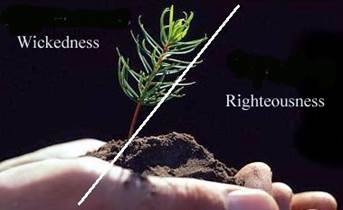 Yet, most
people never make a decision to move their tree one way or the other, and thus
they remain in the middle, balanced between good and evil, they are still
firmly straddling the line, a very bad position to be in. They fail to do what
they were created to do.
Yet, most
people never make a decision to move their tree one way or the other, and thus
they remain in the middle, balanced between good and evil, they are still
firmly straddling the line, a very bad position to be in. They fail to do what
they were created to do.
Revelation 3:16 So then because thou art lukewarm, and neither cold nor hot, I will spue thee out of my mouth.
Rosh HaShanah is a day tailor made by HaShem, for planting one’s tree on the side of righteousness. We were born to choose life. We were born to become tzaddikim![9]
Devarim (Deuteronomy) 30:19 I call heaven and earth to record this day against you, that I have set before you life and death, blessing and cursing: therefore choose life, that both thou and thy seed may live: 20 That thou mayest love the HaShem thy G-d, and that thou mayest obey his voice, and that thou mayest cleave unto him: for he is thy life, and the length of thy days: that thou mayest dwell in the land which the HaShem sware unto thy fathers, to Abraham, to Isaac, and to Jacob, to give them.
The type of choices that are able to accomplish an attachment to HaShem, are those choices taken for the express purpose of attaching to life, and to good, instead of what is temporary, and therefore to the evil.
These kinds of choices are made in the context of confronting moral dilemmas when we are torn in two directions, and we do not have a powerful inner program instilled by heredity or environment pointing us in the right direction. We desire one thing, but we know that the right decision is in the other direction, not because of our inner program but because HaShem told us in the Torah that that is the way to go. It is in these sorts of situations that present us with the opportunity of attaching ourselves to righteousness, to life.
Devarim (Deuteronomy) 30:15-19 Look, I have placed before you today the life and the good, and the death and the evil, that which I command you today, to love HaShem your HaShem, to walk in His ways, to observe His commandments, His decrees, and His ordinances ... But if your heart will stray and you will not listen, and you are led astray, and you prostrate yourselves to strange gods and serve them, I tell you today that you will surely be lost ... I have placed life and death before you, blessing and curse; and you shall choose life so that you will live, you and your offspring...
Now, lets look at the implications that can be derived from the fact that our tree will always have some branches on the other side of this line, no matter which decision we have made.
The Midrash provides a perfect introduction to this subject as it states the way HaShem acts in a very succinct way:
Midrash PESIQTA deRAB KAHANA Pisqa Nine IX:I [Concerning the verse: When a bull or sheep or goat is born, it will remain seven days with its mother; and from the eighth day on it will be acceptable as an offering by fire to the Lord (Lev. 22:27)]: Your righteousness/generosity is like the mountains of God, Your judgments are like the great deep; [man and beast You save, O LORD] (Ps. 36:6). R. Ishmael and R. Aqiba: R. Ishmael says, “With the righteous / generous, who carry out the Torah, which was given from the mountains of God the Holy One, blessed be He, does righteousness / generosity like the mountains of God. Your righteousness / generosity is like the mountains of God. But with the wicked, who do not carry out the Torah, which was given ‘from the mountains of God,’ the Holy One, blessed be He, seeks a strict accounting, unto the great deep. Your judgments are like the great deep. R. Aqiba says, “All the same are these and those: the Holy One, blessed be He, seeks a strict accounting with [all of] them in accord with strict justice. He seeks a strict accounting with the righteous / generous, collecting from them the few bad deeds that they do in this world, in order to pay them an abundant reward in the world to come. And He affords prosperity to the wicked and gives them a full reward for the minor religious duties that they successfully accomplished in this world, in order to exact a full penalty from them in the world to come.”
Now that we have succinctly seen how HaShem works, lets examine this concept in more detail. We shall continue to use the metaphor of the tree to help explain how HaShem works.
The Tzadik Gamur – Totally Righteous
If we have made a conscious decision to move our tree to the side of righteousness, then we are on the road to becoming a great Tzadik. Never the less, we will still have some branches which hang over the side of wickedness. HaShem, in His mercy, will assist us in either moving our tree more, or in pruning the branches which are on the side of wickedness. The pruning of the branches is what we see as the tribulations that the righteous encounter in their walk with HaShem. The sufferings and trials of the righteous are simply the pruning of their wayward branches. These branches are the sins which the righteous commit. Since evil is temporary, it’s reward (punishment) is paid out in this world. HaShem can see that this tree will be with Him in the Olam HaBa, the world to come. In that world of clarity, there will be no sin and no ambiguity. Therefore the sins of the righteous must receive their reward (correction) in this world, because in the Olam HaBa there is only righteousness.
People who have attached themselves to the eternal, even if they have only done so once in their lives, will make it to the Olam HaBa eventually, in spite of the multitude of their transgressions. Never the less, those transgressions must be corrected in this world.
But what about that person’s past transgressions? His transgressions are a barrier to the enjoyment of the Olam HaBa and consequently they must be dealt with and purified. Consequently, the transgressions of such a person must be dealt with either in this world or in Gehenom (hell). But once again utilitarian considerations mandate that the necessary purification be accomplished in this world. Therefore, anyone who belongs in the Olam HaBa but is blemished by transgressions, as most of us are, this world can logically be expected to be a vale of tears.
Jewish tradition teaches that HaShem’s policy is never to allow a person’s mitzvot to be cancelled by his transgressions. Therefore, if a person performed his mitzvot with the type of dedication that is required to attach himself to HaShem and to eternal life, this act altered his inner reality permanently. He is now a person who is attached to Olam HaBa once and for all and he will eventually enjoy that life.
We certainly do not want to think of ourselves as wicked. But most of us know that we are not tzaddikim gemurim, “totally righteous people” either. If so, we will make it to the Olam HaBa with HaShem’s help, as all people in general do except for the wicked. But this means that something has to be done to cleanse us of our many evil deeds. This can either be done by the means of hardships that we suffer in this world, or by subjecting us to the tortures of Gehenom or hell after we die.
As the tortures of hell are infinitely more painful than any tribulation we might experience in this world, we ought to prefer to complete our purification in this one. So why, on Rosh HaShana, are we asking HaShem for an easy year? And how could the decree of a good year possibly be considered a favorable judgment?
Shabbath 104a If one comes to cleanse himself, he is helped by HaShem.
There is an additional component that we need to be aware of. The righteous is seeking an eternal reward and is not interested in a temporary reward, and because HaShem has promised an eternal reward, the ONLY reward is the reward in the Olam HaBa, the world to come. Because the righteous man has not attached himself to the temporary world, any reward in this world becomes unavailable to him. He is not attached to this world.
The Reshaim Gemurim - Totally Evil
On the other hand, if we have made a conscious decision to move our tree to the side of wickedness, then we are on the road to becoming a great rasha, a wicked person. Never the less, we will still have some branches which hang over the side of righteousness. Even the most wicked person does some mitzvot, some kindness in this world. HaShem, in His mercy, will assist the rasha in either moving his tree more, or in pruning the branches which are on the side of righteousness. The pruning of the branches is what we see as the prosperity that the wicked encounter in this world.[10] The prosperity of the wicked is simply the pruning of their wayward branches. These branches are their mitzvot. HaShem can see that this tree will NOT be with Him in the Olam HaBa, the world to come. In that world of clarity there can be no sin and no ambiguity. Therefore the mitzvot of the wicked must receive their “reward” (blessing) in this world, because in the Olam HaBa there is only righteousness. In the Olam HaBa, the world of clarity, the wicked will simply not exist.
Reward in this world is mainly distributed to those who cannot receive their reward in the Olam HaBa because they simply won’t make it there. (The exceptions are too complicated to explain in the context of this essay.) But even such people, known as reshaim gemurim, or “totally evil”, have many good deeds to their credit. They may have been good fathers or husbands, they may have helped people when they felt the urge, and consequently they need to be rewarded.
Of course, it is impossible for us to grasp how such people with all these good deeds to their credit can be considered reshaim gemurim without appreciating how evil is to be understood, according to Jewish tradition.
Never the less, Jewish tradition dictates that it is impossible to receive the reward for any mitzva (good deed) in this world:
Kiddushin 39b Yet is it a fact that he who performs one precept in addition to his [equally balanced] merits is rewarded? But the following contradicts it: He whose good deeds outnumber his iniquities is punished, and is as though he had burnt the whole Torah, not leaving even a single letter; while he whose iniquities outnumber his good deeds is rewarded, and is as though he had fulfilled the whole Torah, not omitting even a single letter! — Said Abaye: Our Mishnah means that a festive day and an evil day are prepared for him, Raba said: This latter agrees with R. Jacob, who said: There is no reward for precepts in this world. For it was taught: R. Jacob said: There is not a single precept in the Torah whose reward is [stated] at its side which is not dependent on the resurrection of the dead. [Thus:] in connection with honouring parents it is written, that thy days may be prolonged, and that it may go well with thee. In reference to the dismissal of the nest it is written, that it may be well with thee, and that thou mayest prolong thy days. Now, if one’s father said to him, ‘Ascend to the loft and bring me young birds,’ and he ascends to the loft, dismisses the dam and takes the young, and on his return falls and is killed — where is this man’s happiness and where is this man’s prolonging of days? But ‘in order that it may be well with thee’, means on the day that is wholly good; and ‘in order that thy days may be long’, on the day that is wholly long.
The commentators explain that it would be utterly cruel of HaShem to reward any good deed in this world when the option exists to reward it in the next. The reward for any good deed preformed by someone with a share in the Olam HaBa, the world to come, should automatically be received later on simple utilitarian grounds. The payoff in this world is incomparably less, and rewarding the good deed here would be an unconscionable waste of a valuable resource.
The truth is that the reward of a mitzva simply doesn’t fit into this world. If you lined up the pleasure felt by all human beings from the beginning of the world to the present and squeezed it into a single moment, it would still not equal a moment’s pleasure in the Olam HaBa.
Nachmanides explains that the word tov[11] or “good”, refers to something “everlasting”, and that the word ra or “evil” refers to something “temporary”. This view is intuitively sensible as well, HaShem wants the good to last forever, whereas evil is clearly a temporary phenomenon. According to this perception, a rasha is not necessarily an evil person in the common sense of the word; rather, he is a person who is attached only to the temporary and transient and has never connected himself to the everlasting.
As Nachmanides explains: Life and good and death and evil are not different things but synonymous; the good is life everlasting, and the evil is death because it is temporary. This passage states that life is gained through choice: choose life so that you will live. The rasha is not evil in the common sense; he is merely a person who chooses the temporary and the short-lived rather than the everlasting.
For the rasha who has failed to attach himself to the eternal even once in his life, but who has performed many good deeds which must be rewarded, this world is the only place where such rewards can be made available, he does not exist in the Olam HaBa! As the rewards of mitzvot are so incomparably large, we would expect him to have a wonderful life in this world. Thus the wicked prosper in this world, but they do not exist in the Olam HaBa.
Further, the wicked does not believe in an eternal existence and would not want is reward in the next world. He wants his reward in this world, and he wants it NOW! Therefore, HaShem must pay him in this world. He would not want any other reward.
In the end of days, HaShem will reveal Himself and say just two words: “Ani HaShem - I am HaShem,” and all will become crystal clear to us. Everything will make sense; it will all fit. We’ll see that there was a divine scheme. A sequence of events had to take place the way it did for our ultimate benefit. And we will see clearly that even what seemed bad and unjust was, without a doubt, orchestrated by HaShem for our benefit.
This world and what happens in it is not about reward and punishment. As we have explained, reward and punishment become a part of our world due to purely secondary considerations.
This world is a workplace. The Divine policies that apply here are generated primarily by concerns over maximizing production, just as you would expect in any industrial setting. After all, the product of this world is the manufacture of eternal life. Practically speaking, this means that the creation of a place in Olam HaBa[12] for all of us is the focus of Hashgacha Pratit, Divine Providence.
There are three primary factors involved: We all must be placed into a situation that will force us to produce. For example, suppose A is sent into the world to correct the character trait of arrogance and cruelty. The extent of the correction achieved will determine A’s place in the Olam HaBa. Providence will have determined that A must be born rich or become wealthy early in his adult life. Such a life situation will guarantee that he will always contend with the character traits he was sent to correct. People will constantly ask him for help, and with each instance he will have to confront his streak of cruelty. The very fact that everyone will always be asking him for help and attempting to curry favor with him will ensure that he has to confront his trait of arrogance.
On the other hand, B is sent to the world to correct the trait of self-pity and to demonstrate the cheerful acceptance of one’s lot. Providence will arrange for B to be poor, as his poverty will automatically force him to contend with the very problems he was sent into the world to work on. If A were poor and B were rich neither would automatically be forced to do their jobs, and their productivity would be entirely dependant on their inner motivation, a very inefficient policy in terms of assuring maximum productivity. As they say, necessity is the mother of invention. No one has ever come up with a better motivator. A’s wealth and B’s poverty thus have zero relationship with reward and punishment. The determination is based on purely utilitarian considerations.
The second function of Providence is to provide help. As the Talmud states “someone who seeks to make himself spiritually impure, they open the way for him, and if someone desires to purify himself, heaven assists him[13]“. Providence is always there to provide assistance; how much assistance, and what sort will be available, is again based on considerations of productivity.
Rabbi Moshe Chaim Luzatto in “Derech HaShem”, “The Way of God”, explains that there are three levels of assistance in either direction. The person who begins on the path towards the Olam HaBa, the world to come, automatically receives some assistance. The person who is firmly set on his way gets more; his assistance comes in the form of redefining his job so that it is easier to complete. The person who has already gone most of the way gets the most assistance; HaShem provides him with whatever it takes to guarantee that he successfully completes his job.
But if we want HaShem to help us and lead us away from the wrong choice and along the path of life and goodness, then we have to do something equal and similar to deserve it. We have to go out onto the roads, where the roads are forked and there is a choice that needs to be made, and we have to stand there and tell other Jews, which way they should go, we have to go out there and scream “go in the right path, go in the path of goodness, away from the avenger, the Satan, away from the yetzer hara, the evil inclination”.
For the rasha who is headed in the opposite direction there are also three levels of “assistance”. Someone who has begun on the path away from the Olam HaBa loses the assistance he could have received and is left to his own devices, but Divine Providence doesn’t hinder him from turning back to face the right direction either. On the other hand, for the person who is well on his way on the road that leads away from the Olam HaBa is positively hindered from turning back. Divine Providence places him in a situation that makes it difficult for him to change directions, while the confirmed rasha is placed in a life situation that renders a change in direction next to impossible.
Luzatto provides a practical example to bring this down to earth. Changing one’s direction in life requires introspection, self-criticism and thought. These in turn require opportunity and motivation. Thus the rasha may be so loaded down with the trials and cares of poverty and ill health that his daily struggles make it impossible for him to enjoy the peace of mind that is required to really look closely at his life and figure out that he is headed in the wrong direction. Or Divine Providence may decide to bless the rasha with great wealth which will remove his motivation to indulge in searching self-criticism. Why rock the boat when everything is going well? The method selected by the Providence will depend on whether the rasha needs to be rewarded for his good deeds in this world or not.
This determination of Divine Providence, of how much positive help a person deserves, or how many obstacles should be placed in his path, is a function of judgment. This is what the judgment of Rosh HaShana is about.
Let us return to our examples A and B.
A, the wealthy man who was sent into the world to struggle with arrogance and cruelty has been doing a poor job. He hasn’t been at all charitable and he has become unapproachable and haughty. He knows about the workings of Providence that we have just described and stands before HaShem on Rosh HaShana, desperately afraid. His wealth was given to him only to ensure a productive struggle with his negative character traits. As he is losing the struggle and not being productive, if he were HaShem, at this point he would decide to take his wealth away as a means of making the task of reaching his objective more cumbersome and difficult.
What can he do about it? He should say to HaShem that he realizes that until now he has been deficient in his task but from now on he intends to fully engage in the activities for which he was born. If he can persuade HaShem of his sincerity, he will not lose his wealth.
B, also stands before HaShem knowing that his poverty is a result of the workings of Providence. But he has done an excellent job and worked on his self-pity and has tried to accept his situation with good cheer. He tells HaShem that he has struggled hard and long and been productive and now he would like some help. He would like his task made easier and therefore there is no more need for him to be poor. Let HaShem consider what he has accomplished as enough and let him contend with other character traits such as arrogance and cruelty. Let Providence place him in a life situation that would make him productive in these new tasks. Let Providence make him rich.
Rosh HaShana is indeed about judgment. The judgment doesn’t concern ultimate rewards but is about the availability of Divine assistance. Unlike the ultimate rewards which are the direct results of the inner transformations accomplished by the person himself and therefore cannot be awarded but must be chosen, assistance is a variable commodity whose availability is never absolutely fixed. Like everything else in this world it is relative rather than absolute, and human beings can employ their creative ingenuity to increase it.
We stand before HaShem on Rosh HaShana to present our case for increased Hashgacha Pratit, Divine Providence. May it be His will to judge our worldly task as finally complete and witness the arrival of the Mashiach, Amen ve Amen!
The wicked prosper because they have chosen evil and death. They are receiving the reward for their mitzvot in a temporary world because they are attached to temporary things only.
The idea that certain things receive their due in this world and others in the next world, is clearly spelled out in the remez of the Nazarean Codicil:
Luqas (Luke) 16:19-31 There was a certain rich man, which was clothed in purple and fine linen, and fared sumptuously every day: 20 And there was a certain beggar named Lazarus, which was laid at his gate, full of sores, 21 And desiring to be fed with the crumbs which fell from the rich man’s table: moreover the dogs came and licked his sores. 22 And it came to pass, that the beggar died, and was carried by the angels into Abraham’s bosom: the rich man also died, and was buried; 23 And in hell he lift up his eyes, being in torments, and seeth Abraham afar off, and Lazarus in his bosom. 24 And he cried and said, Father Abraham, have mercy on me, and send Lazarus, that he may dip the tip of his finger in water, and cool my tongue; for I am tormented in this flame. 25 But Abraham said, Son, remember that thou in thy lifetime receivedst thy good things, and likewise Lazarus evil things: but now he is comforted, and thou art tormented. 26 And beside all this, between us and you there is a great gulf fixed: so that they which would pass from hence to you cannot; neither can they pass to us, that would come from thence. 27 Then he said, I pray thee therefore, father, that thou wouldest send him to my father’s house: 28 For I have five brethren; that he may testify unto them, lest they also come into this place of torment. 29 Abraham saith unto him, They have Moses and the prophets; let them hear them. 30 And he said, Nay, father Abraham: but if one went unto them from the dead, they will repent. 31 And he said unto him, If they hear not Moses and the prophets, neither will they be persuaded, though one rose from the dead.
This passage warns us to hear and heed the law of Moshe. This is just another way of warning us to choose life!
Devarim(Deuteronomy) 30:19 I call heaven and earth to record this day against you, that I have set before you life and death, blessing and cursing: therefore choose life, that both thou and thy seed may live:
Choosing life is nothing more than moving your tree. After all, moving our tree to the side of righteousness is the ultimate choice for life.
Have you ever wondered whether you have trully moved your tree? One of the ways to receive confirmation that you have moved your tree and are now doing the Torah deeds of righteousness, is to see what HaShem is giving you as your due in this world:
Luqas (Luke) 6:20-26 And lifting up his eyes upon his disciples, said, Blessed are ye poor, for yours is the kingdom of God. 21 Blessed ye that hunger now, for ye shall be filled. Blessed ye that weep now, for ye shall laugh. 22 Blessed are ye when men shall hate you, and when they shall separate you from them, and shall reproach you, and cast out your name as wicked, for the Son of man’s sake: 23 rejoice in that day and leap for joy, for behold, your reward is great in the heaven, for after this manner did their fathers act toward the prophets. 24 But woe to you rich, for ye have received your consolation. 25 Woe to you that are filled, for ye shall hunger. Woe to you who laugh now, for ye shall mourn and weep. 26 Woe, when all men speak well of you, for after this manner did their fathers to the false prophets.
Have you moved your tree yet?
The physical world was made neutral, left for man to determine how it would be used. One world, two possibilities, and man is the one to determine whether or not he walks that path, or stumbles in it. But, try it he must, for that is what he was created to do.
For further elucidation on this fascinating subject, I recommend:
Michtav m’Eliyahu - Strive for Truth! by Rabbi E. E. Dessler.
The Worm on the Hook of Reality
It is possible to believe that our prosperity is due to our own hard work and wisdom. When we believe this, we must also believe that HaShem does not control His world. Never the less, it is easy to decieve ourselves and believe in our own abilities.
Hard work does not bring prosperity; HaShem brings prosperity. When people work hard and prosper, they can fool people into believing that they achieved their own properity. We must constantly acknowledge that HaShem is in control of our prosperity and all of our circumstances, and we must verbalize this to others. If we fail to alert others to HaShem’s total control, then we become the worm on the hook of reality. We deceive others into imitating us so that they can achieve what we achieved. We become like the wicked who believe in their own hard work, looks, wisdom, etc. and that those are what brought our success.
Do not become the worm on the hook of reality!
This goal of righteousness/generosity is achieved through the mitzvot, the good deeds, which sanctify us. However, after we die, there are no more mitzvot, as our psalmist declares:
Tehillim (Psalms) 88:6 Free among the dead, like the slain that lie in the grave, whom You remember no more: and they are cut off from Your hand.
The Gemara then explains this enigmatic phrase by showing us that during our lifetime we have the opportunity to draw near to HaShem through the performance of mitzvot, but after we die, there is no more movement, no more opportunity to draw nearer to HaShem.
Shabbath 30a Thy father David said, The dead praise not the Lord;[14] whilst thou saidest, Wherefore I praised the dead which are already dead[15] but yet again thou saidest, for a living dog is better than a dead lion.[16] Yet there is no difficulty. As to what David said: ‘The dead praise not the Lord’, this is what he meant: Let a man always engage in Torah and good deeds before he dies, for as soon as he dies he is restrained from [the practice of] Torah and good deeds, and the Holy One, blessed be He, finds nought to praise in him. And thus R. Johanan said, What is meant by the verse, Among the dead [I am] free?[17] Once a man dies, he becomes free of the Torah and good deeds. And as to what Solomon said, ‘Wherefore I praised the dead that are already dead’ for when Israel sinned in the wilderness, Moses stood before the Holy One, blessed be He, and uttered many prayers and supplications before Him, but he was not answered. Yet when he exclaimed, ‘Remember Abraham, Isaac, and Israel, thy servants!’[18] he was immediately answered.
Thus, we understand that we need to make use of our lives to make progress in our relationship with HaShem. In this world we can praise HaShem for His faithfulness, but after death, we no longer have this opportunity, as we see in the Gemara:
Eiruvin 19a R. Joshua b. Levi stated: Gehenna has seven names, and they are: Nether-world,[19] Destruction, Pit,[20] Tumultuous Pit, Miry Clay, Shadow of Death and the Underworld. ‘Nether-world’, since it is written in Scripture: Out of the belly of the nether-world cried I, and Thou heardest my voice;[21] ‘Destruction’, for it is written in Scripture: Shall Thy Mercy be declared in the grave? Or thy faithfulness in destruction;[22] ‘Pit’,[23] for it is written in Scripture: For Thou wilt not abandon thy soul to the nether-world; neither wilt Thou suffer Thy godly one to see the pit;[24] ‘Tumultuous Pit’ and ‘Miry Clay’, for it is written in Scripture: He brought me up also out of the tumultuous pit, out of the miry clay;[25] ‘Shadow of Death’, for it is written in Scripture: Such as sat in darkness and in the shadow of death;[26] and the [name of] ‘Nether-world’ is a tradition.
Ashlamatah: Yeshayahu (Isaiah) 24:2-8, 13-15
|
Rashi |
Targum |
|
1. ¶ Behold the Lord empties the land and lays it waste, and He shall turn over its face and scatter its inhabitants. |
1. ¶ Behold, the LORD is giving the earth for plunder and handing it over to the adversary, and shame will cover the face of its princes because they transgressed the Law, and He will scatter those who inhabit it. |
|
2. And it shall be, as with the people, so with the priest, as with the slave, so with his master, as with the maidservant, so with her mistress, as with the buyer, so with the seller, as with the lender, so with the borrower, as with the creditor, so with the one who owes him. |
2. And the layman will be as the priest; the servant as his master; and maid as her mistress; the buyer as the seller; the borrower as the lender, the debtor as one who credits him. |
|
3. The land shall be emptied and it shall be pillaged, for the Lord has spoken this thing. |
3. The earth will be utterly plundered and utterly trampled, for the LORD has spoken this word. |
|
4. The land has mourned, it has withered, the land has been humbled and withered, the highest of the people of the land have been humbled. |
4. The earth mourns, is desolate, the world is devastated, desolate; the strength of the people of the earth comes to an end. |
|
5. And the land has deceived because of its inhabitants, for they transgressed instructions, infracted statutes, broke the everlasting covenant. |
5. And the earth has sinned under its inhabitants; for they have transgressed the Law, annulled the feasts, changed the covenant which was from eternity. |
|
6. Therefore, an oath has consumed the land, and the inhabitants thereof were wasted; therefore, the inhabitants of the land were dried up, and few people remained. |
6. Therefore, from oaths of deceit the earth is desolate and those who inhabit it are devastated, therefore the inhabitants of the earth come to an end, and few men are left. |
|
7. Wine mourns, the vine is humbled, all joyful hearted sigh. |
7. All who drink wine mourn, for the vines wither, all the merry-hearted sigh. |
|
8. The joy of the drums has stopped, the stirring of merrymakers has ceased, the joy of the harp has stopped. |
8. The mirth of timbrels is still, the tumult of the strong has ceased, the mirth of the lyre stops. |
|
9. In song they shall not drink wine; strong drink shall become bitter to those who drink it. |
9. They will no more drink wine to music; old wine will be bitter to those who drink it. |
|
10. The wasted city is broken; every house is closed from entering. |
10. Their city is broken down, devastated, all the houses are shut up so that none can enter. |
|
11. A cry for wine is in the streets; all joy is darkened; the joy of the land is exiled. |
11. They cry out for wine in the streets; all the joy has finished; gladness has gone into exile from the earth. |
|
12. In the city there remains ruin; through desolation the gate is battered. |
12. Desolation is left in the city, and tumult in the collapse of gates. |
|
13. For so shall it be in the midst of the land among the peoples, like the cutting of the olive tree, like the gleanings when the vintage is over. |
13. For thus will the righteous/generous be left alone in the midst of the world among the kingdoms, as the stripping of the olive tree, as gleanings after vintage. |
|
14. They shall raise their voice, they shall sing; of the pride of Lord they shall shout for joy more than [by the] sea. |
14. They will lift up their voice, they will sing in the name of the LORD; they will shout as they broke forth over the prodigies that were done for them at the sea. |
|
15. Therefore, for the lights honor the Lord; in the islands of the sea, the Name of the Lord God of Israel. {S} |
15. Therefore, when the light comes to the righteous/ generous they will give glory before the LORD; in the coastlands of the sea, they will praise and bless the name of the LORD, the God of Israel. {S} |
|
16. From the end of the earth we heard songs, "The righteous shall be upraised." And I said, "I have my secret; woe is to me! the treacherous have dealt treacherously; yea, the treacherous have dealt very treacherously." |
16. From the sanctuary, whence joy is about to go forth to all the inhabitants of the earth, we hear a song for the righteous/generous. The prophet said, "The mystery of the reward for the righteous/generous is visible to me, the mystery of the retribution for the wicked is revealed to me! Woe to the robbers, who are robbed, and to the plunder of the plunderers, which now is plundered." |
|
17. Fright and a pit and a trap [shall come] upon you, inhabitant of the land. |
17. Fear, pit and snare are upon you, O inhabitant of the earth! |
|
18. And it shall come to pass, that he who flees from the sound of the fright shall fall into the pit, and he who ascends from within the pit shall be snared in the trap, for windows from above have been opened and the foundations of the earth have trembled. |
18. And it will come to pass that he who will flee before fear will fall into the midst of the pit; and he who will come up from the midst of the pit will be caught in the net. For prodigies are done in the heavens, and the foundations of the earth tremble. |
|
19. The earth has broken; the earth has crumbled; the earth totters. |
19. The earth indeed will tremble, the earth indeed will shake, the earth indeed will rock. |
|
20. The earth sways like a drunken man, and it sways like a lodge, and its transgression shall weigh down upon it, and it shall fall and not continue to rise. {S} |
20. The earth will indeed stagger like a drunken man, and it will come and go like a booth; its sins will be strong upon it, and it will fall and will not rise again. {S} |
|
21. And it shall come to pass on that day, that the Lord shall visit punishment upon the host of heaven on high and upon the kings of the earth on the earth. |
21. And it will come to pass in that time that the LORD will visit the forces of the stronghold, those who dwell in strength, and the kings of the sons of men who reside on the earth. |
|
22. And they shall be gathered a gathering [as] prisoners into a dungeon, and they shall be shut up in the prison, and [sins] of many days shall be visited [upon them]. |
22. And they will gather them together in a prison and shut them in the jail, and after many days they will be remembered. |
|
23. And the moon shall be ashamed and the sun shall be abashed, for the Lord of Hosts has reigned in Mount Zion and in Jerusalem, and before His elders will be glory. {P} |
23. Then those who serve the moon will be ashamed and those who worship the sun will be humiliated; for the kingdom of the LORD of hosts will be revealed on the Mount of Zion and in Jerusalem and before the elders of His people in glory. {P} |
Rashi’s Commentary on Yeshayahu (Isaiah.) 24:2-8, 13-15
1 Behold the Lord empties the land and lays it waste This prophecy represents retribution for Israel. Since he prophesied for them this consolation, and they are destined to see great distress before it, he, therefore, said to them, “Not to you do I say that you will inherit it, for, behold, the Holy One, blessed be He, empties you out and lays you waste, but those of you who survive until the day of redemption, they shall raise their voice and sing;” this is the end of the passage (v. 14), and for them have I prophesied the favorable prophecy.
empties (בּוֹקֵק) empties.
and lays it waste (וּבוֹלְקָה) and lays is waste.
and He shall turn over its face And He shall confuse its esteemed men. עִוָּה is an expression related to (supra 21:3): “I have become confused (נַעֲוֵיתִי) from hearing.”
2 (Addendum) And it shall be, as with the people, so with the priest Not like other travelers, that the master is led by his slave, and the mistress is led by her maidservant; the master is esteemed and the slave is held in low esteem, the mistress is esteemed and the maidservant is held in low esteem, but when the captor leads the captives, all are equal before him. [Addendum to Rashi]
as with the buyer, so with the seller When the people lives in its land securely, the buyer is happy and the seller is unhappy, since he will not return to the land he sold, but when the captor leads them, the buyer will not rejoice and the seller will not mourn, and so, as with the lender, so with the borrower, both are equal, for the borrower has nothing to pay, and the lender, had he not lent to this one, the captor would have taken it. Likewise, as with the creditor, so with the one who owes him. The word לֹֹוֶה applies to money and נֹשֶה applies to other commodities, such as wine, oil, grain, and honey, as it is written (Deut. 24:10): “When you lend your brother anything as a loan.” [Addendum to Rashi]
3 shall be emptied (וְהִבּוֹק תִּבּוֹק) shall be emptied.
and it shall be pillaged (וְהִבּוֹז תִּבּוֹז) an expression of pillage and spoils.
4 it has withered (נָבְלָה) Comp. (Jeremiah 8:13) “And the leaf has withered (נָבֵל).” An expression of withering and languishing.
has been humbled (אֻמְלְלָה), an expression of humility. Comp. (Neh. 3:34) “humble Jews (אֻמְלָלִים).”
The land (תֵּבֵל) This is the land of Israel, which is spiced (מְתֻבֶּלֶת)with many commandments.
the highest of the people of the land the pride of the people of the land.
5 And the land has deceived This is a sort of deceit; it produces grass but does not produce growing grain; it shows growing grain, but there are no wheat kernels in its stalks (lit., in its straws).
because of its inhabitants (תַּחַתיוֹשְׁבֶיהָ) lit., under its inhabitants; because of its inhabitants.
the everlasting covenant That is the Torah that they received with a covenant.
6 Therefore, an oath For the sin of vain oaths. ([Manuscripts read:] Because of the sin of false oaths.)
were dried up (חָרוּ) an expression of dryness and thirst through the heat of dryness. Comp. (Jer. 6:29) “The bellows are dried (נִחַר).”
8 The joy of the drums that you said (supra 22:13), “And behold, joy and happiness.”
10 The wasted city is broken When it is broken, it will be called the wasted city.
from entering for anyone to enter.
11 is darkened (עָרְבָה), is darkened.
the joy of the land That is Jerusalem.
12 Through desolation, the gate is battered Through the desolation of loneliness, that the houses are desolate, without an occupant, the gates shall become battered by demons and destructive creatures.
13 For so shall Israel remain in the midst of the peoples, one in a city and two in a family.
like the cutting of the olive tree that leaves over berries at the tip of the uppermost bough.
14 They shall raise their voice For those few survivors shall come the good that I prophesied above.
they shall shout for joy more than [by the] sea (Lit., they shall shout for joy from the sea.) More than they shouted for joy by the sea during the redemption from Egypt.
15 Therefore, for the lights (בָּאֻרִים). Jonathan paraphrases: When lights come to the righteous, concerning the two good tidings, both that of the redemption from Babylon and that of Edom. ([Most manuscripts read:] Jonathan paraphrases: When lights come to the righteous, concerning the two lights, etc.) And Menachem stated (Machbereth, p. 32) that אֻרִים is an expression of holes and crevices where they were fleeing, and so (Gen. 11:28): “ אוּר, the valley of the Chaldees,” and so (supra 11:8): “And on the hole (מְאוּרַת) of an adder,” the hole of its dwelling.
16 From the end of the earth Jonathan paraphrases: From the Temple, which is at the edge of the land of Israel in the east, as we learned: (Maaser Sheni 5:2) [According to Lev. 19:23 25, the produce of the vineyards produced during the first three years of its growth may neither be eaten nor may any benefit be derived therefrom. The produce of the fourth year must be taken to Jerusalem and eaten there. If this is inconvenient, the owner may redeem the produce and take the redemption money to Jerusalem, where he must buy food to eat with the sanctity of כֶּרֶם רְבָעִי, the fourth year vineyard. The Rabbis decreed, however, that within a day’s journey from Jerusalem, all produce must be brought to Jerusalem, and the owner has no option to redeem it. The following Mishnah delineates the boundaries of this area.] Lod from the west, and the Jordan from the east. It is found that from Jerusalem to the Jordan is a day’s journey. But I say according to the simple meaning, that we heard from behind the heavenly Curtain that they are destined to raise their voices in song from the edge of the earth. Now what are the songs? “The righteous shall be upraised.” There shall be a position and an upraising for the righteous.
And I said, I have my secret; I have my secret; woe is to me! Woe is to me that these two secrets have been revealed to me, the secret of retribution and the secret of salvation, for the salvation will be far off until enemies come, plunderers after plunderers, and marauders after marauders (San. 94a). Five instances of treachery are stated here, corresponding to Babylon, Media, Persia, Greece, and Edom, who will enslave Israel before their redemption, and after these plunderings.
17 Fright and a pit and a trap [shall come] upon you upon the peoples dwelling in the land.
a pit a hole in which to fall, as he goes on to state.
18 he who flees from the sound of the fright shall fall into the pit. etc. Whoever escapes the sword of the Messiah the son of Joseph shall fall into the sword of the Messiah the son of David, and whoever escapes from there shall be snared in the trap of the wars of Gog.
19 The earth has broken (רֹעָה הִתְרֹעֲעָה) an expression of breaking. Comp. (Ps. 2:9): “You shall break them (תְּרֹעֵם) with an iron rod.”
has crumbled (פּוֹר הִתְפּוֹרְרָה), an expression of crumbs.
20 like a lodge a booth of the watchmen at the top of a tree.
21 the host of heaven He shall cast down the heavenly princes of the nation’s first.
22 And they shall be gathered a gathering that is to their detriment, i.e., to bring a prisoner into a dungeon prepared for him, those sentenced to Gehinnom to be brought into Gehinnom.
and they shall be shut up in the prison They are the seven compartments of Gehinnom.
and [sins] of many days shall be visited [upon them] Sins of many days shall be visited upon them. This is what the Kalir (R. Eleazar son of R. Kalir in his final liturgical poem for Parshath Zachor) established: “From many days to be counted, to reckon their reckonings.”
23 And the moon shall be ashamed, etc. Jonathan paraphrases: And the worshippers of the moon shall be ashamed, and the worshippers of the sun shall be humbled.
Commentary on the Ashlamatah of Yeshayahu (Isaiah) 24:2-8, 13-15
By: H.Ex. Adon Shlomoh Ben Abraham
Our Torah reading this week speaks of the returning of the land to its owner as in the year of Jubilee. I think one connection with our Ashlamatah reading is that the earth[27] is mentioned sixteen times in Isaiah 24th chapter and some 7 to 8 times in our Torah reading. The context in the Torah is the land of Israel, but I would posit that in our prophetic reading it is speaking of both the land of Israel and the entire earth, although the same word in Hebrew is used. Therefore, we would have a juxtaposition between the land of Israel and the land of the whole earth and in both cases the word is אֶרֶץ ʾereṣ.[28] Another juxtaposition in relation to land is return (v.13) (שׁוּב šûḇ)[29] and redemption (v.23) (גְּאֻלָּה geʾullāh).[30]
This 24th chapter of Isaiah is one of four chapters that form a distinct group of oracles, these are strongly marked by their general apocalyptic character. They speak of God's desolating judgment of the world and the terrors of that great day. The suppression of the power of evil in heaven and on earth, and the consequent blessings that will come upon Israel and humanity. The abolition of death forever and the wiping away of tears from all faces. Isaiah 24 speaks specifically of that day of universal judgment, and the wickedness of the people, and the consequent misery and wretchedness that is coming.[31] The emphasis seems to be placed on people and place, in totality: people without exception everywhere and in every place, everywhere. Human sin infects the whole human race and environment and this constant sinning by humans is the ultimate environmental threat. Climate change could be God’s answer to the human condition, to destroy the earth by fire.
The translated language cannot easily express in English the sound of despair coming from the Hebrew poetry of these verses. All (the earth) will be affected, he will twist[32] its surface[33] and scatter its inhabitants.[34] According to Rashi, this prophecy pertains to Gog Magog of Ezekiel (38-39) Others maintain it describes the Assyrian conquest of the Northern Kingdom of Israel while others believe it is speaking of Nebuchadnezzar’s conquest of the middle eastern nations.[35] In a novel interpretation R’ Schwab[36] suggests the prophet is referring to worldwide catastrophes that take place over millennia and not all at once due to the words, emptied, cutoff, scattered, twisted and its appearance will be distorted. The destroyer will not discriminate between the high of society or the lowest, between the rich and the poor, all will be equally affected. Our text lists the different stations in life from one extreme to another. (v.2). In (v.4) the earth mourns and withers, the word earth is the word אֶרֶץ ʾereṣ, which refers to the dwelling place of humans, the physical world. R’ Schwab makes a distinction between the earth mourns and withers and the world languishes and withers. Our word here world is תֵּבֵל tēḇēl, which he states refers to the human world or society.[37] One word speaks of the area humans live and the other speaks of the social world and society humans create.
What is the reason all this is coming on the land and world? We can see the land is speaking of Israel and even the greater land of the whole inhabited earth (erets) and the world (tebel) all the societies of the world are to be included in these curses that will devour the land and the people. I’m reminded of something like 98 curses the Torah speaks of if people refuse to follow God’s directives.
Our world today is becoming more concerned about physical pollution of our environment, and yet they never stop to consider that spiritual pollution is the first step in the destruction of the land. Isaiah deals with the even more pressing and tragic matter of moral pollution, which is as widespread and serious today as it was in the eighth century BCE. Rabbi Stiensaltz translates v.5 as, the earth is corrupted because of its inhabitants, for they transgressed laws, violated statute, and breached an eternal covenant with God. The language might seem, to be more appropriate to Israel, because of her possession of the Mosaic Law; but the context here makes it plain that the whole world is in view. One can ask, how can my sin and transgression affect the earth? I am guessing the same as it did when Adam and Eve rejected the moral absolutes they were given.
Many commentators see a reference to the Noachian covenant, especially in the phrase “the everlasting covenant,” which also occurs in Genesis 9:16. It is possible too that the prophet had Genesis 3 in mind, particularly in view of his reference to the curse in (v.6). The world as a whole did not possess the moral commandments of God in written form as in the latter Mosaic Law; but those laws nevertheless represent the will of God for mankind, and mankind is under judgment for their violation. The word “disobeyed” implies at least some awareness of these moral requirements in the human conscience (cf. Rom 1:18–32; 2:11–16), thus an element of deliberateness in sin.[38] “They rejected divine moral absolutes and invented an innovative morality. Thirdly, they discarded a given relationship with God. The term Everlasting covenant is used of the Noahic covenant (Gen. 9:16), the Abrahamic covenant (Ps. 105:10), the Sabbath (Lev. 24:8) and the Davidic covenant (2 Sam. 23:5) with its future messianic fulfilment (55:3; 61:8)”.[39] If the Noahic covenant precedes the Siani covenant, we can see where the second builds on the first just as all the covenants in the Bible build on previous ones and that which came later does not invalidate the earlier.
Rabbi Stiensaltz in his translation of Isaiah 24:6 sounds just a bit like Rabbi Saul (Paul) from some 2000 years ago. Therefore, a curse consumed the land, and its inhabitants bore their guilt. Alternately, they were astonished. Therefore, the inhabitants of the land are seared and shriveled, (to be burned with fire) and few people remain therein. In a couple of weeks, we will be reading of the 98 curses in Leviticus 26, and we will learn of the consequences of “breaking the covenant”.
When we get to (v.13) it speaks of “in the mist of the earth among the nations” The traditional understand is that it speaks of “Israel” among the nations, but others see it as a visitation of Judgement on all the human race with only a small remnant that will survive.[40] Those who survive the catastrophe will sing praise(v.14) and those or “they from the sea”(Yam) also understood as the west, will offer praise and hymns to God.(v.15) Rashi says, the destruction and desolation will be so complete, that only one from a city and two from a family will survive.[41] He also, compares the singing and rejoicing with that done at the Sea of Reeds when the children of Israel where redeemed from Egypt. When the final redemption comes, the people will see the truth of Torah and will flock back to its study and observance. The verse also gives us an ideal of two redemptions, in the word translated “east or lights” maybe from Babylonian and the Roman exiles as some have understood. Abarbanel renders the plural “lights” as torches and all-night celebrations. Since we have just come through the Chanukah season and great promises are attached to Kislev 25, maybe we could see an allusion here to the time of our redemption and a connection to the time of “lights”.
Earlier, we mention that Rashi related this text to the time of Gog and Magog. If we look at the history of Gog u’ Magog as it was understood in time past, we will see that man has had a fascination with trying to find out who and where this person resides. “Gog and Magog” refers to enemies of the Jewish people. Jewish texts describe how, at the dawn of a messianic era, Gog and Magog will wage war against Israel, and God will miraculously defeat them. The terms Gog and Magog first appear together in Ezekiel 38–39, where Gog is the name of a leader, and Magog is his land. In rabbinic literature, Gog and Magog are understood to be the names of two nations or one nation with two names. Sometime around the 12th century, the Ten Lost Tribes of Israel came to be identified with Gog and Magog.[42] Therefore as one can see, Gog u Magog is like the all-inclusive demons in the dark, regardless of where one looks, they can be found.
In Sanhedrin 97b:3 Our Sages taught: "There will be no difference between the current age and the Messianic era except the emancipation from our subjugation to the gentile kingdoms." The simple interpretation of the prophets' words appears to imply that the war of Gog and Magog will take place at the beginning of the Messianic age. Before the war of Gog and Magog, a prophet will arise to inspire Israel to be upright and prepare their hearts, as Malachi 3:23(Hebrew editions) states: 'Behold, I am sending you Elijah.' He will not come to declare the pure, impure, or to declare the impure, pure…... Elijah turns the hearts of the fathers to the children and the heart of the children to the fathers.
The Rabbis link the future retribution against the enemies of Israel to or as a continuation of the divine retribution that began with the ten plagues against Egypt. The Midrash Tanchuma, a medieval collection of midrashim, links the biblical narrative of the Exodus to eschatological themes involving the ultimate defeat of Israel's foes. And I will harden Pharaoh’s heart, etc. (Exod. 7:3). The Holy One, blessed be He, declared: Moses, you shall speak, and I will bring the plague. Moreover, He stated, in this world I will obtain retribution from the Egyptians through the ten plagues, but in the future I will obtain retribution for you from Gog and Magog, as it is said: And I will plead against him with pestilence and with blood; I will cause to rain upon him, and upon his bands and upon the many peoples that are with him, an overflowing shower (Ezek. 38:22). It seems we have a direct link with Egypt and Gog U Magog here and I have often thought there is just one entity which is called by many names that fights against God’s people Israel. In this Ezekiel passage we see the leader and the bands of people in association with him are treated all the same. In the Milstein edition of the Prophet Ezekiel, this verse is linked due to the cognates in the Hebrew language to the Exo 12:12 passage where the first born of Egypt are destroyed and not only by the sword of war but all other ways also and we are told everyone will see the supernatural events and perceive that the hand of God is at work.[43]
In the Mishnah in Berakhot 10a, the questions are asked, why was the chapter of Absalom juxtaposed with the chapter of Gog and Magog? They are juxtaposed so that if a person should say to you, expressing doubt regarding the prophecy of the war of Gog and Magog “against the Lord and against His anointed”: Is there a slave who rebels against his master? Is there someone capable of rebelling against God? You too say to him: Is there a son who rebels against his father and severs the relationship with the one who brought him into the world and raised him? Yet, nevertheless, there was such a son, Absalom, and so too there can be a situation where people will seek to rebel against God. Can we conclude that those in rebellion against their master are operating under the spirit or auspices of Gog u Magog. It is believed that the second chapter of Psalms speaks concerning the war of Gog and Magog.[44]
And I will bring the third in fire and I will bring the third in straits in the smelting-pot of fire (Jonathan), so that some of the proselytes should bear the birth pang of the Messiah and the war of Gog and Magog with Israel. From there they shall be tested [as to] whether [or not] they are true proselytes. Then, many of those who previously converted to Judaism shall return to their pre- conversion customs and join Gog. We find [this idea] in the Aggadah (Avodah Zarah 3b; Midrash Psalms 2:5, footnote 29).[45] If two thirds of the population of the earth are to perish in the “latter days” and of the third who are brought through the fire, even some of those turn back, surely Yeshua was correct when he said broad is the way that leads to destruction. “Enter by the narrow gate. For the gate is wide and the way is easy that leads to destruction, and those who enter by it are many. 14 For the gate is narrow and the way is hard that leads to life, and those who find it are few.[46] Proverbs 10:29 The way of the Lord is a stronghold to the blameless, but destruction to evildoers. The righteous will never be removed, but the wicked will not dwell in the land. [47]
When the Word of the Lord shall reveal Himself to redeem His people, He will say to all the nations: Behold now, that I am He who Am, and Was, and Will Be, and there is no other God beside Me: I, in My Word, kill and make alive; I smite the people of the Beth Israel, and I will heal them at the end of the days; and there will be none who can deliver them from My hand, Gog and his armies whom I have permitted to make war against them.[48]
In the Aggadah, the classical rabbinic literature treat Gog and Magog as two names for the same nation who will come against Israel in the final war.[49] The rabbis associated no specific nation or territory with them beyond a location to the north of Israel, but the great Jewish scholar Rashi identified the Christians as their allies and said God would thwart their plan to kill all Israel. [50] The "Pri Tzaddik” or Zadok Ha-Kohen"[51] on the weekly portion Nasso, connects Gog u Magog with Amalek. In this work, it can be read in chapter 15:2: "And after all of this, there still will be war of Gog u Magog upon the Messiah son of Yoseph, for Gog u Magog is the seed of Amalek, and Amalek corresponds always to the opposite of the sanctity of Israel, deeply...". Similarly, in the Tanakh, book of Judges 5:14 (JPS 1985) it can be read: "From Ephraim came they whose roots are in Amalek".[52]
As we can begin to see, Gog U Magog may be or may not be an individual from a specific land and as in most major movements in society there is always a particular person associated with it, it seems to me that this entity that hates the Jewish and Israeli people has had many names and took on many personas down through time. Egypt and Pharaoh and then Amalek, and then others too numerous to mention. In every age a man was found, and a land was used to apply this motif of Gog U Magog to. So, where do we look for Gog u Magog? I would say, the best place to look for Gog would be in the heart of the individual. I venture to say any evil thought, desire or attitude that looks to fight against God’s people or against God, is the offspring of Amalek. If anyone, is in opposition to the physical children of Israel or if someone is in opposition to God’s written word then that person would be operating under the guise of Gog U Magog and in the end will be dealt with just as the Bible say in many different places. Gog Magog shows up differently all though time but exhibits the same actions and has the goal in mind to fight against God and his people and to resist his holy teaching at every turn. In our earlier mention of Ezekiel 38 we see that even in HaShem’s punishment of the people(humanity), it is rooted in his divine mercy. In judgement a person may repent and come closer to HaShem, or the judgement may inspire others to do so. In the end, not only Israel but all the nations will know, I will be exalted, and I will be sanctified…. Then they will know that I am Hashem. (Ezk.38:23)
Verbal Tallies
By: Hakham Dr. Hillel ben David
The verbal tallies between the Torah and the Aslamata are:
Sale / Seller - מכר, Strong’s number 04376.
Purchase / Buyer - קנה, Strong’s number 07069.
Given that the name of our seder is: וְכִי-תִמְכְּרוּ – “VeKhi Tim’Keru” “And when you make a sale”, it is not surprising that “sale / seller” should be what connects our Torah seder to our Ashlamata. Lets look a bit closer at the two pesukim, verses, that contain this connector word, and a second verbal tally:
Vayikra (Leviticus) 25:14 And when you make a sale תִמְכְּר֤וּ <04376> (8799) to your fellow Jew or make a purchase קָנֹ֖ה <07069> (8800) from the hand of your fellow Jew, you shall not wrong one another.
Yeshayahu (Isaiah) 24:2 And it shall be, as with the people, so with the priest, as with the slave, so with his master, as with the maidservant, so with her mistress, as with the buyer כַּקּוֹנֶה֙ <07069> (8802), so with the seller כַּמּוֹכֵ֔ר <04376> (8802), as with the lender, so with the borrower, as with the creditor, so with the one who owes him.
The thematic connection between the Torah seder and our chapter of Psalms is found in Tehillim (Psalms) 88:13 and Vayikra (Leviticus) 25:23, where the psalmist speaks of the rigors of exile versus what Moshe teaches about the fact that Jews are strangers and settlers in in Eretz[53] Israel:
Tehillim (Psalms) 88:13 Shall Thy wonders be known in the dark? and Thy righteousness in the land of forgetfulness?
And:
Vayikra (Leviticus) 25:23 And the land shall not be sold in perpetuity; for the land is Mine; for ye are strangers and settlers with Me.
From Hakham Dr. Eliyahu ben Avraham:
The Verbal Connection I found based on the Hebrew Text of the Torah Sederim
The one common word that connects all these passages is "give" (natan in Hebrew, didomi in Greek).
Leviticus 25:14–34: Instructions about buying, selling, and redeeming highlight giving fairly and equitably in transactions.
Psalm 88:1–19: The psalmist appeals to G-d to "give" attention to his cries.
Isaiah 24:2–8, 13–15: G-d gives judgment and recompense to the earth and its inhabitants.
2 Peter 1:5–7: G-d gives everything needed for life and holiness.
Luke 14:15–33: The parables discuss giving up possessions and resources to follow G-d’s call.
The word "give" ties together the themes of provision, surrender, and accountability in all these verses.
The Thematic Connections I found were
The thematic connection shared among all the given verses is the covenantal exchange and accountability principle, encompassing provision, redemption, and the cost of faithfulness. This theme unfolds in the following ways:
Provision and Ownership
Each passage reflects G-d as the ultimate source of provision, whether it be land, resources, spiritual growth, or eternal life. Humanity is portrayed as stewards, accountable to the Divine mandate.
Leviticus 25:14–34: The land is G-d’s, and its use must align with His covenant.
2 Peter 1:3–7: G-d provides everything necessary for life and godliness, calling believers to cultivate virtues.
Redemption and Restoration
There is a recurring focus on restoration—of land, people, or relationships. This theme is central to G-d’s covenant with humanity.
Leviticus 25:14–34: Redemption of property reflects restoration within the covenantal community.
Psalm 88:1–19: A plea for redemption from despair, invoking G-d’s faithfulness.
Judgment and Accountability
The theme of mutual accountability is evident, emphasizing consequences for actions and the necessity of aligning with G-d’s will.
Isaiah 24:2–8, 13–15: Universal judgment on humanity for neglecting Divine principles.
Luke 14:15–33: The cost of discipleship underscores personal responsibility in following G-d’s call.
Surrender and Faithfulness
These passages call for surrender, whether in obedience to laws, trust in G-d during trials, or relinquishment of material possessions to follow Him.
Luke 14:15–33: Surrendering all for discipleship reflects covenant loyalty.
2 Peter 1:3–7: Growing in virtues demonstrates active faithfulness.
Summary
The overarching thematic connection is G-d’s covenantal relationship with humanity, characterized by His provision, the responsibility to live in alignment with His principles, and the accountability inherent in that relationship. This theme weaves through laws, lament, prophecy, and teaching, forming a unified Biblical narrative.
Nazarean Talmud
Sidrot of Vayikra (Lev.) Lev. 25:14 – 25:34
“VeKhi Tim’Keru” “And that-you make a sale”
By: Hakham Dr. Eliyahu ben Abraham
|
School of Hakham Shaul Tosefta Luqas (Lk)
|
School of Hakham Tsefet Peshat 2 Tsefet (2 Pet)
|
|
¶ Now large congregations followed with him, and he turned around and said to them, “If anyone comes to me and does not hate[54] his own father and mother and wife and children and brothers and sisters, and furthermore, even his own life, he cannot be my talmid. Whoever does not carry his own cross[55] and follow me cannot be my talmid. For which of you, wanting to build a tower (Heb. migdal), does not first sit down and calculate the cost to see if he has enough (money) to complete it? Otherwise after he has laid the foundation and is not able to finish it, all who see it will begin to ridicule him, saying, ‘This man began to build and was not able to finish!’ Or, what King, going out to engage another king in battle, does not sit down first and deliberate whether he is able with ten thousand to oppose the one coming against him with twenty thousand. But if not, while the other is still far away, he sends an ambassador and asks for terms of peace. In the same way, therefore, every one of you who does not renounce all his own surplus possessions cannot be my talmid. |
¶ Now while you are applying all this diligence Hokhmah/wisdom, add to your faithful obedience Binah - understanding, and to your Binah/understanding add Knowledge (Da’at); And to Knowledge (Da’at) add love (Chessed) and to love (Chessed) add self-control (Geburah) and to self-control (Geburah) add reverence of God (Tiferet); And to reverence of God (Tiferet) add patience (Netzach), and to patience (Netzach) add excellence (Hod), and to excellence (Hod) add brotherly love (Yesod) [and to brotherly love, the governance of G-d (Malkhut)]. |
Nazarean Codicil to be read in conjunction with the following Torah Seder
|
Lev. 25:14 – 34 |
Psa 88:1-19 |
Is. 24:2-8; 13-15 |
2 Tsefet (2 Pet) 1:5-7 |
1 Luqas (Lk) 14:25-33 |
Commentary to Hakham Tsefet’s School of Peshat
Looking Specifically At the Nazarean Codicil
Looking first at the Peshat, Mishnah of Hakham Tsefet, we see that he connects with the Torah Seder through various numbers. Encoded into the Mishnah of Hakham Tsefet is a reference to the Congregation’s ten men (minyan). In the second pericope, Hakham Tsefet speaks of ten offices/officers. However, in the first pericope, Hakham Tsefet mentions the Mesorah, which is the governance of Malchut – the Kingdom/Governance of G-d through the Bate Din and Hakhamim. Therefore, Hakham Tsefet subtly mentions the Congregational officers and the Bench of Hakhamim in the pericope. While we see ten associates with Tishrei the 10th, we still question how the mention of ten men relates to Yom Kippur.
A Peshat look at Mysticism
“Kabbalistic” mysticism need not be confined or relegated to “Ineffable Mysticism” (So’odic Mysticism). “Kabbalah” is a verb that means “to receive.” Kabbalah, as a noun, means “An obscure theosophy[56] of Rabbinical origin based on the Hebrew Scriptures” (i.e., the Torah). The Divine Wisdom of the Torah unfolds through PaRDeS hermeneutics. However, the Rabbis teach these hermeneutic instructions through the four PaRDeS levels. The results of these hermeneutics are passed down (Mesorat) from Hakham to talmid. The talmid, in turn, receives (kibal) the understanding of the Torah from his Hakham through the exegesis of the PaRDeS hermeneutical system. Therefore, “kabbalistic mysticism” only refers to the system of hermeneutics a talmid received from his mentor. Kabbalistic mysticism would then fit the four hermeneutic levels of PaRDeS. Therefore, each hermeneutic level is a vital aspect of Kabbalistic learning.
Herein, the PaRDeS levels of hermeneutics govern differing levels of mysticism. Therefore, this evokes whether or not there can be a Peshat – literal mysticism. In part, there is a Peshat mysticism in “normal mysticism.”
Suppose Peshat takes the meaning “literal” interpretation of a text, i.e. the Torah. In that case, we must assert when applying Peshat to mysticism that we have normal or literal mysticism. Here, we must remember the straightforward interpretation of mysticism: “Knowledge of spiritual truth that’s gained by praying or thinking deeply. We mean that Peshat mysticism requires deep thought before arriving at a hermeneutic conclusion. From the deep thought of Peshat’s hermeneutics comes Peshat admissions of the Divine Presence. Literal acts often have mystical value. Consequently, this is especially true of ceremonial or ritual acts. Ceremonial services such as weddings, funerals, and Bar mitzvahs all have mystical implications or undertones. Talmud Torah (Torah Study) is in and of itself “Gilluy Shekinah” (revelation of G-d).[57] Therefore, “Gilluy Shekinah” – Awareness of G-d, evident in Talmud Torah is its form of mystical experience. The Torah Scholar experiences an awareness of G-d through deep thought and Peshat hermeneutic exegesis. Here, we have confined the expertise within the dimension of the Peshat experience to not exclude this practice from the other levels of hermeneutic exegesis.
The communicative level of Peshat often requires a ritual act to experience “Gilluy Shekinah.” However, some may not consider the Talmud Torah a ritual practice. Yet, it can fit into this category if the Torah Scholar establishes a “ritual” to develop an awareness of “Gilluy Shekinah.” Herein, this may also be the case when seeking “Knowledge of spiritual truth” through Talmud Torah.
Indeed, the readers will want to pause mentally to see if they have ever heard of “literal, normal mysticism.” The phrase is not shared. However, we have not coined the phrase. We have borrowed the term from Rabbi Max Kadushin.[58] We will borrow bits and pieces from his phrase and works to show what Hakham Tsefet pointed to when he paralleled Yom Kippur with the Ten Men (Minyan) of the Congregation.
By “normal mysticism,” we mean that certain standard, practical Jewish practices observed daily qualify as “mystical.” Because these practices are “mundane,” they might not qualify as “So’odic mysticism.” Here, we will use the phrase So’odic Mysticism to refer to those practices that are more abstract and require more profound thought than expressed in the daily practice of ritual observances. We will not refer to the deeper “So’odic Mysticism” as Kabbalistic Mysticism” because we take true “Kabbalistic Mysticism” to mean any teaching received from a mentor or teacher that requires deep thought to be “Received (Kabbalistic) Mysticism.” Furthermore, we can deduce that all levels of PaRDeS hermeneutics are “Kabbalistic Mysticism.” Given this delineation, we can see that there is a “Peshat (Literal) Mysticism, “Remes (allegorical) Mysticism” and “Midrashic (parabolic) Mysticism.” Therefore, as noted above, all levels of PaRDeS hermeneutics have mystical content received (Kibal) from a Hakham or mentor. For the sake of time and space, we will only deal with Peshat mysticism or “Normal (practical) Mysticism.” We may encroach minimally on the Remes and Midrash Mysticism levels with no intention of elaborating on them at length for the present. We will only do so because they have a standard connection through the PaRDeS hermeneutical system.
Mystical experiences, loosely defined, are mental exercises for the sake of drawing nearer to G-d. The Merriam-Webster Dictionary defines ‘mysticism’ as “deep thought” (thinking deeply), as noted above. As such, we can easily see how kabbalistic Mysticism applies to all levels of Hermeneutics.
The Temple and the Synagogue
While we clearly understand that the Temple is a picture of the Synagogue and the Synagogue is a picture of the Temple, we will draw on these two institutions to explain Hakham Tsefet’s paradox. The Sages of Blessed memory teach us that the appellation “Gilluy Shekinah” means the “Revelation of G-d’ in a normal, mystical way. Therefore, Gilluy Shekinah is a means of “drawing near” to G-d. In the Temple, the “korbanot” was a means of “drawing near” to G-d and experiencing “Giluy Shekinah.”
We can see that David HaMelekh had ocular experiences of “Gilluy Shekinah” in the Mishkan (Tabernacle). “To see your power and glory,[59] so I have seen You in the sanctuary.”[60] Therefore, David HaMelekh’s experience was both “mystical” and ocular. In the Sanctuary, David HaMelekh experienced “Gilluy Shekinah.” “Normal mysticism” then contains both mystical and ocular characteristics as well.
Therefore, the sacrificial cult was a means of Gilluy Shekinah. Therefore, this may be what David HaMelekh saw. However, we will here opine that this is not what David HaMelekh was referring to. Likewise, we will see that Hakham Tsefet refers to what David HaMelekh saw.
Most Jewish scholars will agree that during the Second Temple period, the Jewish people practiced non-sacrificial forms of worship. Furthermore, the Sages of Blessed Memory used the same terms to describe the non-sacrificial acts of worship. The key phrase for both non-sacrificial and cultic sacrifice was “abodah,” “service” or “worship.” Consequently, “Gilluy Shekinah” refers to sacrificial and non-sacrificial acts of worship “abodah.” Abodah is then a mixture of valuational and cognitive service. The cognitive act of Abodah stemming from the first mitzvah is to “Know G-d.[61]”
Hence, we can understand that “Gilluy Shekinah” is an expression of G-d’s nearness, which is present in the sacrificial cult and the prayer service of the Synagogue. Tefillah (prayer) and Brakhot (blessings) are non-sacrificial forms of worship, and they are called “Gilluy Shekinah.” The Temple as “Gilluy Shekinah” offers numerous ocular experiences. Smoke rose from the Mitzbeach (altar), and clouds of fragrant incense rose from a special altar. One could see the Levites on the Ducan (porch) singing the Psalms of David HaMelekh. The Esnoga (Synagogue) is not without its ocular experiences of “Gilluy Shekinah.” Like the Levitical Priests, the Chazan chants the prayers from an elevated platform (Bema or Teba). Consequently, the Esnoga offers discernable awareness of G-d’s nearness in ocular form.
There is a discernable, undeniable connection between Tefillah and the sacrificial forms of worship. Both Tefilliah and the sacrificial cult are time-bound. Ba’alim’s vision affirms this truth, “For from the top of the rocks I see him, and from the hills I behold him: Behold, the people will dwell alone, and will not be counted among the nations.”[62] Ba’alim saw the B’ne Yisrael (Ya’aqob) as they prayed outside of their Sukkot during the sacrificial offerings in the Mishkan (Tabernacle). Therefore, there has Always been a connection between Tefillah and the Temple offerings. With the destruction of the Temple in 70 C.E., the Jewish people did not then decide to make Tefillah a part of their daily “Abodah.” At the behest of the Hakhamim, they instituted it long before this time. It was, therefore, natural and “normal” for them to continue to pray the prayers of their ancestors at the time of the Temple sacrifices. They did not need to wait to hear from G-d per se. They did what was natural and normal. Tefillah did not “replace” the sacrificial cult; it merely continued in the absence of the Bet HaMikdash. Tefillah sustained the B’ne Yisrael during the exile in Babylon. Even during the exile from the Temple courts, the Jewish people have had Tefillah as their “Gilluy Shekinah” (Revelation of G-d’s nearness). Sevarah shows us that the sacrificial cult could not stand alone without Tefillah, who offered it during the sacrifices. The reverse is that Tefillah can stand alone as a “Gilluy Shekinah” without the korbanot.
Yom Kippur is a day that, in antiquity, earned the title of “Face to face.” Consequently, this was a “Gilluy Shekinah” of special order because the Kohen came “face to face with G-d.” During the First Temple period, the Kohen Gadol came “face to face” with the Aaron (Ark of the Covenant). During the Second Temple period, the Kohen Gadol came “face to face” with only the Eben Shitiach (foundation stone).
Hence, we can see that “Gilluy Shekinah” is experienced in both Abodah’s sensory and non-sensory acts. Superficially, Tefillah is a non-sensory form of “normal mysticism.” However, this does not preclude it from having So’odic implications and aspects. Therefore, if mysticism is “deep thought,” it does not need to be So’odic or deep Mysticism. Here is where the inspiration of Hakham Tsefet ignites. He demonstrates that the seven/ten men are the sensory experience of “Gilluy Shekinah” within the Synagogue.
Furthermore, he understands that Tefilliah frequently contains Brakhot (blessings) to express “Gilluy Shekinah.” Why did the Sages of Blessed Memory institute specific Brakhot (blessings) within Tefillah? An answer might be that they saw in Tefillah the proper forms of sacrifice that G-d desired. Therefore, as taught and mandated in the Oral Torah, Tefillah is more important than all the “Korbanot” combined. G-d is not looking for the sacrifice of a bull. G-d wishes the sacrifice of the heart and lips, i.e., normal (practical) mysticism. Tefillah preceded sacrifice. Adam and Chavah communed with G-d daily in the Garden of Delight. Normal Mysticism, Tefillah for them was daily and very “Ordinary.”
Furthermore, it preceded sacrificial means of atonement, being near G-d. Therefore, we see that the Sages added Korbanot to Tefillah, not the other way around. The beauty of Tefillah is that even when we whisper our prayers, we can draw the Shekinah of G-d.
The Sages of Blessed Memory added Brakhot (blessings) to Tefillah as a way of experiencing different aspects of the Shekinah. Therefore, “normal” acts like eating, drinking, and waking all have relative experiences of “normal mysticism.” In this way, Tefilliah and Brakhot are time-bound “normal” ritual practices. We find two aspects of G-d’s nearness in these Brakhot (blessings). The first is Middat HaRachamim (a measure of loving-kindness), and the second is Middat HaDin (a measure of Justice). These two manifestations of the “Gilluy Shekinah” stem from the more profound So-odic revelations of the Shekinah. We see the most “normal” expression of these Brakhot (blessings) in the Esnoga at times of prayer. On Yom Kippur, the Kohen offered two goats to atone. We can see the two goats and the Priest in the Esnoga as Seven Paqidim. This normal ocular expression of “Gilluy Shekinah” is more profound than the image of two goats. The mystical experience of seeing the Paqidim is “normal mysticism.” Only with the Minyan of Ten men can we experience the fullness of Tefillah. Therefore, Hakham Tsefet knows that the presence of the Ten Men is a means of drawing the “Gilluy Shekinah.” Each of the eighteen (19) steps of the Amidah/Tefillah mediates on differing facets of G-d’s Shekinah. The absence of the Ten Men precludes experiencing “Gilluy Shekinah” in its fullness. The Sages teach us that the Shekinah was never present in the Temple courts during the Second Temple period. Interestingly, during that time, to experience “Gilluy Shekinah,” one needed only attend the Synagogue and be among the Ten Men.
There is a cliché among the Jewish people regarding Shabbat. “More than the Jewish people have kept Shabbat; Shabbat has kept the Jewish people.” Perhaps we can say that more than the Jewish people have sustained the Ten Men, the Ten Men have sustained the Jewish people.
Hakham Tsefet’s message is clear. You can look at the Temple on Yom Kippur when G-d came face to face with the Kohen Gadol. Conversely, the image G-d wants to see is not a Temple with an empty room but an Esnoga with Ten Men!
Lights of Messiah
It should be evident from the above comments that the “Lights of Messiah” refers to the Seven (Ten) men of the Esnoga (Synagogue). Furthermore, the “presence” of these men, as stated, was indicative of the Shekinah. Their presence is an outward sign of the spiritual reality that G-d has drawn close to His Congregation. In a certain sense, the appellation “Shekinah” means that G-d has “drawn close” or “drawn near.” Interestingly, we see in the Tosefta of Luqas those who are “drawing near” to Messiah. We will highlight how this is accomplished by listening to and observing the Master’s Mesorah. The Master was not in the habit of trying to draw attention to himself. It was quite the opposite. Messiah came to restore humanity to their rightful place in service (abodah) of G-d.
Rabbinic worship (abodah) generally parallels the Peshat experience, which is governed by the Torah (mitzvot and Halakhah).[63] Abodah in the Rabbinic mind is personal service, i.e., the “service of the heart.” Yet, abodah also means the experience of worship. However, concerning the officers of the Esnoga, this means that our involvement in congregational prayer is of greater intricacy than personal prayers. These involvements bring an experience of joy and satisfaction. And, this can account for our joy in service and our habitual worship practices. We have a sensation of being closer to G-d in these times. In this, we become “ebedim” servants, courtiers of the King, i.e., the Messiah.
The Rabbis of the first century saw the work and service of the Kohanim offering sacrifices as “abodah.” Interestingly, they also called the Tefillah, i.e., the Amidah and its benedictions, by the same title. Brakhot (Blessings), said in the Amidah or upon eating a piece of fruit, falls in the category of “Middat HaRachamim” (a measure of merciful loving-kindness). It may be somewhat difficult to comprehend unless we realize that G-d is the creator and benefactor of humankind. The mind should also connect positively to Kedushah (holiness – being separated). What may also be hard for some to grasp is that there are differing levels of “Kedushah.” The courts of the Bet HaMikdash readily exemplify this.
Each “court” possessed a level of sanctity concerning its joining court. Therefore, this is equally true since the Temple and the Esnoga have the same basic overall design. Furthermore, the Bet HaMikdash and the Synagogue have the same essential function. Scholars have argued over the origin of the Synagogue for decades. Levine[64] offers an open door to the past by stating that the term “Synagogue” came into use by the Second Temple period. However, it is likely that before the Second Temple period, there may have been other terms for the Synagogue, such as proseuche (worship). Regardless of the title, formal worship was not dependent on a label. When one researches history trying to find the title “synagogue” or “proseuche,” he will find a dead end. However, when we use simple logic, we can determine that formal worship is as old as Adam and Havah. G-d pointed out the lack of appropriate service (abodah) to Qayin (Cain). In speaking about, Gan Eden (the Garden of Eden – delight) was a special place of worship, a Synagogue per se. As noted above, the Rabbis were very careful about their nomenclature. They reserved notable titles for specific tasks, prayers, and “service.” G-d placed Adam in the Garden of Delight to serve (abodah) and keep (shomer) a special place of communion between G-d and man (Adam). Therefore, the worship environment in a specific place has existed for millennia, perhaps without a particular title.
Hakham Tsefet’s words become clear when we realize that he speaks of communal interactions and observances. Being fruitful in the community means being a contributing factor in its growth both spiritually and numerically. The Torah language this week shows that the fruitless will be “cut off.”
What does Hakham Tsefet consider to be fruitful? What does Hakham Tsefet consider being positively active? And, what is the “calling” he mentions?
Evident throughout his second Igeret (letter) is that he addresses those with an epicurean mindset. Hakham Tsefet addresses those who deny that G-d is the creator or that G-d is actively involved in His creation. G-d’s activities in the world are said to fall into one of these two categories. The first is “dynamis poietike,” His creative power, and “dynamis basilike,” executive power. The previous pericope demonstrates dynamis basilike, His executive power. In the present pericope, we see the extension of those powers. The “Lights of Messiah” of the previous pericope are an extension of His executive power through His plenipotentiary agents. The statements of the present pericope now make perfect sense. If you have the model of the Ten men functioning effectively in your Congregation, you will be “super abounding in fruitfulness.” Furthermore, you will “be grounded” in the intimate Knowledge of the Mesorah of our Master.
Hakham Tsefet defines being fruitful as having full, intimate Knowledge (Da’at) of the Mesorah of the Master. Consequently, this is also what he terms as actively being able to stand in that full intimate Knowledge (Da’at) of the Mesorah. It should be evident that his nomenclature is the equivalent of Abot 1:1.
And as it is said: “Mosheh received the Torah from Sinai and gospelled it down to Yehoshua, and Yehoshua gospelled it down to the Elders, the Elders to the Prophets, and the Prophets gospelled it down to the Men of the Great Assembly. They (the Men of the Great Assembly) emphasized three things: Be deliberate in judgment, make stand many disciples, and make a fence around the Torah” (P. Abot 1:1).
While it is the activity of the Hakham to make his talmidim “stand,” the talmidim are not exempt from being faithfully obedient. This is what Hakham Tsefet is saying in so many words. As talmidim, you must be actively (working) towards becoming Hakhamim full of the Mesorah. Herein, “full Da’at” becomes Hokhmah, and becoming a Hakham is the “calling” we chose. Being fruitful means reproducing yourself. Regardless of our level of understanding in the Torah, we must share it with others. The mark of a true talmid of maturity is his ability to measure the Torah he transmits to others.
The talmid that progresses to maturity is one capable of entering the Kingdom/Governance of G-d through Messiah and his plenipotentiary agents. Seven men of the Congregation are not just handsome men in nice suits. The seven men are potential Hakhamim. As Paqidim, they should press themselves forward into the role they were groomed for. Hakham Tsefet contrasts those who have within themselves the virtue of the seven men with those who do not.
Furthermore, the talmidim must have the mentality of a Talmud Torah even when they become Hakhamim. A true Torah Scholar is never satisfied with his learning. Therefore, he eternally remains a talmid of the Torah and other Hakhamim.
Peroration
Hakham Tsefet finds the seven men living examples modeled in the Congregation. He sees no place for the lackadaisical. His “commend” is to be actively involved in your spiritual development. Hakham Tsefet implies that the peak of character is development epitomized by the Hakham. However, this is achieved when one fully develops wisdom in Torah study.
Questions for Understanding and Reflection
- From all the readings for this Shabbat which verse, or verses impressed your heart and fired your imagination?
- From all the Tanakh: which particular verse or passage taught you about the role of Messiah as described in the Nazarean Codicil readings for this week?
Blessing After Torah Study
Barúch Atáh Adonai, Elohénu Meléch HaOlám,
Ashér Natán Lánu Torát Emét, V'Chayéi Olám Natá B'Tochénu.
Barúch Atáh Adonái, Notén HaToráh. Amen!
Blessed is Ha-Shem our God, King of the universe,
Who has given us a teaching of truth, implanting within us eternal life.
Blessed is Ha-Shem, Giver of the Torah. Amen!
“Now unto Him who is able to preserve you faultless, and spotless,
and to establish you without a blemish,
before His majesty, with joy, [namely,] the only one God, our Deliverer,
by means of Yeshua the Messiah our Master, be praise, and dominion,
and honor, and majesty, both now and in all ages. Amen!”
Next Shabbat: “V’khi-Yamukh Achikha” - “And when your brother”
|
Shabbat |
Torah Reading: |
Weekday Torah Reading: |
|
וְכִי-יָמוּךְ אָחִיךָ |
|
Saturday Afternoon |
|
Reader 1 – Vayiqra 25:35-37 |
Reader 1 – Vayiqra 26:3-5 |
|
|
Reader 2 – Vayiqra 25:38-40 |
Reader 2 – Vayiqra 26:6-10 |
|
|
“Y cuando tu hermano” |
Reader 3 – Vayiqra 25:41–43 |
Reader 3 – Vayiqra 26:11-13 |
|
Vayiqra (Leviticus) 25:35– 26:2 |
Reader 4 – Vayiqra 25:44-46 |
|
|
Yeshayahu (Isaiah) 35:3-10 |
Reader 5 – Vayiqra 25:47-49 |
Monday & Thursday Mornings |
|
Tehillim (Psalms) 89:1-19 |
Reader 6 – Vayiqra 25:50-53 |
Reader 1 – Vayiqra 26:3-5 |
|
Reader 7 – Vayiqra 25:54-26:1-2 |
Reader 2 – Vayiqra 26:6-10 |
|
|
N.C.: 2 Pet 1:8-11; Lk 15:1-10 |
Maftir – Vayiqra 26:1-2 |
Reader 3 – Vayiqra 26:11-13 |
Contents of next week’s Torah Seder
· Practical Love of Neighbour – Leviticus 25:35-38
· No Permanent Servitude for Any Israelite – Leviticus 25:39-46
· Israelites who are Slaves of Aliens – Leviticus 25:47-55
· Idolatry Forbidden, and the Sabbath to be Observed – Leviticus 26:1-2
Reading assignment for next week
|
The Torah Anthology: Yalkut Me’Am Lo’Ez By: Rabbi Yitzchok Magriso, Translated by: Rabbi Aryeh Kaplan Published by: Moznaim Publishing Corp. (New York, 1989) Leviticus II - Vol. 12– “Holiness” pp. 265-287 |
Ramban: Leviticus Commentary on the Torah
Translated and Annotated by Rabbi Dr. Charles Chavel Published by Shilo Publishing House, Inc. (New York, 1974) pp. 450-454 |

Hakham Dr. Hillel ben David
Hakham Dr. Eliyahu ben Abraham
Edited by His Honor Paqid Adon Ezra ben Abraham
A special thank you to HH Giberet Giborah bat Sarah and Giberet Sarai bat Sarah for their diligence in proof-reading.