Tu B'Shevat - חג האילנות - ט"ו בשבט
By Rabbi Dr. Hillel ben David (Greg Killian)

Tu B'Av: 40 Days Before Elul 25
Tu B'Shevat: 40 Days Before Adar 25.
Masculine and Feminine Energies
Paired Creation and Cosmic Symmetry
What Happens Before Each Festival:

In this study I would like to examine the minor festival of Tu B’Shevat, the new year for the trees. This festival begins the spring cycle of festivals as we explored in our study of rains. This festival celebrates the beginning of spring as the sap begins to rise in the trees that have been dormant during the winter.
Tu B’Shevat, the fifteenth day of Shevat, is commemorated in Jewish tradition as a special holiday: the New Year for trees. According to the sages, until this day trees consume water collected from the previous year's rainfall and from this day on the water they consume comes from the current year's rainfall. Thus, legally, Tu B’Shevat determines which tithe is to be taken from the newly-formed fruit of the tree, as it determines to which year the fruit belongs to. In addition, on Tu B’Shevat we celebrate the trees' re-awakening to life, as sap rises from its roots and delivers the earth's blessings and energy to the branches where new fruit is being formed.
The name "Tu B'Shevat", or Hamishah Asar B'Shevat, are ways of saying the fifteenth of Shevat which corresponds with January/February on the Gregorian calendar. To understand the “Tu” we need to understand that the "T" is the English transliteration of the of the Hebrew letter "Tet", which is used to represent the number nine. The "u" is the English transliteration of the Hebrew letter "Vav", which is used to represent the number six. In Hebrew the numbers are the letters. So, nine plus six is fifteen.
Tu B'Shevat is not an appointment with HaShem; it is not a festival. Never the less, it is a Biblically significant day. This is one of four days which are called Rosh Hashana, New Year, because it is the New Year for the tithing of the fruit of the tree. The Talmud speaks of this:
Rosh HaShana 2a CHAPTER I, MISHNAH. There are four new years. On the first of Nisan is new year for kings and for festivals. On the first of Elul is new year for the tithe of cattle. R. Eleazar and r. Simeon, however, place this on the first of Tishri. On the first of Tishri is new year for years, for release and jubilee years, for plantation and for [tithe of] vegetables. On the first of Shevat is new year for trees, according to the ruling of beth Shammai; beth Hillel, however, place it on the fifteenth of that month.
The Mishna tells us that the school of Shammai said that the new year for trees is on the first day of the month of Shevat, while the school of Hillel said that it is on the fifteenth day of Shevat. The halachah follows the opinion of the school of Hillel, and we therefore celebrate the new year for trees on the fifteenth of Shevat.
Rosh Hashanah for The Tree
The Pri Tzaddik points out, it is not called the "Rosh Hashanah for the trees," but for "the tree" (singular); whenever the word "tree" is used, it always refers to Torah, which is called "Aitz Chaim," the Tree of Life.
We all know that the agricultural seasons for planting and harvesting do not usually coincide with the beginning and end of our calendar. As these gifts are gifts of produce which depend on a yearly cycle (as each year's harvest is subject to these gifts, in addition to the fact that the gift may differ from year to year, as mentioned above), a definition of a year is needed so we know the cut-off point for inclusion of the produce in a specific year, and hence subject to a specific year's gift requirement. The beginning of the agricultural year for trees as far as these gifts go is the fifteenth of Shevat, the New Year for Trees. For example: The present Jewish year is 5768. If a fruit was formed on the tree before the fifteenth of Shevat 5768, it is included with all fruits that were formed from Shevat fifteen, 5767 until Shevat fifteen, 5768. If the fruit was formed after Shevat fifteen, 5768, it is included with the fruits formed from Shevat fifteen, 5768 until Shevat fifteen, 5769 for purposes of determining to which year's gift it will be subject. This is the significance of the New Year for Trees.
No Ta'anith (fasting) is permitted on Tu B’Shevat since it is the Rosh Hashanah (New Year) of the trees.
Tu B’Shevat is the day when the fruit of a tree is evaluated for the purpose of tithing. There are three Biblical tithes that applied to the fruit of the tree. The portions are separated according to the seven years of the Shmita cycle. In the following scriptures, we will examine the scripture that relate to this tithe:
Vayikra (Leviticus) 25:2-9 "Speak to the Israelites and say to them: 'When you enter the land I am going to give you, the land itself must observe a sabbath to HaShem. For six years sow your fields, and for six years prune your vineyards and gather their crops. But in the seventh year the land is to have a sabbath of rest, a sabbath to HaShem. Do not sow your fields or prune your vineyards. Do not reap what grows of itself or harvest the grapes of your untended vines. The land is to have a year of rest. Whatever the land yields during the sabbath year will be food for you--for yourself, your manservant and maidservant, and the hired worker and temporary resident who live among you, As well as for your livestock and the wild animals in your land. Whatever the land produces may be eaten. "'Count off seven sabbaths of years--seven times seven years—so that the seven sabbaths of years amount to a period of forty-nine years. Then have the trumpet sounded everywhere on the tenth day of the seventh month; on the Day of Atonement sound the trumpet throughout your land.
Vayikra (Leviticus) 27:30-31 "'A tithe of everything from the land, whether grain from the soil or fruit from the trees, belongs to HaShem; it is holy to HaShem. If a man redeems any of his tithe, he must add a fifth of the value to it.
Bamidbar (Numbers) 18:25-32 HaShem said to Moses, "Speak to the Levites and say to them: 'When you receive from the Israelites the tithe I give you as your inheritance, you must present a tenth of that tithe as HaShem’s offering. Your offering will be reckoned to you as grain from the threshing floor or juice from the winepress. In this way you also will present an offering to HaShem from all the tithes you receive from the Israelites. From these tithes you must give HaShem’s portion to Aaron the priest. You must present as HaShem’s portion the best and holiest part of everything given to you.' "Say to the Levites: 'When you present the best part, it will be reckoned to you as the product of the threshing floor or the winepress. You and your households may eat the rest of it anywhere, for it is your wages for your work at the Tent of Meeting. By presenting the best part of it you will not be guilty in this matter; then you will not defile the holy offerings of the Israelites, and you will not die.'"
Devarim (Deuteronomy) 26:1-16 When you have entered the land HaShem your G-d is giving you as an inheritance and have taken possession of it and settled in it, Take some of the firstfruits of all that you produce from the soil of the land HaShem your G-d is giving you and put them in a basket. Then go to the place HaShem your G-d will choose as a dwelling for his Name And say to the priest in office at the time, "I declare today to HaShem your G-d that I have come to the land HaShem swore to our forefathers to give us." The priest shall take the basket from your hands and set it down in front of the altar of HaShem your G-d. Then you shall declare before HaShem your G-d: "My father was a wandering Aramean, and he went down into Egypt with a few people and lived there and became a great nation, powerful and numerous. But the Egyptians mistreated us and made us suffer, putting us to hard labor. Then we cried out to HaShem, the G-d of our fathers, and HaShem heard our voice and saw our misery, toil and oppression. So HaShem brought us out of Egypt with a mighty hand and an outstretched arm, with great terror and with miraculous signs and wonders. He brought us to this place and gave us this land, a land flowing with milk and honey; And now I bring the firstfruits of the soil that you, HaShem, have given me." Place the basket before HaShem your G-d and bow down before him. And you and the Levites and the aliens among you shall rejoice in all the good things HaShem your G-d has given to you and your household. When you have finished setting aside a tenth of all your produce in the third year, the year of the tithe, you shall give it to the Levite, the alien, the fatherless and the widow, so that they may eat in your towns and be satisfied. Then say to HaShem your G-d: "I have removed from my house the sacred portion and have given it to the Levite, the alien, the fatherless and the widow, according to all you commanded. I have not turned aside from your commands nor have I forgotten any of them. I have not eaten any of the sacred portion while I was in mourning, nor have I removed any of it while I was unclean, nor have I offered any of it to the dead. I have obeyed HaShem my G-d; I have done everything you commanded me. Look down from heaven, your holy dwelling place, and bless your people Israel and the land you have given us as you promised on oath to our forefathers, a land flowing with milk and honey." HaShem your G-d commands you this day to follow these decrees and laws; carefully observe them with all your heart and with all your soul.
Nehemiah 10:34-39 "We--the priests, the Levites and the people--have cast lots to determine when each of our families is to bring to the house of our G-d at set times each year a contribution of wood to burn on the altar of HaShem our G-d, as it is written in the Law. "We also assume responsibility for bringing to the house of HaShem each year the firstfruits of our crops and of every fruit tree. "As it is also written in the Law, we will bring the firstborn of our sons and of our cattle, of our herds and of our flocks to the house of our G-d, to the priests ministering there. "Moreover, we will bring to the storerooms of the house of our G-d, to the priests, the first of our ground meal, of our [grain] offerings, of the fruit of all our trees and of our new wine and oil. And we will bring a tithe of our crops to the Levites, for it is the Levites who collect the tithes in all the towns where we work. A priest descended from Aaron is to accompany the Levites when they receive the tithes, and the Levites are to bring a tenth of the tithes up to the house of our HaShem, to the storerooms of the treasury. The people of Israel, including the Levites, are to bring their contributions of grain, new wine and oil to the storerooms where the articles for the sanctuary are kept and where the ministering priests, the gatekeepers and the singers stay. "We will not neglect the house of our G-d."
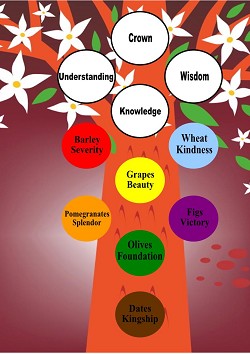
In Shulchan Aruch[1], which discusses the days on which we do not say Tachanun (a special prayer of supplications which is not recited on joyous days), we find that Tu B'Shevat is one of those festive days on which we do not recite the Tachanun prayer. Commenting on this law, the Magen Avraham writes that "The custom of the Ashkenaz is to increase the consumption of different types of fruits on this day," in honor of the significance of the day to trees and their fruits. Ben Ish Chai also advises Sephardim to do likewise. This is a custom which many people keep today, using fruits which the Torah mentions in conjunction with the land of Israel:
Devarim (Deuteronomy) 8:6-10 Observe the commands of HaShem your G-d, walking in his ways and revering him. For HaShem your G-d is bringing you into a good land--a land with streams and pools of water, with springs flowing in the valleys and hills; A land with wheat and barley, vines and fig trees, pomegranates, olive oil and honey; A land where bread will not be scarce and you will lack nothing; a land where the rocks are iron and you can dig copper out of the hills. When you have eaten and are satisfied, praise HaShem your God for the good land he has given you.
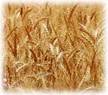
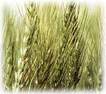
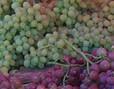
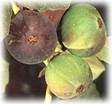
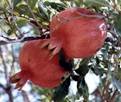
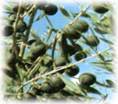
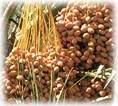
The honey, in the above passage is date honey. This means that the land of Israel is especially praised for the following fruits:
|
Wheat |
Barley |
Grapes |
Figs |
Pomegranates |
Olives |
Dates |
|
|
|
|
|
|
|
|
Since the Torah mentions them in a particular order, so too do we bless HaShem in this order if we have any or all of the above fruits.
The three tithes associated with Tu B’Shevat are:
1. Terumah or Maaser rishon - A 1% portion separated for the Levites every year.
2. Maaser shini - Literally, the second tithe (tenth). A 10% portion the owner was to eat "before HaShem" on the first, second, fourth, and fifth Shmita years. Any Jew who lived too far away from the Sanctuary to bring this tithe there could instead bring its monetary value with which he was to purchase food there and enjoy a festive meal with his family and the Levi'im. (The Ma'aser Sheni was taken after the Terumah [Kohen's portion] and Ma'aser Rishon [Levite's portion] had been removed.
3. Maaser Oni - A 10% portion that was given to the poor in the third and sixth years. This tithe was consumed at home, rather than brought to the Sanctuary
In the seventh year, there is no planting or reaping, so there are no portions to separate
The Halachic proposition is that the seven year shmita cycle obligates us to give fruit tithes to the Levites (who are landless), according to and also to the poor, Devarim (Deuteronomy) 26:1-16.. These gifts are given during the first, second, fourth and fifth years. However, during the third year, and so too the sixth year, this self-same tithe is eaten by the land owner, but only within the domain of Jerusalem, as "Maaser Shini", the second tithe.
What is the decisive border-line date used to decide what belongs to the second year and what to the third year? The decision is made by ascertaining just when the tree blossomed its fruits, before Tu-B'Shevat or after. Because technically the day when trees stop absorbing water from the ground, and instead draw nourishment from their sap. In Jewish law, this means that fruit which has blossomed prior to the fifteenth of Shevat could not be used as tithe for fruit which blossomed after that date. Until this critical date, it yet belongs to the previous (second) year. After that, it is considered to belong to the "third year". (Note: likewise with orlah (fruits produced by a tree during the first three years after its planting), fruits are prohibited until Tu-B'Shevat of the fourth year, and so too the stipulation not to deliver "terumot (the 1% portion separated for the Levites every year) or bikurim" (firstfruits) from fruits of one year, as consideration for fruits of another year, the demarcation line is Tu-B'Shevat.)
Since the Holy Temple was destroyed, the Jewish people can no longer bring the FirstFruits (Bikkurim) to Yerushalayim. On Tu B'Shevat we offer instead the fruit of our lips, to praise HaShem for all the fruit trees in the world.
Why Tu B'Shevat?
Rosh HaShana 14a ON THE FIRST OF SHEVAT IS NEW YEAR FOR TREES. What is the reason? R. Eleazar said in the name of R. Oshaia: Because [by then] the greater part of the year's rain has fallen[2] and the greater part of the cycle[3] is still to come. What is the sense of this? What it means is this: `Although the greater part of the cycle is still to come, yet since the greater part of the year's rain has fallen, [therefore etc.]'.
The above Talmud says that the majority of winter rains fall before Tu B'Shevat. How so? Since the first rains are expected by the seventeenth of Cheshvan, three months pass until Tu B'Shevat, and the rest of the winter season is only two and a half months (until the end of Nisan).
In Jewish law the "majority" is given full weight and authority as if unanimous. We find that all of the agricultural laws of the Holy land of Israel are biblically binding only if all of the Jewish People are dwelling in the land. When only a minority of the Jewish Nation is there, the commandments are binding only rabbinically. However, if the majority of our nation are dwelling in the land of Israel, once again these instructions have biblical weight.
So too, in our winter rain season. If three months pass, out of a sum total of five and a half months (starting with 17th of Cheshvan) it is legally considered as if the entire year has passed.
A fruit which blossomed before the fifteenth of Shevat is considered to be produce of the previous year. If it blossomed afterwards, it is produce of the new year. [By comparison, grains, vegetables, and legumes have the same New Year as humans, the 1st of Tishri.] In Israel, the rainy season begins after the festival of Succoth. It takes approximately three months (from Succoth, the fifteenth of Tishri, until the fifteenth of Shevat) for the rains of the new year to saturate the soil and trees, and produce fruit. All fruit which blossom beforehand is a product of the rains of the previous year, and is tithed together with the crops of the previous year.
"FOR MAN IS AS A TREE IN THE FIELD"
(Devarim 20:19)
Rabbi Uri from Strelisk used to say :"A man should work forever, doing full and honest labor in order to rise step by step in the service of HaShem. But do not look back every few minutes to see if you are progressing. For man is like a tree. And do you look at a tree continually to see how it is growing? If you did, you would see nothing and become tired of looking, unless you prune it and protect it, trim and fertilize and water it to protect it from damage and danger and strong winds. Then the tree will grow and prosper and become beautiful. So must man rid himself of all those things which spoil him, and tend all the qualities which aid him in the service of HaShem so that he will grow and prosper. It is, however, not a virtue to measure from hour to hour how much he has grown."
Many fruits and vegetables from Eretz Yisrael are now available in the United States. Before one is able to eat any of these fruits, Terumah and Ma'aser tithes must be taken. Fresh produce grown in Eretz Israel must undergo the necessary tithe-taking in order to be considered kosher. The same is true about canned fruits and vegetables from Israel (especially to Jaffa Oranges and Israeli canned tomatoes).
Here is the tithe-taking procedure:
1. A penny, nickel, or dime must be in front of you (at least one cent for every ingredient that grew in Eretz Yisrael).
2. Break or cut off slightly more than one one-hundredth of the food and set it aside from the rest.
3. Say the following: IF THERE IS ONLY ONE TYPE OF FOOD THAT REQUIRES SEPARATIONS, THEN WHATEVER IS MORE THAN ONE ONE-HUNDREDTH OF THAT FOOD SHALL BE TERUMAH ON THE NORTH SIDE OF THE PIECE WHICH I HAVE SET ASIDE, THE REST OF IT ALONG WITH NINE OTHER SIMILAR PIECES ON THE NORTH SIDE OF THE ORIGINAL FOOD SHALL BE MAASER RISHON. THAT SAME REMAINDER OF THE BROKEN-OFF PIECE SHALL BE TERUMAS MAASER. FURTHERMORE, I AM PROCLAIMING MAASER SHENI TO BE IN EFFECT ON THE SOUTH SIDE OF THE FOOD, AND I AM REDEEMING IT AND ITS FIFTH ON A PERUTA OF THIS COIN WHICH I HAVE IN FRONT OF ME. IF THIS FOOD NEEDS MAASER ONI, THE MAASER ONI SHALL TAKE EFFECT ON THE SOUTH SIDE OF THE FOOD. IF THIS FOOD IS SUBJECT TO THE LAWS OF NETA REVOI THEN IT AND ITS FIFTH (a redemption surcharge) SHALL BE REDEEMED ON A PERUTA OF THIS COIN WHICH I HAVE IN FRONT OF ME. IF THERE IS MORE THAN ONE TYPE OF FOOD HERE WHICH REQUIRES SEPARATIONS, TITHE-TAKING AND/OR REDEMPTION, THEN THIS DECLARATION SHALL HAVE EFFECT ON EACH TYPE OF FOOD SEPARATELY FOR ITS OWN TYPE.
There is a short-cut to the above declaration. Hang this declaration up in a conspicuous place in your room. Follow steps one and two. When you get to step three, say: ALL SEPARATIONS AND REDEMPTIONS SHALL TAKE EFFECT AS SPECIFIED ON THE PIECE OF PAPER OUTLINING THE PROCEDURE OF SEPARATING TITHES AND OF REDEMPTIONS THAT IS HANGING IN MY ROOM.
4. Wrap the broken or cut-off piece in a piece of plastic and discard.
5. The penny, nickel, or dime coin must be disposed of in a manner such that it will never be used again (by anyone).
6. The food may now be eaten.
NOTE: If the Maaser Sheni (9% of the food) is not worth a U.S. penny the above procedure cannot be followed.
There is an intrinsic connection between Tu B’Shevat and Purim because they are always exactly thirty days apart. This is not coincidental because thirty days before a festival we are required to start studying the halachic requirements of the coming festival. Tu B’Shevat stands in good company in this regards, with Purim preceeding Pesach by thirty days, with Pesach preceeding Pesach sheni by thirty days, and Purim Katan preceeding Purim by thirty days as well.
There is also a connection between Tu B'Shevat and Shavuot. Tu B'Shevat is the New Year for the trees. Any tree that has bloomed before Tu B'Shevat is considered to be bearing fruit from the previous calendar year. A tree that blooms on or after Tu B'Shevat is therefore bearing the fruit of the current calendar year. On Shavuot the world is judged concerning the fruits of the trees. How are they judged? If the fruits are the children and the trees are the parents, and Tu B'Shevat is the New Year upon which hinges the bloom of the trees, then it is clear that the factor which is being judged is that which Shavuot comes to teach us: The Torah.
This next section contains most of the Talmudic material on Tu B'Shevat that does not appear elsewhere in this paper. I have provided it as reference material:
Rosh HaShana 14b Our Rabbis taught: `It is recorded of R. Akiba that he once plucked a citron tree on the first of Shevat and gave two tithes from it[4], one[5] in accordance with the ruling of Beth Shammai and one[6] in accordance with the ruling of Beth Hillel.[7] R. Jose b. Judah said: He did not follow the [two] rulings of Beth Shammai and Beth Hillel, but the [two] rulings of Rabban Gamaliel and R. Eliezer, as we have learnt:[8] `A citron tree follows the rule of a tree in three respects and of a vegetable in one respect. It follows the rule of a tree in three respects _ for `uncircumcision,'[9] for fourth-year fruit, and for the Sabbatical year. It follows the rule of a vegetable in one respect, its tithe [year] being determined by its plucking. So Rabban Gamaliel. R. Eliezer, however, says that a citron follows the rule of a tree in all respects.[10]
But is it right to adopt the harder rule from both sides?[11] Has it not been taught: `As a general principle, the halachah follows Beth Hillel. If one prefers, however, to adopt the rule of Beth Shammai, he may do so, and if he desires to adopt the rule of Beth Hillel he may do so. One, however, who adopts the more lenient rulings of both Beth Shammai and Beth Hillel [on the same subject] is a bad man, while to one who adopts the more stringent rulings of both Beth Shammai and Beth Hillel may be applied the verse, But the fool walketh in darkness.[12] No; either one must follow Beth Shammai both where they are more severe and more lenient or Beth Hillel both where they are more severe and more lenient'? [The answer is that] R. Akiba was doubtful about the tradition, and did not know whether Beth Hillel fixed [the New Year for trees] on the first of Shevat or on the fifteenth of Shevat.[13]
Tu B'Shevat[14]
Trees contribute so much to our lives as human beings that it is only fitting that we take a day out of the year to honor them. In ancient Hebrew poetry, and in the Garden of Eden, the tree symbolized the secret of life. Today, with scientific knowledge we know that this is true. Trees give us oxygen, shelter, food, the basic necessities of survival.
Tu B'Shevat, the new year of the trees, falls on the fifteenth day of the Hebrew month of Shevat. It is on this day that the first almond trees of Israel bloom.
The almond tree (Sh'keidiyah) has special significance for Tu B’Shevat. It is the first of the fruit trees to blossom each year in Israel. The word for almond in Hebrew also means to watch. It is the subject of one of Jeremiah's prophecies:
Jeremiah 1:11 "The word of HaShem came to me, "What do you see, Jeremiah?' I replied 'I see a branch of an almond (shakeid) tree. HaShem said to me, 'You have seen right for I am watchful (shokeid) to bring my word to pass."
This reminds us that we must be watchful and vigilant to HaShem's commandments.
Returning to Eden[15]
On Tu B’Shevat, we return to the place of our first encounter with trees: The Garden of Eden. We enter once again into harmony with nature as we were in the garden. The antagonism between humans and nature is set aside. In Bereshit (Genesis), for eating of the Tree of Knowledge, HaShem punishes us:
Bereshit (Genesis) 3:17-19 To Adam he said, "Because you listened to your wife and ate from the tree about which I commanded you, 'You must not eat of it,' "Cursed is the ground because of you; through painful toil you will eat of it all the days of your life. It will produce thorns and thistles for you, and you will eat the plants of the field. By the sweat of your brow you will eat your food until you return to the ground, since from it you were taken; for dust you are and to dust you will return."
We were driven from the garden, driven from a symbiotic relationship with HaShem and nature into one of bitter struggle. However, on Tu B'Shevat we reconnect to trees and to the Tree of Life. We grasp the eternity symbolized by the long-living trees. We glimpse what the Garden was and how life could be again. No thorns or thistles, no returning unto dust.
On Tu B'Shevat we return to the Garden of Eden, beckoned by the trees all around us pointing the way to the Tree of Life.
For more insights on The Tree of Life, check out my study on this interesting tree: ETERNAL Remember that the Tree of Life is Yeshua HaMashiach according to Proverbs chapter three. For more insight on the garden’s other famous tree, the tree of the knowledge of good and evil, look at: Thetree.
* * *
Tu B'Shevat appears to be the day when we will be able to eat, for the first time, from the Tree of Life!
* * *
This next section is an excerpt of a paper written by Rabbi Pinchas Winston:
Conceptually, Tu B'Shevat means much more, especially coming in the weeks of Shov'vim (see Parashat Bo). As the Pri Tzaddik points out, it is not called the "Rosh Hashanah for the trees," but for "the tree" (singular); whenever the word "tree" is used, it always refers to Torah, which is called "Aitz Chaim," the Tree of Life. What is this supposed to allude to?
Most people are aware that there were at least two trees in the Garden of Eden: the Tree of Knowledge of Good and Evil, and the Tree of Life. What many are not aware of is that, really, there had only been one tree before Adam ate the Forbidden Fruit: the Tree of Life.
But the Torah speaks about the Tree of Knowledge of Good and Evil before the sin as well? Yes, says the Zohar, but before the sin, it existed merely as a branch off the Tree of Life itself. Only once Adam ate from the Tree against God's will not to did the "branch" break off and become an independent tree and source of knowledge.
Rectification of creation means re-unifying the Tree of Knowledge of Good and Evil with the Tree of Life; Mashiach comes once they are one, just as with the reunification of God's Ineffable Name (see Rashi at the end of Parashat BeShallach). We do this primarily by learning Torah and doing mitzvot, which serves to remove the veil of nature from over HaShem's hand and make His Presence clearer.
Therefore, Tu B'Shevat is not simply a non-holiday, to be marked merely by the consumption of carob. It is a time of deep contemplation, of developing a spiritual unity with Torah and Eretz Yisrael. Like on Purim after it, the festive mood of Tu B'Shevat is to help us elevate our consciousness to tap into God's master plan for creation, and find our place within that plan. In doing so, we bring the Tree of Knowledge closer to unification with the Tree of Life.
Not only this, the Pri Tzaddik (how appropriate-his name means: Fruit of the Tzaddik!) points out, but the Jewish people are referred to as "apples hanging on the Tree in the orchard," the Tree here referring to HaShem Himself. Therefore Tu B'Shevat is also the celebration of the unique and intimate relationship the Jewish people have with their HaShem, and a day to pursue that closeness.
1. In the early 20th century, the Jewish National Fund was founded for the promotion of planting trees in Israel and re-establishing the personal connection between the Jew and his land. Since that time, to the present it has been customary to plant all kinds of fruit and non-fruit trees.
2. In the land of Israel the birth of the tree is celebrated by planting saplings in honor of births. A cedar sapling would be planted for a boy and a cypress for a girl (cedar symbolizes height and strength while a cypress symbolizes tenderness and fragrance). When the boy and girl are ready for marriage, a branch from each tree would be cut and used for the marriage canopy, the chuppah.
3. Eating of dried fruits (often from what is native to the Land of Israel) is customary in Jewish communities throughout the world. Many make fruity, nutty, and Israeli-type dishes for this day.
4. The 17th century saw the institution of a "set" celebration, a seder. The idea of a Tu B'Shevat seder or tikkun is attributed to, either, Rabbi Benjamin HaLevy of Safed or Natan Benjamin of Gaza. The main body of the text can be found in Pri Etz Hadar.
It is a good custom to increase the number of fruits one eats, and to sing songs and praises concerning them, as is laid out in the tikkun. It is known that, in kabbalistic terms, by saying the blessings on fruits we cause the continuation of the abundance above and the angel in charge of that particular fruit receives this abundance in order to cause the fruit to grow once again.
There are supposed to be thirty (30) types of fruit:
Ten which have no pit and no peel, but are eaten the way they are. These include grapes, figs, apples, citrons, lemons, pears, quince, carob and berries.
Ten which have pits inside. These include olives and apricots, and
Ten which have a peel. These include nuts.
When eating these fruits, there is an opinion that one should have in mind that through eating them we are making a Tikkun (correction) for the Sin of Adam, who sinned by eating the forbidden fruit. In truth, we should have this intent all year round, but on Tu B’Shevat it is all the more appropriate.
The Tu B'Shevat seder contains many citations about trees and fruits from the Bible, Talmud, and Zohar. It is traditionally seventeen chapters long, each chapter dedicated to a different fruit and that fruit eaten. There are many variations.
5. In Temple times, on Tu B'Shevat the first fruits would be brought to the Temple as a tithe, or portion tax. 10% of the fruit is given to the Levites as a tithe, the Levites then give to the Kohanim (priests) 10% of all that they had collected.
6. In all communities the tree is remembered and celebrated for as it is said: "Although you will find the land full of good things, you should not say: we will sit and not plant, rather as others have planted for you, so you must plant for your children." [16]
7. There is a Chassidic custom of praying, on Tu B'Shevat, for a beautiful etrog (citron) to be used for the following Hag HaSuccoth (the Feast of Tabernacles). Another custom linking these two holidays is to make a jam from the etrogim of Hag HaSuccoth and eating it on Tu B’Shevat. Hag HaSuccoth as the harvest festival bears witness to how the trees were judged on the previous Tu B’Shevat.
8. Another custom is to donate ninety-one cents or dollars to tzedaka since “charity averts the evil decree.” Because Tu B'Shevat is the day of judgment for the trees, we give ninety-one, which is the numerical value of the Hebrew letters that make up the word ilan, tree.
9. A good custom is to germinate something for the New Year of the Trees. One suggestion is to keep etrog pits in the freezer until a week before Tu B'Shevat, then put them in moist cotton. They will begin to sprout in a short while.
Sephardi Jews, sometimes call Tu B’Shevat: Las Frutas (Feasts of Fruits).
Sephardic Jews of the 16th century had a Ma-ot Perot fund, money collected to provide fruit for the poor on Tu B'Shevat.
There is a beautiful custom of eating jam or a similar delicacy made from the etrog (citron) used on the festival of Succoth for the ceremony of waving the four species. Often that very same etrog was planted on Tu B'Shevat some years before.
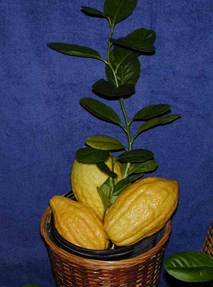
There is a custom to plant trees, in Israel, on Tu B’Shevat. One of the reasons for this custom is contained in a command of the Torah:
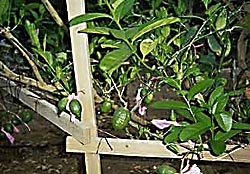
Vayikra (Leviticus) 19:23 "'When you enter the land and plant any kind of fruit tree, regard its fruit as forbidden. For three years you are to consider it forbidden; it must not be eaten.
This verse not only commands us to refrain from eating the fruit, but also to plant trees! We purposely fulfill this command on Tu B’Shevat in order that we and our descendants may enjoy that which a tree provides.
The Talmud has many stories which deal with the respect Judaism has for nature. Tu B'Shevat, the fifteenth of the month of Shevat, celebrates the praise of the land of Israel. It is a renewal of our contact with the land and nature.
The Old man and the Tree
Many years ago the Emperor Hadrian was passing though the green hills of the Galilee near Tiberias. Off to the side of the road, he spotted an old man, his back bent under the strain, digging a trench on a terrace in which to plant fig trees.
"Old man", called the Emperor, "If you hadn't wasted the years of your youth you wouldn't have to work so hard now."
"Not true", replied the old man. "I didn't waste away my younger years nor do I waste them away now. I do what I have to do and let HaShem do the rest".
"How old are you, old man?" asked Hadrian. "I am one hundred," was the reply.
Hadrian look up at the wrinkled and sweaty face and wondered out loud, "Do you really expect to see the fruits of your labor?"
"Why not", rejoined the man. "Even if I don't, didn't our fathers plant before us knowing that only we would enjoy the fruits?"
Hadrian was pleased with the answer and requested the old farmer, "If you ever live to see the harvest, let me know", and with that the Emperor's retinue continued their journey.
Years passed and the trees nurtured by the old man began to bear fruit. They grew and the old man yet lived. One year he waited until the middle of the harvest season and picked a small basket of the largest and most beautiful of all his fruits. He packed them carefully and proceeded on his donkey to Jerusalem. The old man waited outside the Emperor's gate and requested to be allowed in. The gate keeper derisively laughed at the thought of Hadrian inviting this old Jew to the palace... Hadrian heard the laughter and looking out his window he saw the old man. He remembered his invitation, and marveling at the man persistence he immediately gave an order for the old farmer to be brought to him. The Emperor showed the man full respect and ordered his basket to be emptied and refilled with gold.
His advisors stood astonished. "Why should the Emperor honor such a person"? The Emperor stood with the old man at his side. "I only honor whom HaShem has honored. Look at his age, look at his persistence, use him as an example." With that he sent the old man back to his village with his treasure. Needless to say upon his return he was received in wonder and was taken around the village telling and retelling his story.
One of his rapt listeners was a jealous and bitter woman who upon hearing the story thought to herself, "Hmm... The Emperor surely must like figs. If he has given such riches to the silly old farmer for a small basket what would he give for a whole sack"?
She quickly ran home and berated her husband. "Quick, don't waste time, get a sack and fill it up with figs, for I have it on the best authority that the Emperor will pay well for them."
The poor man filled up his largest sack put it on his donkey and began a long and arduous journey to Jerusalem. After many days he reached the palace, totally exhausted and in a sour mood. The man approached the gate keeper and demanded entrance to the Emperor. "I need to see Hadrian for I have brought him a most precious present, a sack full of figs. Just like the old man in our village". The gate keeper, not wanting to cause another incident, duly reported the story to the Emperor, who laughed at the man's impertinence. "He demands a reward, does he? Let him remain at the gate and every passer-by must take a fig and throw it in his face. That is all he deserves for his demands".
The poor man stood at the gate, his face pelted by passers-by, the object of total ridicule. He began to wish not for gold but for the sack to be empty, thinking of each time he had pushed in another fig to fill it up even more.
Like everything else in life, this pain too came to an end and the man in total humiliation began the long trek home.
What was happening all this time with his wife? Sure enough she had been figuring out how to spend all the money her husband would bring. He came in bedraggled as a cat and totally exhausted. She looked at the empty bag and figured he had the money in his pocket. A quick embrace dispelled that notion. "Well, where is it? How much did you get? What luck did you have?"
The poor man, his patience at an end, burst out, "I have had great and greater luck. The great luck was that the figs were ripe, the greater luck was that we sent figs and not peaches!"
Choni the Circle Maker
R. Yohanon said: Through all the days of that righteous man, he was troubled about the meaning of the verse "A Song of Ascents. When the Lord brought back those that returned to Zion, ,we were like unto them that dream" (Ps. 126:1). Is it possible for a man to doze off and dream continuously for seventy years? [But the following incident clarified the verse's meaning for him.] One day, as he was walking on the road, he saw a man planting a carob tree. He asked him, "How long will it take this tree to bear fruit?" The man replied, "Seventy years." He asked, "Are you quite sure you will live another seventy years to eat its fruit?" The man replied, "I myself found fully grown carob trees in the world; as my forebears planted for me, so am I planting for my children."
Once, when Honi sat down for a meal, sleep overcame him and he dozed off. During his sleep, a grotto formed itself about him and hid him from sight, so that he continued sleeping for seventy years. When he awoke, he saw a man gathering the fruit of that same carob tree. He asked, "Are you the man who planted this tree?" The man replied, "That was my grandfather." Next, when Honi saw the herds and herds descended from his own she-ass, he exclaimed, "No doubt I slept for seventy years." He went to his home an inquired, "Where is the son of Honi the Circle Maker?" He was told, "Honi's son is no longer in this world, but his grandson is." At that, he announced, "I an Honi the Circle Maker," but no one believed him. Next he went to the house of study, where he overheard the sages say, "This tradition is as clear to us now as it was in the days of Honi the Circle Maker," for whenever he came to the academy, he would settle any difficulty the sages had. Hearing these words, he cried out, "But I am Honi!" Since the sages neither believed him nor accorded him the honor due him, he was so mortified that he besought HaShem's mercy, and he died.
Rava observed: For this reason mortals say, "The fellowship of men or the fellowship of death."
Amos 9:13-15 "The days are coming," declares HaShem, "when the reaper will be overtaken by the plowman and the planter by the one treading grapes. New wine will drip from the mountains and flow from all the hills. I will bring back my exiled people Israel; they will rebuild the ruined cities and live in them. They will plant vineyards and drink their wine; they will make gardens and eat their fruit. I will plant Israel in their own land, never again to be uprooted from the land I have given them," says HaShem your G-d.
There is a custom in Eretz Yisrael to eat fifteen different types of fruits on Tu B’Shevat. The Gematria of the word "Tu", which is "tet" and "vav" in Hebrew, is 15, and the 15th of the month of Shevat is the date of this holiday. It is an opportunity to show our appreciation for all the varieties of fruits with which HaShem has blessed us.
This is the interpretation of the Beracha:
"Borei Nefashos Rabos Vechesronan" - He created many creatures and that which they lack-i.e., basic necessities without which man could not exist, such as bread and water;
"Al Kol Ma She'Barasa" - In addition to all that which You created, i.e., all the varieties of foods;
"Le'Hachayos Bahem Nefesh Kol Chai" - To give life to all living beings...
This idea is hinted at in the Gematria:
This is the Day to Give Thanks for All Types of Fruit of the Tree! =
Zeh Yom Lehodos Al Kol Minei Pri Haetz =
12 + 56 + 451 + 100 + 50 + 110 + 290 + 165 = 1234
The 15th Day of the Month of Shvat =
chamisha asar shvat =
353 + 570 + 311 = 1234
* * *
Written by Rav Yehuda Samet
Tu B'Shevat, the 15th of Shevat, is the New Year for trees. On this day, it is customary to eat from the seven species for which the land of Israel is praised: "...a land of wheat and barley and (grape) vines and fig trees and pomegranates, a land of olive trees and (date) honey." (Devarim (Deuteronomy) 8)
Tu B'Shevat is the day when new sap starts to rise in the tree, when new life is starting to emerge. Even though we are still in the middle of winter and all looks bleak, cold and lifeless, Tu B'Shevat comes, a day of new life with the promise of rejuvenation.
That's why Tu B'Shevat can be compared to the coming of the Mashiach and the final redemption of mankind. Everything looks bleak and there seems to be no sign of life; we are threatened by increasing assimilation and the loss of Jewish identity; Jewish life seems frozen and moribund. But even at that very moment, the sap is rising. On the surface, you can see no change whatsoever, but precisely at that moment, life secretly and inexorably starts to burgeon anew.
Based on Sefer B'nai Yesaschar
The mazzaroth, constellation, for Shevat is Deli, “The water bucket”. The water bucket draws water from its source, and brings the water to where it is used. This symbol also represents an object that serves someone. It draws water. It is written of the Jewish people:
Bamidbar (Numbers) 24:7 "He shall pour waters from his bucket, moistening his seed plentifully. ."
The symbolism of the water bucket is very important. A bucket has but one function, design, and purpose: to draw and carry water. That is, to be a vessel of transmission. Its whole essence is one of serving. It is not an end unto itself. It is meant to be a vehicle for something else. This is the function of a Jewish teacher.
Water, in many places throughout Jewish thought, is a metaphor for the wisdom of Torah. There are a number of qualities that water has, which are conceptually parallel to Torah.
One of the qualities of water is that it always flows to the lowest spot. How is this parallel to Torah? The out-pouring of wisdom that comes from God rests on the most humble personality. The more selfless a person is, the more wisdom flows toward him. If a person devotes himself to ideals, to living truth, to helping others... then he becomes a vessel fitting to receive the Torah's wisdom.
At the beginning of the month, the abundant rains fill the wells which overflow, even after the buckets of water have been extracted. Towards the end of the month, however, the plentiful rain tapers off and the signs of spring appear. Trees begin to grow leaves again, and the first blossom of the almond tree (Israeli almond trees are the first to blossom shortly after Tu B'Shevat, followed by peaches and apricots) is seen in the fields and gardens.The countryside becomes a carpet of wildflowers, including the colorful spring flowers: anemones, daffodils and primroses.
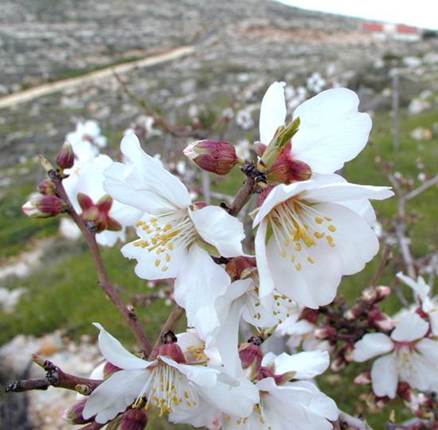
Israeli Almond Tree
The fact that the New Year for Trees falls under the mazzaroth of Deli is, of course, no coincidence. Most obviously, trees need water for their survival, and the needed delivery of water to the trees so that fruit forms is a focus on the New Year for Trees. The deeper significance arises from the comparison made in the Torah:
Devarim (Deuteronomy) 20:19 When you lay siege to a city for a long time, fighting against it to capture it, do not destroy its trees by putting an ax to them, because you can eat their fruit. Do not cut them down. Are the trees of the field people, that you should besiege them?
"For the trees of the field are like man." Man, like trees, needs "water" for sustenance. Just as physical water enables a tree to bring forth fruit, so too does the Torah, spiritual water, enable man to bring forth fruit. And just as Messiah Yeshua is the Living Torah, and therefore Living Water, so too does He expect us to bring forth fruit:
Matityahu (Matthew) 7:15-20 "Watch out for false prophets. They come to you in sheep's clothing, but inwardly they are ferocious wolves. By their fruit you will recognize them. Do people pick grapes from thorn bushes, or figs from thistles? Likewise every good tree bears good fruit, but a bad tree bears bad fruit. A good tree cannot bear bad fruit, and a bad tree cannot bear good fruit. Every tree that does not bear good fruit is cut down and thrown into the fire. Thus, by their fruit you will recognize them.
The above passage is given more emphasis in this next passage:
Luqas (Luke) 6:43-45 "No good tree bears bad fruit, nor does a bad tree bear good fruit. Each tree is recognized by its own fruit. People do not pick figs from thorn bushes, or grapes from briers. The good man brings good things out of the good stored up in his heart, and the evil man brings evil things out of the evil stored up in his heart. For out of the overflow of his heart his mouth speaks.
Matityahu (Matthew) 12:33-37 "Make a tree good and its fruit will be good, or make a tree bad and its fruit will be bad, for a tree is recognized by its fruit. You brood of vipers, how can you who are evil say anything good? For out of the overflow of the heart the mouth speaks. The good man brings good things out of the good stored up in him, and the evil man brings evil things out of the evil stored up in him. But I tell you that men will have to give account on the day of judgment for every careless word they have spoken. For by your words you will be acquitted, and by your words you will be condemned."
Trees are often a metaphor for humans:
Tehillim (Psalm) 1:3 And he shall be like a tree planted by the rivers of water, that bringeth forth his fruit in his season; his leaf also shall not wither; and whatsoever he doeth shall prosper.
Many of us have heard the injunction that during war one may lay siege to a town, but one may not cut down the trees. The entire verse, Devarim 20:19, reads:
Devarim (Deuteronomy) 20:19 "When you lay siege to a city for many days to capture it by making war against it, you shall not destroy its tree, wielding an axe against it; for you shall eat of it but not cut it down; for man is a tree of the field..."
Man is a tree?
In the Talmud we read:
Ta'anit 7a R. Jeremiah said to R. Zera: Pray, Master, come and teach. The latter replied: I do not feel well enough1 and am not able to do so. [Then said R. Jeremiah] Pray, Master, expound something of an aggadic character, and he replied: Thus said R. Johanan: What is the meaning of the verse, For is the tree of the field man?1 Is then man the tree of the field? [This can only be explained if we connect the verse with the words immediately before it] where it is written, For thou mayest eat of them, but thou shalt not cut them down; but then again it is written, ‘It thou shalt destroy and cut down’?1 How is this to be explained?-If the scholar is a worthy person learn [eat] from him and do not shun [cut] him, but if he is not destroy him and cut him down.
Hakham Yoseph Hayyim states that the Tzaddikim (righteous) are likened to a tree and that the wicked are likened to grass. Just like grass has no roots, so too the wicked have no roots or foundation and even a small wind can uproot them.
The righteous, on the other hand, have deep roots like the palm tree, making it virtually impossible to uproot. And even when they leave this world their ways and teachings will remain and continue to flourish through their children and students.
The Jewish people are likened to the vine. Just as the vine is weak and soft (when compared to other trees), but its fruit which can be used both for eating and drinking is excellent, so too the Children of Israel, even though we may be soft and weak, our Torah and mitzvot bear fruit, as we see in the Nazarean Codicil:
Yochanan (John) 15:1-5 I am the true vine, and my Father is the husbandman. 2 Every branch in me that beareth not fruit he taketh away: and every branch that beareth fruit, he purgeth it, that it may bring forth more fruit. 3 Now ye are clean through the word which I have spoken unto you. 4 Abide in me, and I in you. As the branch cannot bear fruit of itself, except it abide in the vine; no more can ye, except ye abide in me. 5 I am the vine, ye are the branches: He that abideth in me, and I in him, the same bringeth forth much fruit: for without me ye can do nothing.
Others consider the fruit of one's "tree" as the mitzvot that we do, or indeed, our children which we train in the mitzvot. One can also see that one’s talmidim are also his “fruit”:
Mishle (Proverbs) 11:30 The fruit of the righteous [is] a tree of life; and he that winneth souls [is] wise.
Matityahu (Matthew) 3:10 And now also the axe is laid unto the root of the trees: therefore every tree which bringeth not forth good fruit is hewn down, and cast into the fire.
The etrog, the fruit of the beautiful tree, is said by our Sages to be the fruit of the Tree of the Knowledge of Good and Evil, in the Garden of Eden. This tree was the only tree that obeyed HaShem at its creation. The fruit of the Etrog and the bark of the etrog tree taste the same. All the other trees disobeyed in this regard. (see Rashi on Bereshit 1:11) Adam, therefore, felt he could disobey HaShem as the trees had, and not bear a consequence. Thus we have the connection of man to a tree.
Now we can understand why HaShem, when he created the world, created the trees with the bark and the fruits having the same taste! A man is a "tree of the field". The lesson is clear. The fruits of the tree should have the same taste as the tree itself! The parent must insure that his fruits, his children (and his talmidim), have the same taste, the same path in life as the parent himself. Look at the way a tree produces fruits. First, the tree brings forth blooms. As the bloom withers, the tree is setting the fruit, and only then does it begin to grow. Each fruit in turn will produce its own seeds which will be capable of producing a tree which can bring forth identical fruits. Of primary importance is the bloom and the setting of the fruit, for this is the beginning of the fruit. So the parent must begin to train and nurture the child in the ways of Torah from the time that he first blooms forth, while he is still very, very young. If the blooming period is successful, then certainly the period of the growth of the fruit will be successful and the fruit will surely be delicious, bearing the same taste as the tree which brought it forth.
Was the “bloom” and “setting of the fruits” accomplished with the objective of instilling into them the values of and love for the Torah? If so then the judgment will surely be favorable, and the fruits will mature and ripen retaining the same delicious taste as the tree from which they came.
Yochanan (John) the Baptist also spoke of this fruit:
Luqas (Luke) 3:7-11 Yochanan (John) said to the crowds coming out to be baptized by him, "You brood of vipers! Who warned you to flee from the coming wrath? Produce fruit in keeping with repentance. And do not begin to say to yourselves, 'We have Abraham as our father.' For I tell you that out of these stones HaShem can raise up children for Abraham. The ax is already at the root of the trees, and every tree that does not produce good fruit will be cut down and thrown into the fire." "What should we do then?" the crowd asked. Yochanan (John) answered, "The man with two tunics should share with him who has none, and the one who has food should do the same."
Luqas (Luke) 13:6-9 Then he told this parable: "A man had a fig tree, planted in his vineyard, and he went to look for fruit on it, but did not find any. So he said to the man who took care of the vineyard, 'For three years now I've been coming to look for fruit on this fig tree and haven't found any. Cut it down! Why should it use up the soil?' "'Sir,' the man replied, 'leave it alone for one more year, and I'll dig around it and fertilize it. If it bears fruit next year, fine! If not, then cut it down.'"
Yochanan (John) 15:1-8 "I am the true vine, and my Father is the gardener. He cuts off every branch in me that bears no fruit, while every branch that does bear fruit he prunes so that it will be even more fruitful. You are already clean because of the word I have spoken to you. Remain in me, and I will remain in you. No branch can bear fruit by itself; it must remain in the vine. Neither can you bear fruit unless you remain in me. "I am the vine; you are the branches. If a man remains in me and I in him, he will bear much fruit; apart from me you can do nothing. If anyone does not remain in me, he is like a branch that is thrown away and withers; such branches are picked up, thrown into the fire and burned. If you remain in me and my words remain in you, ask whatever you wish, and it will be given you. This is to my Father's glory, that you bear much fruit, showing yourselves to be my disciples.
Ephesians 5:8-12 For you were once darkness, but now you are light in the Lord. Live as children of light (For the fruit of the light consists in all goodness, righteousness and truth) And find out what pleases the Lord. Have nothing to do with the fruitless deeds of darkness, but rather expose them. For it is shameful even to mention what the disobedient do in secret.
Trees are also a metaphor for Torah. The most famous expression of this is in:
Mishle (Proverbs) 3:18 It is a tree of life for those who hold fast to it.
As we mentioned before, producing fruit requires work and toil. So that we remember that we have help in our task, we celebrate the New Year for Trees on the fifteenth day of the month. Until the fifteenth day, the moon has been growing in light. The fifteenth day is typically the day of the full moon. It signifies the completeness and fullness that we have right when we are born, we have been taught the entire Torah. We start our toil realizing that HaShem was there to help us, to plant a seed within us.
The fifteenth day of Shevat is a day on which we pray that growth should begin. Trees should get the water they sorely need so that they bear fruit. Man should properly immerse himself in Torah so that he reaches his full potential. The fifteenth day of Shevat is a day on which we recognize that HaShem is there to help us with our endeavors. He provides us with what we need to be successful, although our success depends on our efforts as well. Tu B'Shevat should be the start of a truly fruitful year for all of us.
The tribe of Asher is kabbalistically associated with Shevat. "Asher" in Hebrew grammar connects the subject of a sentence to a verb. It supports the subject.
The letter kabbalistically associated with Shevat is the tzadi, which represents the tzaddik. Tzaddik in Hebrew means "righteous one."
The human attribute kabbalistically associated with Shevat is "eating."
* * *
There are supposed to be thirty (30) types of fruit:
10 (from 'Olam Habbereeah) which have no pit and no peel, but are eaten the way they are:
Grapes
Figs
Apples
Ethrogh (Citron)
Lemon
Pears
Quince
Raspberries
Blueberries
Carob
10 (from 'Olam Hayeseera) which have pits inside:
Olives
Dates
Cherries
Jujubes
Peaches
Plums
Apricots
Morels
Medlars
Azaroles
10 (from 'Olam Ha'aseeya) which have a peel:
Pomegranates
Walnuts
Almonds
Chestnuts
Hazelnuts
Coconuts
Capers
Pine nuts
Pistahios
Pecans
When eating these fruits, there is an opinion that one should have in mind (the Kavanah) that through eating them we are making a Tiqqun (reparation) for the sin of Adam, who sinned by eating the forbidden fruit. In truth, we should have this Kavanah all year round, but on Tu Bishbat it is all the more appropriate.
This section comes from the Virtual Jerusalem site.
Introduction
The Tu B'Shevat Seder (modeled after the Pesach Seder) is an old-new custom which is being revived in our day. Based on a kabbalistic work, the Seder takes the participants on a journey through different physical and metaphysical realms. Fruits are eaten, blessings are recited and tales are told about trees and Nature and the "repairing of the world."
The Seder provides a means to celebrate the change of seasons: Four cups of wine are drunk - each one redder than its predecessor - symbolizing the shifting pattern of wildflowers in Israel during the year, and evoking the awakening of the earth from slumber to eventual ripening.


Fruits of the Land are eaten during the ceremony, each offering a metaphor for four metaphysical realms of existence, and a corollary with human nature and the people of Israel's collective personality.
The Seder offers an opportunity to contemplate our connection with the world, and to reflect on the Source of all nurturing on our planet.
The Seder Structure
Our Seder is adapted from a variety of sources. There are five stages to our Seder. In the first stage, the youngest member of the assembled group asks four questions about Tu B'Shevat, and responses are given. Each of the next four stages of the Seder features a different type of wine and fruit.
The First Cup:
White Wine and the Walnut
1. Say: The first cup of wine is wintry white. It represents the potential of the seedling, beginnings, first light. . . .
2. Take the cup of wine in the hand and say the blessing:
Blessed are You, our HaShem and King of the Universe, who creates the fruit of the vine.
The Fruit - Walnut
1. Point to the walnut on the plate and say: The walnut has a hard outer shell, but its inner fruit is soft. In the kabbalistic tradition, it recalls our world of Action in which we peel away the outer boundaries to pierce to the spiritual within.
2. Everyone present takes a piece of walnut and utters the blessing:
Blessed are You, our HaShem and King of the Universe, Who creates the fruit of the tree.
If this is the first time in the season that the walnut is being eaten, add the blessing:
Blessed are You, our HaShem and King of the Universe, Who has kept us alive, sustained us and brought us to this special occasion.
3. One of those present reads the following: "Rabbi Tarfon likened the people of Israel to a pile of walnuts: He would say: If one walnut is removed, each and every walnut in the pile will be shaken." - Avot de Rabbi Nathan 18:1
The Second Cup:
Blush Wine and the Date
Note: Any pale pink wine is fine. The blessing indicated below, HaTov V'Hametiv, acknowledges HaShem's bounty. It is intended to be recited when one samples a better wine than the one preceding it. The blush wine should be more expensive or of a better taste than the white wine before it.
1. Say: The second cup of wine is light pink, for the first flowering of the spring anemones. It symbolizes the Divine spark, the stirrings of growth drawn from primeval elements.
2. Take the cup of wine in the hand and say the blessing for a second drink of wine: ". . . HATOV VEHAMEITIV."
Blessed are You, our HaShem and King of the Universe, Who is good and does good.
The Fruit - Date
1. Point to the date on the plate and say: The soft outer fruit of the date recalls the world of Formation. The date's inner core is hard, its impenetrable nature drawing us to contemplate the core of our being and the cycle of our lives.
2. Everyone present takes a date and says: May it be His will that we should be as upright as the date-palm, as it is written: "The righteous shall bloom as the date-palm."
3. One of those present reads the following: "The date palm abounds in blessing, for every part of it can be used; every part is needed. Its dates are for eating; its branches are for blessing on Succoth; its fronds are for thatching roofs; its fibers are for ropes; its webbing for sieves; its thick trunk for building. . . So it is with Israel: each person plays a part in building the people." - Midrash, Bamidbar Rabbah
The Third Cup:
Rose Wine and the Fig
1. Say: The third cup of wine is half-white, half-red for the mix of red and white wild flowers in the Land. Blooming trees now provide us with physical and spiritual sustenance. And, in return, we provide them with their needs. The equality in colors indicates interdependence and reciprocity.
2. Take the cup of wine in the hand and say:
"LECH ECHOL BESIMCHAH LACHMECHAH; USHTEH BALEV TOV YEYNECHAH.""
Go, eat your bread in gladness, and drink your wine in joy. . . ." - Ecclesiastes 9:8
The Fruit - Fig
1. Point to the fig on the plate and say: A fig - one of the symbols of peace - has no protective shell or hard pits inside. It evokes the World of Creation - harmony between opposing forces and the completion of our relationships with each other and nature.
2. Everyone present takes a fig in hand and says: ". . . ETZ NASO PIRYO TE'EINAH NATNU CHEILAM." - ". . . for the tree bears its fruit, the fig tree and the vine yield their strength." - Joel 2:22
3. One of those present reads the following: "The rabbis asked - 'Why are the words of the Torah compared to the fig tree?' They answered: 'Since all the figs do not ripen at the same time, the more one searches the tree, the more figs one finds in it. So it is with the words of Torah. The more they are studied, the more delight that is taken in them.'"- Talmud, Eruvin
The Fourth Cup:
Red Wine and the Etrog
1. Say: The fourth cup of wine is red, the dominant color of early summer flora. Red symbolizes omnipresent reality, the Source of Everything.
2. Take the cup of wine in the hand and say the blessing:
"You shall be blessed in the city,
And blessed in the field.
Blessed shall be the fruit of your body,
And the produce of your land,
And the offspring of your cattle,
The increase of your herd,
And the young of your flock.
Blessed shall be your basket
And your kneading trough.
You shall be blessed when you come in,
and blessed when you go out."
The Fruit - Etrog (Citron)
1. Point to the etrog on the plate and say: No fruit can actually represent the Upper Realm beyond our senses. Yet the perfect fruit of "the goodly tree," the etrog, comes close. The kabbalists named their seder service Pri Etz Hadar after this fruit, and even planted the etrog tree on Tu B'Shevat to provide themselves with beautiful etrogim for Succoth.
2.Everyone present takes a piece of etrog and says:
"VEHAYA K'ETZ SHATUL AL PALGEI MAYIM ASHER PIRYO YITEN B'ITO VE'ALEYHU LO YIBOL."
"And he shall be like a tree, planted by streams of water, that brings forth its fruit in its season, and whose leaf does not wither."
3.One of those present reads the following: "Rabbi Yochanan used to say - "If you happen to be standing with a sapling in your hand and someone says to you: 'Behold the Messiah has come. . . !' First, plant the tree - and then go out to greet the Messiah." - Avot de Rabbi Nathan 31
4. All say:
"LESHANAH HABA'AH B’YERUSHALAYIM!"
Next Year in Jerusalem!
Before you begin:
Prepare four types of wine, one cup per person:
1. white
2. blush (or any light pink wine, like a white zinfandel)
3. rose (or any dark pink wine, like a cabernet blanc, or zinfandel)
4. dark red (such a cabernet sauvignon, bordeaux or burgundy)
Prepare a plate with these four fruits: walnut, date, fig and etrog (citron). Where the fresh variety is unavailable, used dried fruits instead.
Try to have as many fruits on the table as you can, so that you can also eat up to fifteen fruits to symbolize the day. After you finish the fourth cup of wine and etrog, you can enjoy the other fruits.
Invite as many people as you wish to the seder table, which should be decorated festively with fruits and plants. The children could have garlands in their hair to add to the atmosphere.
In addition to the readings we provide, you can add your own thoughts, songs, and sources to enrich your seder, according to the spirit that you want to create.
The Questions
While everyone is sitting around the festive table, the youngest person present asks four questions:
1.WHY are we having a seder in the winter?
2.WHY do we eat different kinds of fruit?
3.WHY do we drink four cups of wine in
different shades from white to red?
4.WHY do we tell stories about trees?
The Response
One of the older members of the assembled group responds:
From the earliest days of Creation, when the world was in its pristine state, trees and plants played a major role in shaping the character of the planet. From the time of the first stirrings of life, flora featured in our consciousness, offering color, shade, food, protection and any number of useful by-products, as well as a critical role in the universal eco-system.
An appreciation of nature was already expressed in the Biblical account of the appearance of trees during the third day of Creation:
"And the earth brought forth grass, herb yielding seed after its kind, and tree bearing fruit, wherein is the seed, after its kind. And HaShem saw that it was good." - Bereshit (Genesis) 1:12
Another member of the assembled group continues:
When our ancestors entered the Promised Land, they were told:
"And when you come to the land, and shall have planted all manner of trees for food . . ." - Vayikra (Leviticus) 19:23
This verse contained the promise to the Children of Israel that they will enter the Land of Israel, their planting of trees symbolized the people striking strong roots in their land. Trees were to be planted, but also respected. For instance, when making war against enemies, the Jewish people were commanded not to destroy trees by wielding an ax against them: ". . . for you may eat of them, but you shall not cut them down . . . For is the tree of the field man, that it should be besieged by you?"
The Torah stresses that the aim of conquest is to settle the land and develop it; the principle of conservation needed to be stressed even in the midst of fighting. The tree has done you no harm, therefore, do not harm it.
The next in the group continues:
The tree is associated with lofty ideas in Judaism. For example, in the Song of Songs, HaShem's love of the Jewish people is portrayed as follows:
"As a lily among thorns,
So is my love among the daughters.
As an apple tree among the trees of the wood,
So is my beloved among the sons."
- Song of Songs 2:2-3
And we know that Abraham attached a great symbolic value to the relatively simple concept of planting a tree in the Land of Israel, as it is written: "Abraham planted a tamarisk tree in Beersheba and called there in the name of the Lord, the ever-lasting HaShem."
The next in the group continues:
While fruit trees were to be planted in Eretz Yisrael, the inhabitants of the Land were to appreciate the Source of all food. One way this was achieved was by bringing their First Fruits (bikkurim) to the Temple in Jerusalem, once a year, in a very moving ceremony in which the farmers and their families recorded their appreciation for the bounty with which they were blessed.
Another command, required the population to put a tenth of their produce aside to be eaten by the priests in the Temple, or by poor people. Thus were the people taught not to take their food for granted nor to neglect the needy in society. In order to calculate the dates from which the fruits needed to be tithed, however, it was necessary to fix a New Year.
Since the Torah didn't fix such a date, the Rabbis in the Mishna fixed the fifteenth of Shevat as this day, in common with other New Years in the Jewish calendar.
The next in the group continues:
Tu B'Shevat, the fifteenth of Shevat, is the time when the trees in the Land of Israel begin to bear fruit. The almond trees begin to blossom, and the wild flowers begin to color the landscape. Over the months the wild flowers in Israel change their colors from white to pink to red as the different varieties bloom.
When the Jewish people went into exile, the original significance of Tu B'Shevat as a demarcation of the new tax year was no longer relevant. Instead the strong links to the Land of Israel were recalled through a ceremony which celebrated this transition in nature.
The Tu B'Shevat Seder that we have today reinforces our links with the Land of Israel, the spring rebirth, our strong regard for trees and conservation and our appreciation for the Source of all sustenance. The kabbalists of the 16th century saw other, hidden meanings embodied in particular fruits.
What hidden meanings?
While the Land of Israel is blessed with many fruits, the seven described in the Torah verse, below, had special status: They were brought to the Temple as First Fruits, once a year, and on Tu B'Shevat, it became customary to make a point of eating, and saying blessings, on these fruits in particular. As such they both symbolize the Land and the close links of the Jewish people with that land.
"For the Lord your HaShem
is bringing you into a good land. . .
of wheat and barley and
grapevines and figs and pomegranates;
a land of olives and honey (from dates).[17]"
1. WHEAT - Chitah
Wheat's essential role puts it first among the seven species. Since ancient times, it has been considered one of man's most basic crops: from wheat flour, bread is produced. On Shavuot, the festival of the First Fruits, the first of the wheat crop would be brought to the Temple.
2. BARLEY - Se'orah
Barley was, and still is, an important grain in Israel. Because it requires less water than wheat, it grows even in the arid fields of the Negev. Since it ripens before wheat, its harvest begins in the month of Nisan (spring). Two weeks later, the Omer offering brought to the Temple in Jerusalem as part of the Pesach festival was a barley offering. Bread prepared from barley was considered to be "poor man's" bread, possibly because it was not considered as tasty as bread made from wheat.
3. GRAPES - Gefen
Man has been cultivating grapes from the earliest times: the first vineyard mentioned in the Bible was planted by Noah after the Flood. The cluster of grapes, brought to the Children of Israel in the wilderness by the Spies, symbolized the bounty of the Land of Israel. Throughout the generations, grapes have provided fruit and wine, and contributed to the economy of the indigenous Jewish community. Wine, indicative of joy, is used in many Jewish rituals and ceremonies.
4. FIG - T'einah
The broad fig tree gives a lot of shade, hence the prophet Micha proclaims in his vision of peace in the Land: "Each man will sit beneath his grapevine and his fig tree, and no one will fear. . . ." The sweet tasting fruit ripens in the hottest part of the summer, and the figs are eaten fresh or dried.The Tanach refers to the fig as a symbol of fertility: it was also one of the fruits brought back by the spies to prove that the Land bore fruit.
5. POMEGRANATE - Rimon
An old Hebrew song by Yaakov Orland portrays the pomegranate:
The pomegranate tree has aromas that flow Out from the Dead Sea and on to Jericho…
The pomegranate also has rich red flowers and dark red fruit, and its abundant seeds serve as a powerful symbol of fertility.
The pomegranate's shape has been used in many decorative objects, such as the rimonim bells used to decorate Torah scrolls, the 200 rimonim of copper on the beams of the Temple and the rimonim which decorated the High Priest's garment in the Temple.
6. OLIVE - Zayit
The olive tree is one of the oldest and most common trees in the Land of Israel. There are olive trees in the Galilee that are estimated to be thousands of years old. Its leaves are green all year round, its roots are strong and the silvery underside of the leaves gives off a sheen of light.
In Biblical times, olive oil was used to anoint priests and kings; in its purified form it was used to light the seven-branched Menorah (candelabra) in the Temple. The olive itself is eaten after being preserved; its oil is used for cosmetics, healing compounds and soaps, as well as for food.
The olive branch is a symbol of peace: it was evidence for Noah that the flood had ended. It is part of the emblem of the State of Israel, its deep roots symbolizing the people's strong attachment to the land.
7. DATE (Honey) - Tamar (D'vash)
The date is both one of the Seven Species for which the Land of Israel is noted, and one of the Four Species used on the festival of Succoth. The date tree is a tall one, and its fruit grows in clusters near the top. The sweet dates, which ripen at the end of summer, are eaten fresh or dried - and are also used to make honey. The tree itself is very versatile, its branches being used for cover (as in the Succah), its fibers for rope and its trunk for building.
The following diagram was built by Joel David Bakst and depicts the festivals as laid out on the sefirotic tree. Pay particular attention to the partial festivals of Tu B'Av / Tu B'Shevat. This will help to inform the following text.
|
“Festival Man”—Sefirotic Map of the Festivals |
||
|
|
|
|
|
|
(Three Concealed Higher Sefirot) Keter (Crown) Cranium |
|
|
Binah (Understanding) left brain |
|
Chochmah (Wisdom) right brain |
|
|
[Da'at (Knowledge)] [middle brain and spine] |
|
|
|
|
|
|
|
Lower Seven Sefirot of “Festival Man” |
|
|
Gevurah (Power) left arm/hand (2/5) Rosh HaShanah. Yom Kippur. Succoth |
|
Chesed (Lovingkindness) right arm/hand (1/4) Passover |
|
|
Tiferet (Harmony) Torso (3/6) Shavuot |
|
|
|
|
|
|
Biblical in origin |
||
|
|
||
|
Rabbinical in origin |
||
|
|
|
|
|
Hod (Splendor) left kidney/gonad/leg (5/8) Chanukah |
|
Netzach (Eternity) right kidney/gonad/leg (4/7) Purim |
|
|
Yesod (Foundation-Channel) reproductive organs (6/9) Tu B'Av / Tu B'Shevat |
|
|
|
|
|
|
|
Malchut (Kingdom) Mouth of reproductive channel, Microcosm revealing the sum total of the 6 Sefirot above (7/10) To be revealed in the Messianic Era |
|
|
By Rabbi Joel David Bakst |
|
|
As we will see below from a Torah-graphical perspective the pivotal teaching is that each festival cannot be fully understood without juxtaposing and interfacing one with the other. When viewed from this perspective Tu B’Shevat and Tu B’Av are keys to an authentic Biblical understanding of the paradoxical nature of masculine and feminine energy.
While not technically a Torah portion, the Song of Songs is deeply connected to both holidays in Kabbalistic interpretation:
Shir HaShirim (Song of Songs) 2:11-13 - "For behold, the winter is past; the rain is over and gone. The flowers appear on the earth, the time of singing has come, and the voice of the turtledove is heard in our land. The fig tree ripens its figs, and the vines are in blossom."
The Zohar teaches this passage describes both:
When we juxtapose the first six months of the Biblical year with the second six months we get the following perspective:
|
“Female"[18] Half of the Year |
"Male"[19] Half of the Year |
|
Nisan |
Tishri |
|
Iyar |
Heshvan |
|
Sivan |
Kislev |
|
Tammuz |
Tevet |
|
Av |
Shevat |
|
Elul |
Adar |
The Mishna, edited by Judah HaNasi in 200, refers to the Fifteenth Day of the Hebrew month of Shevat as “the New Year for Trees.” Why did trees need this New Year? I turn to Rabbi Irving “Yitz” Greenberg’s The Jewish Way: Living the Holidays (1988) to answer that question: “There is no trace of the festival in the Bible. The origins of the day may lie in the ancient custom of celebrating the first day of each season. A Talmudic passage describes the year as divided into six seasons. From 15 Shevat to 15 Nissan is the season of kor (cold) which comes after the season of winter and before the season of reaping, harvesting.” 15 Shevat was a special day in an agricultural, rural society.
Tu B’Shevat is the masculine festival that is paired with the feminine festival of Tu B’Av. We can see from the following table that the year can be divided into the spring months and the fall months, as we have seen previously in my study titled ‘rains’. When divided this way, we can see that Ab is paired with Shebat. And middle of each month is also a special time on the calendar, as well as being a full moon.
The Midrash states, in Midrash Rabba VaEthanan 31, “Said the Holy One to Israel, ‘My children, all that I have created I created in paired units (zugot). Heaven and earth are a paired unit. The sun and the moon are a paired unit. Adam and Chava (Eve) are a paired unit. This world and the incoming world (haba) are a paired unit...’”. Likewise, the Talmud states, in Baba Bathra 74b, “All that the Holy One created in His world He created male and female, even the Leviathan...”.
Rosh HaShana 2a c h a p t e r i Mishnah. There are four new years. On the first of Nisan is new year for kings and for festivals. On the first of Elul is new year for the tithe of cattle. R. Eleazar and r. Simeon, however, place this on the first of Tishri. On the first of Tishri is new year for years, for release and jubilee years for plantation and for [tithe of] vegetables. On the first of Shebat is new year for trees, according to the ruling of Beth Shammai; Beth Hillel, however, place it on the fifteenth of that month.
|
Masculine |
Feminine |
|
Tishri Heshvan Kislev Tevet Shebat Adar |
Nisan Iyar Sivan Tammuz Ab Elul |
|
Tu B’Shevat |
Tu B’Av |
|
|
|
|
25th of Adar, the universe was conceived. Tu B’Shevat is forty days earlier. |
25th of Elul, The universe was created. Tu B’Av is forty days earlier. |
|
|
|
|
Soul mate is chosen by Heaven.
The Talmud[20] states: Forty days before the formation of the embryo the heavens declare that this soul will be wed to this soul.
Forty days before the 25th of Elul is Tu B’Av. [That is, since the 1st of Tishri is the day of the creation of Humanity / Adam, by counting backward we find that 25th of Elul is the day of creation of the universe.][21] |
40 days |
Embryo is formed |
|
|
|
|
|
Ab 15 Tu B’Av Women choose husbands.
The day of creation according to Rebbe Eliezer.
It was on the Tu B'Av before creation that Israel became a thought in the divine Mind and Israel was first destined to receive the Torah (the Second Tablets) on Yom HaKippurim.* This is the reason that the tribes were permitted to intermarry on that day and the day was designated for marital union. |
40 days |
Elul 25 (Creation of the heavens and earth. First opinion) |
|
|
|
|
|
Shebat 15 Tu B’Shevat New Year for Trees[22]
The day of creation according to Rebbe Yehoshua.
We already know that man is likened to a tree.[23]
Therefore, even though we don't hold that Nisan is the month of creation, we designate Tu B’Shevat as the New Year for the Trees in that the first blossom is the embryonic stage of what will blossom into fruit and flower and fill the world with beauty. |
40 days |
Adar 25 (Creation of the heavens and earth. Second opinion) |
|
* Rabbi Arthur Waskow's comment: Although I see that Reb Zvi Elimelekh wishes to connect the two wedding days and thus connect the "pre-creation creation" with the Torah of Israel, it seems to me that the connection between Tu B'Av and 25th of Elul (creation of the universe) makes it more apt to the text and the dating to say that forty days before the Creation, HaShem decreed the joining of HaShem’s Own Self to the Universe. Thus, TU B’Av, which is really Y"H B'Av, celebrated the very first covenant of all, and that is why we celebrate covenantings on that day.
Now -- WHY does the spark of the Creation began on that day? BECAUSE THAT IS "WHEN" Y"H (the real way of spelling fifteen) ENTERS (the month of) AV -- "ALEPH-BET."
That is, the entire creative process begins, the great tzimtzum happens, when yah enters the aleph-bet. That's why creation begins with a "bet", Bereshit: because yah goes far enough into the aleph-bet to get to "bet," (which unlike aleph has a sound, and also as the 2nd in the series is necessary to make it a series; both are crucial aspects of the emergence of a universe), and that's when the spark is struck. |
||
The core idea is that both festivals mark a spiritual "conception" of the world, 40 days before a significant "birth" or manifestation point.
The 25th of Elul is traditionally understood as the day of the creation of the world itself (specifically, the initial six days of creation culminating in the creation of Adam on Rosh Hashanah, Tishri 1). This is the Tishri-centric view of creation. Rosh HaShana and Yom Kippur are days of ‘din’, judgment. HaShem’s plan was for a world of din only. However, He saw that we could not endure din alone and He layered on rachamim in order to allow us to survive.
The "Conception": Counting back 40 days from Elul 25 lands us precisely on Tu B'Av. Kabbalistically, this signifies that Tu B'Av is the day when the “thought of creation" or the "divine will to create" was conceived in the Supernal Realms. It's the moment the Divine decision to bring the universe into being was formed.
Kabbalistic Meaning: This links Tu B'Av to the very genesis of existence and the deepest roots of relationship. Just as 40 days before human conception, a soulmate is decreed, so too on Tu B'Av, the "match" between HaShem and creation (and specifically, HaShem and the Jewish people) was established. It's the ultimate expression of Divine love and desire for union. This explains why Tu B'Av is seen as a day particularly auspicious for finding a spouse and for general expressions of love and unity – it mirrors the cosmic love that initiated creation itself. It represents the arousal from Above that precipitates existence.
Three months after conception, Chazal indicate that the fetus is fully recognizable in terms of its major structure. This stage marks a significant transition, after which the chance of miscarriage drops considerably. 3 Months after Elul 25 brings us to Kislev 25, Chanukah.
The vessels, tapestries, wall sections and other components of the Mishkan (the portable sanctuary or "Tabernacle" built under Moses' direction to house the Divine Presence during the Israelites' journeys through the desert) were completed on the 25th of Kislev in the year 2449 from creation (1312 BCE).
Pesach is in the month of rachamim,[24] compassion. When HaShem created the world, He desired that it should be created with din. However, He saw that we could not endure din so He layered on rachamim.
The "Birth": This connection is based on the Talmudic debate about whether the world was created in Tishri or Nisan. If one follows the opinion that creation began in Nisan, specifically with its manifestation in the physical world, then:
Adar 25: This is often cited as the beginning of the creation process in the Nisan cycle, where the raw potential for the physical world began to be formed.
Nisan 1: The 1st of Nisan is seen as a "New Year for Kings and festivals," and for the "birth" of the actualized physical world, especially in relation to the agricultural cycle and the spring renewal.
The "Conception": Counting back 40 days from Adar 24 (or Nisan 1, as mentioned by the Bnei Yissachar in other contexts) brings us to Tu B'Shevat.
This places Tu B'Shevat as the "conception" of the physical, manifest world, particularly as it relates to growth, life force, and the vegetation that sustains it. It's the moment the desire for physical manifestation and the arousal of life within the earth were set into motion. This reinforces Tu B'Shevat's role as the "New Year for Trees" and the day connected to the flow of sap and the potential for fruit. It's about bringing the spiritual blueprint of creation into tangible, living form.
Three months after conception, Chazal indicate that the fetus is fully recognizable in terms of its major structure. This stage marks a significant transition, after which the chance of miscarriage drops considerably. 3 Months after Adar 25 brings us to Sivan 25, which was a minor holiday commemorating an event of national deliverance and the establishment of Jewish sovereignty.[25]
Kabbalistic Relationship of these Twin "Conceptions":
This dual system of "40 days before" highlights a fundamental Kabbalistic principle: the interplay between thought/potential (machshava) and action/manifestation (ma'aseh).
Tu B'Av as the Spiritual/Conceptual Conception: It represents the initial, abstract, and spiritual will for creation, the ultimate "marriage" of God with existence. This corresponds to the higher, more abstract worlds of Atzilut (Emanation) and Beriah (Creation). It's the source of Divine love and unity.
Tu B'Shevat as the Physical/Manifest Conception: It represents the actualization of that will into the tangible, natural world. This corresponds to the lower worlds of Yetzirah (Formation) and Assiyah (Action). It's the source of physical life and sustenance.
Together, they form a complete cycle: the divine thought (Tu B'Av) descends and becomes actualized in the physical realm (Tu B'Shevat), ultimately leading to the full "births" of the spiritual and physical dimensions of creation. The 40-day period in between is the time of gestation and formation, where potential is translated into reality. This process is reflective of how all creation, both macrocosmic and microcosmic, unfolds.
Tu B’Av has numerous parallels with Tu B’Shevat, as we will now explore. Both days fall on the 15th day of their respective months, making them both full moons. In fact, Tu B’Av is exactly six months after Tu B’Shevat, and thus they are situated 180° across from each other in the full circle of the Jewish calendar.
Another parallel between Tu B’Shevat and Tu B’Av is that each one heralds the beginning of a new season. In Israel, Tu B’Shevat ushers in the very beginning of spring, whereas Tu B’Av represents the very beginning of the waning of the summer sun, leading inevitably to autumn. Tu B'Av and Tu B'Shevat, as the "fullest" points of their respective halves of the year, represent the culmination of spiritual processes: Tu B'Av for the summer, Tu B'Shevat for the winter.
Before discussing the numerous parallels between these two days any further, it should be noted that there are many other days in the Jewish calendar that also fall 180° across from each other, creating a kind of 4th dimensional symmetry of meaningful connections that is woven geometrically throughout the calendar year. An example that was discussed in the section on Pesach parallels the holidays and significant events of the month of Nisan with the holidays of Tishri. For example, Rosh Chodesh Nisan is exactly 6 months before Rosh Hashanah. Shabbat Hagadol, the 10th day of the month of Nisan, when Israel took a lamb in preparation for sacrificing it and putting its blood on their door posts upon leaving Egypt, is six months before Yom Kippur, the 10th day of Tishri. The 15th day of Nisan, Pesach, is exactly six months before the 15th day of Tishri, Succoth. And finally, Hoshanah Rabbah, the seventh day of Sukkot, corresponds to the seventh day of Pesach. These temporal balancing points exist throughout the calendar year and provide us with numerous opportunities for meaningful reflection and symbolic connection between various times, themes and ritual practices.
The ancient Israel Torah readings were set to complete the Torah in three and a half years; with two such cycles fitting precisely in a seven-year shmita cycle. Thus, the calendar examples in the previous paragraph are graphically displayed and attenuated.
The Talmud, in Sotah 2, tells us that it was on Tu B’Av that the last group of people in the desert who thought they too would die realized that they had been spared. Spiritually and psychologically, this was as if they were resurrected from the dead, as they had been living with a constant cloud of death over their heads. Related to this theme, we should note that during the winter, fruit trees and many other trees lose their leaves and become dormant. From an outside perspective, these trees appear to be dead. On Tu B’Shevat, however, the sap begins to flow in the trees again, which also represents a resurrection of the (apparently) dead world of vegetation. Both Tu B’Av, coming on the heels of Tisha B’Av, and Tu B’Shevat therefore express this profound dynamic of physical and spiritual revival.
The custom, on both Tu B’Shevat and Tu B’Av, is not to recite tachanun on that day as well as at mincha on the preceding day.
Yirmiyahu (Jeremiah) 31:21 How long will you hide, O backsliding daughter? For the Lord has created something new on the earth, a woman shall surround a man.[26]
Tu B’Av embodies the feminine / circular / surrounding energy (Ohr Chozer),[27] symbolized by the circle dance of the maidens and themes of union and romance.
Tu B’Shevat embodies the masculine / linear / upright energy (Ohr Yashar),[28] symbolized by the rising sap in trees and the “erect” growth of the tree, as well as the Torah scroll’s upright form.[29]
The union of Tu B’Av and Tu B’Shevat is seen as a mystical dance of male and female energies, ultimately united in the “circle dance of the righteous” in the messianic era.
Note to self:
“Ohr Makif – The Encompassing Light”
Each is linked to one aspect of creation: Tu B’Av to the masculine side, Tu B’Shevat to the feminine, reflecting the cosmic principle that everything is created in pairs.
The Jewish year is structured as six pairs of months, with Av and Shevat paired as masculine and feminine twins.
Both are associated with renewal, fertility, and the emergence of hidden potential—
Tu B’Av in human relationships and
Tu B’Shevat in the natural world (the rising sap, new fruit cycle).
For the first three years of a tree’s life, its fruits are called orlah. We may not eat them or derive benefit from them in any other way; they are rather left to decay in the field.
Whether in or outside Israel, if one has a fruit tree to which the law of orlah would apply, the way to calculate the three years is somewhat complex. We do not count full years, but the number of Rosh Hashanahs which pass. Thus, if a tree is planted six months before Rosh Hashanah, its second year begins six months rather than a full year later.
However, there is a minimum amount of time which must pass before the period prior to the first Rosh Hashanah is counted as a “year”. This is a month and a half. The reason is because we assume two weeks are needed for a seed or sapling to take root, and another month must pass to minimally be considered a year. Thus, in practice, a seed or sapling must be planted by the 15th of the month of Av for its first year to be complete on Rosh Hashanah.
After the third Rosh Hashanah, the tree’s new fruit is not permitted immediately, but only the fruit which began forming after Tu B’Shevat. The reason for this is that although Rosh Hashanah is considered the birthday for trees, the birthday for fruits is later, on Tu B’Shevat. Thus, another 41⁄2 months must pass for the fruit to be considered a product of the new year and permissible.
Tu B’Av (15th of Av) and Tu B’Shevat (15th of Shevat) are separated by exactly six months on the Hebrew lunar calendar. Though one is often seen as romantic (Tu B’Av) and the other agricultural (Tu B’Shevat), Jewish sources—especially midrashic and mystical—do suggest deep structural and symbolic parallels.
Tu B'Av is also the last day to plant many types of fruit trees especially smaller ones like grape vines in Israel, to gain an extra Halachic year YEAR towards orlah. Trees planted before Tu B'Av begin to take root, and in ONLY 45 days are considered rooted enough in the ground to be counted as year 1 towards orlah.
Then after Rosh Hashana will begin year 2 of orlah! Had the same tree been planted right after the previous Rosh Hashana the farmer has to wait a full year for the 1st year or orlah. By planting right before this Tu B'Av the farmer can save 10 & ½ months in the cost of water, fertilizer weeding, and other expenses involved in caring for fruit trees.
Trees planted by the 15th of Av become one year old on Rosh HaShana.[30] After three Rosh HaShana have passed, the orlah period is complete on Tu B’Shevat.
While the underlying logic is not identical – a matter that cannot be covered in these few lines – in regard to Shmita too the rule of not planting fruit trees extends backwards from Rosh Hashanah to Av 16 in order that a tree planted prior to Rosh Hashanah take root prior to the one-month period that precedes the relevant Rosh Hashanah. That month known as Tosefet Shvi’it – an addition to the seventh – can be compared to the way that we bring in Shabbat 18 minutes prior to sunset, thereby extending somewhat its holiness. In the case of Shmita, the extension is one month. And although the farmer may have no active part in a tree taking root during that one-month period, one still seeks to avoid it actually happening; basically, because the Torah requires the land to rest (Vayikra 25:2) irrespective of whether we do the agricultural work. And so, in regard to Shmita also, Tu B’Av has relevance – it is the last day for pre-Shmita planting of trees.
|
Plant Stage |
Festival |
Reasoning |
|
|
|
|
|
Rooting |
Tu B’Av till Rosh HaShana (RH) |
The reason is because we assume two weeks are needed for a seed or sapling to take root, and another month must pass to minimally be considered a year. Thus, in practice, a seed or sapling must be planted by the 15th of the month of Av for its first year to be complete on Rosh Hashanah. |
|
Growing plant fruit is orlah |
1st RH till 3rd RH |
After the third Rosh Hashanah, the tree’s new fruit is not permitted immediately, but only the fruit which began forming after Tu B’Shevat. The reason for this is that although Rosh Hashanah is considered the birthday for trees, the birthday for fruits is later, on Tu B’Shevat. Thus, another 41⁄2 months must pass for the fruit to be considered a product of the new year and permissible. |
|
Fruit is orlah |
3rd year fruit till Tu B’Shevat |
Fruits that started blossoming in the 4th year prior to Tu B’Shevat are considered Orlah. |
|
3rd Tu B’Shevat[33] until 4th Tu B’Shevat |
Fruits that blossom in the fourth year after Tu B’Shevat until Tu B’Shevat of the fifth year are neta revii. |
|
|
Fruit of the 5th year |
4th Tu B’Shevat until 5th Tu B’Shevat |
Fruits that blossom after Tu B’Shevat of the fifth year are regular fruit. |
The Kabbalists compared the eating of the fruit at the seder with the fruit eaten by Adam and Eve in the Garden of Eden. The purpose of the Tu B’Shevat seder is to repair all of one’s eating and repair the sin of Adam and Eve, who ate the fruit of the wrong tree. Thus, symbolism of a return to Eden pervades.
During the seder, two kinds of wine are used. The white represents Tu B’Av, and the weakening of the sun’s rays. The red is for Tu B’Shevat, signifying new flowering and the victory of spring over winter. Thirteen biblical passages about the produce of HaShem, fruits and plants are read. There are also readings from the Talmud (mostly Zeraim) and the Zohar. The seven fruits of Israel, as mentioned in the Tanach, are featured: wheat, barley, grapes, figs, pomegranate, olives dipped in olive oil, and honey dates, as well as new fruits not yet tasted during the season. It also includes and etrog, apple, walnut, carob and almond. Special efforts are made to obtain rare fruits.
* Tu B’Av was celebrated in vineyards (Taanit 4:8).
* Tu B’Shevat is celebrated with fruit—especially the seven species of Eretz Israel.[34] Grapes appear prominently in both.
* The “trees of the field are people” (Deut. 20:19) is commonly invoked on Tu B’Shevat. Tu B’Av reveals which “trees” will be joined together to grow into fruitful families.
Bereshit (Genesis) 8:22 So long as the earth exists, seedtime and harvest, cold and heat, summer and winter, and day and night shall not cease.
Rashi to Bereshit 8:22 - So long as the earth exists… shall not cease. Each of these six seasons has two months, as we learned: Half of Tishri, Marcheshvan, and half of Kislev are “seedtime.” Half of Kislev, Tevet, and half of Shevat are the “cold” season, etc. in B.M. (106b). (Other editions add: So long as the earth exists — Heb. עֹד means “always,” like (Num. 19:13): “his uncleanness is permanently (עוֹד) upon him.”)
cold. is more severe than winter. [the second half of Shevat, all of Adar, and the first half of Nisan - "cold"]
winter. Heb. חֹרֶף, the time for sowing barley and beans, which are early (חֲרִיפִין) to ripen quickly. The winter period is half of Shevat, Adar, and half of Nissan.
harvest. Half of Nissan, Iyar, and half of Sivan.
summer. קַיִץ. This is half of Sivan, Tammuz, and half of Av, which is the time of the gathering of the figs and the time when they dry them in the fields, and it (the dried fig) is קַיִץ, as (II Sam. 16:2): “the bread and the dried fruits (וְהַקַּיִץ) for the young men to eat.”
heat. That is the end of the sunny season, half of Av, Elul, and half of Tishri, when the world is hottest, as we find in Tractate Yoma (29a): The end of the summer is more severe than the summer.
and day and night shall not cease. From here we deduce that they ceased for the duration of the Flood: the planets did not function, and day was indistinguishable from night. — [from Gen. Rabbah 25:2, 34:11]
shall not cease. All these shall not cease to perform according to their natural course.
* * *
Shevat 15 marks the transition between winter and the cold months. Shevat 15 is a full moon.
Av 15 marks the transition between summer and the hot season. Av 15 is a full moon.
Midrash Rabbah - Genesis XXXIV:11 R. Isaac said: They used to sow once in forty years, and they travelled from one end of the world to the other in a brief period, cutting down the cedars of Lebanon in their course, making no more of the lions and leopards than of the vermin in their skin.[35] How is this to be understood?[36] They enjoyed the climate [now usual] between Passover and Pentecost [right through the year].[37] R. Simeon b. Gamaliel said in R. Meir's name, and R. Dosa too said thus:
[The latter] half of Tishri, Marheshwan and the first half of Kislew is seedtime;
the second half of Kislew, Tebeth and half of Shebat are the winter months;
the second half of Shebat, Adar and the first half of Nisan are the cold season;
the second half of Nisan, Iyar and the first half of Siwan is harvest time;
the second half of Siwan, Tammuz and the first half of Ab is summer;
the second half of Ab, Elul and the first half of Tishri are the hot season.
R. Judah counted from Marheshwan. R. Simeon commenced with [the beginning of] Tishri.[38] R. Johanan said: The planets did not function the whole twelve months [of the Flood]. Said R. Jonathan to him: They did function, but their mark was imperceptible. R. Eliezer said: THEY SHALL NOT CEASE implies that they never ceased. R. Joshua deduced: THEY SHALL NOT CEASE: hence it follows that they had ceased.
1. the second half of Tishri, all of Marcheshvan, and the first half of Kislev - "seeding time"
2. the second half of Kislev, all of Tevet, and the first half of Shevat - "winter"
3. the second half of Shevat, all of Adar, and the first half of Nisan - "cold"
4. the second half of Nisan, all of Iyar, and the first half of Sivan - "harvest"
5. the second half of Sivan, all of Tammuz, and the first half of Av - "summer"
6. the second half of Av, all of Elul, and the first half of Tishri - "heat"
|
Date |
Season |
Event |
|
Tishri 15 |
Celebrating the time for planting. |
Succoth. |
|
Kislev 15 |
Celebrating the beginning of winter. |
Prayer for rain (Dec. 5) |
|
Shevat 15 |
Celebrating the beginning of cold weather. |
New year for trees. |
|
Nisan 15 |
Celebrating the beginning of the harvest. |
Passover |
|
Sivan 15 |
Celebrating the beginning of summer. |
Birth of Yehuda ben Yaakov. The Chashmonaim captured Beit Shean and Emek Yizrael, and removed anti-Jewish forces; once a Yom Tov.[39] |
|
Av 15 |
Celebrating the beginning of hot weather. |
Tu B’Av |
|
Month |
|
|
|
Cold |
Nisan |
|
|
Harvest |
Nisan |
|
|
Iyar |
|
|
|
Iyar |
|
|
|
Sivan |
|
|
|
Summer |
Sivan |
|
|
Tammuz |
|
|
|
Tammuz |
|
|
|
Av |
|
|
|
Hot |
Av |
|
|
Elul |
|
|
|
Elul |
|
|
|
Tishri |
|
|
|
Seedtime |
Tishri |
|
|
Heshvan |
|
|
|
Heshvan |
|
|
|
Kislev |
|
|
|
Winter |
Kislev |
|
|
Tevet |
|
|
|
Tevet |
|
|
|
Shevat |
|
|
|
Cold |
Shevat |
|
|
Adar |
|
|
|
Adar |
|
|
|
|||||||||||||||||||||||||||||||||||||||||||||||||||||||||||||||||||||||||||||||||||||||||||||||||||||||||||||||||||||||||||||||||||||||||||||||||||||||||||
Rosh Chodesh and the 15th of the month are the two most powerful days of the month besides Shabbat and the holidays. Rosh Chodesh is the seed of the month and inside the seed is the full potential of the month. If you look at a seed of an apple tree, you can imagine from that seed comes a big apple tree with beautiful fruit. The 15th of the month is full moon and is the total manifestation of the whole month. The 15th of the month is important in the calendar. Both Pesach and Succoth begin on the 15th. We also have Tu B’Shevat and Tu B’Av and Purim is also connected to the 15th (Shushan Purim). From all this we see that the full moon is a very powerful time of the month.
The sun and the moon are the perfect soul mates. In many of the writings, Jewish and non-Jewish, there are many stories about how the sun and the moon go together. Their unification is the perfect unification. The unification on Tu B’Av is the most powerful unification of the whole year and this is why it is the day of love, because there is complete unity between the sun and the moon, like there should be between a man and a woman. When you have a unification and unity like this anything is possible.
Tu B'Av's "romantic" connection relates as much to Jewish unity as it is to marriage. For thousands of years, this has been a day of connection, reconciliation, and love.
|
Tu B’Av – The 5th Month |
Tu B’Shevat – The 11th Month |
|
|
|
|
Four is the number representing exile, and five is the number representing redemption. |
Wherever the issue of daat arises, it is not unusual to find the number eleven as well. |
|
|
|
|
The number ten denotes a complete set, because we have ten fingers. Five is therefore representative of half of a set. |
Yosef was the eleventh son born to Yaakov, the one through whom the hand of HaShem became clear and from whom Mashiach ben Yosef will descend to help us across the threshold into Mashiach’s time. |
|
|
|
|
Tisha B'Av, which precedes Tu B'Av, is the day commemorating five major national tragedies. The transition from Tisha B'Av to Tu B'Av is seen as the ultimate transformation of those five sorrows into five positive events and a day of joy. It symbolizes the Messianic promise that sorrow will be turned into celebration. |
The number eleven represents a transitional state or a point of exceeding the natural order. |
|
|
|
|
|
Tu B'Shevat marks a critical transition in the agricultural year, moving from the barrenness of winter to the hidden renewal of spring. This "in-between" status is a perfect parallel for the number eleven, signifying a move from a finished cycle (the previous year's fruits) to a new, not-yet-manifest cycle (the coming year's fruits). |
Thus, we see that B’Av and Tu B’Shevat are both transitional periods from the hottest and coldest parts of the year to the more moderated hot and cold seasons.
* * *
winter, in Jewish thought, is a metaphor for the long and dark galut (exile) to which the Jewish people have been subjected for centuries and millennia. Just as in winter, all planting and physical growth ceases and the earth lies dormant and “dies”, and many people also experience the winter blues and feel emotionally and spiritually dead, so, too, have our many enemies throughout the long galut tried to stunt our growth and kill us both physically and spiritually.
Shir HaShirim (Song of Songs) 2:11-12 For, behold, the winter is past, the rain is over and gone. The blossoms have appeared in the land; the time of singing has come, and the voice of the turtledove is heard in the land.
* * *
If one planted his grape seed on the 16th of Av, the plant would have to pass through Rosh HaShana four times.[40] [41] The orlah period would end on Tu B’Shevat three and a half years later. This would match the time taken to read the Torah in the ancient triennial Torah lectionary.
* * *
The 15th of Shevat is the midpoint between fall and spring. Once half the winter has passed, its strength is weakened, the cold is not as intense, and the budding process begins.[42] Beit Hillel’s reasoning is that since the fifteenth of Shevat is the median date between the winter solstice and the vernal equinox, and since half of the period has already passed, the winter has abated and the cold has diminished, and the formation of the fruits accelerates.
The 15th of Av is the midpoint between spring and fall. Once half the summer has passed, its strength is weakened, the heat is not as intense, and the budding process ends. Since the fifteenth of Av is the median date between the summer solstice and the autumnal equinox, and since half of the period has already passed, the summer has abated and the heat has diminished, and the ripening of the fruits accelerates.
* * *
Tu B’Shevat – “Man is a tree of the field”.[43]
The Daat Zekeinim Baalei Tosafot quotes the Tractate of Taanit (Chapter One) that this verse is referring to a Torah scholar. This means that Torah scholars who study Torah are compared to fruit trees from the field, because the entire world enjoys their fruits, and we live from their teachings.
Tu B’Av – Man produces fruit only through marriage.
In Halacha:
From a halachic point of view, Tu B’Shevat is of dual importance. It is the birthday of all trees, such that regardless of when a tree may have been planted, it marks the end of its third year on Tu B’Shevat. It is on this date that the orlah period—when it is forbidden both to eat the fruit or to derive any form of benefit from it—ends.
When a tree turns one year old is determined 44 days before Rosh Hashanah (the one in Tishri), so that a tree planted 44 days before Rosh Hashanah turns one on Rosh Hashanah whereas those planted after Tu B’Av do not turn one for another 13 months.
What that means in practice is that a tree planted in July of 2022 will turn one this upcoming Rosh Hashanah, turn three on Rosh Hashanah of 2024, and the orlah period will end on Tu B’Shevat of early 2025—somewhat less than three years from when it was planted. If that tree was not planted until September, the orlah period would only end in 2026, somewhat more than three years after it was first planted. Fruit that blooms in year four has the status of neta revai, and that fruit, or its 125% monetary equivalent, is to be eaten in Jerusalem.
Understanding the lead-up to these festivals further deepens their significance.
Before Tu B'Av: The Three Weeks and Tisha B'Av
The period immediately preceding Tu B'Av is the most intense and somber on the Jewish calendar:
The Three Weeks (Bein HaMetzarim), culminating in Tisha B'Av.
The Three Weeks (17th of Tammuz to 9th of Av):
This is a period of mourning, introspection, and national tragedy, commemorating the breaching of Jerusalem's walls, the destruction of the Temples (First and Second), the exile of the Jewish people, and other calamities. It's a time when joy is diminished, and certain celebratory activities (like weddings, listening to music) are forbidden.
Tisha B'Av (9th of Av): The nadir of this period, Tisha B'Av is a full-day fast, observed with intense mourning akin to Yom Kippur. It commemorates the ultimate destruction and separation between God and Israel, manifested by the loss of the Temple.
Significance for Tu B'Av: Tu B'Av, falling just six days after Tisha B'Av, represents a radical shift. It's the transition from deep mourning and shattered unity to joy, hope, and renewed connection.
Rav Moshe Wolfson in Emunas Itecha examines Tu B’Av from yet another perspective. When we look at the structure of Pesach, we see that the first and last days are Yamim Tovim, with a bridge of Chol Hamoed. In the future, Tisha B’Av will become a moed. The seventh day after Tisha B’Av will be the culmination of that festival of redemption — Tu B’Av. Just as the seventh day marks the height of Pesach, so, too, Tu B’Av will be the peak of the festival of redemption.
Although most holidays create an energy and light that affect our observance thereafter, there is a concept of ohr chozer, a light that influences the day even before the main event has happened. So we see, Avraham Avinu prepared matzos even before Yetziat Mistrayim. On Seder night as we sing Nirtzah and we recount the many wondrous miracles took place on the night of the Exodus hundreds of years prior to the Jews’ redemption. The future light creates sparks of salvation that can be felt even before the intensity of that light is revealed.
Tu B’Av is such a day. The events of Tu B’Av are not intrinsically special — it’s what they indicate that’s unique. They whisper of redemption to come. They hint of a future day that will be an ecstatic celebration of our redemption. So much so, that even today we feel something of that greatness.
Tu B’Av, then, is a day that celebrates our yearning and desire for the ultimate time of redemption. With this we can appreciate why it is the women who go out and dance. A woman’s strength is in her emunah: her ability to hold steadfast to the belief that redemption will come. The borrowed clothing of the women indicated the fact that the redemption was not yet ours — it was still just a yearning.
The dance took place in a vineyard, since wine is a symbol of the passionate connection with Hashem, the aspect of deep emotional belief. It’s therefore appropriate that on this day, the Rabbanim of Yavneh instituted the brachah of hatov v’hameitiv on drinking fine wine. This bracha is part of the yearning of Yavneh, yibaneh, that the Beit Hamikdash will be built. The women’s dance in the vineyards mirrored that ultimate dance that we are long for: when the tzaddikim will dance around HaShem in celebration of the ultimate redemption.
Rectification (Tikkun): The suffering of Tisha B'Av is seen as having within it the seeds of future redemption. Tu B'Av is the moment when those seeds begin to sprout. It's the initial stage of tikkun for the spiritual damage and disunity caused by the destruction.
Divine Comfort: Historically, it marked the end of the decree that the generation of the wilderness would die, and the return of God's direct speech to Moses. It signifies the beginning of divine comfort and a renewed openness for relationship after a period of estrangement.
In essence, both Tu B'Av and Tu B'Shevat serve as pivot points on the calendar, emerging from periods of reflection, potential judgment, or spiritual rectification. They both herald new beginnings, with Tu B'Av focusing on the spiritual, relational, and unified aspect of creation, and Tu B'Shevat on the physical, growth-oriented, and manifest aspect. Their shared 40-day "conception" mechanism underscores a deep kabbalistic symmetry in the unfolding of divine will and the universe's continuous renewal.
* * *
Pesach – 118 days -> Tu B’Av – 40 days -> Elul 25 – 6 days -> Tishri 1 (Rosh HaShana) – 15 days -> Succoth.
Succoth – 118 days[44] -> Tu B’Shevat – 40 days -> Adar 25 – 6 days -> Nisan 1 – 15 days -> Pesach.
This shows a stunning bimodal and interconnected cyclical structure of the Jewish year.
This is a good mapping of the Jewish calendar's cyclical symmetries! We've presented a sophisticated understanding of how these key dates are interconnected through precise numerical and thematic relationships, moving both forwards and backwards.
Tu B'Shevat Sameach!
* * *
This study was written by
Rabbi Dr. Hillel ben David
(Greg Killian).
Comments may be submitted to:
Rabbi Dr. Greg Killian
12210 Luckey Summit
San Antonio, TX 78252
Internet address: gkilli@aol.com
Web page: http://www.betemunah.org/
(360) 918-2905
Return to The WATCHMAN home page
Send comments to Greg Killian at his email address: gkilli@aol.com
[1] Orech Chayim 131
[2] And the trees now begin to blossom.
[3] The cycle of Tevet; i.e., the winter season beginning at the winter solstice. V. supra p. 30, n. 5.
[4] The second tithe for the second year and the poor tithe for the third.
[5] The poor tithe.
[6] The second tithe.
[7] Who say that the New Year begins only on the fifteenth of Shevat.
[8] Bek. II, 6.
[9] `Orlah, v. Glos.
[10] And its tithe-year is determined by its blossoming. Being in doubt whether to follow R. Gamaliel or R. Eliezer, R. Akiba gave two tithes.
[11] Where two authorities give each two rulings with regard to a certain subject, one being more stringent in respect of one point and the other in respect of the other. For instance, Beth Shammai rule that the lack of one vertebra in a human spine still leaves it capable of defiling by `overshadowing' (v. Glos. s.v. ohel) but does not make an animal trefa (v. Glos.) whereas Beth Hillel says that it makes an animal trefa but leaves it incapable of defiling by overshadowing. Here Beth Shammai are more stringent in the matter of defilement and Beth Hillel in the matter of trefa (v. `Er. 6b). So here, R. Akiba took on himself two burdens when one would have sufficed.
[12] Eccl. II, 14.
[13] And he followed Beth Hillel only.
[14] Most of this study comes from: The Joint Authority for Jewish Zionist Education
[15] The Jewish Holidays, by Michael Strassfeld, page 185.
[16] Vayikra Rabba 28
[17] Devarim 8:8
[18] "Female" energy is associated with receiving, nurturing, containing, and revealing through reception.
[19] "Male" energy is associated with giving, emanating, initiating, proactive, and direct revelation/action.
[20] Sotah 2a, Sanhedrin 22a
[21] According to Bnei Yesakhar, a Hassidic teaching by R. Zvi Elimelekh Shapira of Dinov, p. 112d, translated by Ivan Ickovits
[22] Mishna: Seder Moed: Tractate Rosh HaShanah: 1:1
[23] Devarim 20:19, Yeshayahu 65:22, and Yirmiyahu 17:8
[24] Rachamim comes from the Hebrew word Rechem, meaning womb.
[25] 1 Maccabees 13:41–42
[26] In imagery with sexual connotations, the female surrounds the male, that is, the female genitals envelop the male.
[27] In the Kabbalah there are two modes of divine energy that appear and reappear on many levels. They are known as “straight”, “linear” or “erect” light and “round”, “curved” or “returning” light, light being a metaphor for these two potencies within the Ain Sof. Linear light (ohr yashar) is masculine-like Divinity and curved light (ohr chozer - אוֹר חוֹזֵר) is feminine-like Divinity. (They are also associated with the Hasadim and gevurot)
[28] Radiant light and dark light; light that extends outward and light that pulls inward. Generally known in Kabbalah as Ohr Yashar אוֹר יָשָׁר and Ohr Chozer, translate: Direct Light and Returning Light. When one studies something and immediately understands it, that's related to the Ohr Yashar and that the Talmud Yerushalmi (the Jerusalem Talmud). If someone studies something and does not immediately understand it, having many questions on the subject, that's related to the Talmud Bavli (the Babylonian Talmud).
[29] This is even more apparent in the Sephardic Sefer Torah that is contained in a cylindrical case that opens vertically and sits upright both in the ark and on top of the reader’s platform.
[30] Beginning with Tu B’Av, you can also begin to end letters and emails with "May you be inscribed for a good year!"
[31] The Torah (Vayikra 19:24) writes that, “In the fourth year [of the tree] all the fruit shall be sanctified for praising HaShem.” Fruits that blossom in the fourth year after Tu B’Shevat until Tu B’Shevat of the fifth year are neta revai.
[32] Neta Revai: (lit. "fourth year fruits"); fruit produced by a tree in its fourth year (following the three years of orlah) and which in the days of the Beit HaMikdash was eaten in Jerusalem
[33] Fruit is considered to belong to the year in which it ripened, and that year begins with the 15th of Shevat: Rosh HaShanah 10a-b
[34] Devarim (Deuteronomy) 8:8
[35] This is a picture, exaggerated of course, of the extreme ease of their lives, which led to over-confidence in themselves and rebellion against God.
[36] This is a new passage. Since Scripture implies that henceforth there would be alternating seasons of cold and heat, how was the climate hitherto?
[37] I.e. the weather of a mild spring or early summer.
[38] B.M. 106b
[39] Megilat Taanit, 3
[40] Rosh Hashanah 9b–10a; Mishneh Torah, Hilchot Maaser Sheni 9:10–12
[41] Rosh Hashanah is the New Year for saplings, Tu B’Shevat is the New Year for trees. So the sapling becomes a tree (on Rosh Hashanah), but does not “age” as a tree for the purposes of orlah until Tu B’Shevat.
[42] Beit HaBechirah, Rosh Hashanah 1:1.
[43] Devarim (Deuteronomy) 20:19-20
[44] Assuming Heshvan is 29 days and Kislev is 30 days.